

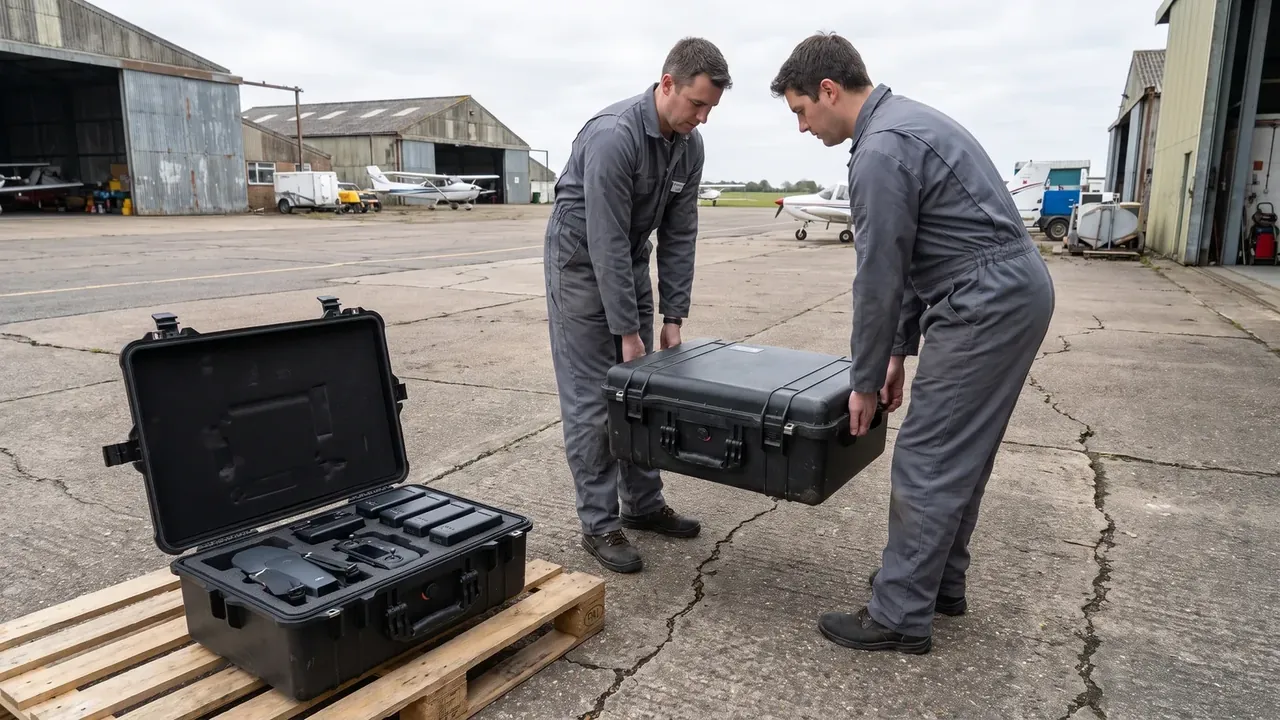
Quick answer: An outdoor drone controller hard protection box is sized by one gap: an 18 mm stick under a 22 mm lid cavity, with a 26 mm foam bore and a 2.6 kg body.
Table of contents
- How the lid cavity protects the sticks
- Stick travel and the cavity height
- Antennas and the video link module
- Battery bay and external power
- Pre-flight check in the field
- FAQ
How the lid cavity protects the sticks
A transmitter rides in a pack for an hour and comes out with the crosshair off centre the moment the sticks are released. Sticks stand 18 mm above the faceplate and return on one spring, so any load passed down through the lid lands on them first.
The governing number on an outdoor drone controller hard protection box is the 22 mm lid cavity. Eighteen millimetres of stick under twenty-two of clear space leaves 4 mm of headroom, and that 4 mm is the allowance for a lid flexing inward under a strap, a stacked case or a rough road.
Centring error is measured in degrees. A 20 N side load held for 2 h leaves a 0.3°–0.5° offset that turns hover into a constant drift corrected by hand.
So on an outdoor drone controller hard protection box the sticks hang free. Foam is bored to 26 mm at each stick with a 1 mm chamfer, and at 25% compression the insert holds the body at 30–70 kPa without pressing the gimbal.
Stick travel and the cavity height
A limit is not a clamp. At 18 mm long with 30° of throw each way, the tip sweeps about 9 mm, and an outdoor drone controller hard protection box bores 26 mm to give a 13 mm radius, leaving 4 mm around that arc.
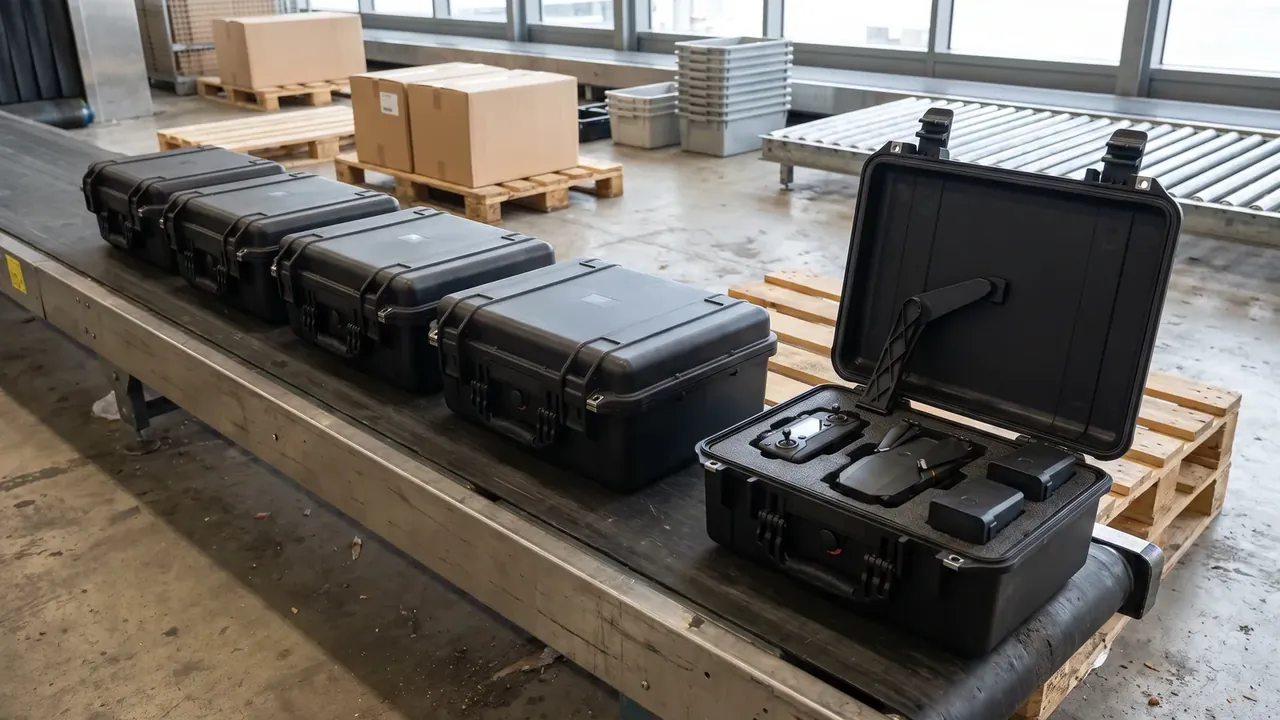
Shrink the bore to 20 mm and the radius falls to 10 mm: the shaft rubs at full deflection and centring goes grainy. Past 32 mm the limit disappears and one shove slides the controller inside.
Cavity height on an outdoor drone controller hard protection box needs a datum: 22 mm from the underside of the foam to the top of the stick. Lid depth totals about 35 mm, including 10 mm of foam that compresses to 7.5 mm.
| Layer | Size | Job |
|---|---|---|
| Ribs | 3 mm | Resist stacking |
| Foam | 10 mm (7.5 mm compressed) | Hold body, damp vibration |
| Clear cavity | 22 mm | Free stick travel |
Foam density sits at 45–70 kg/m³. Under 40 the insert slides and drags the sticks on the bore; over 80 it compresses less than 20% and the lid must be forced onto its latches.
Antennas and the video link module
Free-space wavelength is about 125 mm at 2.4 GHz and 52 mm at 5.8 GHz, so a quarter wave is 31 mm and 13 mm. An antenna wants that much clearance from metal, which sets the keep-out at 31 mm for 2.4 GHz, 13 mm for 5.8 GHz and 31 mm when both are used.
Hinge pins, latch springs and corner plates sit within 100 mm of the slot, and an antenna folded against them develops a null that drops video exactly when the aircraft turns that way. An outdoor drone controller hard protection box runs its slot mid-way along the lid, 80 mm from each hinge, with 2 mm of foam behind.
| Band | Wavelength | Quarter wave | Keep-out |
|---|---|---|---|
| 2.4 GHz | 125 mm | 31 mm | 31 mm or more |
| 5.8 GHz | 52 mm | 13 mm | 13 mm or more |
The slot follows the folded antenna: 62 mm long, 12 mm wide, 6 mm deep, with 3 mm behind for the feed cable to curve, since a bend under 5 mm fatigues the inner conductor. A 1 mm lip stops the antenna springing out onto a stick.
A 3 mm PP wall costs little at 5.8 GHz, but an antenna under a closed lid still loses margin, so pairing and video checks belong to the open-lid state.
Battery bay and external power
Three packs sit side by side at 22 mm each in a 24 mm bay. The extra 2 mm is swelling allowance: a pack grown 1 mm still slides, one grown 3 mm jams, and the bay must keep every pack removable for its service life.
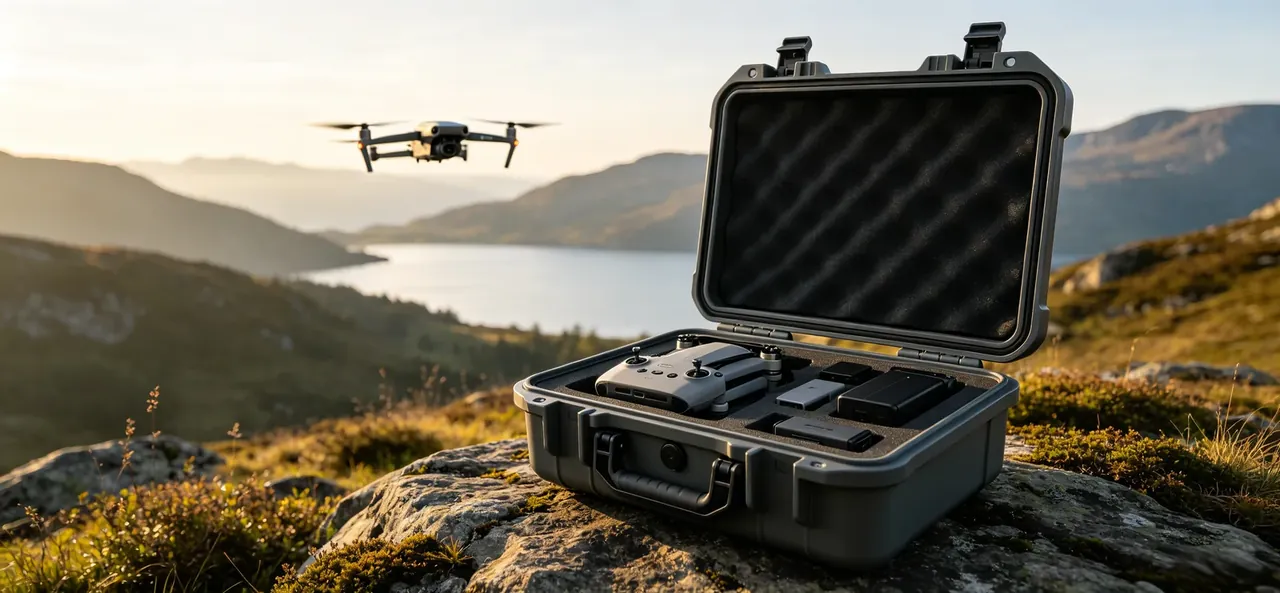
Six millimetres of foam separates battery bay from stick bay — crash distance, not insulation. In a 1.2 m drop the packs see roughly 30 g, three near 0.6 kg together, and 6 mm crushing to 4.5 mm takes the hit.
The external port sits in the lid wall with a 20 mm notch and a 1.5 mm flap, clear of hinges and above the base low point, or water follows it in. Sealing on an outdoor drone controller hard protection box holds only with the lid closed and the flap seated: IP67 is 1 m of still water for 30 min under IEC 60529, not a jet wash.
An outdoor drone controller hard protection box is rated −10 °C to 50 °C. Sticks feel stiff at −10 °C and centre slowly, and pack capacity falls below 0 °C, so a 2 mm bay wall lets packs track ambient and cuts condensation.
Pre-flight check in the field
Forty seconds after the lid opens decides the flight. Release the sticks and watch the crosshair return to within one ring; extend both antennas; press all three packs home; check the foam for dents; seat the controller and confirm the antenna lip.
Each step takes 5–10 s and the order matters on an outdoor drone controller hard protection box: centring comes before the antennas go up, and packs before the lid closes.
A drop demands a retest: six faces from 1.2 m, then centring within 0.5°, cavity height change within 1 mm, battery clearance within 1 mm. Any one out of line and the insert is replaced on an outdoor drone controller hard protection box of this class, never shimmed with foam.
| Check | Limit | Action |
|---|---|---|
| Cavity height | 22 mm ±1 mm | Change foam thickness |
| Centring error | ≤0.5° | Replace gimbal module |
| Battery clearance | ≤1 mm | Adjust bay wall |
Conclusion
An outdoor drone controller hard protection box comes down to 4 mm: 22 mm of cavity minus an 18 mm stick. Give that margin to lid flex, bore the foam to 26 mm, keep 31 mm around the antenna and 2 mm in the battery bay, and the sticks still centre after a 1.2 m drop. The 2.6 kg body and the −10 °C to 50 °C window are what let those dimensions hold.
These figures cover the shell, foam and cavity only, not the aircraft or its operation.
Related Reading
- Hard cases and cartons in export packing
- Shock isolation for aerial camera cases
- Dust trade-offs in landscape photography cases
- Moisture control in trolley cases for camera gear
Related Products
- 8 Series — Gun Cases; Military Equipment Cases; Camera Equipment Cases; Drone Cases; Watch Cases; Knife Cases; First Aid Cases; Electronics Equipment Cases
- WL8-2812 PP Gun Case — model WL8-2812
- All protective cases and toolboxes: 7 series, 158 models