

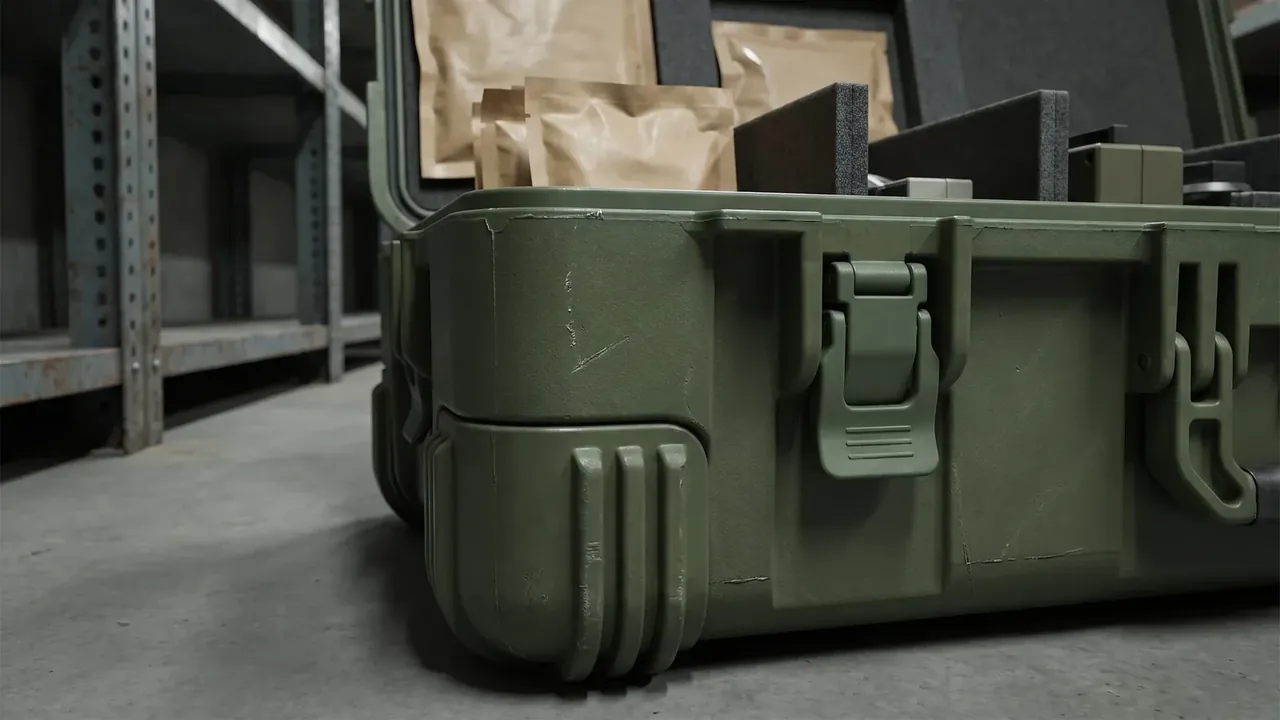
Quick answer: Outdoor photography gear moisture-proof trolley case: two desiccant bays hold the cavity at ≤45% RH with no lid condensation after an 8 h cycle.
Table of contents
- How an Outdoor photography gear moisture-proof trolley case places two desiccant bays
- Lid liner and the 30 mm EVA buffer
- Checking condensation over an 8 h day-night cycle
- Holding ≤45% RH in steady state
- Handle, wheels and latches that keep the rim sealed
- FAQ
1. How an Outdoor photography gear moisture-proof trolley case places two desiccant bays
An Outdoor photography gear moisture-proof trolley case puts humidity control inside the lid, with two desiccant bays set in opposite corners and grilles facing the cavity. Placed front and back, they make cavity air pass a grille wherever it drifts, so no corner stays stale. The target is ≤45% RH, a margin against condensation: the dew point moves with temperature, and a low baseline keeps the lid face from reaching it during a cool-down. Each bay has a clip-off cover; the grille holds the granules yet lets air through. Their combined load is sized to the 525×365×210 mm free cavity.
The body of an Outdoor photography gear moisture-proof trolley case leaves room for both bays. Outside 580×420×260 mm, wall 3.7 mm, the lid liner and shell keep a bay-thick gap. Empty 5.2 kg and loaded 8.5 kg, the lid closes without squashing the grilles. JUNZHIJIA makes the two bays identical, so they swap left to right; both covers sit on the lid inner face, visible at a glance on opening.
2. Lid liner and the 30 mm EVA buffer
An Outdoor photography gear moisture-proof trolley case lines the lid with 30 mm EVA cut into 9 slots, a buffer against humidity swings rather than a second desiccant. Closed-cell EVA takes in little water, but it holds the lid face one layer away from cavity air, so a cooling surface does not sit against moist air directly.
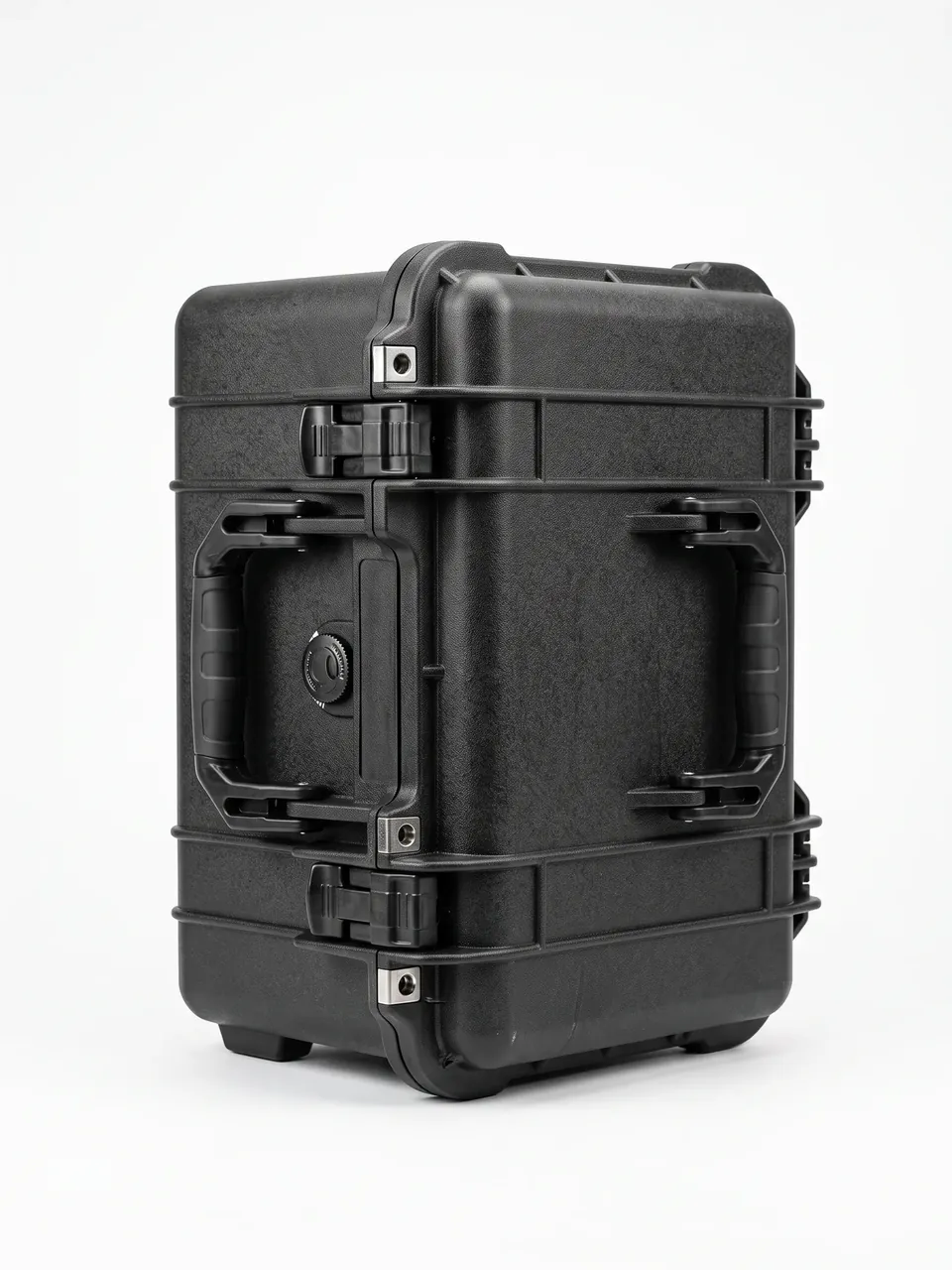
EVA rebound ≥92% after cycling is the criterion. Nine slots survive the 8 h day-night cycle and repeated handling without wall collapse or crumbling. The 30 mm thickness leaves room to spring back; thinner foam dents permanently at the cold end.
| Time span | Temperature | Condensation risk |
|---|---|---|
| Day warm-up | up to 45 °C | bays release moisture |
| Night cool-down | down from 45 °C | lid face nears dew point |
| Pre-dawn cold | down to −10 °C | lid most likely to fog |
| Re-warm | from −10 °C | trapped drops may stay |
An Outdoor photography gear moisture-proof trolley case rides out the pre-dawn cold on a low baseline humidity.
3. Checking condensation over an 8 h day-night cycle
An Outdoor photography gear moisture-proof trolley case runs one 8 h day-night cycle from −10 °C up to 45 °C and back, then the lid is opened at once. The criterion is plain: no condensation on the lid inner face, no water marks along the seal. The cool-down moves fast and the dew point follows; if the bays have not pulled humidity down, water shows first at the coldest liner edge.
Condensation is judged on the lid, not the dividers. Only visible drops and water marks count.
Humidity is logged before and after. ≤45% RH is the steady line; two cycles off it send the bays back for inspection.
| Control part | Location | Job |
|---|---|---|
| Desiccant bay A | lid front corner | main uptake, vented |
| Desiccant bay B | lid rear corner | covers dead zones |
| Lid gasket | around the rim | blocks outside damp air |
| 30 mm EVA liner | lid inner face | holds a buffer layer |
4. Holding ≤45% RH in steady state
Steady state on an Outdoor photography gear moisture-proof trolley case rests on bays and seal together. Two bays pull baseline humidity to ≤45% RH, and the rim gasket stops outside damp air from topping it up; miss either and humidity creeps back during re-warm. Grille area is matched to cavity volume: too open and the bay saturates early, too tight and it cannot follow a fast cool-down.
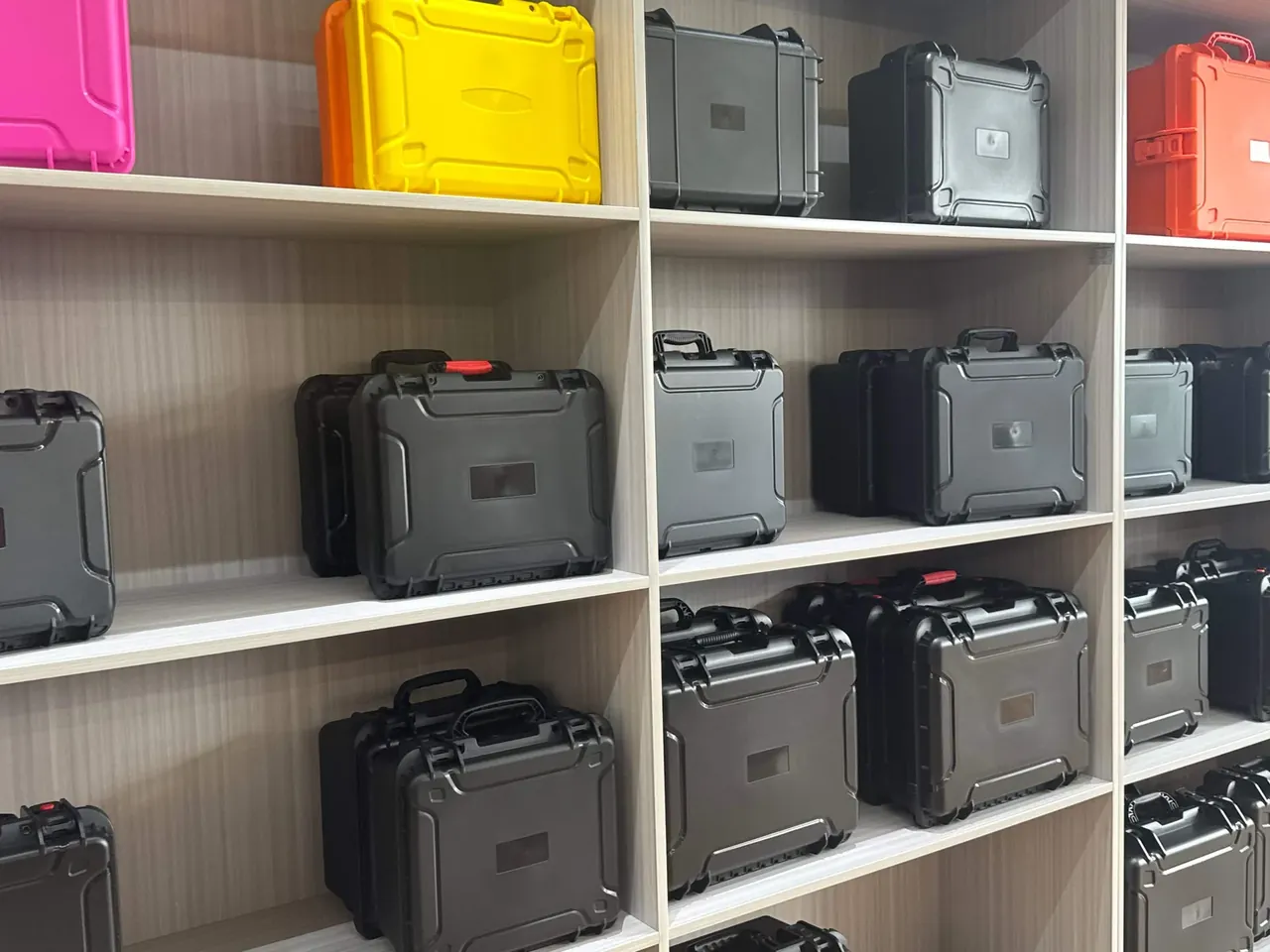
A round valve seat on the lid centre of an Outdoor photography gear moisture-proof trolley case balances pressure between −10 °C and 45 °C, so opening does not draw damp air through the seam. Humidity is read from an indicator card; the steady test cares only about ≤45% RH, not what sits inside the bays.
5. Handle, wheels and latches that keep the rim sealed
On an Outdoor photography gear moisture-proof trolley case, structure backs up humidity control. A 400 mm handle travel and φ55 mm wheels carry towing vibration into the wheel seats and shell; if the rim twists open a hair, outside damp air follows the gap. Two latches at 360 N each press the lid evenly onto the gasket, and two load points hold their notch better than one after towing.
After a 1.0 m drop the lid and shell tongue must stay aligned and the seal must still sit flat, with humidity re-read at ≤45% RH. The case is benchmarked to IP67 by the matching method. An Outdoor photography gear moisture-proof trolley case groups these parts under rim retention, since even good bays fail once the rim loosens.
| Humidity value | Condition | Criterion |
|---|---|---|
| ≤45% RH | steady and post-cycle | upper humidity line |
| End of 8 h cycle | cycle complete | lid free of condensation |
| −10 °C end | pre-dawn cold | no dew point contact |
| 45 °C end | day warm-up | bays not saturated |
| Rebound ≥92% | EVA after cycling | slots hold shape |
Conclusion
An Outdoor photography gear moisture-proof trolley case uses two desiccant bays to hold ≤45% RH, then proves it with an 8 h day-night cycle: no lid condensation and EVA rebound ≥92%. The −10 °C to 45 °C band, the latches and the 1.0 m drop all guard one thing, a rim that stays shut.
Related Reading
- How humidity is controlled in a camera gear case
- Selecting a camera equipment case
- Wheels and pull handle fit for trolley cases
- Moisture notes for sea-freight cases
Related Products
- 8 Series — Gun Cases; Military Equipment Cases; Camera Equipment Cases; Drone Cases; Watch Cases; Knife Cases; First Aid Cases; Electronics Equipment Cases
- WL8-2812 PP Gun Case — model WL8-2812
- All protective cases and toolboxes: 7 series, 158 models