

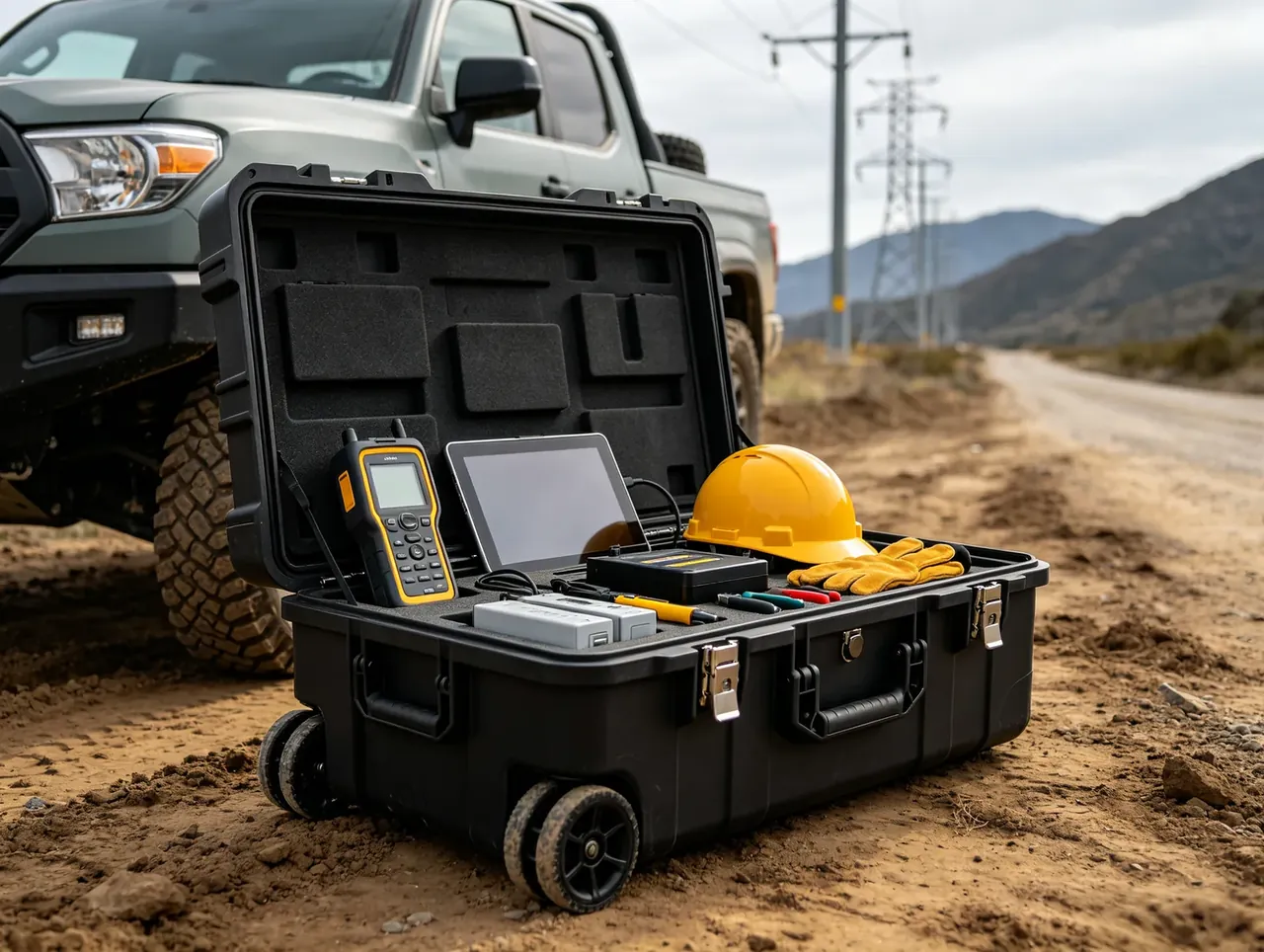
Quick answer: Outdoor hunting gear protective transport case sets 128 mm insert pitch and 24 mm floor ribs; 3000 m of towing leaves wheel-seat play under 0.30 mm.
Table of contents
- Outdoor hunting gear protective transport case wheel-seat insert pitch
- Height of the floor longitudinal ribs
- Wheel-seat play after 3000 m of towing
- Floor wear on wheel-off recheck
- Insert pitch locked for transport batches
- FAQ
1. Outdoor hunting gear protective transport case wheel-seat insert pitch
A tow does not pull on the shell itself; the load lands first on the metal inserts embedded in the wheel seat, then spreads along the floor ribs. Inside a 760×500×320 mm outline with a 690×435×245 mm cavity, the floor is kept to 5.2 mm. Outdoor hunting gear protective transport case leaves 128 mm between inserts, drawn from how many bearing strips the floor can offer: every insert sits on a rib crown and the force runs straight. At 100 mm the inserts crowd and extra seats eat into the 9.6 kg empty shell; at 156 mm the floor middle sags first under a 25 kg load. JUNZHIJIA logs the trade-off on the batch card before a hole is dimensioned.
| Insert pitch grade | Insert vs rib | Wheel-seat play after 3000 m |
|---|---|---|
| 100 mm | between ribs | 0.18 mm |
| 128 mm | on rib crown | 0.24 mm |
| 156 mm | spanning gap | 0.41 mm |
The hole pattern is trued before the inserts are bedded, so a mould drift is not charged to the pitch. Inserts are logged first, ribs second, in separate columns.
2. Height of the floor longitudinal ribs
The floor ribs run along the towing direction and spread the concentrated push at the wheel seat across the whole base; Outdoor hunting gear protective transport case sets them 24 mm high so the floor does not bulge downward with a 25 kg load in tow. An insert sits on a rib crown and the force travels to the four corners; a shorter rib lets the floor centre sag and opens clearance at the insert.
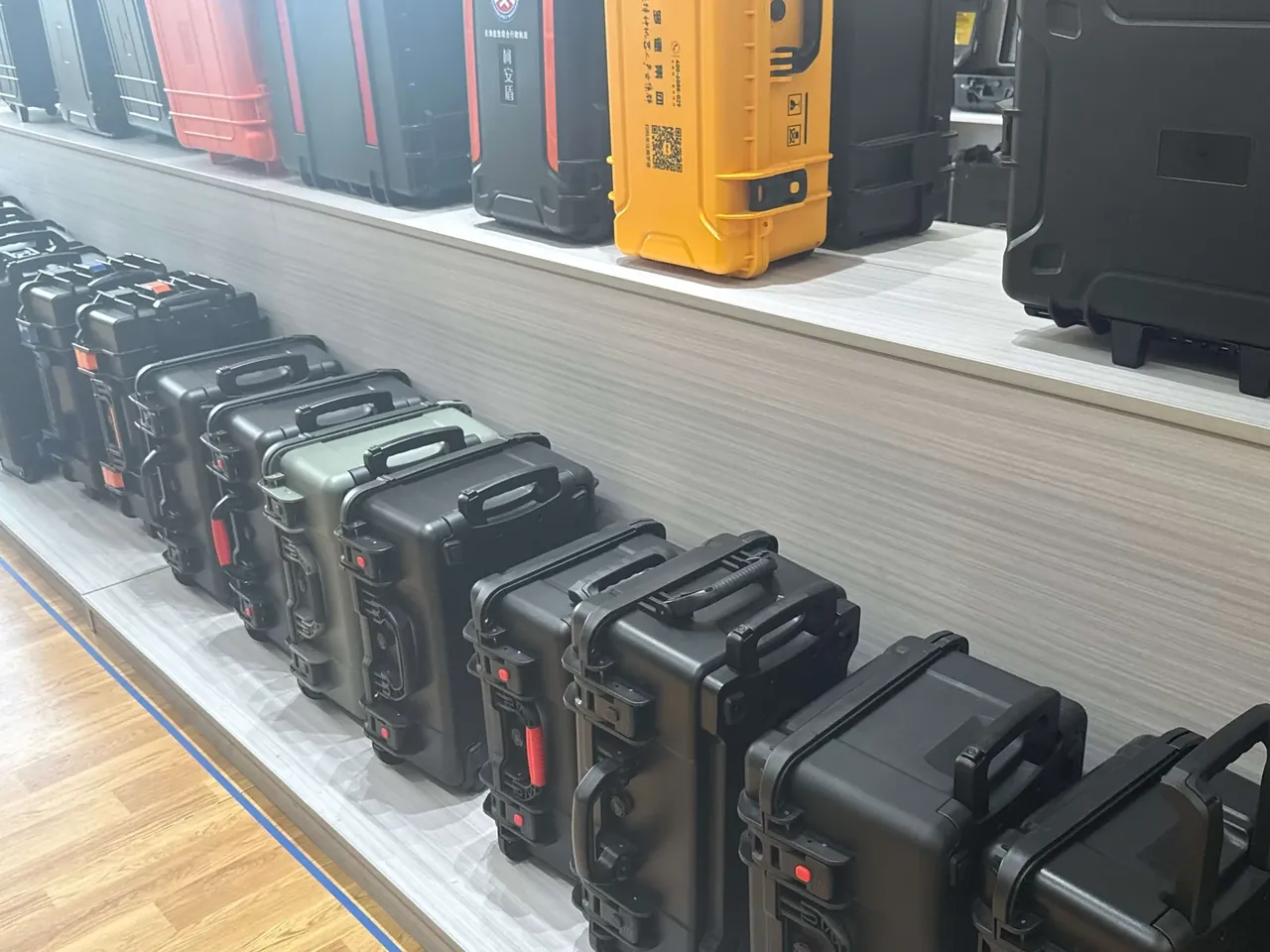
A 16 mm rib cannot carry a temperature swing from -20 C to 50 C, and the floor no longer returns flat after that pass; a 32 mm rib eats into the cavity, and four latches at 455 N then press a thickened floor, tipping the lid mouth. The mouth carries two gaskets at 22 % compression, benchmarked to the IP67 method; a rib that bows the base splits the lid-mouth load unevenly.
3. Wheel-seat play after 3000 m of towing
With the rated load aboard, the shell goes on the towing rig and covers 3000 m at a steady pull, and the play reading of Outdoor hunting gear protective transport case builds from the first revolution. Ground reaction opens the fit between insert and sleeve bit by bit, and a wider pitch loads each insert harder. At the third kilometre the handle comes off, a dial indicator bears on the side of the wheel seat, and the play must stay within 0.30 mm.
| Tow distance | Side play at wheel seat | Spread across four inserts |
|---|---|---|
| 1000 m | 0.09 mm | 0.05 mm |
| 2000 m | 0.17 mm | 0.10 mm |
| 3000 m | 0.24 mm | 0.13 mm |
Each of the four inserts is read on its own. If one loosens first, the rib on that side missed the load and the play carries a skew.
4. Floor wear on wheel-off recheck
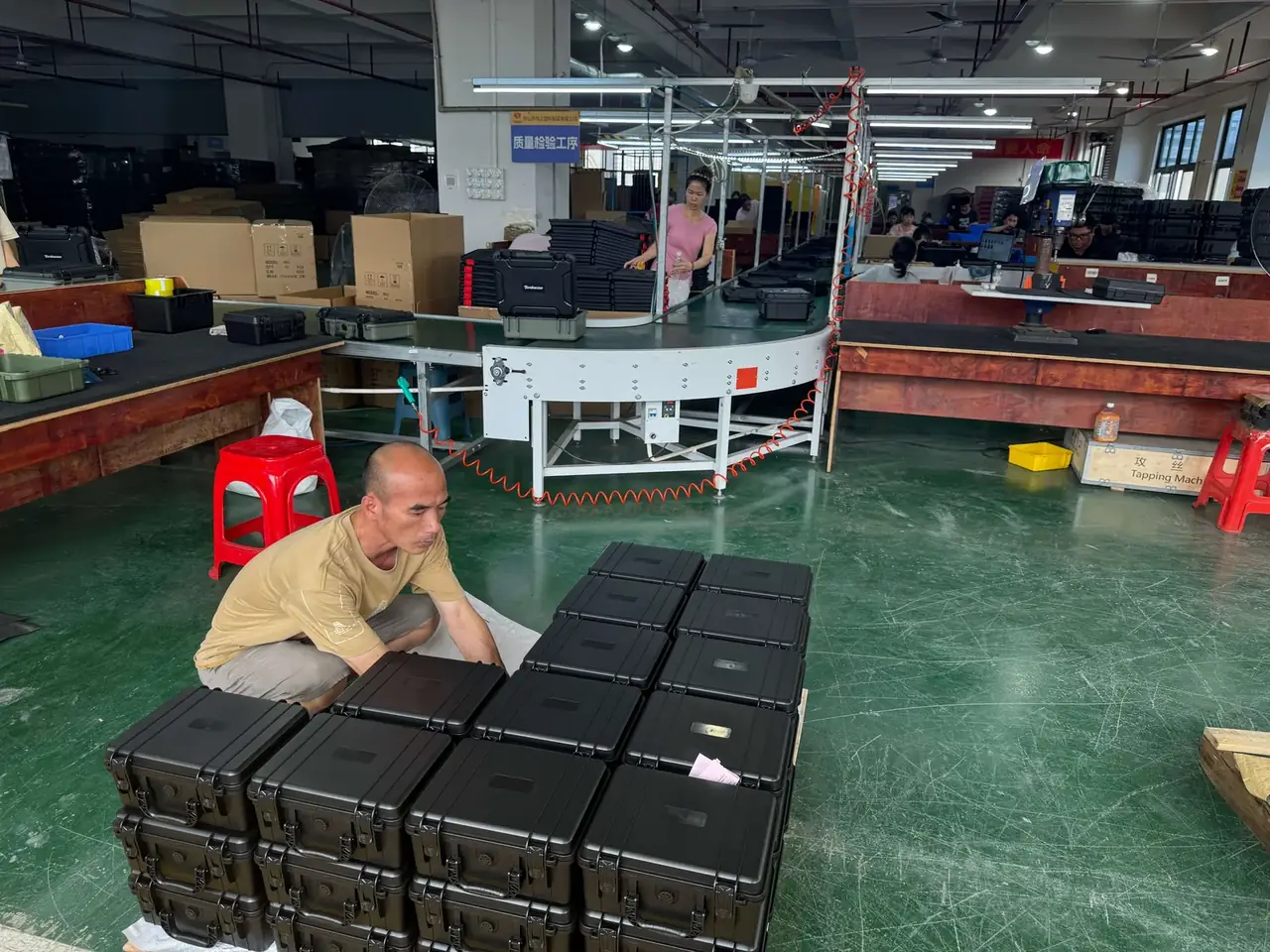
After 3000 m the wheel set is lifted off and the shell is turned over, and Outdoor hunting gear protective transport case looks here for bright wear tracks on the rib crowns and the floor. A loose wheel seat lets an insert turn slightly in its hole, so wear shows first on that short rib crown. Floor wear must not exceed 0.15 mm, measured with the same depth gauge used before the rig.
| Play reading | Grade | Floor wear after wheel-off |
|---|---|---|
| 0.18 mm | 100 mm | 0.07 mm |
| 0.24 mm | 128 mm | 0.11 mm |
| 0.41 mm | 156 mm | 0.19 mm |
The 156 mm row still holds 0.19 mm once the wheels are off, past the 0.15 mm line, while the 128 mm row sits at 0.11 mm, inside it. No insert is swapped and no rib is welded; the wheel set goes back in its original position. A shell touched mid-test is remoulded rather than logged.
5. Insert pitch locked for transport batches
By the locking step the drawing of Outdoor hunting gear protective transport case carries a single pitch figure. Pitch, rib height, tow distance and play each hold a column on the card; the job is to pick the grade that stays inside 0.30 mm without piling mass onto the floor. JUNZHIJIA does not take the loosest grade, but the narrowest one that still clears the line.
Locking settles on the narrowest grade whose play at the third kilometre is still within 0.30 mm; any wider insert layout goes to static turnover as a whole batch. That criterion is written into the locking column on the back of the card, and 128 mm becomes the drawing value; the 100 mm and 156 mm grades stay on the sample rack.
Conclusion
From the wheel-seat inserts to the floor ribs, Outdoor hunting gear protective transport case says one thing with 128 mm pitch, 24 mm ribs and the play logged over 3000 m: a firm wheel seat after the haul earns the release. Play inside 0.30 mm and floor wear inside 0.15 mm tell a 760×500×320 mm shell where its base carries load, rather than telling it to keep thickening the wall. The transport drawing keeps the narrowest grade that passes, and Outdoor hunting gear protective transport case goes by the towing readings, not by luck on a sample shell.
Related Reading
- How Outdoor Low-Voltage Boxes Achieve IP67: Four Core Elements of System-Level Protection
- Wheeled vs Standard Toolboxes: What Is the Difference?
- What Outdoor Uses Are ABS Protective Cases Best Suited For?
- Carrying Cases: Portable Structure & Everyday Handling Protection
Related Products
- 8 Series — Gun Cases; Military Equipment Cases; Camera Equipment Cases; Drone Cases; Watch Cases; Knife Cases; First Aid Cases; Electronics Equipment Cases
- WL8-2812 PP Gun Case — model WL8-2812
- All protective cases and toolboxes: 7 series, 158 models