

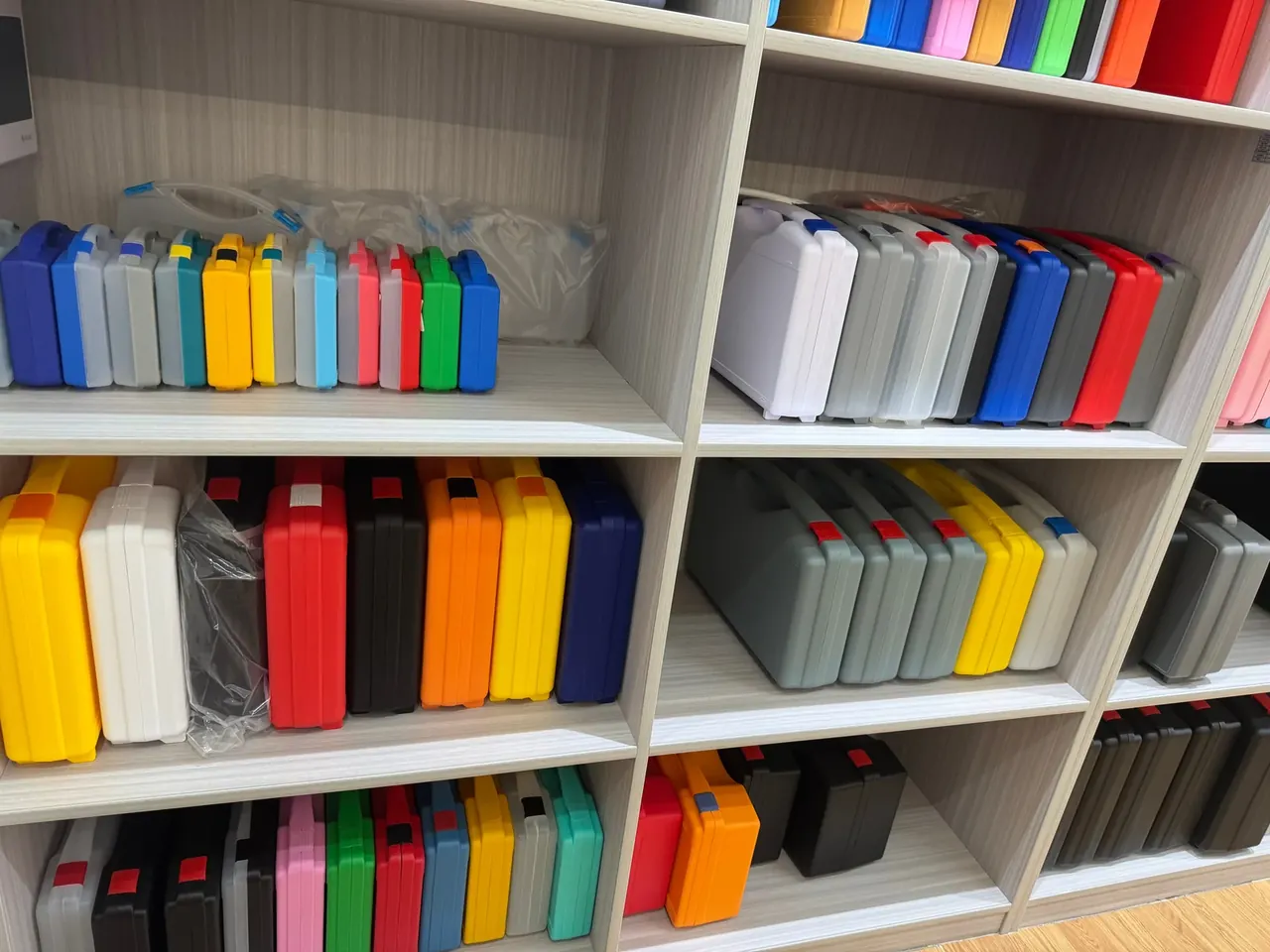
Quick answer: An outdoor lure fishing tackle hard box is judged by its grid, not its volume: 12 cells, 2.0 mm dividers, 45 mm depth, a 3 mm drain at each low corner.
Table of contents
- How the twelve-cell grid is laid out
- Separating hook points from soft plastics
- Divider thickness and the finger gap
- Desiccant pocket and drain holes
- The lid as a temporary work surface
- FAQ
How the twelve-cell grid is laid out
Leave a wet lure beside a dry one overnight and both come out freckled with rust. Water runs along the cell floor into the next bay and takes the spare hooks with it. An outdoor lure fishing tackle hard box has to design that out first.
Twelve cells are not twelve equal parts. The body measures 320×220×70 mm outside and about 300×200×58 mm inside. An outdoor lure fishing tackle hard box at this size splits into four hook cells 46 mm wide, six soft-plastic cells at 60 mm, and two cells for snaps and weights. A hard bait needs only a drop point for its treble; a soft plastic must lie flat.
| Zone | Cells | Clear width | Contents |
|---|---|---|---|
| Hook | 4 | 46 mm | Hard baits, trebles down |
| Soft plastic | 6 | 60 mm | One bait per cell |
| Fittings | 2 | 46 mm | Snaps, weights, rings |
Depth comes from the folded bait. Soft plastics run 75–130 mm long and sit 30–40 mm thick when doubled, so 45 mm leaves about 20 mm under the lid; below 35 mm they go in at an angle and the lid lands on them. Weight follows: an outdoor lure fishing tackle hard box with 12 cells, 2.0 mm dividers and a 2.4 mm PP wall weighs 0.86 kg empty, about 1.4 kg loaded.
Separating hook points from soft plastics
A treble stands 6–10 mm proud of the bait, the sharpest thing in the box. An outdoor lure fishing tackle hard box moulds the hook zone as a shallow tray whose floor sits 1.5 mm above the soft-plastic floor, so a point drops in tip-first and hangs clear of the bay beside it.
Dividers run full depth with no gap at the bottom. A 2 mm gap lets a hook tip pass through and punch a hole in a soft plastic alongside, and the saltwater that leaks out follows the same gap back.
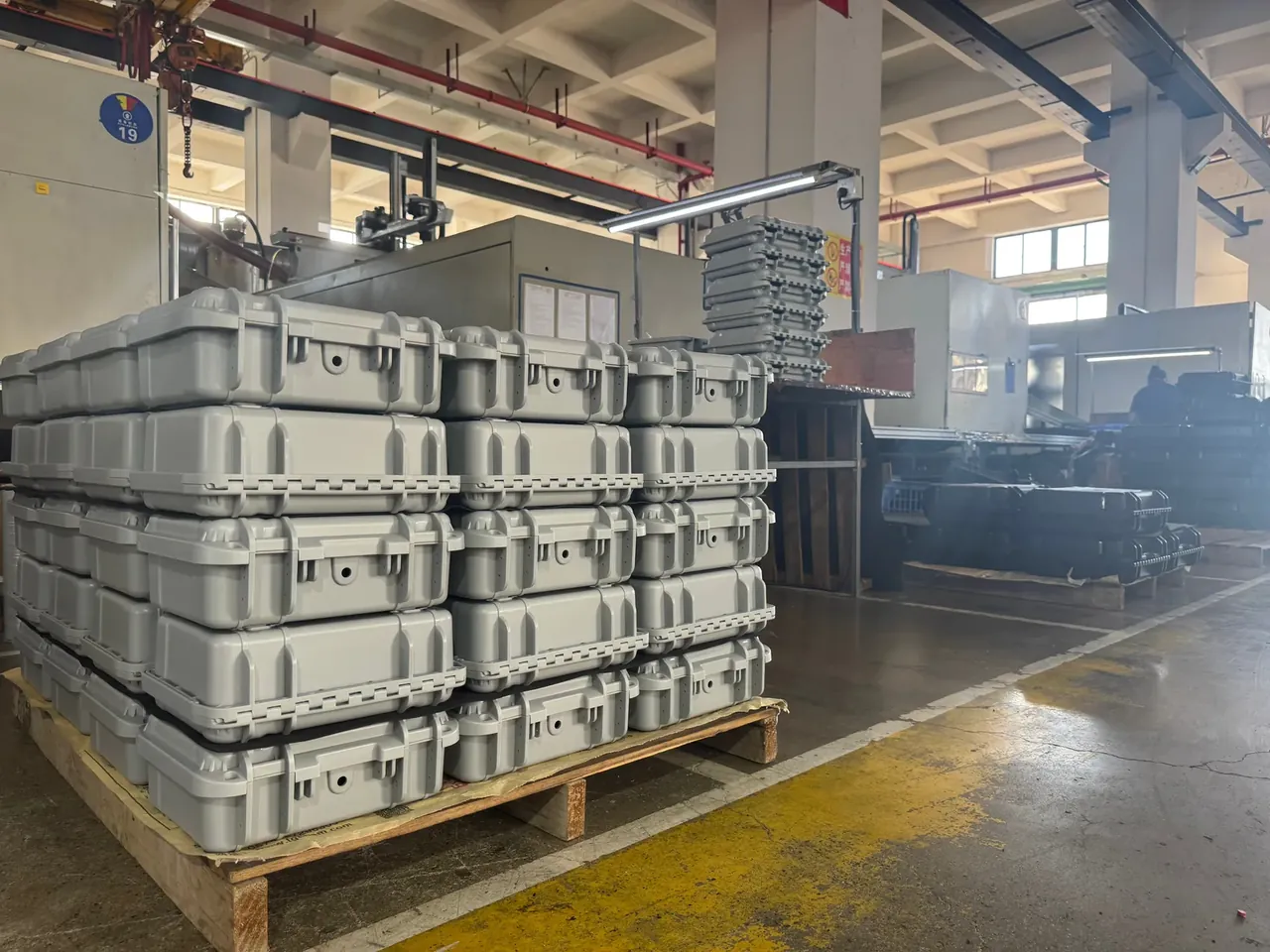
A chipped patch of paint changes how a lure flashes, so an outdoor lure fishing tackle hard box that lets baits knock together in transit costs you fish. One bait per hook cell, treble left on, point down, and the 20 mm under the lid holds the body steady.
Homopolymer PP turns brittle near 0 °C, while impact copolymer holds to about −20 °C, which suits a box sitting in 5 °C water at dawn. PP shrinks 1.2%–2.5%, and a thin divider bows first, so the tool compensates the 0.2–0.6 point spread between flow and cross-flow.
Divider thickness and the finger gap
A 2.0 mm divider balances stiffness against space. At 1.2 mm the faces cool at different rates and a 45 mm tall divider walks 0.8 mm off vertical after ejection; at 3.0 mm the divider area across 12 cells eats about 8% of the cavity.
| Divider | Straightness | Clearance per side | Verdict |
|---|---|---|---|
| 1.2 mm | 0.8 mm | 16 mm | Mouth distorts, reject |
| 2.0 mm | 0.4 mm | 14 mm | Standard build |
| 3.0 mm | 0.3 mm | 11 mm | 8 cells or fewer |
On an outdoor lure fishing tackle hard box, straightness is held to 0.6 mm. Beyond that, a 46 mm cell loses a corner. The check is a plug gauge down the cell mouth: it should stop at 30 mm depth without rocking.
The finger gap sets the width. Hands are wet at a lure change, and an index finger in a half-finger glove measures about 18 mm, which is where 14 mm per side comes from. An outdoor lure fishing tackle hard box with under 10 mm takes two attempts per bait. Corners need R1.0, or a 1.0 m drop cracks upward from the sharp edge.
Desiccant pocket and drain holes
The lid of an outdoor lure fishing tackle hard box carries a 60×40 mm recess for 10 g of silica gel, closed by a 0.5 mm perforated sheet clipped under two hooks. Silica takes up 20%–30% of its own weight, so 10 g holds 2–3 g of water, roughly one month in a 0.9 L cavity.
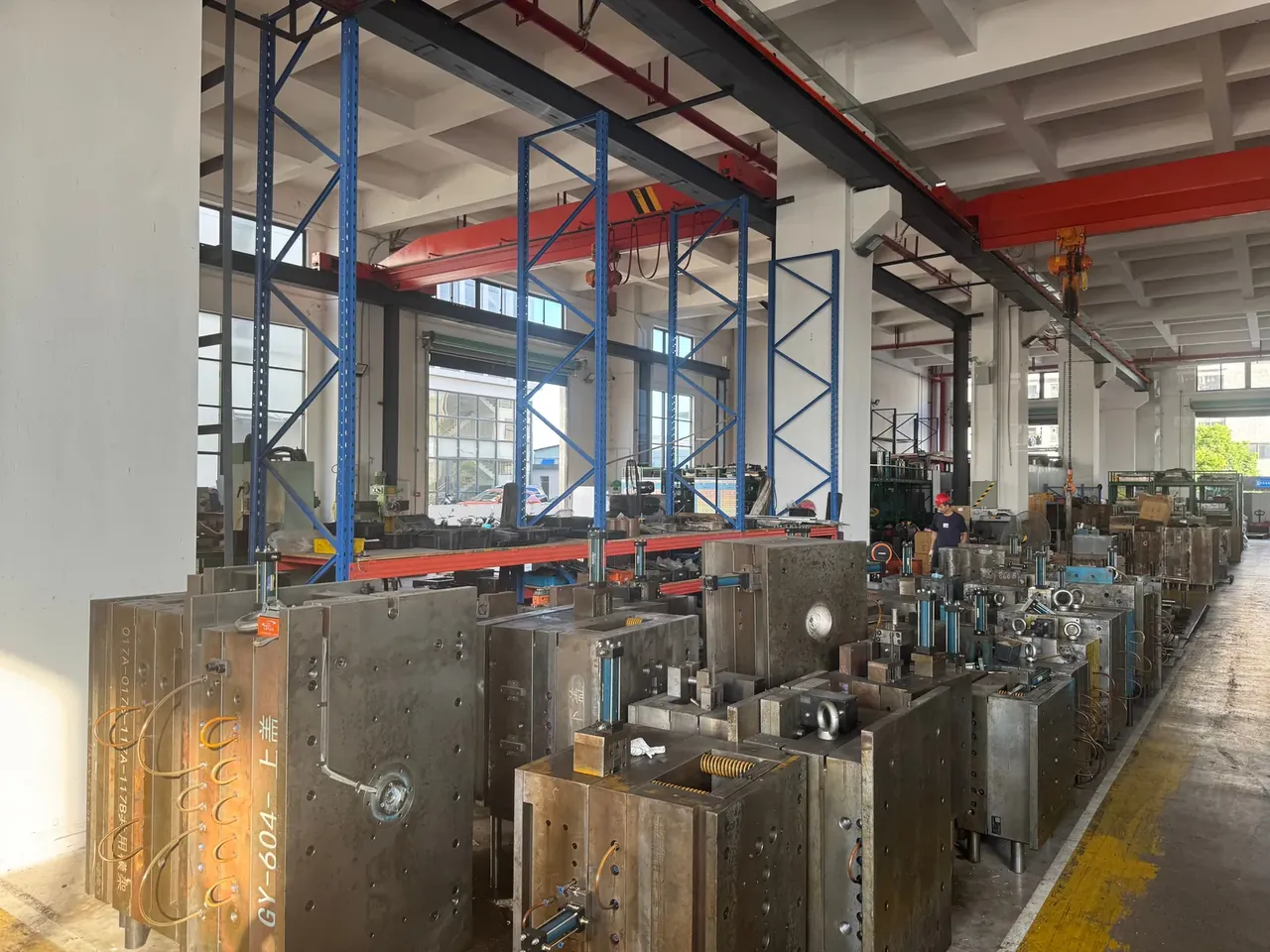
Two 3 mm drains sit at the lowest corners. Under 2 mm, dried attractant films over and seals the hole; over 5 mm, sand and grass wash in from the bank and load the desiccant early. The rim takes a 1.0 mm radius, since PP concentrates stress there.
Position matters as much as size: the shell gates from both ends, so the melt fronts knit along the middle of the long side, the weakest line in the part. A drain set 15 mm inboard of the corner radius misses it.
| Check | Limit | Failure mode |
|---|---|---|
| Divider straightness | ≤0.6 mm | Baits jam in the cell |
| Hook clearance | ≥5 mm | Point punctures plastics |
| Drain diameter | 3 mm ±0.1 mm | Clogs, or admits sand |
Fail any one and the unit is scrap: rework is a new cavity insert at close to 40% of the tool cost.
The lid as a temporary work surface
A lure change happens with wet hands on wet rock. Opened to 180°, an outdoor lure fishing tackle hard box turns its lid inner face up as a 220 mm bench, and a damped hinge holds between 100° and 180° so a gust cannot slam it shut mid-change.
On an outdoor lure fishing tackle hard box, three ridges 1.5 mm high divide that bench into two shallow trays; taller than 2 mm and they land on the opposite cell mouths at closing, leaving marks that crack after a few hundred cycles. Two 2 mm ribs under the base lift the body off wet ground and keep the drains clear.
The −10 °C to 50 °C window covers a cold stream and a summer car boot, and a deflection temperature of 85–100 °C at 0.45 MPa leaves margin. A single-cavity tool runs CNY 8,000–18,000 with two trials, 500 pieces minimum, 25–35 days. Any grid change is an insert change.
Conclusion
An outdoor lure fishing tackle hard box is decided in the second it opens: whether wet and dry stay apart, whether points face down, whether a finger fits. Fix the 12 cells, 2.0 mm dividers, 45 mm depth and 3 mm drains and it works; 0.86 kg empty and a −10 °C to 50 °C window decide whether it rides in a pack all day.
These figures describe the shell and its grid only, not the tackle inside it.
Related Reading
- How usable cavity volume is calculated
- Matching a gasket lip to immersion conditions
- Where to put a desiccant pocket in a small case
- Hard cases and cartons in transport
Related Products
- 8 Series — Gun Cases; Military Equipment Cases; Camera Equipment Cases; Drone Cases; Watch Cases; Knife Cases; First Aid Cases; Electronics Equipment Cases
- WL8-2812 PP Gun Case — model WL8-2812
- All protective cases and toolboxes: 7 series, 158 models