

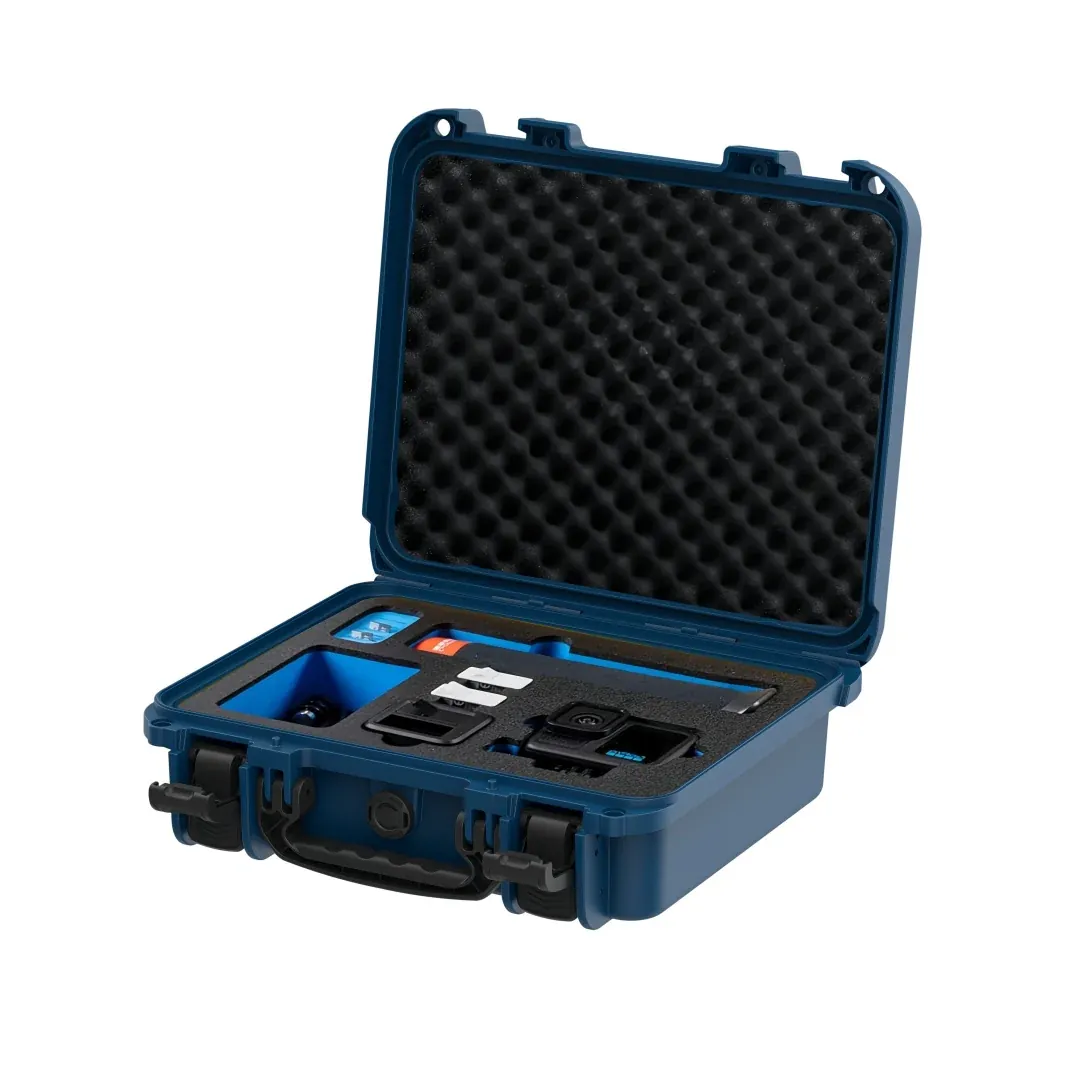
Quick answer: An Outdoor marine instrument waterproof sealed case is judged by gasket compression, latch force and a working pressure valve, not by its IP number.
Table of contents
- Salt spray against the gasket and latches
- Deck vibration and instrument fixing points
- Where IP67 immersion stops
- Condensation inside the cabin and the pressure valve
- Freshwater rinsing after the case comes ashore
- FAQ
1. Salt spray against the gasket and latches
Seawater carries salt into every gasket gap. A neutral salt spray run at 5% sodium chloride, 35 °C, 48 h — the ISO 9227 grade — screens rubber and metal finishing, not a two-day life at sea. Wet and dry cycles keep salt in the seam, redissolving it with every wave.
Water enters an Outdoor marine instrument waterproof sealed case by four routes: latch pivot, hinge pin, groove corners, lid joint. Three sit on metal parts; chloride attacks the plating, white rust lifts the latch seat, and holding force falls from the 200–400 N range.
A 2.0–3.5 mm wall is rigid enough, but on saltwater the aluminium frame matters as much: 12, 20 and 30 mm profiles, a thin wall leaning on the 30 mm frame. Gasket compression of 25%–30% is the second number, and an Outdoor marine instrument waterproof sealed case lives or dies on it: too little lets spray past the groove lip, too much takes a set in the cold.
| Inspection point | After a 48 h salt spray run | Action on site |
|---|---|---|
| Latch pivot and seat | White rust, stiff closure | Rinse, dry, thin grease film |
| Hinge pin | Higher torque | Clear salt, no abrasive paper |
| Groove corners | Fine salt grit | Swab with fresh water, dry |
2. Deck vibration and instrument fixing points
Vibration rarely cracks an Outdoor marine instrument waterproof sealed case; it walks the instrument out of position. A 7–200 Hz sweep covers engine order and blade rate, and loose fixing points show up first.
| Fixing method | Density or tension | Compression set | Suits |
|---|---|---|---|
| Cut EVA cavity | 25–45 kg/m³ | ≤5% | Regular shapes, no knobs |
| Padded PU blocks | 30–60 kg/m³ | ≤5% | Panels with dials and ports |
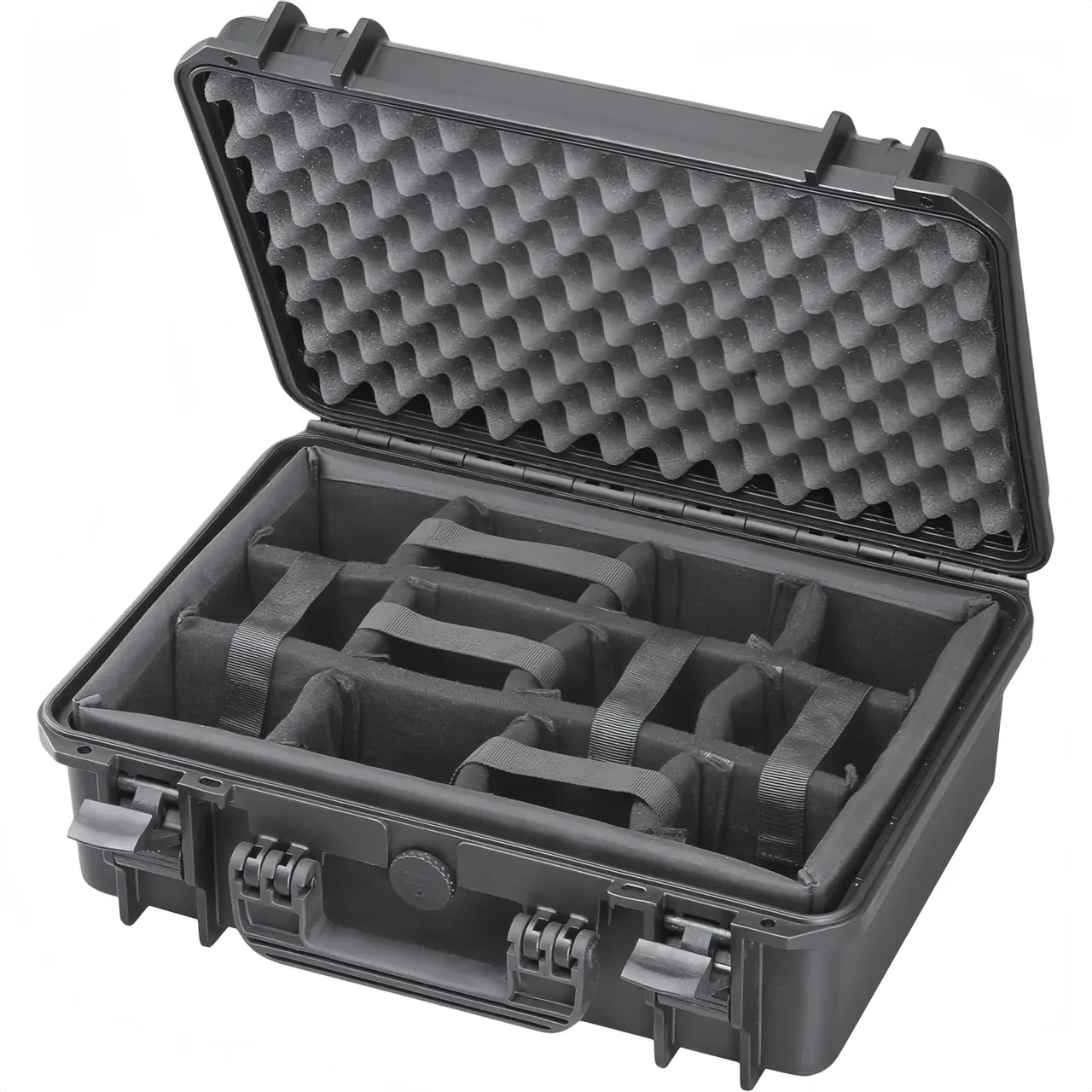
| Dividers and straps | Set by buckle | Not applicable | Mixed loads, fast access |
Too dense and the foam becomes a rigid part passing vibration into the housing; too soft and the cavity collapses within a few trips. Never drill the body to bolt an instrument down — every hole is a leak path. Trap it with dividers and shake the closed case: nothing knocking means movement is controlled.
A 20,000-cycle hinge is a lifetime figure no shaker reproduces; loose fixing points usually mean lost latch preload.
3. Where IP67 immersion stops
IP67 is three lines: 1 m of water, 30 min, and no more than 5 K between specimen and water; all three must hold. The third is usually dropped — a case baked on deck, lowered into cold seawater, sees its air contract and the pressure difference pull water toward the groove.
IP67 does not include jetting: IPX5 and IPX6 test the dynamic pressure of a hose or a breaking wave, so a deck hose on the latch seam asks an Outdoor marine instrument waterproof sealed case to pass a test it never had.
Nor does IP67 cover seawater or repeated dips: salt and suspended particles change how the gasket recovers between the first dip and the tenth. IP68 depth and duration are set by the manufacturer and only need to be stricter, so ask for both figures.
| Water action | Dynamic pressure | Test condition | First to fail |
|---|---|---|---|
| Rainfall | Low but present | Rain angle and rate per project | Long lid edge, middle |
| Deck spray | High short peaks | IPX5 / IPX6 jet | Latch seat and hinge pin |
| Still immersion | Static head only | IP67: 1 m, 30 min | Groove corner |
| Pressure washer | Far above immersion | Outside IP67 scope | Gasket off the groove floor |
Seal verdict: visible droplets or salt crystals inside after a 30 min immersion mean the seal has failed.
4. Condensation inside the cabin and the pressure valve
Condensation and leakage look alike but are treated in opposite ways: condensation leaves an even film on the lid with a dry floor, leakage concentrates on the latch side, usually with grit.
Cabin air is warm by day and the trapped air picks up moisture; at night the lid falls below the dew point. An Outdoor marine instrument waterproof sealed case needs a pressure valve that lets internal pressure follow temperature, opening at 0.3–0.5 bar, passing vapour but not liquid.
A blocked valve changes the picture: as the case cools it goes into vacuum, the lid needs force, the gasket is drawn to one side and compression falls below 25%–30%, exactly where the next immersion leaks.
What damages instruments is not the droplet but the droplet drying with salt on a circuit board. An Outdoor marine instrument waterproof sealed case handles condensation through the valve, not by sealing harder.
5. Freshwater rinsing after the case comes ashore
Rinsing comes before opening. Salt left on the shell keeps drawing moisture, so a rinse postponed by a day costs more effort and leaves grit deeper in the groove.
Work the way water runs: lid and sides at tap pressure, then the latch and hinge seams with the case closed, then the rim, then open. Dry the instrument separately. Swab the groove to lift fine salt and wipe until no mark remains. Do not peel the gasket back: every lift costs rebound, and a 25%–30% margin does not survive repeated pulling.
Close it only when dry. Closing it wet traps water in the groove, and the next opening brings mould and a salt bloom that no longer tells seepage from condensation. The life of an Outdoor marine instrument waterproof sealed case is rarely ended by a wave; it is spent in dozens of wet closures.
Related Reading
- How waterproof equipment case ratings turn into checkable numbers
- IP68 waterproof dustproof small hard box: beyond the rating
- Usable volume, cavity shape and corner loss in a case
- Choosing a safety case for an outdoor GPS tracker
JUNZHIJIA
Related Products
- 8 Series — Gun Cases; Military Equipment Cases; Camera Equipment Cases; Drone Cases; Watch Cases; Knife Cases; First Aid Cases; Electronics Equipment Cases
- WL8-2812 PP Gun Case — model WL8-2812
- All protective cases and toolboxes: 7 series, 158 models