

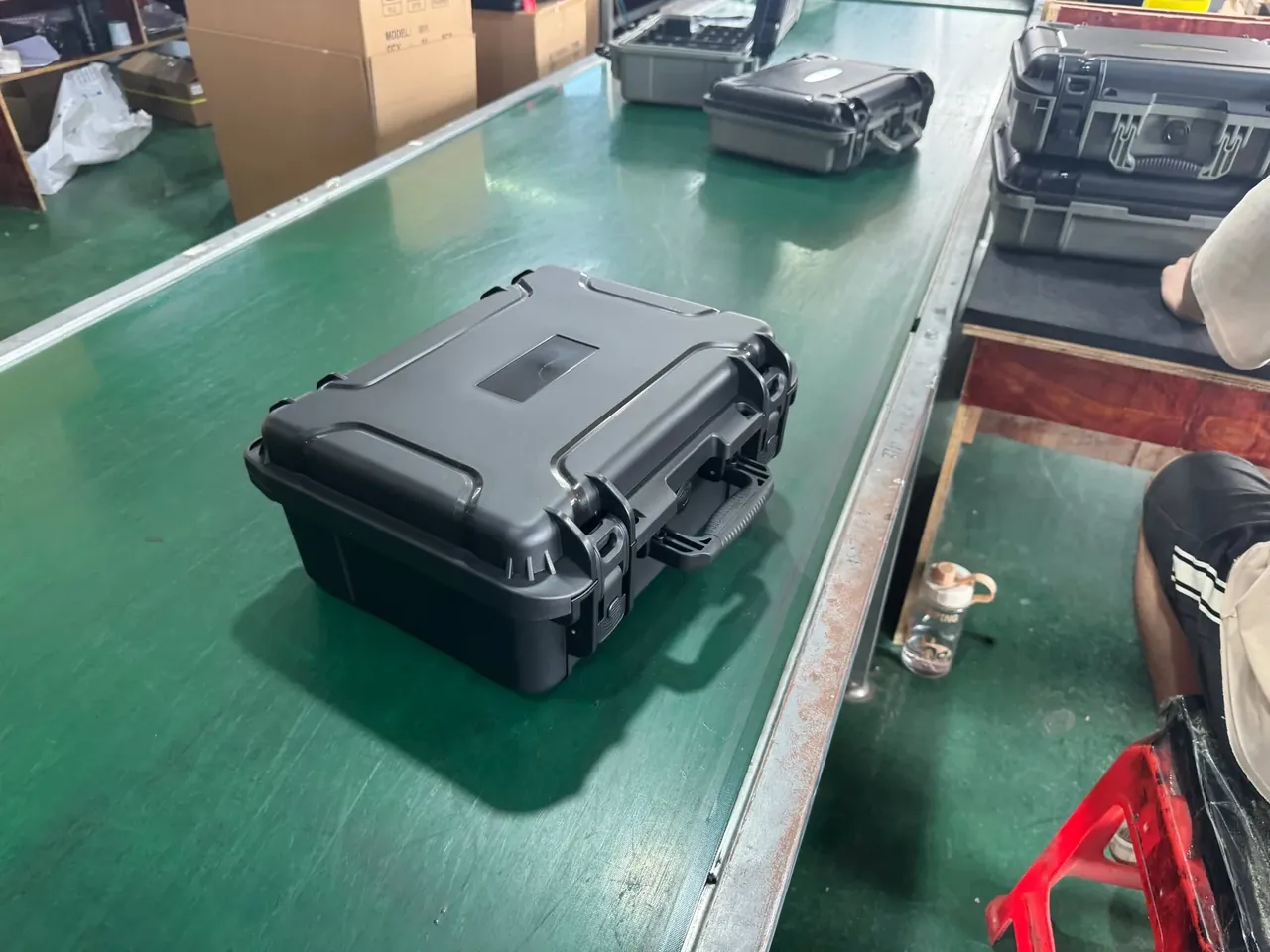
Quick answer: Outdoor non-slip wear-resistant thick plastic box grip comes from rib contact area, not tread depth: 1.0–1.5 mm ribs, 2.5–3.5 mm walls.
Table of contents
- Base ribs and the area that actually touches ground
- Where a thick wall turns brittle in the cold
- Latch preload and how it fades
- Wear testing at the corner and at the base
- Weight, load and carrying radius
- FAQ
An Outdoor non-slip wear-resistant thick plastic box either holds or slides, and the pattern has little to do with which. Only a few narrow rib crowns press on concrete; the bridged base passes load downward and produces no friction at all.
1. Base ribs and the area that actually touches ground
Rib depth runs 1.0–1.5 mm on an Outdoor non-slip wear-resistant thick plastic box. The deep end bites grass and leaf litter, where soil shear does the holding. The shallow end suits concrete and tile, because a deeper rib narrows the crown and gives up contact on hard ground.
Crown width sets the patch. Wide crowns spread pressure and sit stable; narrow crowns scratch tile and chip on gravel. The 0.6–0.8 band describes dry concrete against hard plastic, and a water film wipes it out, since extra tread depth cannot enlarge a patch that water has separated.
| Ground | At 1.0 mm rib | At 1.5 mm rib | Deciding factor |
|---|---|---|---|
| Concrete, decking | Wide crown, stable | Narrower, less bite | Crown width, root radius |
| Glazed tile | Fine dry, slips wet | Edges chipped by grit | Cleanliness, crown hardness |
| Gravel | Stones lodge, contact breaks | Bites between stones | Rib direction, pitch |
| Grass, litter | Weight only | Cuts in, shear holds | Soil moisture |
Tile is the row buyers skip. Dry, it sits inside the band; wet, it does not, and water rather than tread is what separates the two surfaces. Root radius adds a second correction: a square root cools slowly, and the crown ends up slightly concave after ejection, smaller than the drawing promises.
2. Where a thick wall turns brittle in the cold
A 2.5–3.5 mm wall is where the thick version of an Outdoor non-slip wear-resistant thick plastic box lands. Under 2.0 mm the rim follows latch preload; over 3.5 mm weight and material climb and the carrying radius shortens.
At -20 °C, ABS notched impact falls from 100–400 J/m at 23 °C to 40–120 J/m, under a third, so a corner splits instead of deforming. Thickness buys margin through section modulus, not through mass. PP shrinks 1.0%–2.5% against 0.4%–0.7% for ABS, which widens wall tolerance and waves the base until thickness damps the cooling gradient.
Summer tests the same wall differently. Heat deflection at 80–105 °C lets a base pressed against a sun-heated truck bed soften and the ribs flatten. In winter the 1.2 m drop runs at -20 °C onto a corner, where three faces meet, and the bumper pad is the only part still able to deform.
3. Latch preload and how it fades
Preload is the force a catch applies to pull the lid onto the rim. Latches on an Outdoor non-slip wear-resistant thick plastic box hold 200–400 N; the top of the range needs a palm, the bottom opens one-handed. Too little leaves a gap that works the sealing face on every carry, too much keeps hook and keeper at stress until the plastic creeps.
| Stage | Holding force | Feel | Action |
|---|---|---|---|
| First article | Inside 200–400 N | Crisp snap | Record reading |
| 20,000 hinge cycles | Near lower limit | Muted close | Retest, adjust keeper |
| -20 °C | Reading drifts | Stiff, chipped edge | Warm before closing |
| Mud or ice | Travel blocked | Will not reach keeper | Clean before latching |
Fading on an Outdoor non-slip wear-resistant thick plastic box starts where the hook rounds and the keeper root whitens. Hinge life is quoted at 20,000 cycles, by which point the foam has usually been replaced twice and the keepers never retested. Two latches also need symmetrical preload, or the lid tilts about the hinge and opens one corner to rain.
4. Wear testing at the corner and at the base
The base sees sliding wear and the corner impact wear, so one method cannot cover both. Load the box to its rating, drag a fixed distance over grit, and read crown loss with a depth gauge from marks made on the original plane.
On an Outdoor non-slip wear-resistant thick plastic box the corner test drops 1.2 m onto a corner: a bumper breakthrough retires the box, whitening alone does not. The rejection line belongs in the purchase clause: 0.8 mm of loss on the base ribs, or any through crack, ends outdoor service.
That 0.8 mm is not arbitrary. Ribs are 1.0–1.5 mm deep, so the figure removes more than half and leaves a wide flat that cannot press through a wet film. Concrete grinds because grit sits in the surface; decking and grass do not, but grit packs the channels. The rib-to-wall joint on an Outdoor non-slip wear-resistant thick plastic box flexes on every drag and cracks before the crowns wear out.
5. Weight, load and carrying radius
An empty weight of 6.5 kg is the usual landing point for an Outdoor non-slip wear-resistant thick plastic box carried as well as loaded, and each step in thickness shortens one person's radius to a few dozen paces.
Rating and tare weight are separate sums. Rating follows rib height and wall support, weight follows thickness and lid area, so two boxes can share a rating and feel nothing alike. A 0.6–0.8 band also means dragging costs about half the box weight, which pushes heavier boxes into being lifted, and lifting is when corners meet steps.
| Duty | Wall | Rib depth | Cost |
|---|---|---|---|
| Dragged daily, carried alone | 2.5–3.0 mm | 1.5 mm | Fewer stack layers |
| Palletised, forklift handled | 3.0–3.5 mm | 1.0–1.5 mm | Too heavy to lift alone |
| Long haul in a truck bed | 3.5 mm | 1.0 mm | More material, higher cost |
Dragged duty takes 2.5–3.0 mm walls with 1.5 mm ribs; palletised duty stacked three layers high takes 3.5 mm and trades weight for stiffness, which an Outdoor non-slip wear-resistant thick plastic box can afford once a forklift does the lifting.
Related Reading
- Structure trade-offs in drop-rated cold-weather cases
- Load and step tests for case bodies
- Plastic cases against wooden crates in transit
- Feet, stacking and the load above
JUNZHIJIA
Related Products
- 8 Series — Gun Cases; Military Equipment Cases; Camera Equipment Cases; Drone Cases; Watch Cases; Knife Cases; First Aid Cases; Electronics Equipment Cases
- WL8-2812 PP Gun Case — model WL8-2812
- All protective cases and toolboxes: 7 series, 158 models