

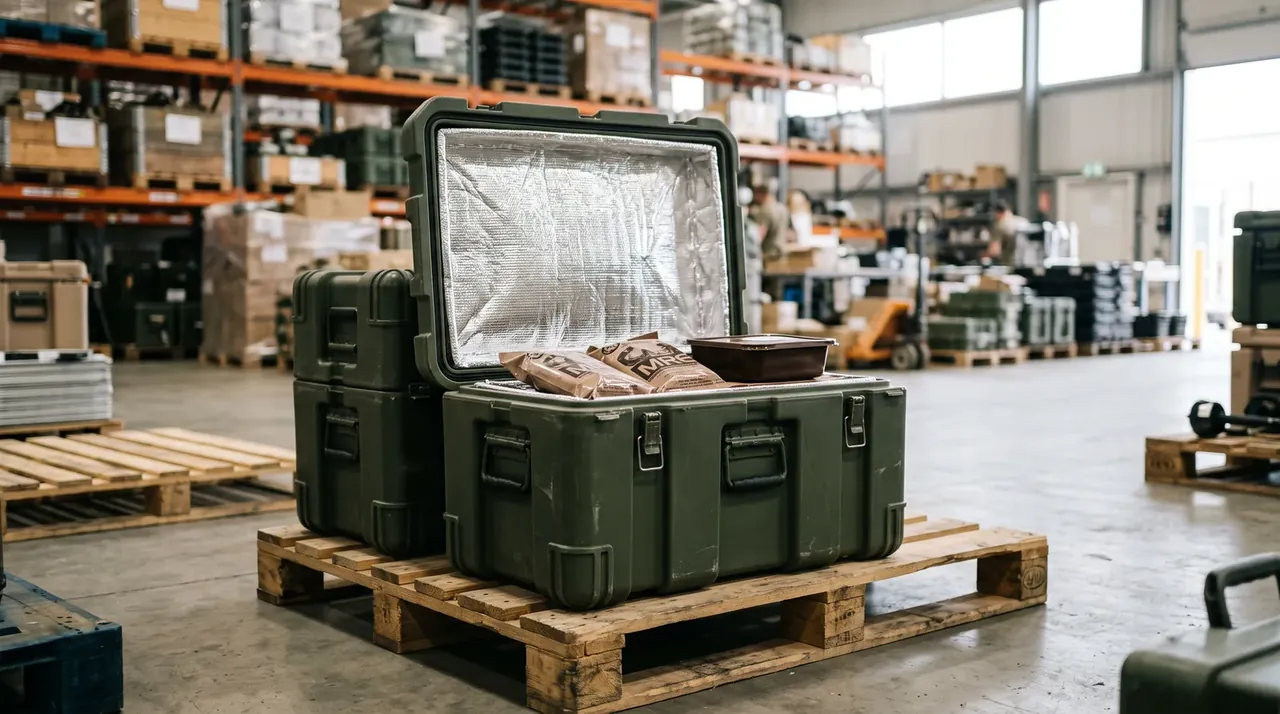
Quick answer: The Outdoor thermal drop-proof plastic hard box keeps an 8 h drop within ≤6 °C at −20 °C using a 25 mm PU core, and clears a 1.2 m drop.
Table of contents
- Double wall and foam split in the Outdoor thermal drop-proof plastic hard box
- Thickness and conductivity limits of the foam layer
- Load path through corners and bond lines in a six-face drop
- Probe points and readings in the low-temperature hold test
- Sampling items and rejection lines for batch acceptance
- FAQ
1. Double wall and foam split in the Outdoor thermal drop-proof plastic hard box
The Outdoor thermal drop-proof plastic hard box splits a 4.2 mm wall into two skins with a 25 mm PU foam cavity between them. The outer skin takes the 1.2 m drop, the inner gives the 540 × 360 × 280 mm cavity a flat datum, and the foam holds conductivity to 0.024 W/(m·K). One adhesive bonds the layers under heat and pressure and spreads corner shear across the wall. At impact the skins pull the foam both ways; a released bond leaves a hollow patch and a thermal bridge, so the ≤6 °C drop over 8 h at −20 °C stops holding. The Outdoor thermal drop-proof plastic hard box therefore treats debonding and cracking as two separate red lines.
No metal fastener runs through both skins; latch seats anchor only to the outer wall.
| Foam zone | Bond face | Thickness or value |
|---|---|---|
| Lid inner layer | heat-pressed to inner skin | 25 mm PU foam |
| Base interlayer | poured on outer skin | 25 mm PU foam |
| Corner transition | continuous bond, no seam | 0.024 W/(m·K) |
| Rim fold | skins closed into a frame | 4.2 mm wall |
2. Thickness and conductivity limits of the foam layer
Twenty-five millimetres is the clear space between a 620 × 440 × 360 mm outer size and a 540 × 360 × 280 mm cavity, after twice the 4.2 mm wall is subtracted. Thicker foam thins both skins and leaves corners short of support at 1.2 m; thinner foam lets the 0.024 W/(m·K) figure be eaten by the rim bridge, so the 8 h drop at −20 °C climbs past ≤6 °C. The limit is a band, not a maximum, so foam density and skin stiffness must match. The Outdoor thermal drop-proof plastic hard box writes 25 mm and 4.2 mm as a linked pair, so changing either alone means recalculating both the drop and the hold.
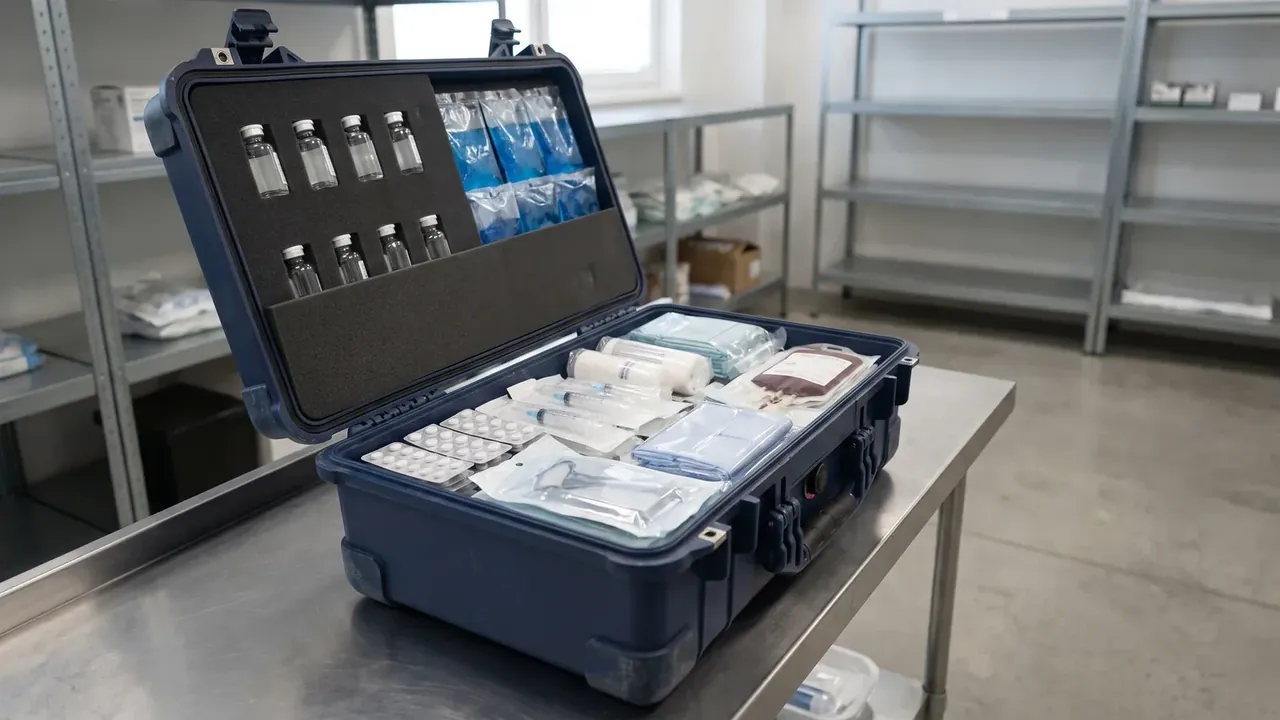
A −30 °C to 60 °C working band bounds the foam and adhesive: cold embrittles the bond and heat creeps the foam, with no certificate numbers or test-grade codes in the sheet. Empty at 7.8 kg and loaded at 14 kg set the drop-rig clamp.
3. Load path through corners and bond lines in a six-face drop
A 1.2 m six-face drop lands on corners, edges, then faces, and the corner is where the Outdoor thermal drop-proof plastic hard box works hardest. The outer skin passes shock to the bond line, the bond drags the inner skin, and the foam takes the shear. Radiused corners keep the load off a joint. Cracks are checked first, then each face is tapped for hollows, and only then does the hold rerun. The rejection line comes from the loaded state at 14 kg.
| Drop contact | Load path | Rejection line |
|---|---|---|
| Corner | outer skin, bond, inner skin | no crack |
| Long edge | rim fold, foam | no debond |
| Broad face | outer skin spread, inner skin | no hollow |
| Rim | latch seat, rim fold | 2 latches stay shut |
Two 380 N latches are rechecked after the drop.
4. Probe points and readings in the low-temperature hold test
For the ≤6 °C drop over 8 h at −20 °C, contact probes sit at the cavity centre and just inside the rim. At 8 h the higher of the two groups decides, not an average. The Outdoor thermal drop-proof plastic hard box lists the rim group apart because the fold and bond bridge shows there first; the centre group only confirms continuous foam, and a wide gap between the two sends the rim fit to check first.
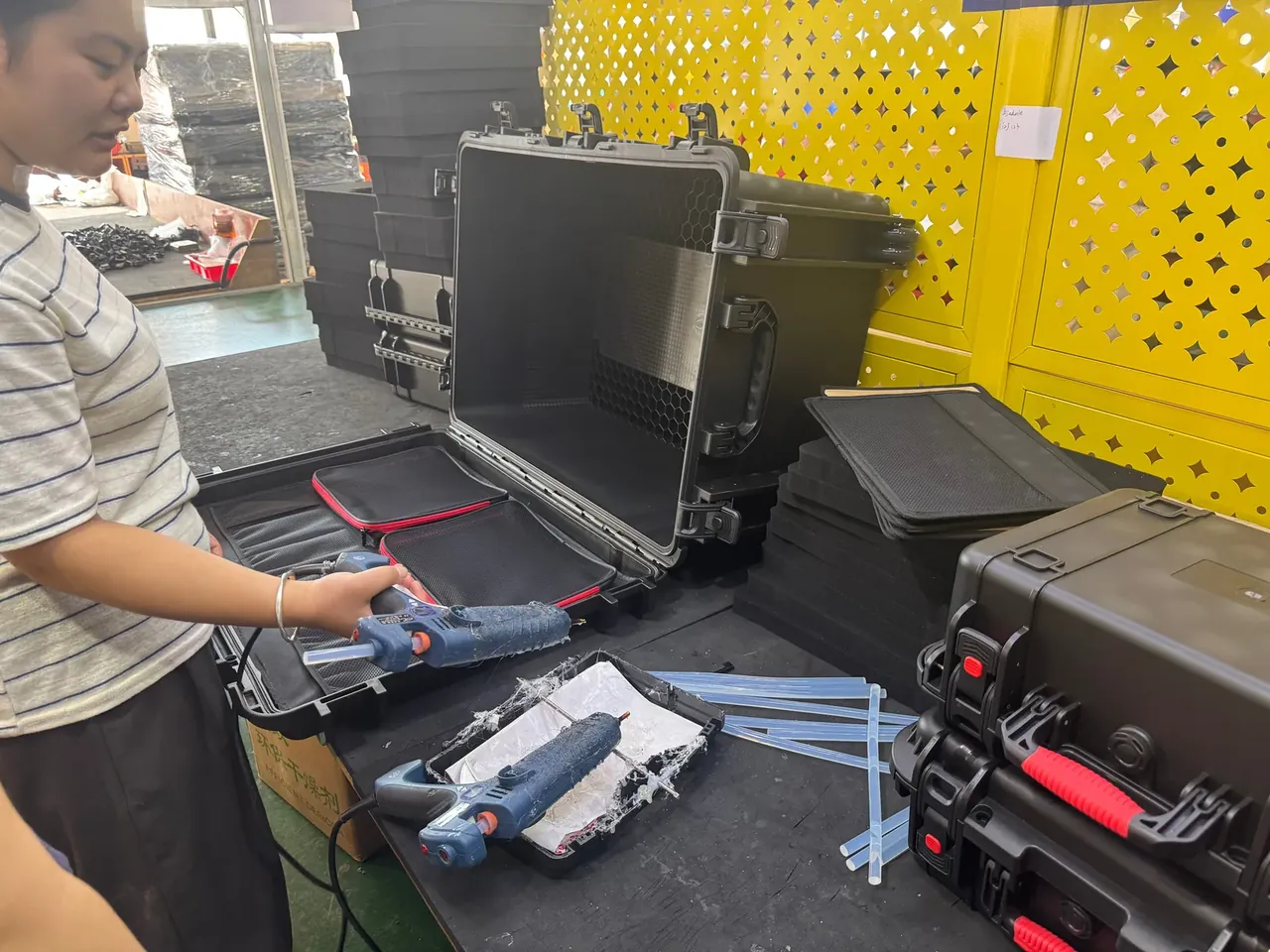
A −20 °C rerun follows the drop: a reading off the pre-drop baseline fails the bond, with no extra hold time added. Both 7.8 kg empty and 14 kg loaded are run.
| Temperature-drop reading | Probe position | Verdict |
|---|---|---|
| Start | cavity centre | baseline logged |
| 8 h centre | mid foam | ≤6 °C |
| 8 h rim | inside rim fold | not above centre group |
| Post-drop rerun | same two points | matches pre-drop |
5. Sampling items and rejection lines for batch acceptance
Batch acceptance samples each lot. The 620 × 440 × 360 mm outer size, 540 × 360 × 280 mm cavity, 4.2 mm wall and 25 mm foam are measured, then a 1.2 m six-face drop, an 8 h hold at −20 °C, IP67 and 3000 cycles follow. The 0.024 W/(m·K) conductivity is checked on a retained sample, two 380 N latches are rechecked after the drop, and neither may release after 3000 cycles. A crossed line returns the lot for a bond and density review. JUNZHIJIA keeps a reading table so each lot of the Outdoor thermal drop-proof plastic hard box traces to a number; KeXin New Materials (Guangdong) Co., Ltd. validates against methods.
Conclusion
The Outdoor thermal drop-proof plastic hard box uses one double wall: 25 mm of PU foam at 0.024 W/(m·K) holds an 8 h drop to ≤6 °C at −20 °C, while a 4.2 mm twin skin survives a 1.2 m six-face drop with no cracked corners or hollow foam. Outer 620 × 440 × 360 mm, cavity 540 × 360 × 280 mm, 7.8 kg empty and 14 kg loaded bound the shell; two 380 N latches, IP67, 3000 cycles and a −30 °C to 60 °C band are the recheck list.
Related Reading
- How thermal cycling is set up for case shells
- Drop test sequence and how to read it
- Spec baseline for high and low temperature test cases
- Temperature extremes for outdoor case shells
Related Products
- 8 Series — Gun Cases; Military Equipment Cases; Camera Equipment Cases; Drone Cases; Watch Cases; Knife Cases; First Aid Cases; Electronics Equipment Cases
- WL8-2812 PP Gun Case — model WL8-2812
- All protective cases and toolboxes: 7 series, 158 models