

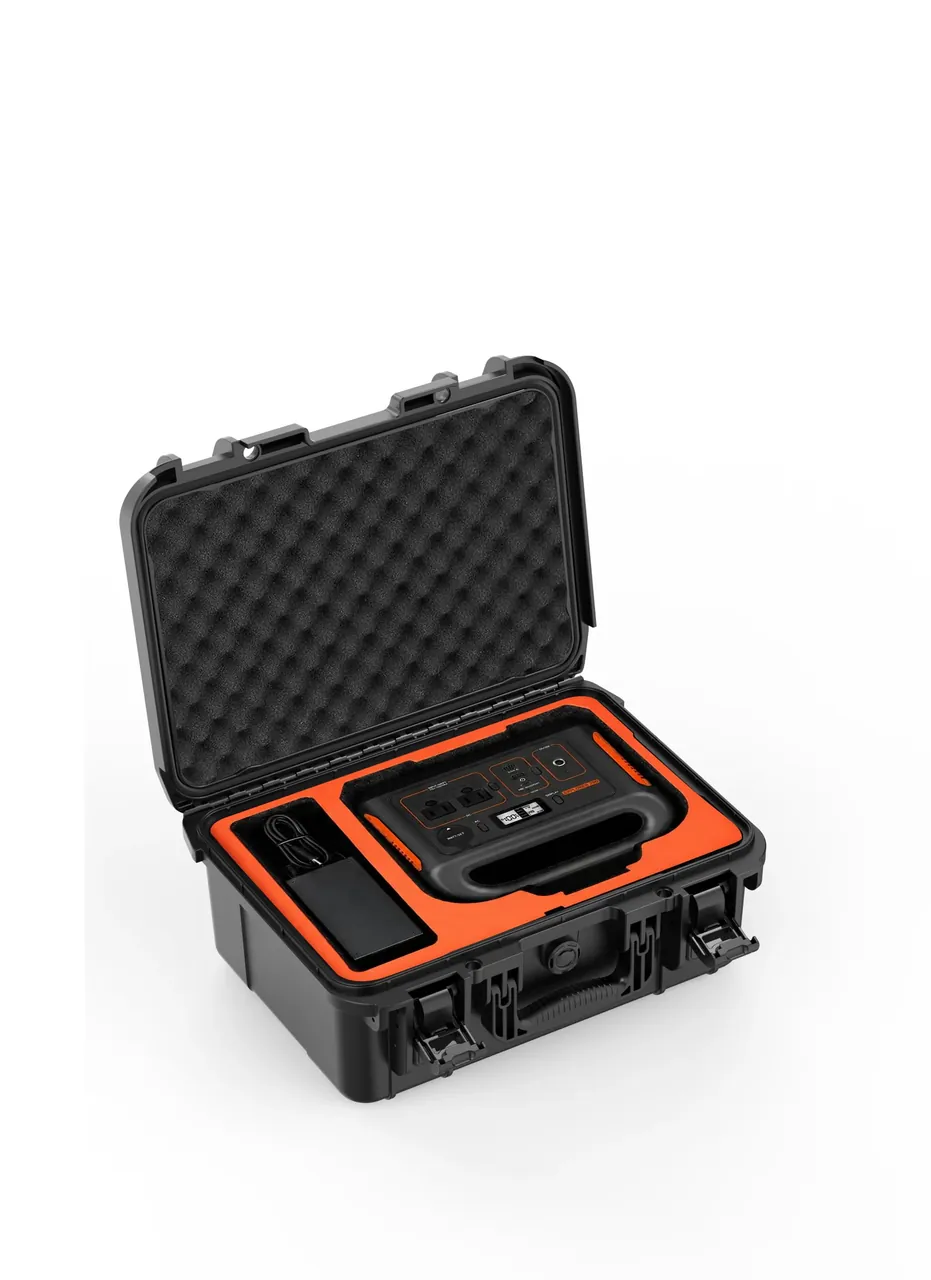
Quick answer: An Outdoor Power Supply Protective Case holds two lines at once: the internal rise under 8 °C, and the charge under 30% before the trip.
Table of contents
- Heat paths out of the host
- Panel cut-outs and cable exits
- Internal temperature and state of charge
- Holding the battery pack against a drop
- Transport marks and the opening sequence
- FAQ
Fitting a power station into a box is the easy half. The hard half is letting the host breathe while the sockets face the hand, on the same wall.
1. Heat paths out of the host
Heat leaves through two doors: conduction into the wall, airflow out of the mouth. An 8 °C internal rise is the working limit on an Outdoor Power Supply Protective Case.
Duct geometry decides how much of that path is used. Inlet and outlet on one side at one height let air take the shortest route and leave the far half of the cavity hot; a low inlet with a high outlet gives warm air a reason to climb.
On an Outdoor Power Supply Protective Case the fan has to agree with the outlet. Blowing inward against a closed wall pushes heat back into the battery bay; drawing outward uses the pressure difference. Insert foam must keep clear of the vent, or EVA at 25–45 kg/m³ and PU at 30–60 kg/m³ turn into a blanket over the intake.
| Route | What carries the heat | Fails first at | Field check |
|---|---|---|---|
| Wall | 2.0–3.5 mm plastic section | Inner face against the host | Touch the wall after shutdown |
| Mouth | Inlet and outlet height gap | Vent masked by foam | Line up the cut-outs |
| Liner | 12, 20 or 30 mm aluminium frame | Liner lifting off the wall | Press for a hollow knock |
| Forced path | Fan aimed at the outlet | Fan stalled or reversed | Feel the exhaust flow |
The -10 to 45 °C ambient band breaks at both ends. At 45 °C the margin under the 8 °C limit is thinnest and the host derates; at -10 °C the fan slows and heat pools.
2. Panel cut-outs and cable exits
A 1–2 mm panel gap covers moulding tolerance on an Outdoor Power Supply Protective Case. Past that, moisture travels the seam and no gasket preload recovers it.
The 25 mm cable exit is a common gland bore. A thinner cable needs a reducing bush, a thicker one forces the gland open and turns the exit into a drain. On an Outdoor Power Supply Protective Case in service the panel opening stands open with a plug inserted, so the rating applies only with the lid shut.
IP67 means 1 m of immersion for 30 minutes, and it describes static water. A gland never tightened, or a panel pulled down on one side, voids the figure on site.
| Opening | Permitted gap | Sealing method | Check |
|---|---|---|---|
| AC socket bay | 1–2 mm | Hinged cover with gasket | Cover springs back |
| USB and DC ports | 1–2 mm | Silicone plug pressed in | Plug body undistorted |
| Cable exit | Matched to cable | Gland plus locknut | Cable will not shift |
| Vent louvre | Per duct design | Louvres down, mesh inside | Mesh not clogged |
3. Internal temperature and state of charge
Charge held under 30% in an Outdoor Power Supply Protective Case is a rule, not a preference. From 1 January 2026 IATA applies PI 966 to lithium-ion cells packed with equipment, where 30% is mandatory; PI 967, for cells inside equipment, treats it as a recommendation.
Temperature and charge pull against each other. At 45 °C ambient plus an 8 °C rise the inside sits above fifty, where a pack held for weeks loses capacity fast; at -10 °C a low charge cuts usable capacity again.
The rejection line reads: an internal rise above 8 °C on two consecutive runs, or a carbonised mark at the panel opening, fails the thermal design.
Two runs matter: an overshoot can follow a hot afternoon, two in a row point at the duct. A carbonised opening is an arc, unrelated to ambient, and the case leaves service on sight.
On an Outdoor Power Supply Protective Case, read charge from the host display where one exists. Without one, work back from resting time and self-discharge, then discharge to 30% and mark the date outside.
| State of charge | Shipment mode | Handling |
|---|---|---|
| Under 30% | Packed with equipment or alone | Ship with the UN38.3 summary |
| Over 30% | Packed with equipment | Discharge before handover |
| Over 30% | Inside equipment | Discharge, or indicate 25% or less |
4. Holding the battery pack against a drop
A 1.0 m drop is the usual verification height for an Outdoor Power Supply Protective Case. What damages a pack is the shift afterwards: a few millimetres of travel loads the terminals, and loaded terminals bend the internal tabs.
EVA at 25–45 kg/m³ and PU at 30–60 kg/m³ trade support against absorption, and compression set under 5% at 25% compression, 23 °C for 24 hours keeps an insert from flattening after a few drops.
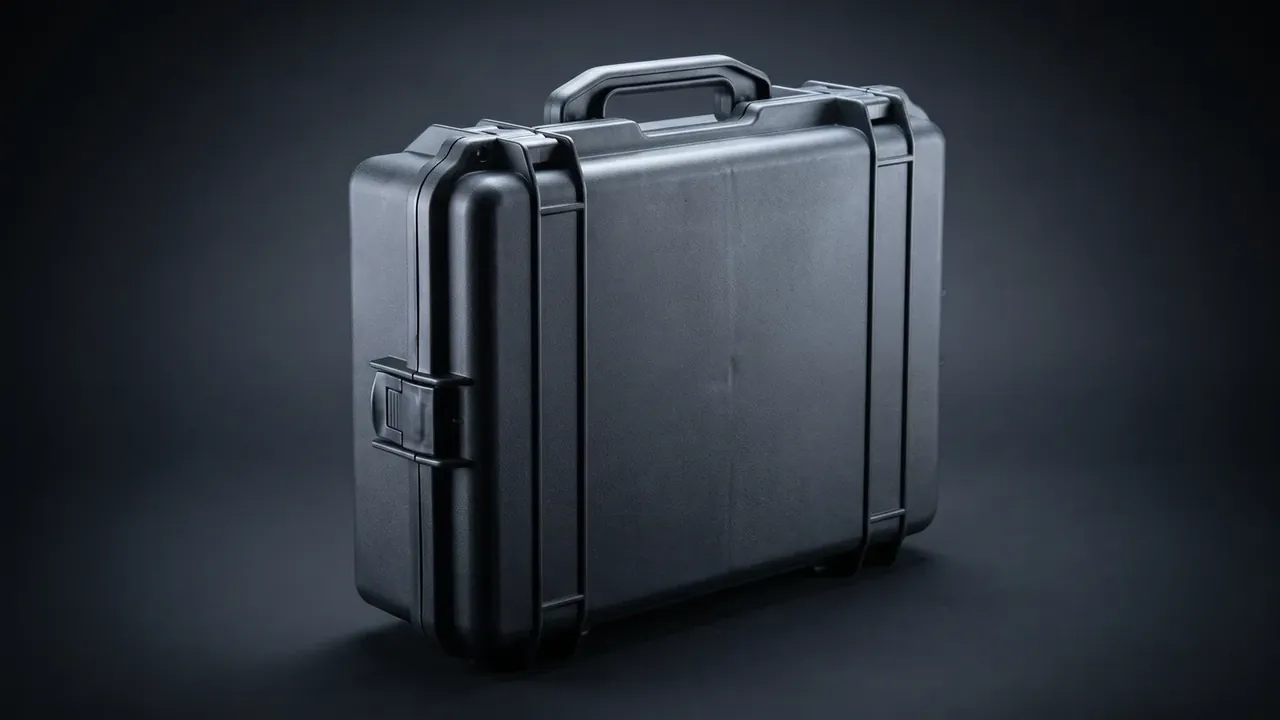
The pack needs clearance on every side inside an Outdoor Power Supply Protective Case. Pressed against a wall it looks secure, but on impact force passes straight through and the foam never joins the work.
Latches close the chain. Holding force runs 200–400 N and the hinge is rated for 20,000 cycles, so the drop test watches for a latch that pops: one pop opens the lid and the pack loses its upper constraint.
The pack itself has to pass UN38.3 T4, a 150 g, 6 ms shock. The case only keeps external impact from stacking onto that figure, so a cell result cannot stand in for a whole-case drop.
5. Transport marks and the opening sequence
Marks on an Outdoor Power Supply Protective Case belong where the lid opens. The lithium battery mark, the up arrow, a moisture warning and a stack limit make a set, with the stack figure following lid capacity, usually 3 layers.
Opening follows risk order: check the seal tape for a second application, look for water at the panel opening, inspect the gland, then touch the pack. A smell or a swollen pack stops the process.
Records carry a date and case number. Two openings in a row with water at the panel mean the gasket has failed; an immersion test only confirms it later.
For storage, drop charge under 30%, keep ambient between -10 and 45 °C, stand the case upright, and dry the panel bay before the lid closes.
Related Reading
- Case requirements around portable generators
- Storing solar panels and chargers
- How battery safety cases are specified
- Converting case load ratings into practice
JUNZHIJIA
Related Products
- 8 Series — Gun Cases; Military Equipment Cases; Camera Equipment Cases; Drone Cases; Watch Cases; Knife Cases; First Aid Cases; Electronics Equipment Cases
- WL8-2812 PP Gun Case — model WL8-2812
- All protective cases and toolboxes: 7 series, 158 models