

Quick answer: Outdoor rock climbing equipment crushproof box spec hinges on an 18 mm domed lid holding a 0.65 mm dent after 8 h of three-tier stacking.
Table of contents
- Curvature of the domed lid on an outdoor rock climbing equipment crushproof box
- Wall thickness gradient down the side walls
- Lid dent after three-tier stacking
- Side-wall bulge once the load is removed
- Lower curvature bound for the storage batch
- FAQ
1. Curvature of the domed lid on an outdoor rock climbing equipment crushproof box
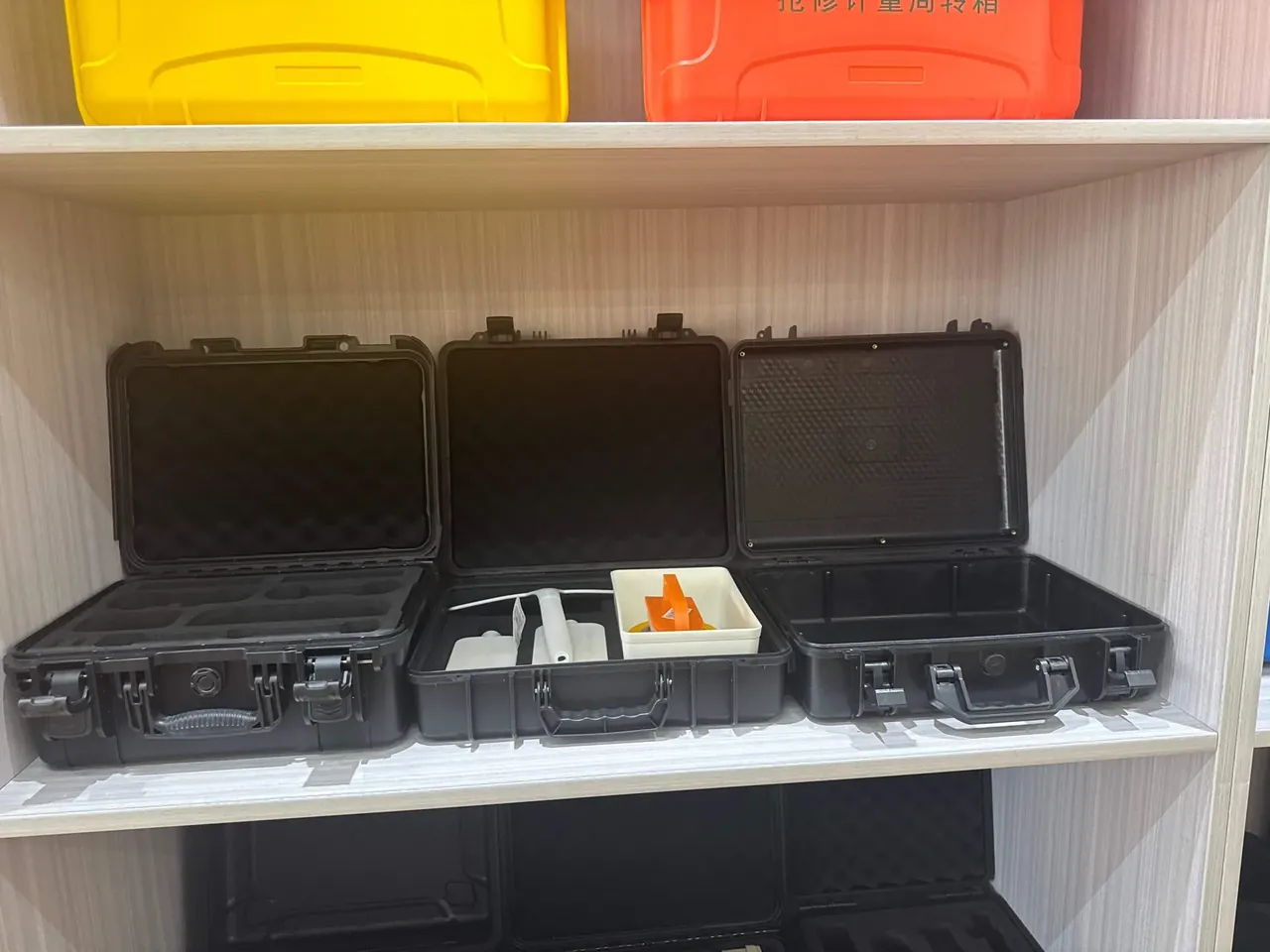
Load from a third tier travels along the crown toward the side walls, and a poorly matched pair of curvature and wall taper leaves a dent on the lid before the shell ever collapses. The outdoor rock climbing equipment crushproof box measures 520×380×240 mm outside and 455×320×175 mm inside, which leaves just 18 mm of rise for the crown. Too little rise and the panel behaves like a flat cover under three tiers; too much rise thickens the shell and pushes the 5.2 kg empty weight back up. Curvature is therefore a way of distributing stack load, not a styling choice, and the outdoor rock climbing equipment crushproof box fixes it on the first drawing sheet.
2. Wall thickness gradient down the side walls
The side wall is not uniform from the rim to the base: it starts at 3.9 mm and grows to 5.1 mm at the root, and that 3.9–5.1 mm gradient decides at what height the crown load is caught. Machine the wall to a flat 4.5 mm and the mouth no longer seals, eating the 18% compression reserve of the single gasket. Cycling from −20 ℃ to 45 ℃ loads the thickness transition with residual stress; a smooth gradient springs back after unloading, a reversed one leaves a swell along the wall. An outdoor rock climbing equipment crushproof box treats gradient and crown as one matched set, so changing either side means re-running the stack.
The bulge limit on an outdoor rock climbing equipment crushproof box is 0.5 mm, read after unloading rather than at full load. A dial gauge sits at mid-height, one reading at 14 kg payload, another once the case is empty, and the difference is the bulge. Two latches at 355 N each hold the mouth together; without that restraint even a correct gradient bulges a little more.
3. Lid dent after three-tier stacking
A three-tier, 8 h rig holds one crown profile under load for a full shift; the dent is the largest of nine depth-gauge points, a permanent mark rather than elastic give.
| Curvature step | Crown rise | Lid dent after 8 h |
|---|---|---|
| Flat arc | 12 mm | 0.78 mm |
| Mid arc | 18 mm | 0.61 mm |
| Steep arc | 24 mm | 0.49 mm |
The mid arc at 18 mm settles at 0.61 mm, one step clear of the 0.65 mm limit; the flat arc at 12 mm runs straight to 0.78 mm and crosses it. An outdoor rock climbing equipment crushproof box therefore ships the mid arc, not the most crowned one.
| Stacking interval | Lid dent | Side-wall bulge |
|---|---|---|
| 2 h | 0.19 mm | 0.12 mm |
| 5 h | 0.43 mm | 0.31 mm |
| 8 h | 0.61 mm | 0.47 mm |
The reading climbs with time, but the fifth-to-eighth-hour gain is only 0.18 mm, so creep has already slowed. Bulge at 0.47 mm still sits under 0.5 mm, and the profile passes only when both figures clear their lines together.
4. Side-wall bulge once the load is removed
Unloading is not finished when the tiers are lifted off; the shell needs a rest period before the rebound is read, and dent and bulge belong to two different moments.
Re-check on the same rig without moving the shell, lid first then wall, because a shuffle carries the reading away. With one gasket at 18% compression, reopen the lid after checking against the IP65 spray and dust conditions and confirm the mouth has not shifted into a mismatch. Shells that ran the −20 ℃ to 45 ℃ swing form a separate group: the cold wall is more brittle and bulges slightly higher, so it is logged apart. An outdoor rock climbing equipment crushproof box files both groups on one card without letting them substitute for each other.
5. Lower curvature bound for the storage batch
Before a whole outdoor rock climbing equipment crushproof box batch is released, the eighth-hour figures of all three crowns go onto one sheet and only the mid arc at 18 mm enters the configuration. The bound is taken as the flattest step whose eighth-hour dent still stays within 0.65 mm, and more crowned shapes remain as trend records only.
| Dent reading | Crown shape | Batch disposition |
|---|---|---|
| ≤0.65 mm | Mid arc 18 mm | Into the configuration |
| 0.66–0.78 mm | Flat arc 12 mm | Trend record only |
| >0.78 mm | Flatter crowns | Back to mould rework |
There is no thicken-and-retry row, because the 3.9–5.1 mm gradient and the crown rise are already a matched pair and moving one alone scatters the other. Boundary values such as 5.2 kg empty, 14 kg payload and 4400 cycles stay with the batch, ready to be reused as a set next time.
Conclusion
On an outdoor rock climbing equipment crushproof box, crown curvature and side-wall gradient are one paired set; tune either alone and the dent and bulge after 8 h of three-tier stacking both drift. The four figures of 18 mm rise, a 3.9–5.1 mm gradient, a 0.65 mm dent and a 0.5 mm bulge sit on a single inspection card and say more about a crown than wall thickness ever does. An outdoor rock climbing equipment crushproof box picks the step just inside the line rather than stacking margin through extra material. JUNZHIJIA files curvature and gradient as a pair on these storage batches so the next run reuses the set.
Related Reading
- Pressure-proof safety cases for outdoor adventure gear
- Climbing gear cases: storing ropes, locks and protectors
- Outdoor protective cases versus ordinary storage boxes
- Hard cases for outdoor field work storage
Related Products
- 8 Series — Gun Cases; Military Equipment Cases; Camera Equipment Cases; Drone Cases; Watch Cases; Knife Cases; First Aid Cases; Electronics Equipment Cases
- WL8-2812 PP Gun Case — model WL8-2812
- All protective cases and toolboxes: 7 series, 158 models