

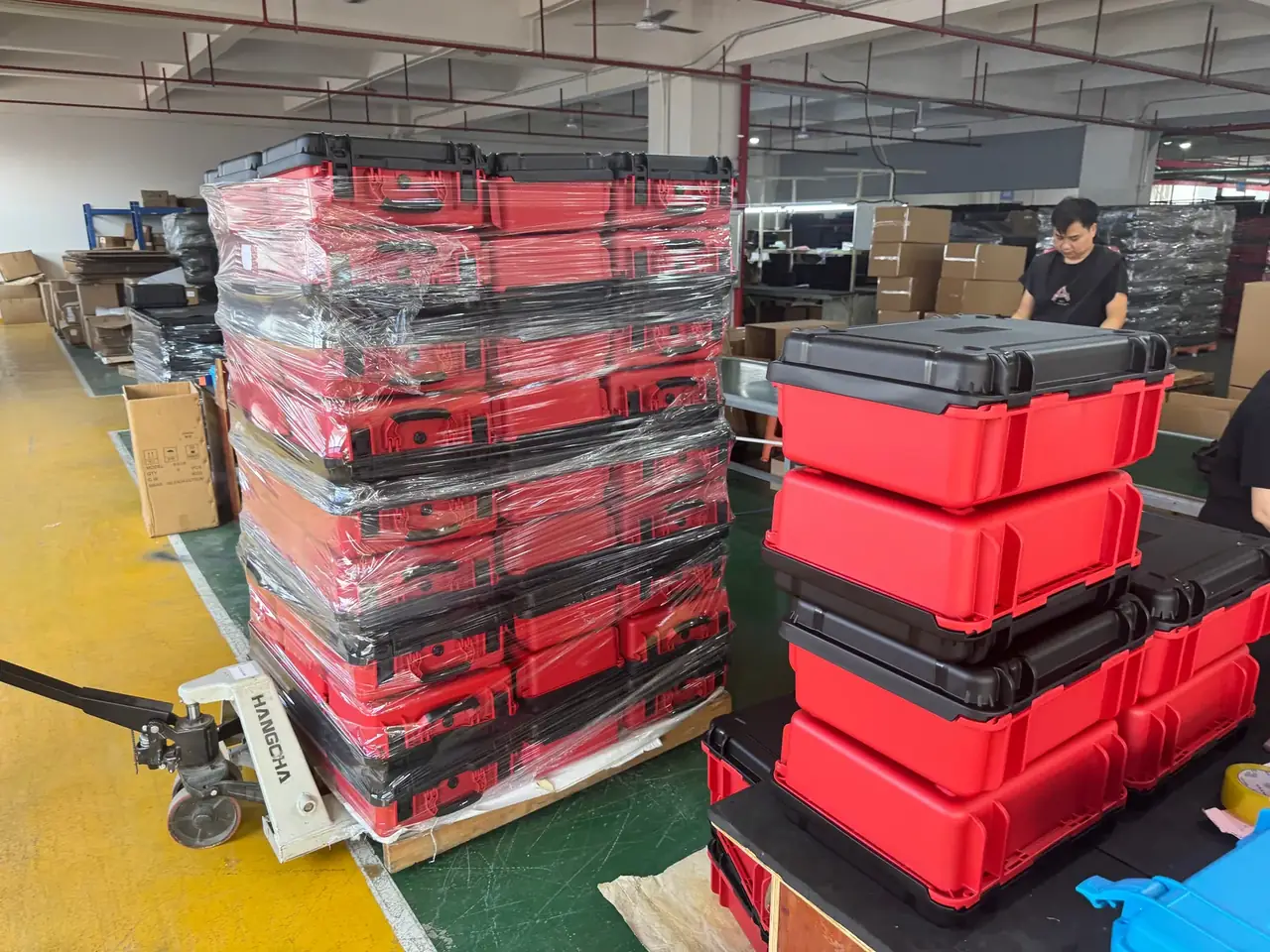
Quick answer: The Outdoor ski goggles & accessories hard case sets the lid frame at 9 mm and post fit at 0.28 mm, holding shift within 0.45 mm after a 1.2 m drop.
Table of contents
- Outdoor ski goggles & accessories hard case lid frame height
- Fit clearance of the base locating posts
- Post displacement measured after six-face drops
- Frame sink over the hinge-cycle bench
- Clearance scrap threshold for outdoor lots
- FAQ
1. Outdoor ski goggles & accessories hard case lid frame height
A hold-down frame is a rib on the inside of the lid that bears on the liner top edge once the shell shuts. The Outdoor ski goggles & accessories hard case fixes it at 9 mm because a 460×340×170 mm outer shell against a 405×285×115 mm cavity leaves little free height inside the lid. Set it lower and a 1.2 m six-face drop lets the liner push upward, loading the four φ7 mm posts in shear first; set it higher and the closing stroke grows, so part of the 325 N preload from each of the two latches is spent on interference and the one-hand opening force drifts past 28 N. JUNZHIJIA tried three lid settings on a 3.4 mm wall shell. At 9 mm the liner stayed still at 3.2 kg empty and 6 kg loaded, with post shift on the rig under 0.45 mm after the drop. A rounded root keeps injected material from piling up at corners and decides how evenly the ring springs back.
Two datums fixed, the clearance split has a reference.
2. Fit clearance of the base locating posts
The four locating posts are the second datum, each φ7 mm in diameter, with fit clearance to the liner holes held at 0.28 mm. Too tight leaves no give for drop shock and drives load into the post root; too loose lets post shift cross 0.45 mm before the 9 mm frame does any work.
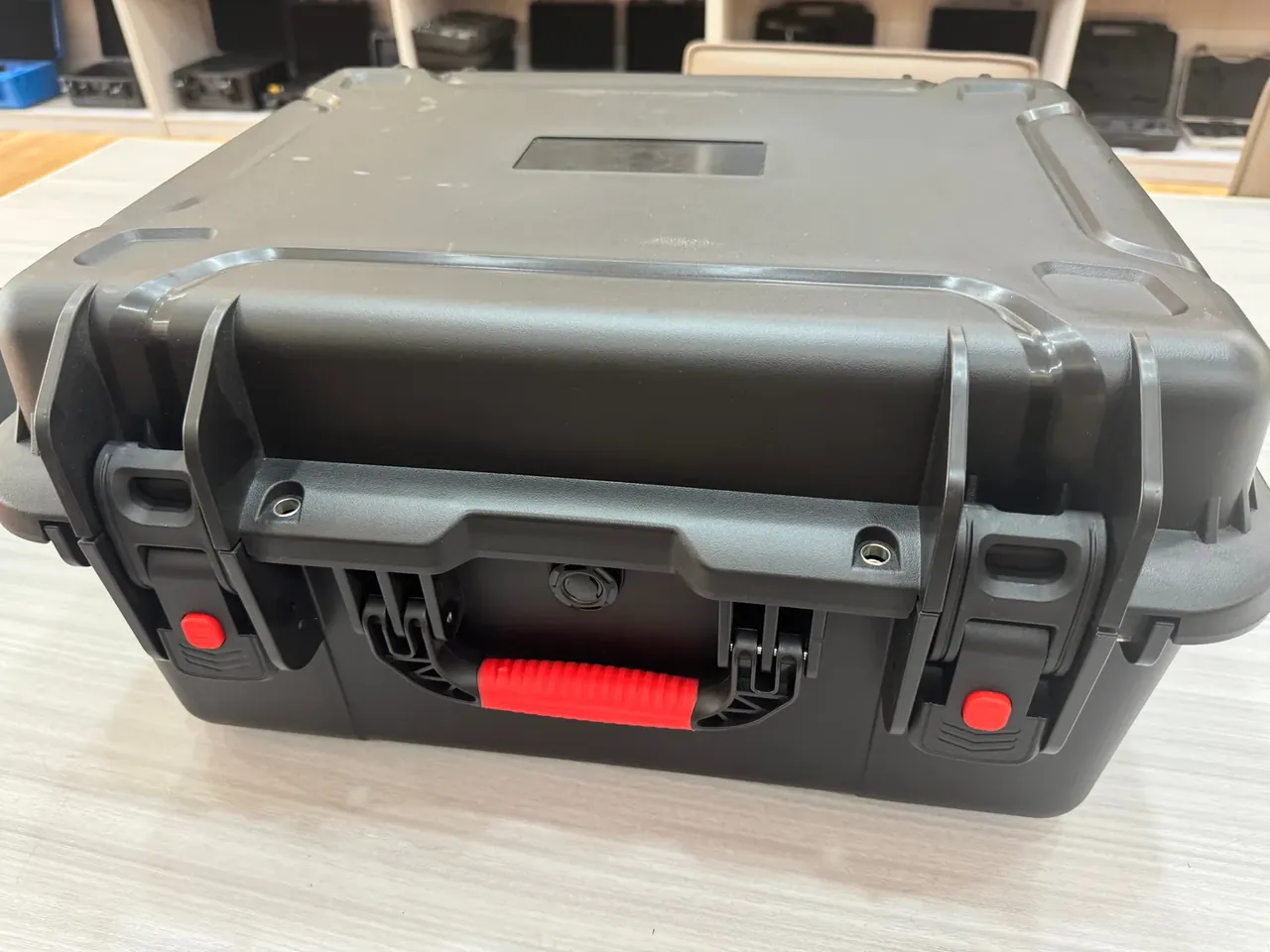
Front and rear rows are reamed together at 0.28 mm, then every post is checked with a feeler gauge. JUNZHIJIA logs one clearance reading per post on the inspection card, and any post outside 0.28 mm sends the whole base back. On the Outdoor ski goggles & accessories hard case, post numbers and clearance readings share one table, so a re-check by number finds a mould offset faster than sampling by lot.
| Post number | Measured clearance | Reading after drop |
|---|---|---|
| Front left | 0.28 mm | within 0.45 mm |
| Front right | 0.28 mm | within 0.45 mm |
| Rear left | 0.28 mm | within 0.45 mm |
| Rear right | 0.28 mm | within 0.45 mm |
3. Post displacement measured after six-face drops
The drop rig runs one release per face at a common 1.2 m with no external cushioning. For the Outdoor ski goggles & accessories hard case each landing returns to the same coordinate measuring machine, reading post tip offset against the base datum plane rather than shell deformation. The 0.45 mm line is the 0.28 mm clearance plus liner give; beyond it the post reaches the 9 mm frame edge.
| Drop face | Drop height | Post shift acceptance |
|---|---|---|
| Base | 1.2 m | ≤0.45 mm |
| Lid | 1.2 m | ≤0.45 mm |
| Left side | 1.2 m | ≤0.45 mm |
| Right side | 1.2 m | ≤0.45 mm |
| Front end | 1.2 m | ≤0.45 mm |
| Rear end | 1.2 m | ≤0.45 mm |
Landings on the short side read closest to the limit and the long base is softest, following the stiffness of a 3.4 mm wall along each axis. JUNZHIJIA does not release on an average: the largest of the six faces is compared with 0.45 mm, and one face over the line sends the base back with its lot. Both the 3.2 kg empty and 6 kg loaded states run a full round, and both must pass.
4. Frame sink over the hinge-cycle bench
The cycle bench lifts and lowers the lid on a fixed rhythm, stops after 3800 cycles, and measures frame sink from the start position. The Outdoor ski goggles & accessories hard case draws this line at 0.32 mm, tighter than the 0.45 mm post shift, because any sink eats into the 9 mm clamping travel and gives the liner play again. The 325 N preload from each of the two latches is not reset, and the one-hand opening force is re-checked against 28 N.
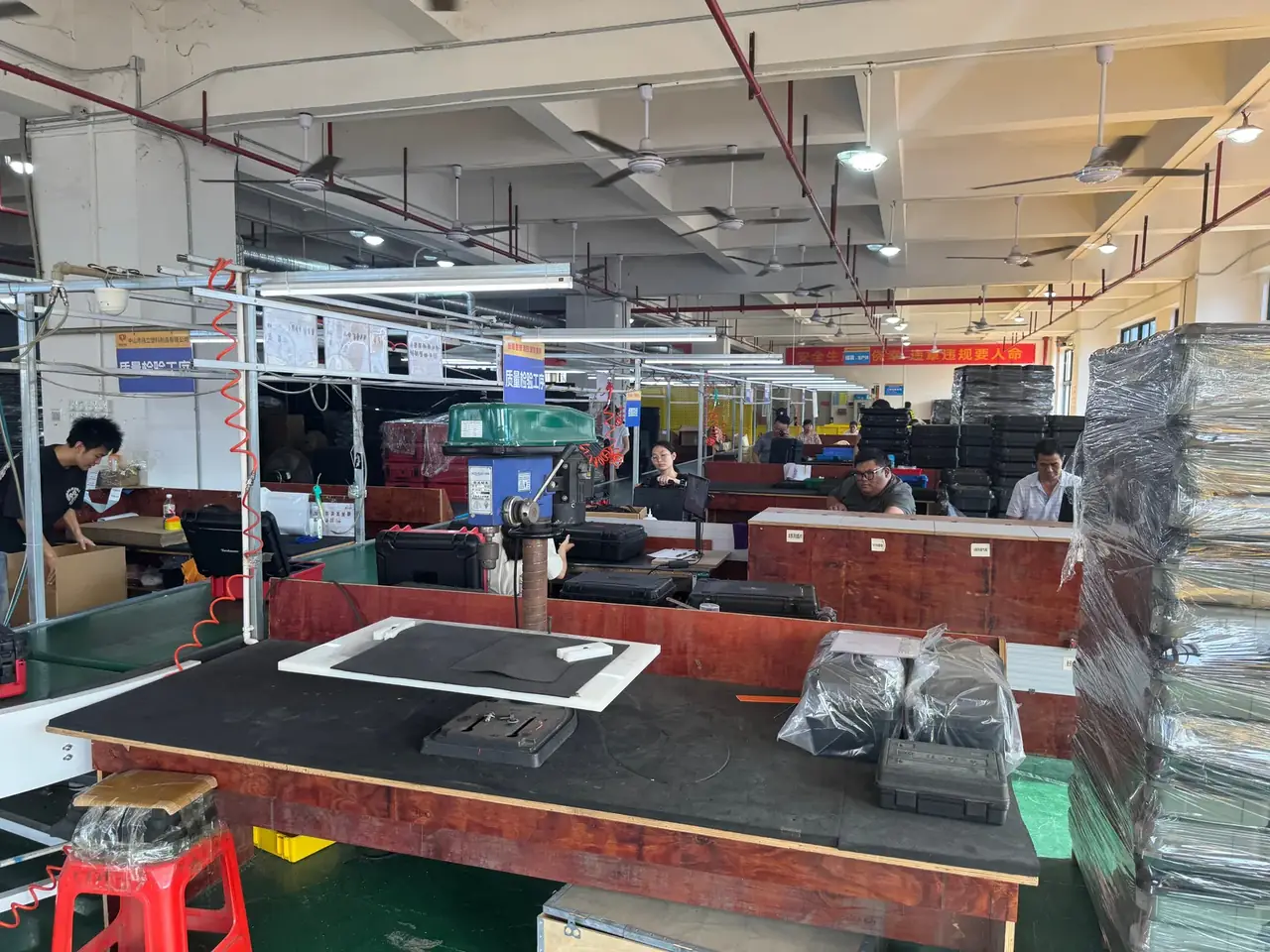
The bench reads sink at a fixed interval and logs the curve slope beside the final number. JUNZHIJIA rejects a lid that has already spent half of 0.32 mm early in the run, even if the final figure sits on the line.
| Shift value | Cycle count | Verdict |
|---|---|---|
| 0 mm | 0 cycles | starting datum |
| ≤0.32 mm | 3800 cycles | frame sink passes |
| ≤0.45 mm | 3800 cycles | post shift passes |
| beyond 0.45 mm | any face | whole unit scrapped |
Seal condition sits beside frame sink on one card, and an IP65 spray check is taken separately.
5. Clearance scrap threshold for outdoor lots
A lot is released on a set of scrap lines, not one good reading. The Outdoor ski goggles & accessories hard case writes four numbers on one release card: 0.28 mm fit clearance, 0.45 mm post shift, 0.32 mm frame sink and 28 N opening force. All four must pass before the stamp; if any crosses, the whole lot returns to base reaming and lid-frame forming.
In volume production JUNZHIJIA samples shells onto the coordinate machine at a fixed ratio, and each sampled shell still takes a 1.2 m drop on all six faces with the trial-part reading method. An IP65 spray check reads the sealed mouth on its own re-check path.
Conclusion
The Outdoor ski goggles & accessories hard case ties a 9 mm frame height to a 0.28 mm post clearance, closing the loop with post shift held to 0.45 mm after a 1.2 m six-face drop and frame sink held to 0.32 mm after 3800 cycles. JUNZHIJIA runs trial and volume re-checks against those thresholds rather than releasing on one flattering unit. When choosing such a shell, check both datums first, then how seal and liner allowance are split.
Related Reading
- What Outdoor Uses Are ABS Protective Cases Best Suited For?
- Why Does an Outdoor Protective Case Need Dustproof Design?
- Ball-Sports Gear Cases: Storage & Protection for Football, Basketball & Volleyball Training Kit
- Buoyant waterproof box for water sports
Related Products
- 8 Series — Gun Cases; Military Equipment Cases; Camera Equipment Cases; Drone Cases; Watch Cases; Knife Cases; First Aid Cases; Electronics Equipment Cases
- WL8-2812 PP Gun Case — model WL8-2812
- All protective cases and toolboxes: 7 series, 158 models