

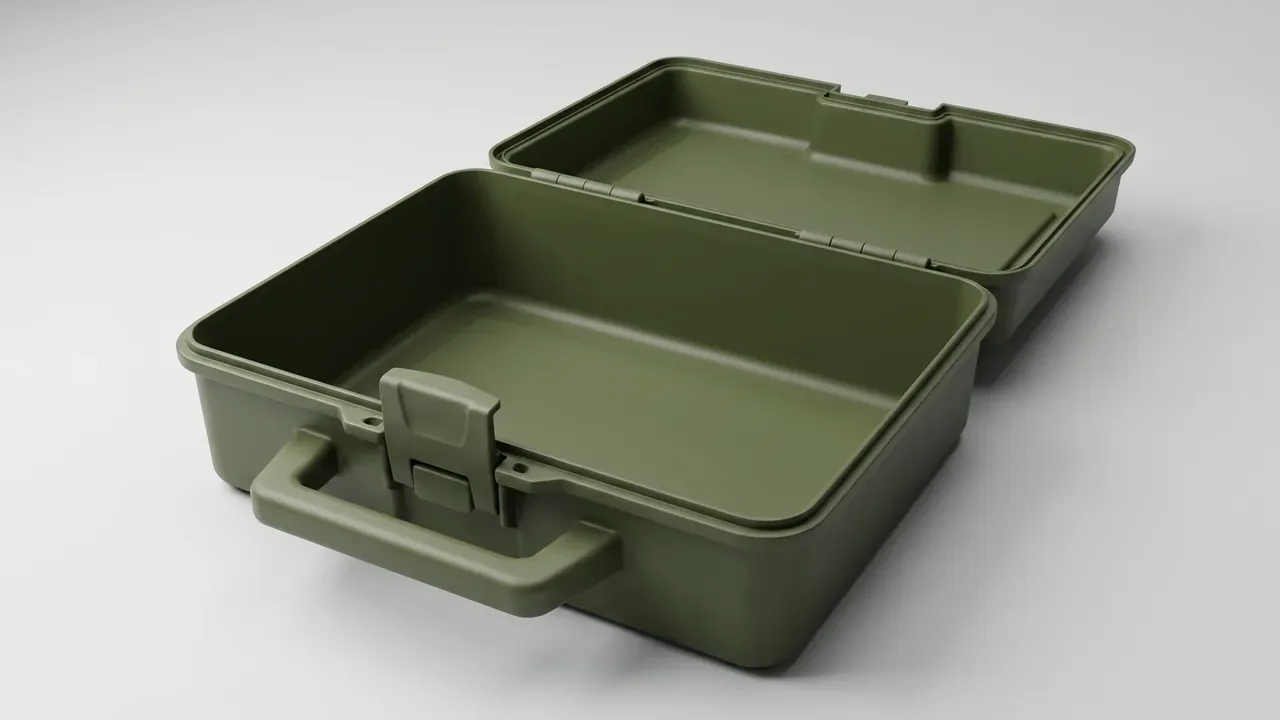
Quick answer: Twenty minutes with a scale, a tape and a feeler gauge grades an outdoor tactical plastic storage box better than any brochure, because kilos per litre, narrowest clear width, rim overlap and lid deflection under a four-high stack all answer the same question.
Table of contents
- Weigh It Before You Price It
- Measure the Interior, Not the Opening
- Rim Overlap and Gasket Groove
- Latch Span and Opening Force
- Four-High Stack and the Carry Handle
- FAQ
1. Weigh It Before You Price It
Two 50-litre boxes, one at 4.2 kg and one at 6.8 kg, often sit less than five dollars apart on a quote.
Divide weight by nominal volume and they become 0.084 and 0.136 kg per litre, a 3.0 mm wall against 3.8 mm. Below 0.07 the lid flexes under a flat palm; above 0.16 an empty box drags at the shoulder. Weigh with lid and handle fitted, since some suppliers quote shell weight alone and a 50-litre lid runs close to 400 g.
| Nominal size | Typical weight | kg per litre | Main wall | Working load |
|---|---|---|---|---|
| 25 L | 2.6–3.4 kg | 0.10–0.14 | 2.6–3.0 mm | 12 kg |
| 50 L | 4.2–6.8 kg | 0.08–0.14 | 3.0–3.8 mm | 25 kg |
| 80 L | 6.5–9.8 kg | 0.08–0.12 | 3.2–4.0 mm | 40 kg |
Heavier is not better: rotomoulded PE runs 30 percent heavier than an injection-moulded PP box of equal volume and survives drops by flexing, not by wall. Under 8 mm of rib height a stack lands on the corners, with the middle unsupported.
2. Measure the Interior, Not the Opening
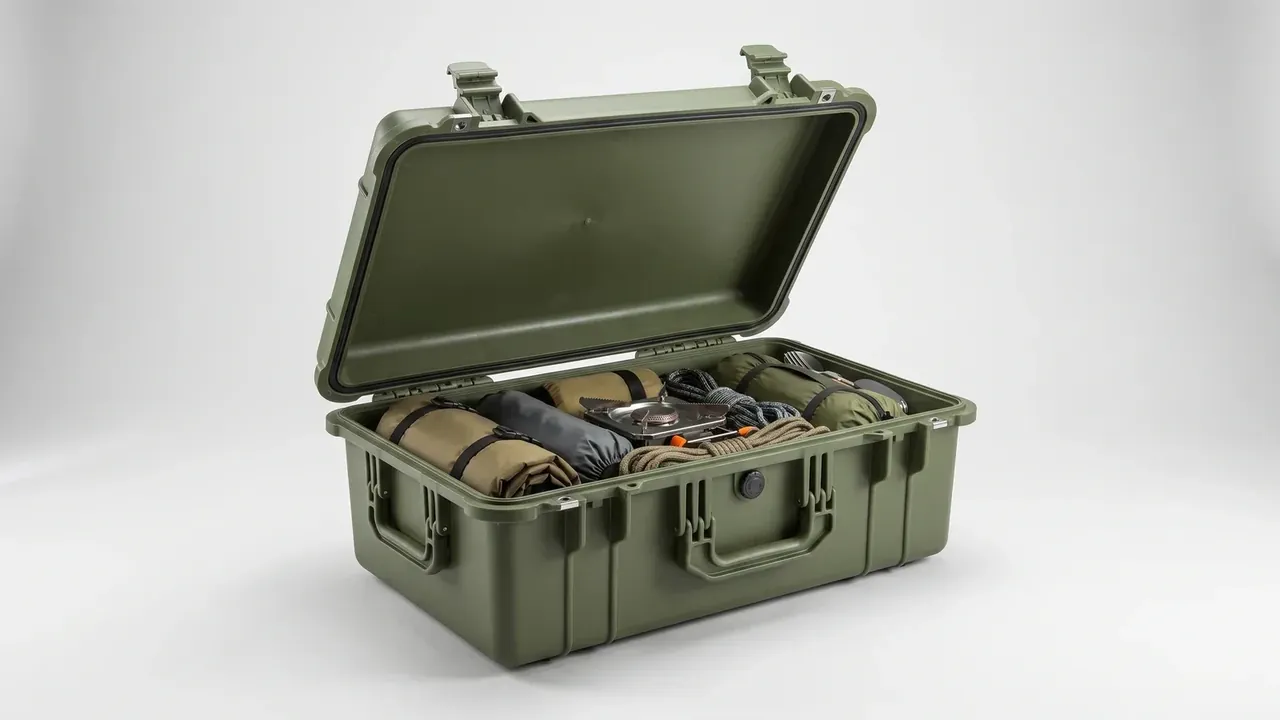
A box marked 565 x 390 x 320 mm will often measure 557 mm at its narrowest point, and that is the figure that decides whether the gear goes in. The missing 8 mm is a stiffening rib. Vertical ribs 6 to 10 mm proud of the wall buy rigidity without thickening the whole shell, so size to the clear distance between two ribs rather than across the opening.
Take four readings:
- 20 mm below the rim, for the widest clear width
- at one-third and two-thirds height, where draft tapers the walls
- 10 mm above the floor, which decides whether a flat base sits level
- corner to corner, the only figure that says whether a long item loads diagonally
Past 12 mm of spread, plan the load against the floor dimension. At 557 mm clear a 545 mm case drops in; a 552 mm one presses the sidewall and takes every shock of the trip on one line.
3. Rim Overlap and Gasket Groove
Close the lid and push a sheet of paper along the rim. At 0.1 mm thick, a sheet that slides 10 mm inward means the seal on this outdoor tactical plastic storage box is decorative.
Sealing is two dimensions. Below 12 mm of rim overlap the lid shifts sideways when the body is twisted and one side of the gasket stops touching; 14 to 16 mm is the common range, and beyond it the lid turns stiff in cold weather.
| Feature | Common practice | Field check |
|---|---|---|
| Rim overlap | 14–16 mm | 0.5 mm feeler gauge will not enter |
| Gasket groove | 7–9 mm wide | cord 1.5–2 mm larger than groove |
| O-ring compression | 22–28% | lid springs back within 30 s |
| Lid flatness | 1.5 mm over 300 mm | straight edge plus feeler gauge |
Under 20 percent compression the cord never seats; over 35 percent it takes a set and the second closure leaks. EPDM runs 25 percent set at 60 C against 15 for silicone, so a hot-vehicle box wants silicone.
IP67 means one metre for thirty minutes, not year-round exposure. For permanent outdoor use read the drainage: a lid slope of two degrees, no pocket at the latch seats, feet holding the floor 5 mm clear.
4. Latch Span and Opening Force
Push the span between two latches past 300 mm and the middle of the lid lifts under stack load and water pressure, so the seal fails there first. On a 50-litre box the lid spans about 560 mm. Two latches at 280 mm centres leave 140 mm of cantilever at each end, and past 180 mm you need a cross rib in the lid or two more latches.
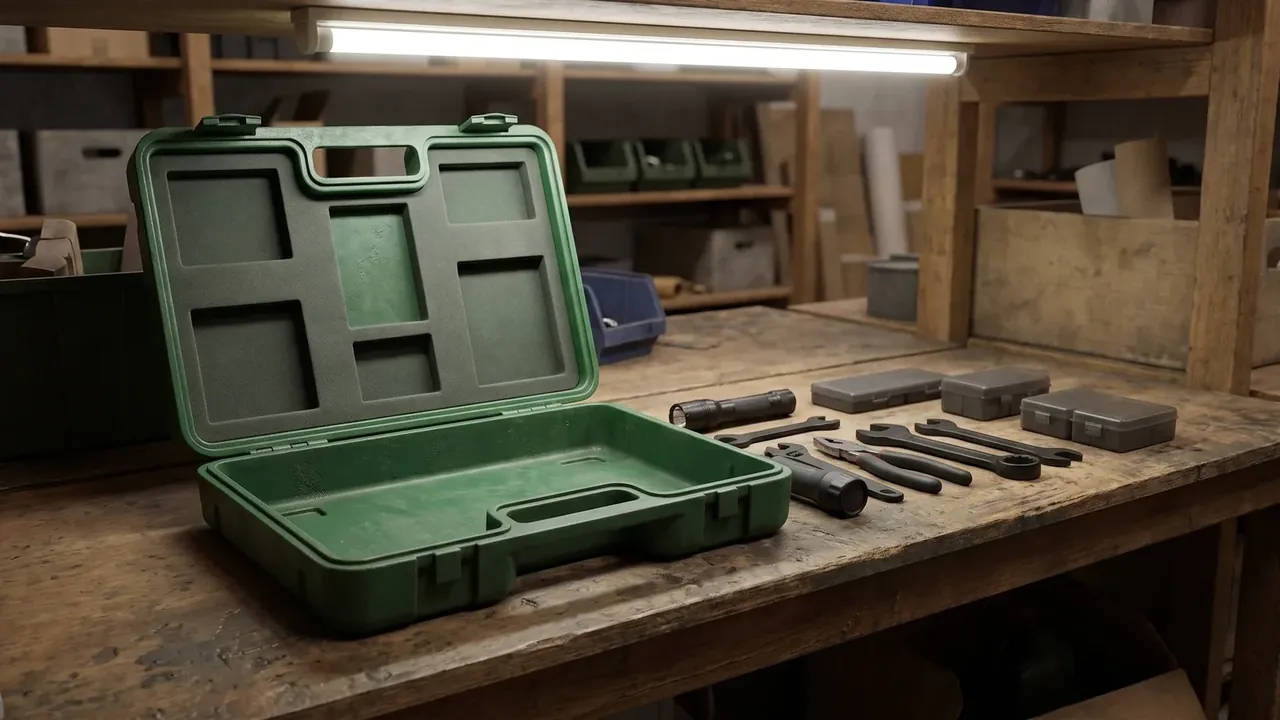
Hook a spring scale on the latch handle: 70 to 110 N is the working band. Under 60 N the latch walks open in vibration, and over 130 N a gloved hand cannot work it, so someone reaches for a screwdriver.
Holding force should exceed 300 N, the inertia of a 25 kg box under hard braking. Without a rig, load to rating, lift one end 300 mm, drop it ten times, and check that the latch still closes one-handed.
Push a closed latch sideways: 1 mm of travel means a soft keeper. Hook roots under 2 mm wear through in a season, a metal pin bridge outlasts plastic, and 50 cycles with a 15 percent loss of force points to the wrong model.
5. Four-High Stack and the Carry Handle
Four high, the bottom outdoor tactical plastic storage box carries 75 kg of the three above it.
Ten minutes will show the trend. Stack three loaded boxes and run a 300 mm straight edge along the lid with a feeler gauge: up to 2 mm at mid-span is elastic, while 4 mm or 1 mm of set two hours after unloading means the box has yielded. A lid recess 2 to 3 mm deep with a matching base boss keeps a stack true where flat-on-flat drifts by the third layer. On concrete, floor flatness must be within 3 mm or the bottom box is loaded in torsion. Read the gap with the load still on, since elastic recovery hides the peak. Photograph the straight edge and the gauge together, because a claim without a number never survives the next meeting.
| Item | Condition | Pass line |
|---|---|---|
| 4-high stack | 75 kg on base, 24 h | mid-span deflection ≤2.5 mm |
| Recovery | 2 h after unloading | set ≤1 mm |
| Handle, static | 3x load, 30 min | no whitening at the root |
| Handle, cyclic | 500 loaded lifts | rivets stay tight |
| Hinge | 5,000 cycles | play ≤0.5 mm |
The handle is rated at three times the load, but only as a static figure; carrying a 25 kg box downstairs one-handed puts a dynamic factor near 1.8 on the same part. Under 2.5 mm of wall at the root, a year is optimistic, and a full-width hinge on a 5 mm pin is what survives 5,000 cycles.
Conclusion
Four tools settle an outdoor tactical plastic storage box on site: a scale, a tape, a feeler gauge and a spring scale. Kilos per litre, clear width, rim overlap and latch force are numbers you can defend in a meeting; brochure adjectives are not.
This article discusses only the container (case body) side of specifications and design intent, and does not cover any handling, loading or use of the contents.
Related Reading
- Choosing PP compounds for plastic cases
- How IP ratings are judged on waterproof hard cases
- Configuring dividers inside a case
- Loading multi-purpose outdoor cases in the field
Related Products
- 8 Series — Gun Cases; Military Equipment Cases; Camera Equipment Cases; Drone Cases; Watch Cases; Knife Cases; First Aid Cases; Electronics Equipment Cases
- WL8-2812 PP Gun Case — model WL8-2812
- All protective cases and toolboxes: 7 series, 158 models