

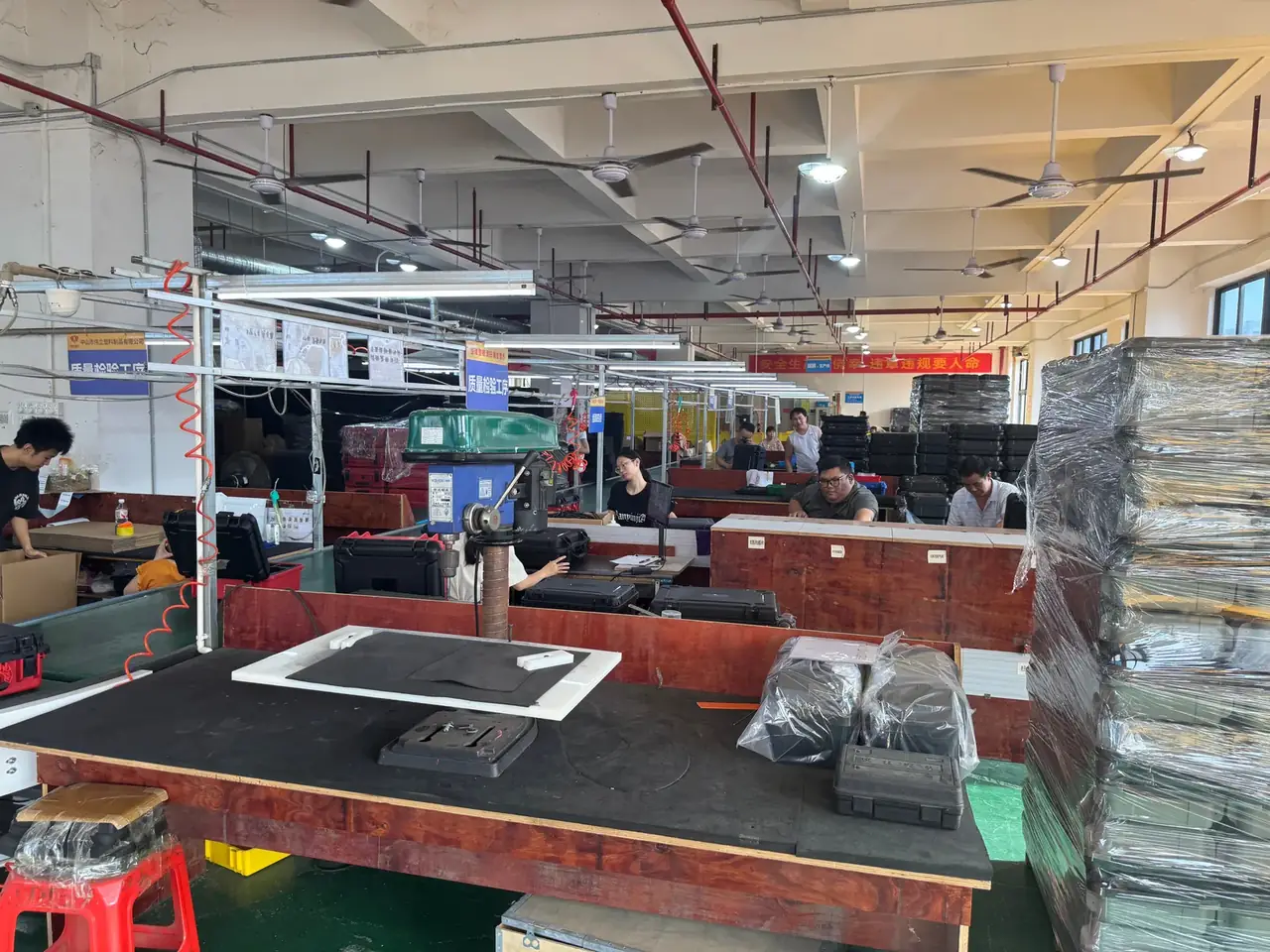
Quick answer: A parcel hub case opens 300 times a shift and 150,000 times a year on two shifts, 40 times a household toolbox, so the latch wears out first.
Table of contents
- How many cycles a year
- Spring plate and over-centre failures
- Hinge pin wear and lid gap
- Life judgement and spare parts
- FAQ
1. How many cycles a year
A 600 mm × 400 mm × 320 mm parcel hub case passes one operator 300 times in an 8-hour shift, two cycles a pass, one every 96 s. Two shifts over 250 working days give 150,000 cycles a year.
Wall thickness settles stiffness and the gasket settles moisture, but the latch is the only stressed part that moves every 96 s, at 600 cycles a day.
| Basis | Cycles | Derivation |
|---|---|---|
| One shift, 8 h | 300 | One every 96 s |
| One day, two shifts | 600 | 300 × 2 |
| One year, 250 days | 150,000 | 600 × 250 |
| Household toolbox, a year | 3,750 | 10 a day |
| Ratio | 40 | 150,000 ÷ 3,750 |
The same box at home logs 3,750 cycles a year, so it needs 10 years to reach what a hub reaches in 3 months. Ask for rated cycles before wall thickness: a 3 mm or 4 mm wall changes shell stiffness and empty weight, while a latch rated 20,000 or 80,000 cycles decides how often a line stops.
2. Spring plate and over-centre failures
A parcel hub case closes on a spring plate that flexes or an over-centre link that locks past dead centre. One cracks at the plate root, the other wears its hook pin hole, and the two are not interchangeable.
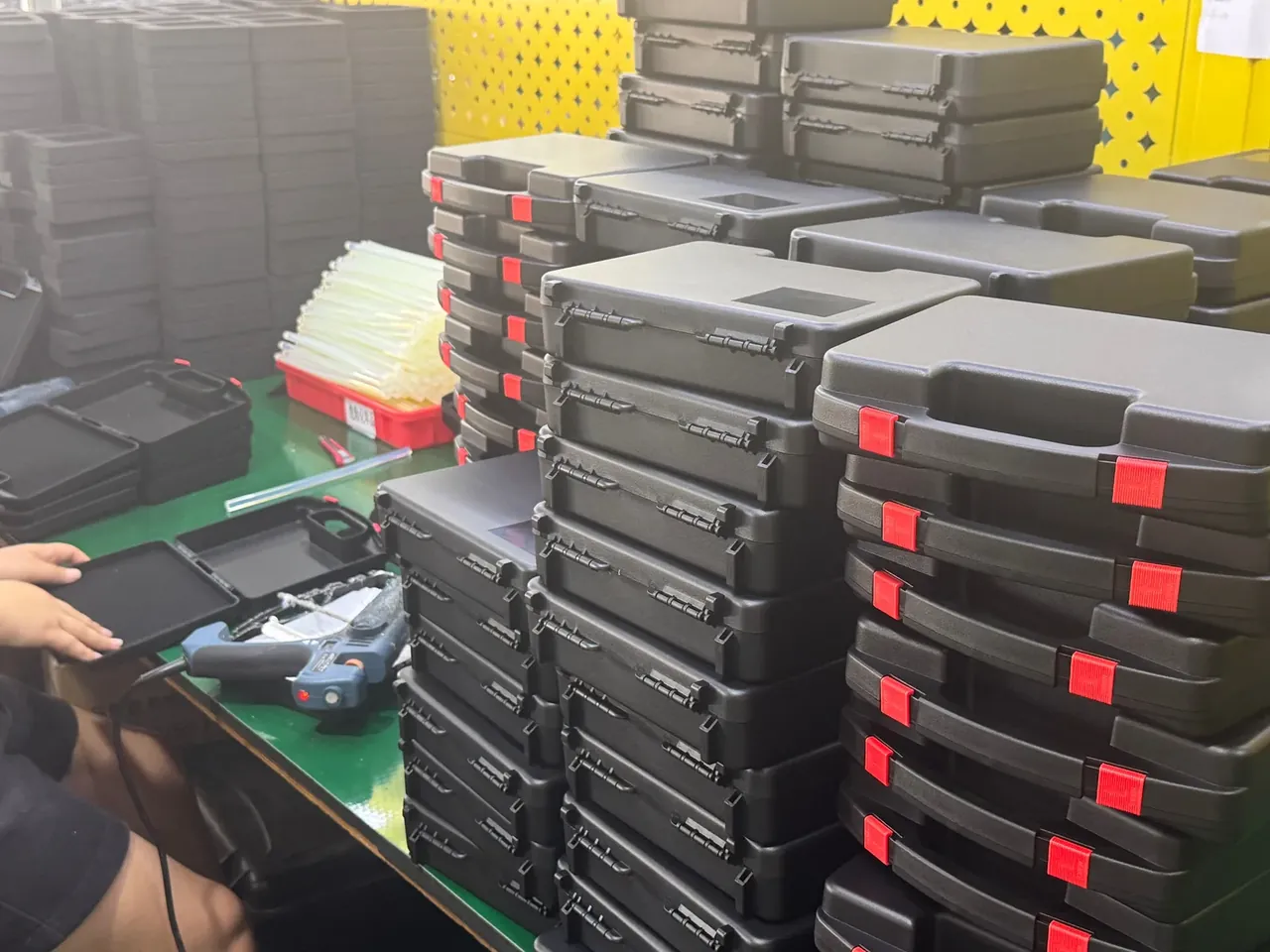
A 0.8 mm plate carries the full moment at an R1.5 root, so closing force falls from 140 N new to 118 N at 5,000 cycles and 96 N at 20,000, losing 8 N per 10,000 after a knee at 15,000.
An over-centre latch puts the load into the link and still reads 118 N at 20,000 and 102 N at 50,000, while the hole grows from 5.0 mm to 5.2 mm and the click turns dull before the gauge moves.
| Item | Spring plate | Over-centre |
|---|---|---|
| Load path | Plate root, R1.5 corner | Hook pin hole, keeper pin |
| Typical failure | Fatigue crack, will not catch | Worn hole, loose closure |
| Closing force, new | 140 N | 140 N |
| At 20,000 cycles | 96 N (−31%) | 118 N (−16%) |
| At 50,000 cycles | 74 N (−47%) | 102 N (−27%) |
| Swap time per part | 6 min | 11 min, keeper and re-align |
The 20,000 cycle row is the divide. Against a 30% limit the plate is out of spec at 20,000 and the over-centre holds to about 70,000, a factor of 3.5, which matters at 150,000 cycles a year.
3. Hinge pin wear and lid gap
A latch that still catches does not prove the lid still seats. A 5.0 mm pin in a 0.15 mm clearance locates the lid and absorbs assembly tolerance as it drops.
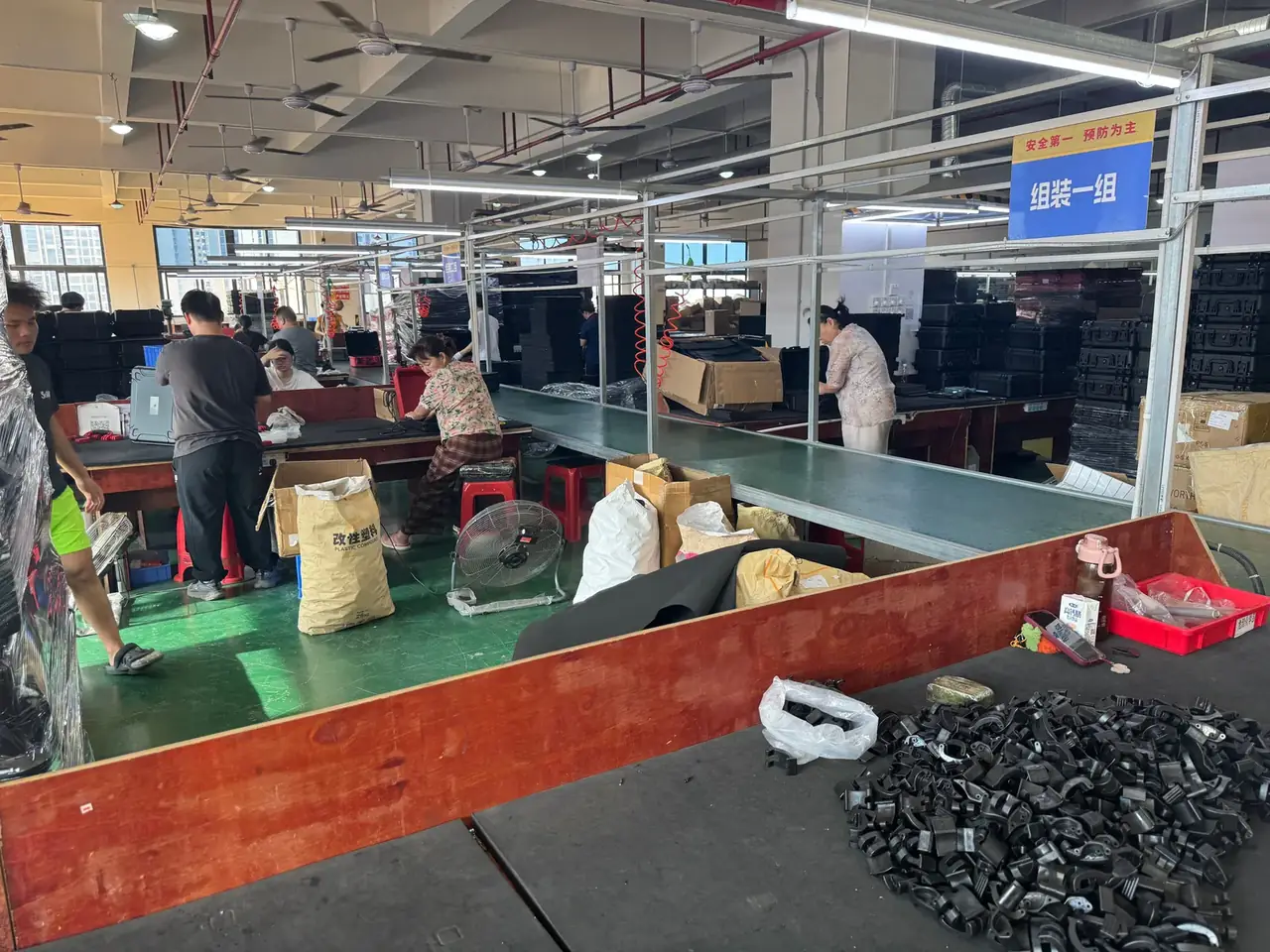
Dry rubbing turns the pin 90° every cycle, so after 150,000 cycles it is 0.3 mm thinner and clearance is 0.45 mm. The lid edge then shifts 0.6 mm at closure and gasket compression falls from 1.2 mm to 0.5 mm. The first 50,000 cycles add only 0.11 mm; later the hole turns oval and adds 0.17 mm per 50,000, which is why the second latch change pulls the pin.
Test it by hand: open to 90°, hold the body, push the lid edge sideways. Over 0.6 mm is one finding and three in a month takes the box off the line. Dry lubricant every 5,000 cycles cuts growth to 0.07 mm, and a removable pin pulls in 3 min against 20 min for a hinge.
4. Life judgement and spare parts
One criterion governs replacement: after 50,000 cycles closing force may not fall more than 30%, so it holds 98 N from a 140 N start, with the gasket still past 0.8 mm and no lid springing open on a 1.2 m/s conveyor.
At 150,000 cycles a year that is 4 months, so each parcel hub case takes 3 latch sets a year and a 100 box crew stocks 300 latches and 150 pins. Keep them at the hub: a 6 min latch swap and a 3 min pin swap cost less than the rework from a taped latch.
Write two clauses: rated cycles and spare term. A latch rated 50,000 cycles should quote three sets for year one, and a quote saying only durable cannot pass goods-in.
Conclusion
Latch life on a parcel hub case resolves into one table of cycles against design. Under 20,000 cycles a spring plate at 96 N still holds; at 50,000 it is down to 74 N and past the 30% limit while an over-centre latch holds 102 N; at 80,000 the over-centre is at 88 N and due. A hub running 150,000 cycles a year outruns every design, so the purchase is not a stronger box but a rhythm: a latch set every 4 months, a pin set every 8 months, 300 latches and 150 pins per 100 boxes. Three actions make it hold. Put the rated cycle count in the purchase clause, put 98 N on the weekly check sheet, and keep spares at the hub instead of a central store.
This article discusses container-side specifications and design implications only, and does not cover any handling, loading or use of the contents.
Related Reading
- How latch closing force is tested
- Tool roll layout and access order
- PP versus ABS tool boxes
- Tool box types by trade
Related Products
- 8 Series — Gun Cases; Military Equipment Cases; Camera Equipment Cases; Drone Cases; Watch Cases; Knife Cases; First Aid Cases; Electronics Equipment Cases
- WL8-2812 PP Gun Case — model WL8-2812
- All protective cases and toolboxes: 7 series, 158 models