

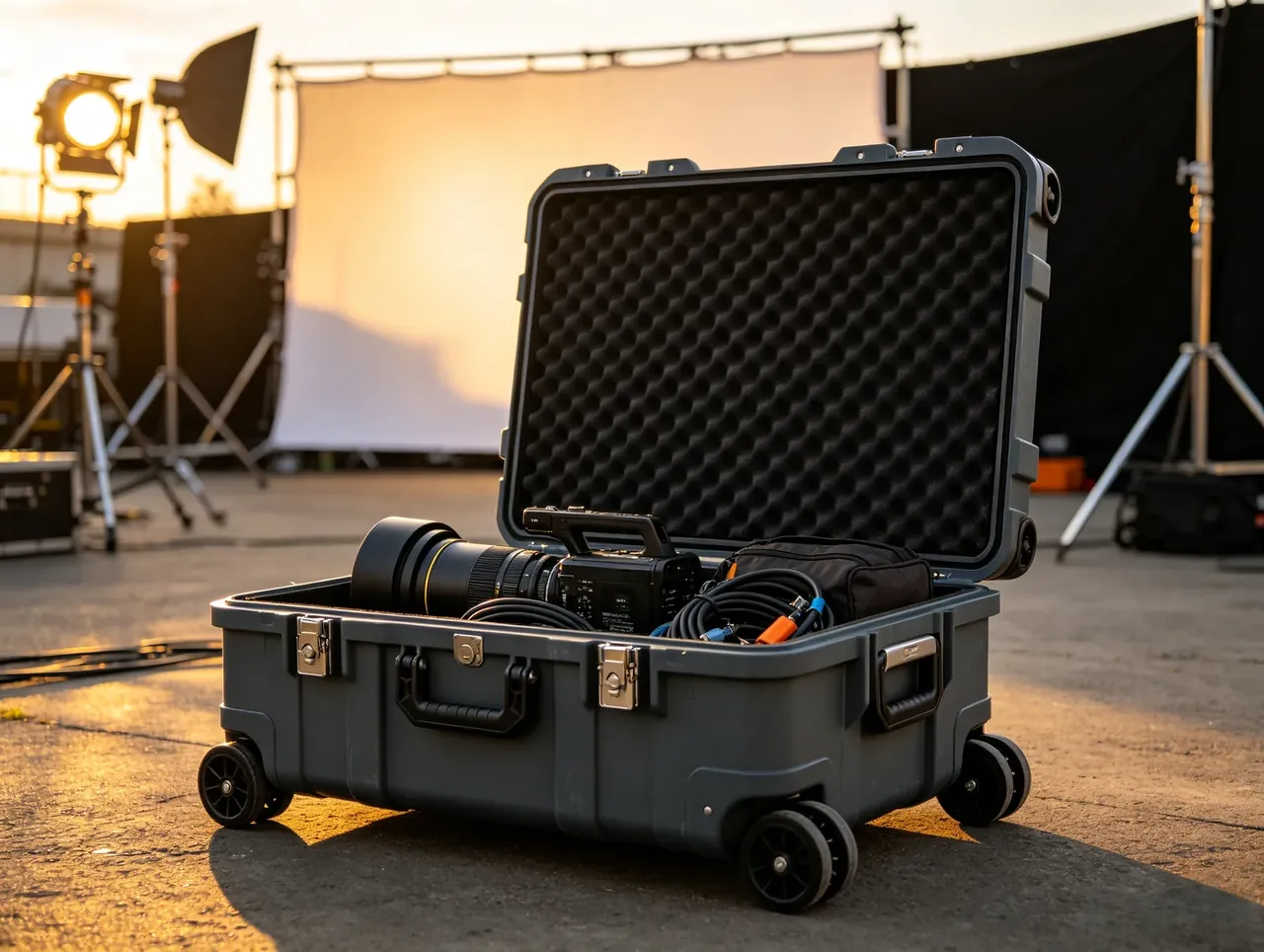
Quick answer: A photography tripod and ballhead hard protective case measures 900×280×220 mm outside, 840×220×170 mm inside and 5.4 kg empty on a 3.0 mm wall; over an 840 mm span, three lengthwise ribs hold 15 kg to 2.8 mm of sag.
Table of contents
- By folded length, three length bands
- Bending in a long case, and how the wall is ribbed
- A separate ballhead pocket against one-piece foam
- Latches, hinges and wheels at 15 kg
- Air freight, salt spray and temperature swing
- FAQ
1. By folded length, three length bands
Tripods fold between 600 mm and 660 mm, so a photography tripod and ballhead hard protective case needs 20 mm of length beyond that or the legs go in at an angle. The 900 mm band gives an 840 mm cavity and lies across a car boot with 30 mm of padding each side.
The middle band is a 560 mm cavity at 620 mm outside for a tripod folding to 520 mm, at 4.2 kg empty; anything longer wants wheels.
The long band runs 1050 mm outside at 7.1 kg, with two φ75 mm wheels taking 70% of it and a handle extended 180 mm tipping the shell back 12°.
Lying flat or standing on edge changes how the lid is loaded. Flat in a boot, 2.8 kg of lid presses the gasket; on edge in a van rack the latches shift from compression to shear and the same shell drops from 15 kg to 11 kg.
| Band | Outside | Fits folded length | Carry method |
|---|---|---|---|
| Long | 1050×280×220 mm | 660 mm and up | two wheels plus handle |
| Middle | 900×280×220 mm | around 600 mm | side handles |
| Short | 620×260×200 mm | under 520 mm | one hand |
2. Bending in a long case, and how the wall is ribbed
A long case is a deflection problem first. Take the span as the 840 mm cavity, put 15 kg at mid-span, and a flat 3.0 mm panel works out past 9 mm of sag; three lengthwise ribs at 6 mm tall and 70 mm pitch bring it to 2.8 mm.
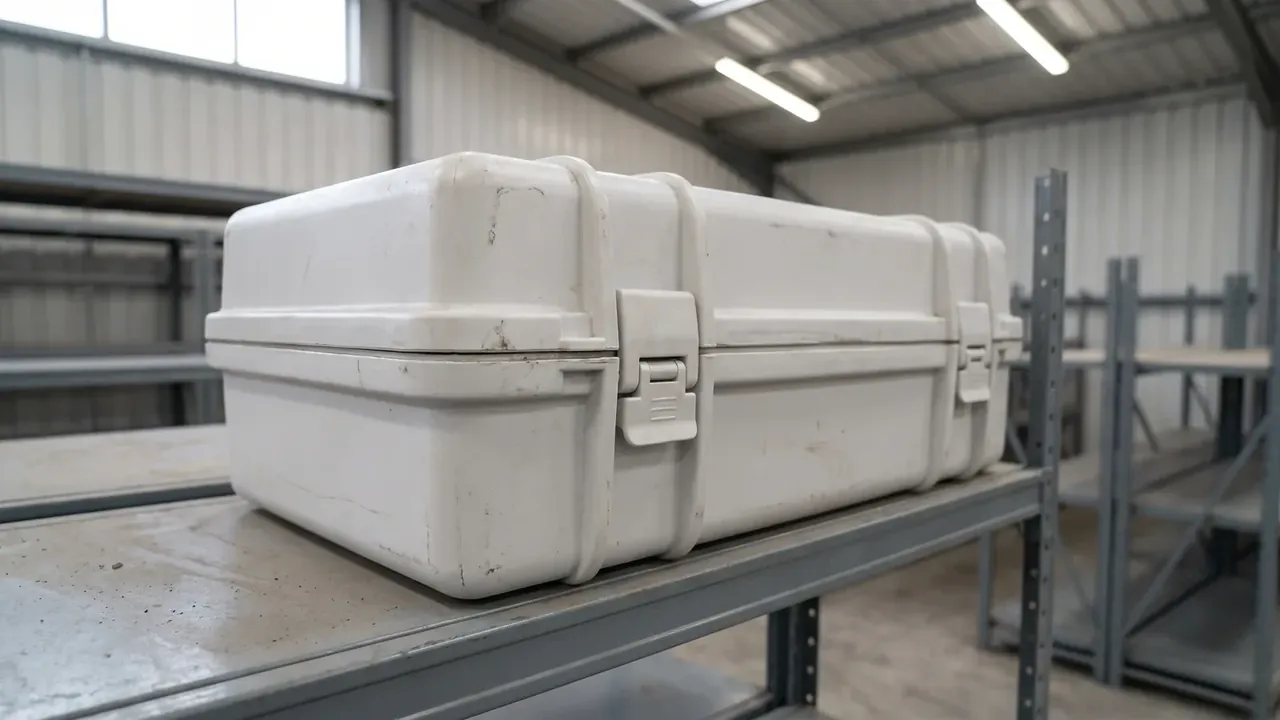
A 3.0 mm wall is the floor here. The shell measures about 0.86 m², and at 2.6 mm the side bows 1.6 mm under 15 kg, opening the joint until the gasket sits below 20%.
The joint tongue decides whether the lid seals: 6 mm wide and 3 mm deep it locates the lid before the gasket compresses, while at 4 mm the shell shifts 0.6 mm and shears a bevel into the rubber.
End walls carry concentrated load, so two corner brackets and one 5 mm upright cut deformation in a 1.2 m end drop from 3.2 mm to 1.4 mm; short cases can skip that rib, long ones cannot.
3. A separate ballhead pocket against one-piece foam
Ballheads run 40 mm to 60 mm across the sphere at 380 g to 620 g and are the part most easily knocked. A photography tripod and ballhead hard protective case gives the ballhead a 90×90 mm pocket, 70 mm deep, with 15 mm of foam each side so the sphere never meets a leg tube.
Density matters inside it: the usual EVA grades are 45 and 65 kg/m³, bottoming out at 30% and 45% compression. Pocket walls take 65 kg/m³, with 10 mm of 45 kg/m³ underneath for shock.
One foam block is simpler but looser: in 25 mm EVA a ballhead shifts 8 mm and returns at a new angle.
Divided foam costs cavity length: a 90 mm pocket leaves 740 mm, so a tripod folding to 760 mm no longer fits and the choice is a 950 mm shell or a shallow lid recess.
| Lining | Ballhead play | Length taken |
|---|---|---|
| one-piece 25 mm EVA | 8 mm | none |
| 90×90 mm pocket | 2 mm | 90 mm |
| 60 mm lid recess | 4 mm | none |
4. Latches, hinges and wheels at 15 kg
Two latches, 400 N each. Loaded to 15 kg, a photography tripod and ballhead hard protective case carries a 2.8 mm lid, and a 1.2 m drop converts to about 560 N of pull, leaving 1.4× on an 800 N pair.
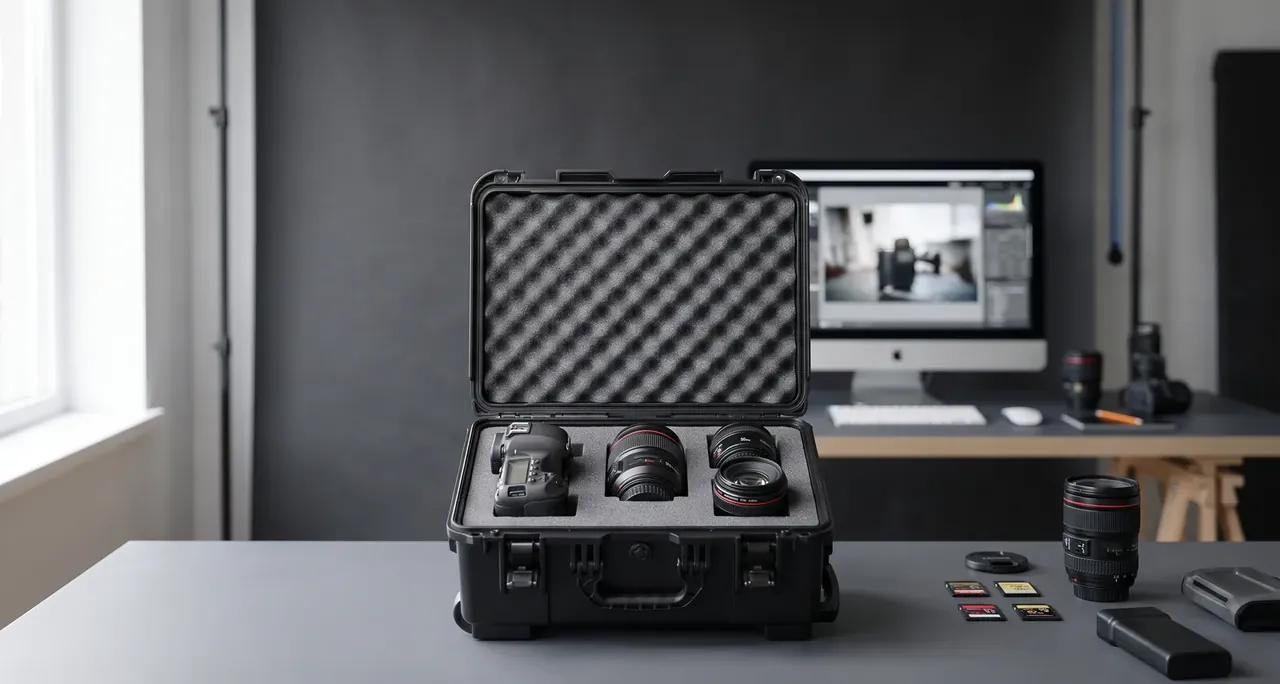
Hinges sit along the long edge 300 mm apart. At 400 mm spacing the middle of an 840 mm lid sags 0.8 mm after 6000 cycles; φ5 mm stainless pins in bronze bushes hold wear to 0.12 mm.
A 26 mm wide, 140 mm long side handle puts the palm 30 mm above the centre of gravity and keeps tilt under 8° in a one-hand carry; 60 mm higher and the same load tilts 15°.
Wheels are sized at 15 kg: two φ75 mm wheels lift the shell 4 mm over a 3 mm threshold, while at φ50 mm the lift is 7 mm, the tip angle goes from 12° to 18° and the moment at the handle root rises 40%.
5. Air freight, salt spray and temperature swing
Checked baggage is the hardest leg. A hold reaches −20 ℃, and 40 min on a 35 ℃ belt makes about 9 kPa across a 31 L cavity, so the valve has to open below 12 kPa or the latches carry it.
Pressure also depends on where the case was closed: sealed at 30 ℃ and flown into a −20 ℃ hold, a photography tripod and ballhead hard protective case draws 9 kPa; sealed at 5 ℃ the same leg makes 5 kPa.
Salt spray is rated at 48 h. Latches, pins and bracket screws are the exposed metal: 304 stainless spots at 48 h and plated parts go white, so coastal work moves to 316.
| Condition | Value | Case response |
|---|---|---|
| Air freight swing | −20 ℃ to 35 ℃, 9 kPa | valve opens under 12 kPa |
| Neutral salt spray | 48 h | 304 stainless, 316 optional |
| Hot storage | 60 ℃, 200 cycles | foam left at 15% compression |
Conclusion
The length of a photography tripod and ballhead hard protective case is not copied from the tripod: an 840 mm span with three 6 mm ribs, a 90 mm pocket traded for 2 mm of play, and φ75 mm wheels holding threshold shock to 4 mm.
This article covers the container side only, meaning shell specifications and their design consequences, and does not address handling, loading or use of anything carried inside.
Related Reading
- Layering and bonding case foam
- Dividers or foam, choosing one
- Case depth and centre of gravity
- Asset labels and tracking on cases
Related Products
- 8 Series — Gun Cases; Military Equipment Cases; Camera Equipment Cases; Drone Cases; Watch Cases; Knife Cases; First Aid Cases; Electronics Equipment Cases
- WL8-2812 PP Gun Case — model WL8-2812
- All protective cases and toolboxes: 7 series, 158 models