

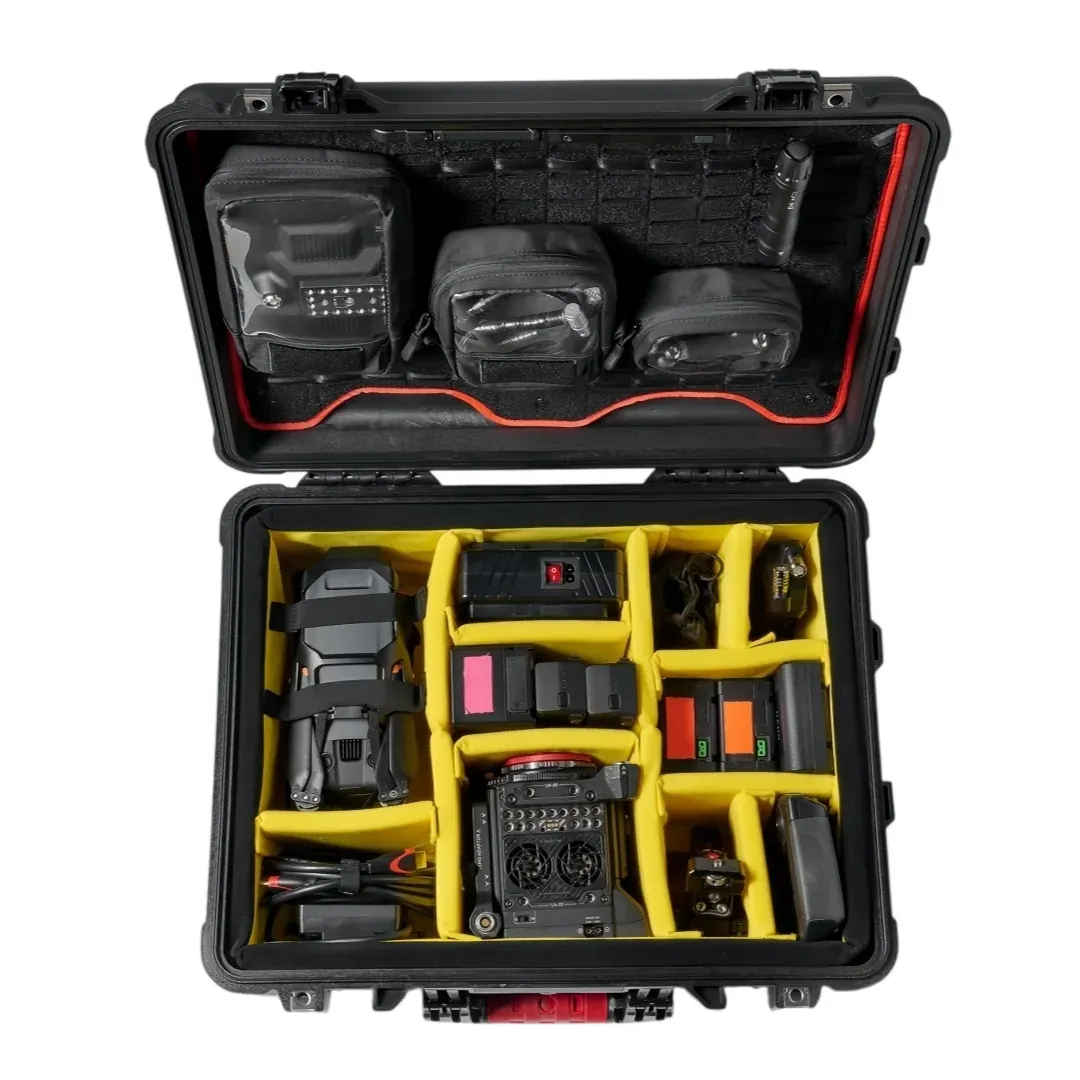
Quick answer: Pipeline inspection robot equipment case keeps base sag under 1.4 mm over a 1.5 m span after 2 h cantilever, with support posts rebounding above 94%.
Table of contents
- Rib Junction Fillets on a Long Equipment Case
- Net Height of the Foam Support Posts
- Base Deflection Under One-Sided Cantilever
- Rebound Measured After Unloading
- Fillet Values Released for Inspection Batches
- FAQ
1. Rib Junction Fillets on a Long Equipment Case
Lift a long case by one end and the bending moment lands on its rib crossings first; whichever yields, the fillet or the post height, decides where the readings go. Pipeline inspection robot equipment case measures 1080×360×200 mm outside, 1000×295×140 mm inside, wall 4.2 mm, a slender ratio that turns the base into a narrow beam.
Three longitudinal ribs cross five transverse ones at fifteen junctions, each milled with the same R8 mm radius cutter. A smaller fillet narrows the section and bends early under cantilever, a larger one heaps material and lifts the 7.0 kg empty weight; JUNZHIJIA numbers all fifteen and remeasures them after trial.
| Fillet grade | Junction root treatment | Base deflection after 2 h |
|---|---|---|
| R6 mm | Sharp transition, no arc | 1.63 mm |
| R8 mm | Single pass with radius cutter | 1.28 mm |
| R10 mm | Extra material, higher dead weight | 1.35 mm |
Of the three grades R8 mm sinks least, the sharp R6 mm reads 1.63 mm and is out at once, and R10 mm holds shape but makes the shell heavier. Pipeline inspection robot equipment case fixes the junction at R8 mm and writes rib spacing and height on the drawing; change one crossing and the sheet is hung again.
2. Net Height of the Foam Support Posts
The 32 mm post net height runs from the foam locator top to the lid clamping face, not the foam thickness. Pipeline inspection robot equipment case uses four posts to split the long cavity into three bays, tops carrying the lid and feet on the ribs, so lid force travels down the ribs into the base.
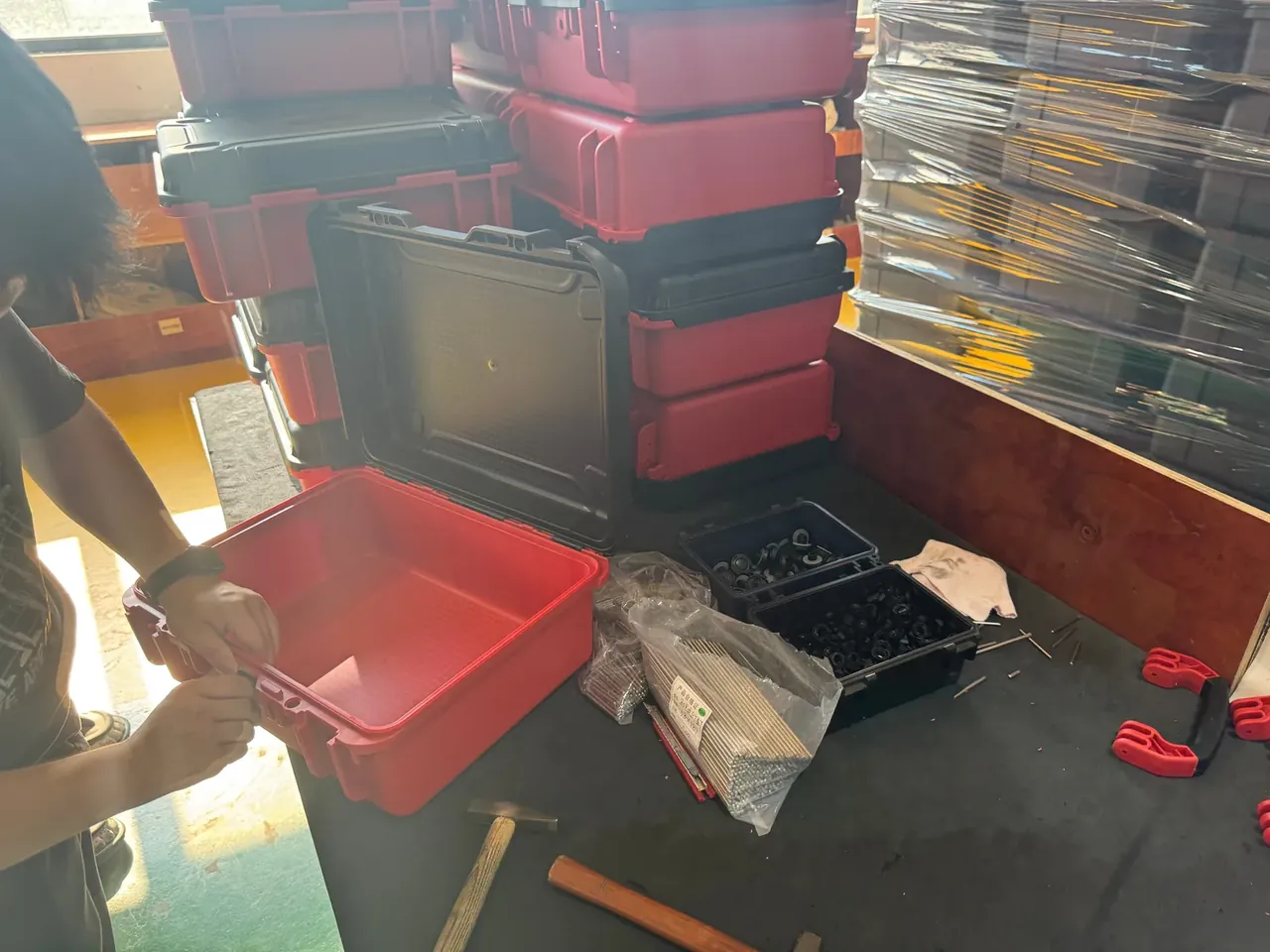
Posts are moulded foam for a 15 kg load, each capped with a 2 mm wear pad against 3700 open-close cycles. Clamping from 4 latches at 400 N each spreads around the mouth, the 2 seals at 19% compression close on the same ring of tops, and the IP66 spray check watches only that mating line.
3. Base Deflection Under One-Sided Cantilever
A 1.5 m span held 2 h is how this long shell is watched under static load. Pipeline inspection robot equipment case sets the supports 1.5 m apart, lifts one end, loads 15 kg and reads centre sag with a dial indicator; the first hour moves fast, the second flattens, and the ≤1.4 mm line falls at two hours.
| Cantilever period | Load state | Centre base sag |
|---|---|---|
| 0.5 h | Loaded 15 kg | 0.86 mm |
| 1 h | Loaded 15 kg | 1.19 mm |
| 2 h | Loaded 15 kg | 1.32 mm |
The 1.19 mm of the first hour is no release figure, since foam and ribs keep yielding; only when the two-hour 1.32 mm presses past 1.4 mm is the R6 mm group at 1.63 mm ruled out. Empty at 7.0 kg and loaded at 15 kg are each hung once, and Pipeline inspection robot equipment case files the two hang readings.
4. Rebound Measured After Unloading
A rebound ≥94% is how much of the base returns once the 15 kg is removed and the shell rests 30 min, not the instant spring-back. The repeat check stays on the same rig after the 2 h cantilever: log the 1.32 mm before unloading, the residual after resting, then divide the difference by 1.32 mm.
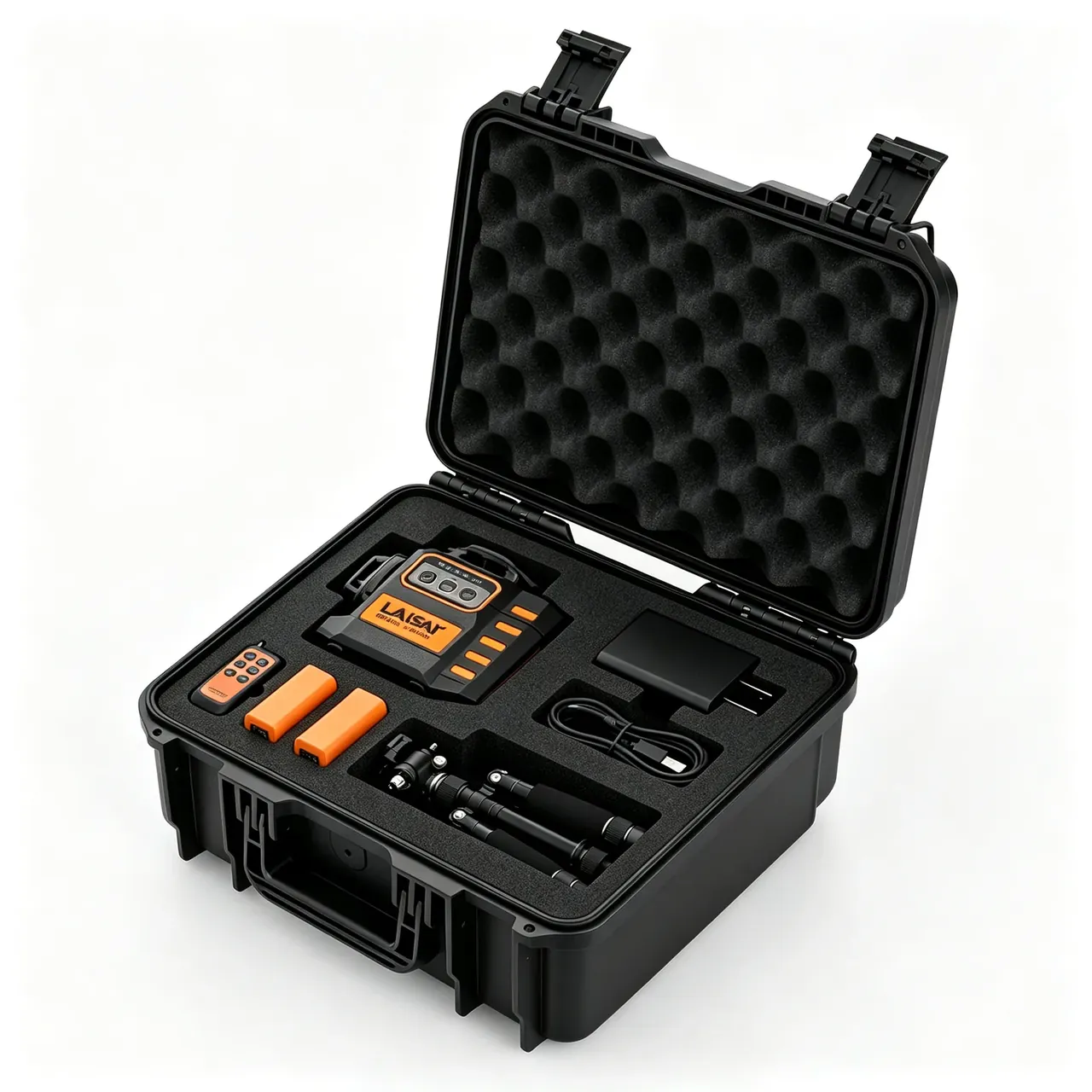
After 3700 open-close cycles the rebound set answers whether wear pads collapsed or the 32 mm net height thinned. Pipeline inspection robot equipment case stores the pre-cantilever and post-cycling rebounds in two columns, and if the later sits over 2 points lower it checks the four posts' go/no-go records before the foam grade.
5. Fillet Values Released for Inspection Batches
The released fillet value is the smallest grade whose second-hour deflection holds 1.4 mm; sharper junctions go wholesale to a short-shell specification. Printed in every rib drawing's title block beside R8 mm, 32 mm net height and 4.2 mm wall, this is the sole release basis Pipeline inspection robot equipment case checks before a run.
| Deflection reading | Fillet and net height pairing | Where the batch goes |
|---|---|---|
| ≤1.20 mm | R8 mm with 32 mm | Whole batch cleared |
| 1.21–1.40 mm | R8 mm with 31 mm | Each shell measured before a call |
| >1.40 mm | R6 mm or sharper | Moved to short-shell drawings |
Fillet, net height and wall are calibrated on one rib drawing, so changing one forces the other two readings to be recomputed. Kexin New Materials (Guangdong) Co., Ltd. accepts only rig measurements here, benchmarks IP66 by method, lists no certificate numbers, and keeps 15 kg or 3700-cycle figures on the structural side; Pipeline inspection robot equipment case hands over the drawing with three deflection grades.
Conclusion
Set the R8 mm junction fillet, 32 mm post net height and 4.2 mm wall together, and a long base hung 2 h over a 1.5 m span stays inside 1.4 mm of sag with rebound above 94% once unloaded. If readings from 7.0 kg empty to 15 kg loaded across 3700 cycles run level, stiffness is matched; Pipeline inspection robot equipment case is checked against the static rig and the rib drawing alone.
Related Reading
- Oil-well pressure and pipeline detection instrument cases
- Pipeline detection and pigging equipment cases
- Detection instrument cases for field use
- Industrial detection protective cases for instruments
- Cobot Teach Pendant Case
Related Products
- 8 Series — Gun Cases; Military Equipment Cases; Camera Equipment Cases; Drone Cases; Watch Cases; Knife Cases; First Aid Cases; Electronics Equipment Cases
- WL8-2812 PP Gun Case — model WL8-2812
- All protective cases and toolboxes: 7 series, 158 models