

Quick answer: Work backwards: cavity from the item plus foam, exterior from cavity plus wall, then check the wall against load and stacking, and finish with a weight budget set by the carry method.
Table of contents
- Setting the Interior Cavity and Its Tolerances
- Wall Thickness and Ribs as Load Paths
- Working Out Static Load and Stacking
- Sealing and the Temperature Window
- Weight Budget and What It Costs
- FAQ
1. Setting the Interior Cavity and Its Tolerances
A pistol case specification starts at the cavity, not the outer profile. Net cavity length is the largest item dimension plus foam both sides plus a handling gap. A 200 mm item with 20 mm EVA each side and a 2 mm gap gives 244 mm, drawn as 245 mm; depth takes 15 mm more for lid foam.
| Dimension | Value here |
|---|---|
| Cavity length | 245 mm |
| Cavity width | 165 mm |
| Cavity depth | 75 mm |
| Outer length | 285 mm |
Tolerance sits on the cavity: ±0.4 mm long, ±0.3 mm wide, ±0.5 mm deep, while the outer profile may drift ±1.0 mm. Outer size never scales with the cavity: a wall plus ribs eats 20 mm and returns 12 mm.
2. Wall Thickness and Ribs as Load Paths
Wall thickness on a pistol case is three numbers: main wall 2.8–3.2 mm, lid 2.5–2.8 mm, base 3.5–4.0 mm. The base is heaviest because a case lying flat puts its whole load there; upright, that load moves into the side walls and corners.
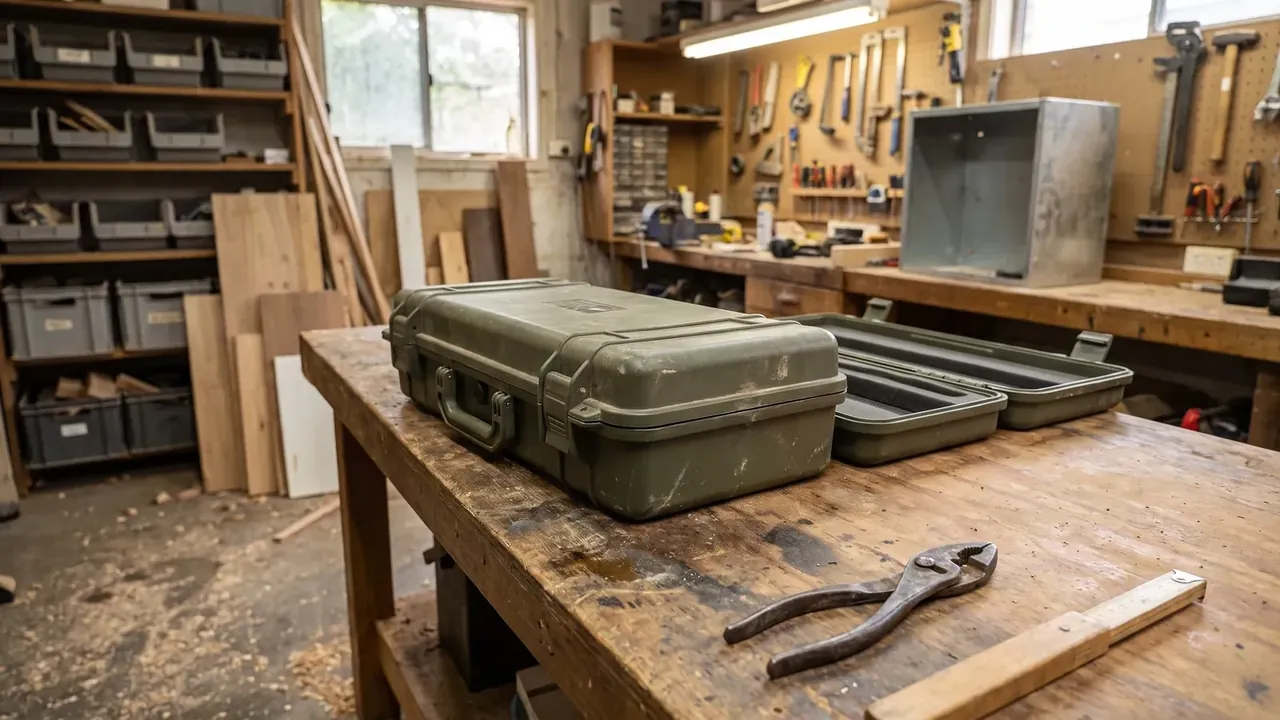
Ribs decide what the wall delivers. On a 3.0 mm main wall, one 8 mm ring rib raises bending section modulus by about 40 percent, and anything taller adds sink marks instead of strength. Corner radius matters more than thickness in a 1.2 m six-face drop: under 6 mm whitens first, so 8–10 mm plus 0.3 mm of local thickening is the cheapest fix.
3. Working Out Static Load and Stacking
Static load is figured over the base projection: a 245 x 165 mm cavity floor rated at 25 kg sees about 6.2 kPa. The limit is stacking, checked at the bottom unit. A 2.8 kg case carrying 5 kg, four high, takes three cases above it, roughly 23 kg; at a 1.5 safety factor the body must hold 35 kg with residual deflection under 1 mm after 24 hours.
| Stack height | Load on bottom case | Main wall | Setting |
|---|---|---|---|
| 2 high | about 11 kg | 2.8 mm | indoor storage |
| 4 high | about 23 kg | 3.0 mm | general warehouse |
| 6 high | about 34 kg | 3.5 mm | pallet transport |
One hidden constraint: the lid face must be a bearing surface. Keep it flat with ribs inside the rim, and stack load travels down the side walls.
4. Sealing and the Temperature Window
Sealing needs three lines: gasket material, compression and ingress rating. A 6 mm foamed silicone cord at 25–30 percent compression matches a 1.5–1.8 mm gap at the rim; less leaks, more makes latches hard to close and deforms the cord.
Give the temperature window in two ranges. A PP body stores from -20 C to 60 C, with transport excursions to 70 C capped at 48 cumulative hours. Below -20 C the material turns brittle and cracks on impact.
5. Weight Budget and What It Costs
Weight budget follows the carry method: one hand to about 12 kg, shoulder strap to 18 kg, two-person lift to 40 kg. The shell is 71 percent of a 2.8 kg case, so savings come from the body.
| Component | Weight | Share |
|---|---|---|
| Shell | 2.0 kg | 71% |
| Foam insert | 0.4 kg | 14% |
| Hardware and gasket | 0.3 kg | 11% |
| Marking and fittings | 0.1 kg | 4% |
Dropping the main wall from 3.2 mm to 3.0 mm removes about 0.2 kg, and thin ribs save another 0.1 kg. Each 0.2 mm costs one layer of stacking, so sacrifice cavity and sealing first, load capacity second, weight last.
Conclusion
A pistol case specification is a subtraction: the cavity claims space, the wall claims strength, the weight budget decides the margin left. A pistol case specification is credible only when its tolerances, stack layers and temperature ranges are fixed in writing.
This article discusses only the container (case body) side of specifications and design intent, and does not cover any handling, loading or use of the contents.
Related Reading
- What a pistol case is: structure and protection logic
- Pistol case selection: working back from item dimensions
- Pistol case acceptance: inspection items and verdicts
- How to specify a custom foam insert
Related Products
- 8 Series — Gun Cases; Military Equipment Cases; Camera Equipment Cases; Drone Cases; Watch Cases; Knife Cases; First Aid Cases; Electronics Equipment Cases
- WL8-2812 PP Gun Case — model WL8-2812
- All protective cases and toolboxes: 7 series, 158 models