

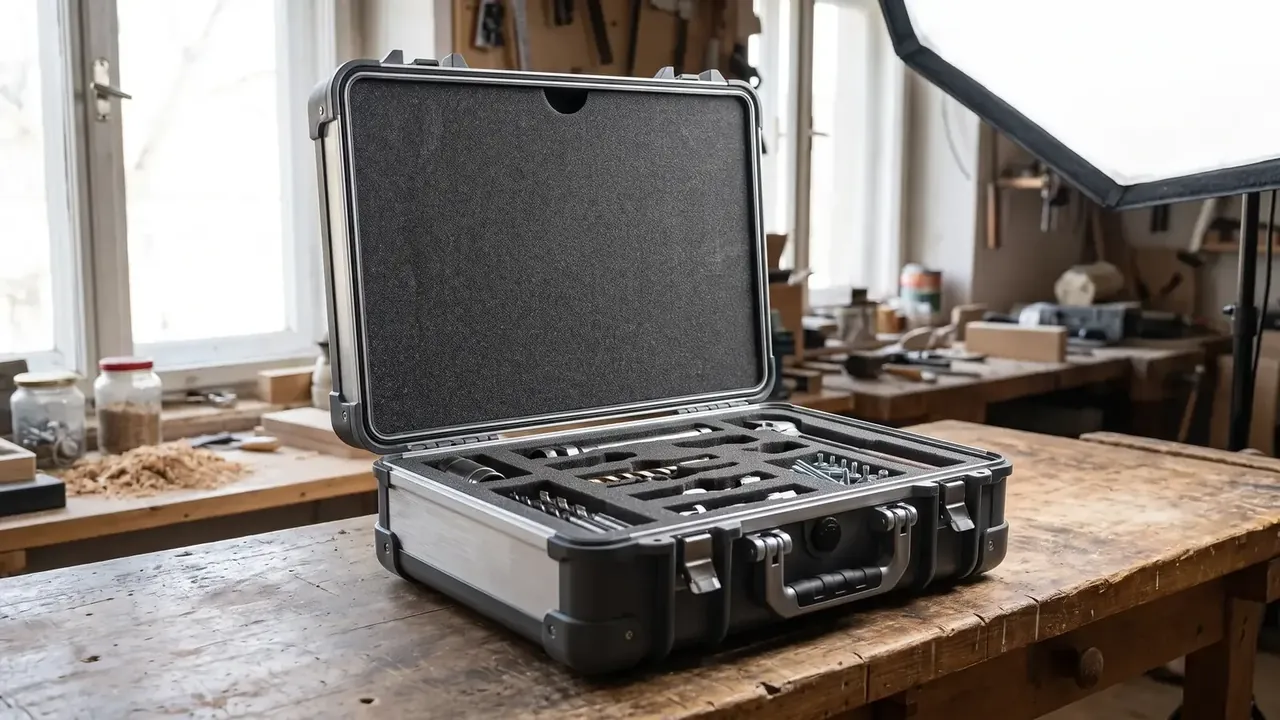
Quick answer: Five things decide a pistol storage case: moulding route, wall-to-rib ratio, groove and cord size, latch and hinge hardware, and pocket depth. Skimp on one and the other four cannot cover for it.
Table of contents
- How a Pistol Storage Case Body Is Moulded
- Wall Thickness and Rib Layout
- Gasket Groove and Seal Compression
- Latches and Hinges That Hold the Lid
- Foam Inserts and How They Hold Gear
- FAQ
1. How a Pistol Storage Case Body Is Moulded
Rotomoulding and injection give two characters to the same shell. Rotomoulding turns a powder-filled tool on two axes until polyethylene fuses seamlessly; injection forms lid, base, ribs and channel in one shot.
The window is narrow: powder near 300 C, an oven at 340 C, then cooling, with a 500 mm pistol storage case running about 30 minutes per unit and a 6 to 8 mm wall. Injection holds 2.5 to 3.5 mm on a 1,000 tonne clamp unit in 90 seconds, channel moulded, not machined.
| Item | Rotomoulded PE | Injection PP |
|---|---|---|
| Wall | 6 to 8 mm | 2.5 to 3.5 mm |
| Cycle | about 30 minutes | about 90 seconds |
| Tolerance | loose, rim needs work | tight, channel as moulded |
2. Wall Thickness and Rib Layout
Crush resistance comes from the wall-to-rib ratio, not from adding wall. On a 2.5 mm lid the ribs sit near 1.2 mm, so root and wall cool at one rate; a rib as thick as the wall pulls a sink mark, and a sink mark on the seal channel is a leak path.
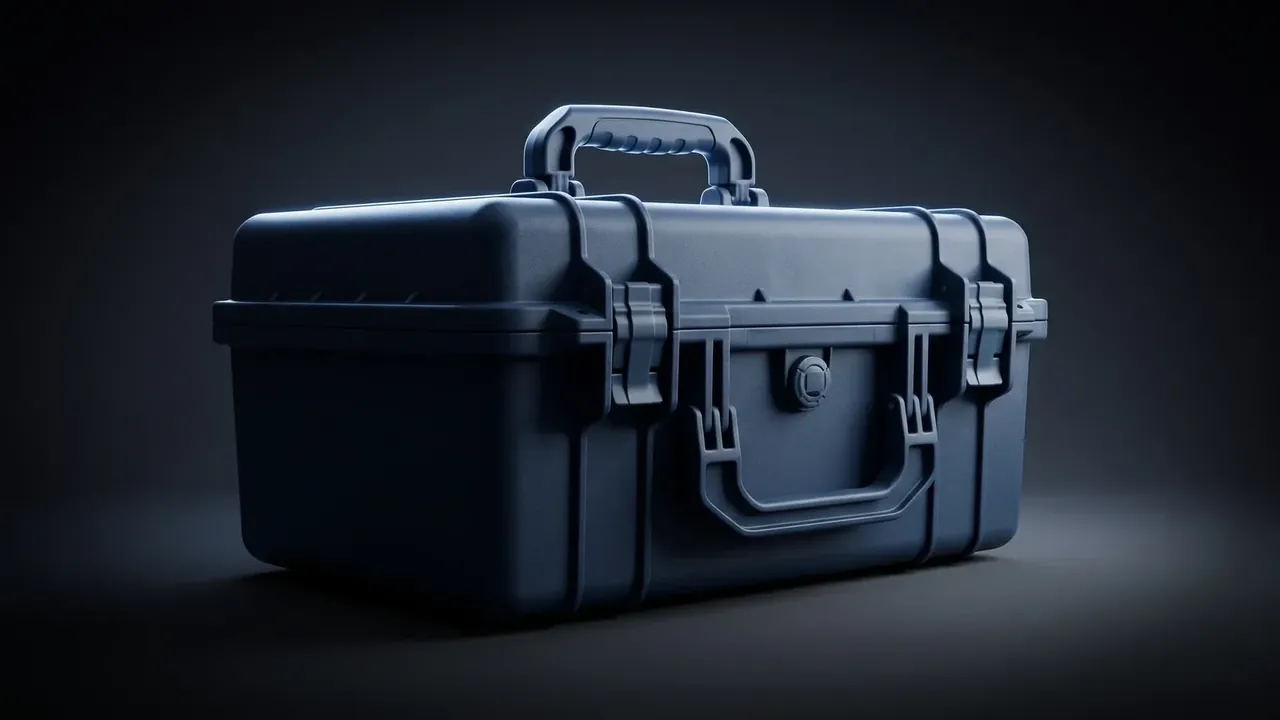
Ribs 12 mm tall at 90 mm centres break the lid into panels and cut the drum effect; a wider pitch lets the centre dip. Load to real stacking height for 24 hours and the set should stay under 1.5 mm; rotomoulded bodies are judged on wall variation.
| Feature | Reference | Failure if missed |
|---|---|---|
| Wall | 2.5 to 3.5 mm | flexing, then cracking |
| Rib | half the wall | sink mark over the channel |
| Rib pitch | 12 mm tall, 90 mm apart | lid centre dips |
3. Gasket Groove and Seal Compression
Sealing is decided by the groove, not the gasket. A 6.2 mm groove with 5.5 mm solid cord gives 25 to 30 percent compression; less and moisture tracks along the rim, more and the cord loses rebound in two or three years.
EPDM at 55 Shore A covers minus 40 to plus 90 C; the cord runs unbroken, joint on the hinge side. Thirty minutes at 1 m immersion covers rain and warehouse humidity, and a valve opening near 0.35 bar handles temperature extremes.
4. Latches and Hinges That Hold the Lid
A draw latch is over-centre: it resists until it passes the pivot line, then snaps shut, and that snap compresses the gasket. One latch holds about 350 N, so two points give 700 N, or 25 N per 100 mm of seal perimeter.
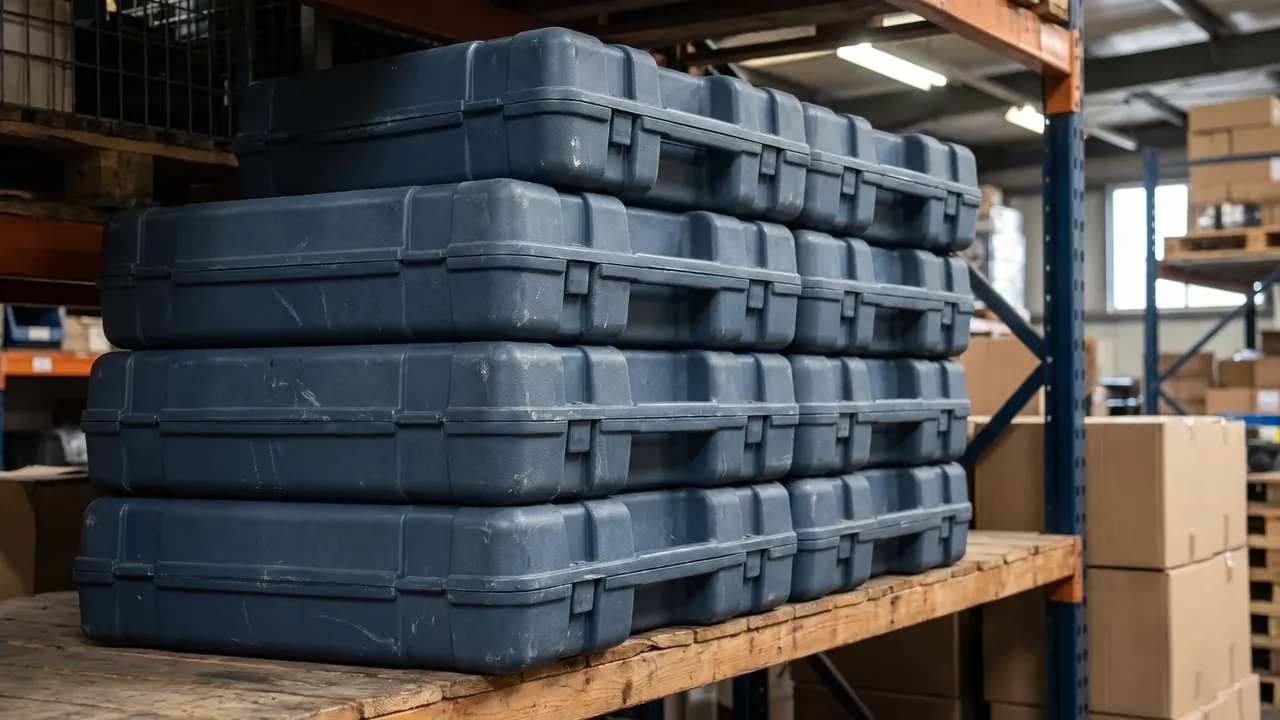
Hinges keep the lid true: a 4 mm stainless pin in a polyacetal bush holds play under 0.3 mm after 5,000 cycles, and once play grows one side of the gasket is crushed while the other barely touches. Cold drop at minus 20 C from 1.2 m onto six faces tests both.
5. Foam Inserts and How They Hold Gear
Foam absorbs shock that reaches through the shell and holds gear in place, so pocket size matters more than grade. A pocket 0.5 mm wider than the outline and 3 mm shallower lets the lid foam press 3 to 5 mm without making the item hard to lift out.
| Grade | Density | Best for | Watch out |
|---|---|---|---|
| EVA | 30 kg per cubic metre | frequent handling | compresses under load |
| PE | 45 kg per cubic metre | humid storage | hard, needs a facing |
| PU | 60 kg per cubic metre | precision items | hydrolyses in humidity |
One insert can mix grades, high density under load and medium for location, cut to plus or minus 0.5 mm; a 5 mm PVC divider holds long accessories.
Conclusion
The process level of a pistol storage case hides in five places: moulding route, wall-to-rib ratio, groove and cord pairing, hardware, and pocket depth. They pull against each other, so a saving in one costs something in the other four. Ask for the numbers behind each of them, because that is where a pistol storage case is decided.
This article discusses only the container (case body) side of specifications and design intent, and does not cover any handling, loading or use of the contents.
Related Reading
- What a pistol case is made of
- Choosing a pistol storage case: lock grade and size
- Pistol storage case or safe: the trade-off
- Pistol case setups for service and civilian use
Related Products
- 8 Series — Gun Cases; Military Equipment Cases; Camera Equipment Cases; Drone Cases; Watch Cases; Knife Cases; First Aid Cases; Electronics Equipment Cases
- WL8-2812 PP Gun Case — model WL8-2812
- All protective cases and toolboxes: 7 series, 158 models