

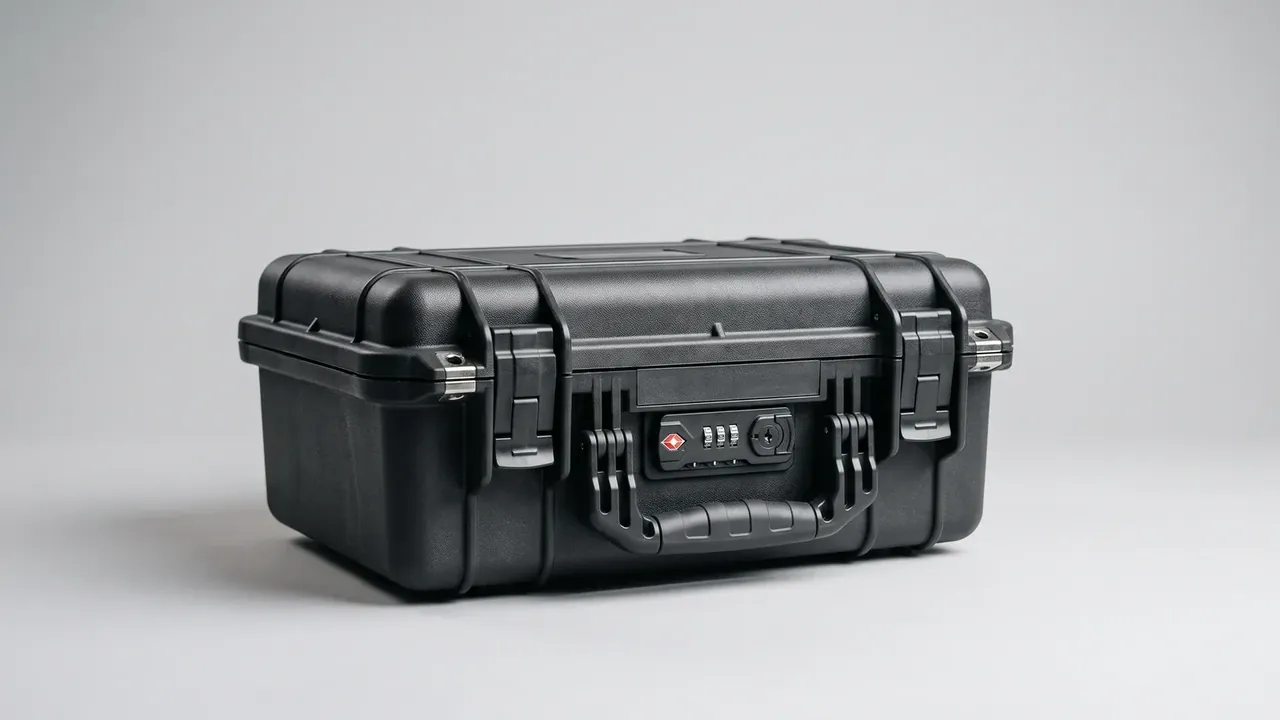
Quick answer: A pistol storage case specification translates requirements into numbers: interior size and tolerance decide fit, wall and ribs decide strength, stack load decides height, and IP rating with temperature decides where it can be used.
Table of contents
- Turning Requirements into Drawing Numbers
- Interior Size and the Tolerance Stack
- Wall Thickness and Rib Spacing
- Load, Stack Height and Floor Pressure
- IP Rating and Temperature Range
- FAQ
1. Turning Requirements into Drawing Numbers
A requirement arrives in one sentence: two pistols, four magazines, lockable, fit for checked baggage. None of it can be stamped on a drawing, so a pistol storage case specification splits it into six groups — interior size, wall, ribs, load, IP rating, temperature — each with a target, tolerance and proof method.
Every requirement needs a measurable stand-in: fits becomes interior size minus liner, survives the stack becomes residual deformation. Pick the wrong stand-in and the drawing only tidies the error.
| Requirement as spoken | Drawing parameter | Value |
|---|---|---|
| Two pistols, four magazines | Interior 355 × 255 × 95 mm | 3 mm clearance per side |
| Carried by hand | Loaded mass under 9 kg | 3.4 kg body, 0.6 kg liner |
| Stacked in store | Floor pressure 56 kg | Five high, no collapse |
Signing the first row accepts 355 × 255 × 95 mm, not a phrase about two pistols.
2. Interior Size and the Tolerance Stack
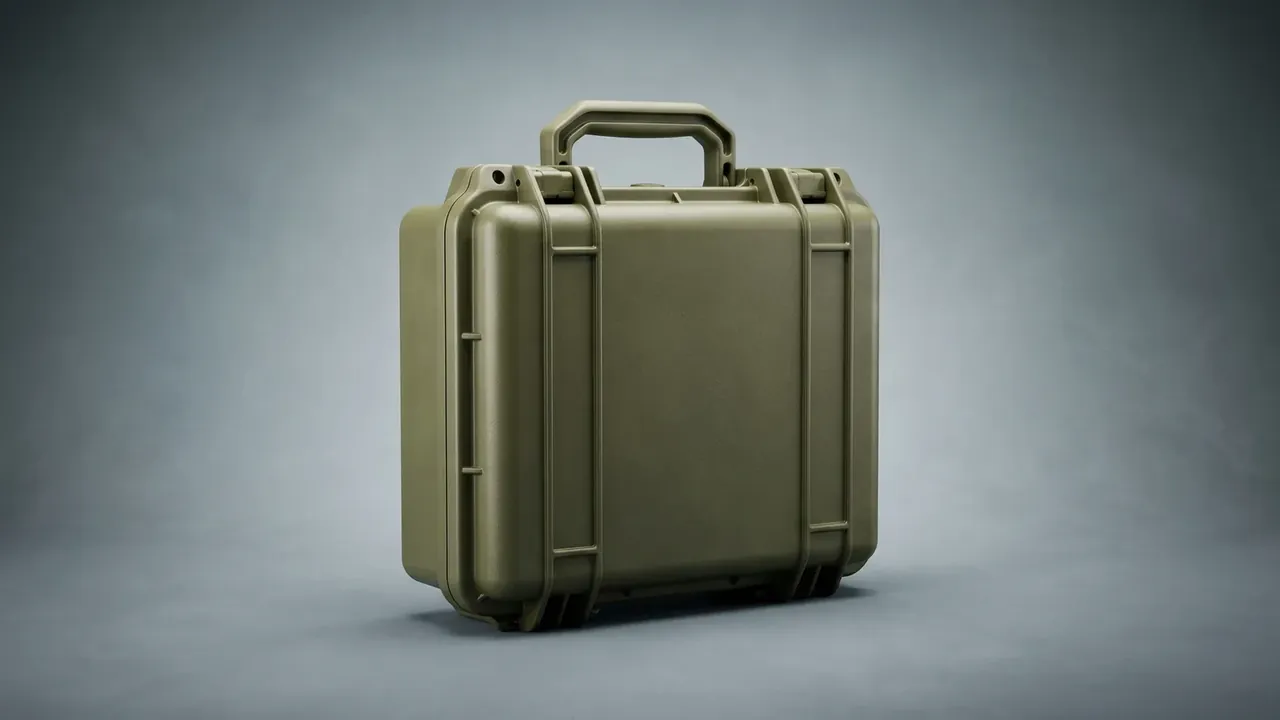
Interior size runs backwards from the contents, using the worst combination: longest item, thickest liner, widest clearance. A 355 mm interior with a 300 mm item, 20 mm foam each side and 3 mm clearance totals 346 mm, leaving 9 mm for the lid liner.
Tolerance belongs on the chain: a pistol storage case holds ±0.5 mm length, ±0.3 mm width and ±0.4 mm depth inside, and ±1.2 mm outside.
| Link in the chain | Nominal and tolerance | Effect |
|---|---|---|
| Item length | 300 mm ±0.6 | Incoming, not controlled |
| Foam per side | 20 mm ±0.5 | ±1.0 mm across the pair |
| Interior length | 355 mm ±0.5 | Sets the clamping force |
Worst case, interior 0.5 mm short and foam 1.0 mm thick, pushes clamping force to 1.4 times design value; the cure is a 2 mm relief groove.
3. Wall Thickness and Rib Spacing
On a pistol storage case the thickness is quoted three ways: 3.0 mm main wall, 3.6 mm base, 2.6 mm lid. The base carries the load when flat; the lid only carries compression.
Rib spacing follows span, not a wall multiple. On a 255 mm span, ribs every 60 mm at 8 mm height and 1.5 degrees of draft hold bulge below 0.5 mm at 56 kg; closer ribs stall the melt and leave sink marks on the seal groove.
Corners collect drop stress: under 8 mm radius the case crazes first at -25 °C, so the drawing asks for 10 mm and two gussets.
4. Load, Stack Height and Floor Pressure
Load is checked as floor pressure. A 355 × 255 mm interior is 0.09 square metres; at 9.4 kg per loaded case and five stacked, the bottom carries 37.6 kg, so a 1.5 factor asks for 56 kg, about 6.1 kPa.
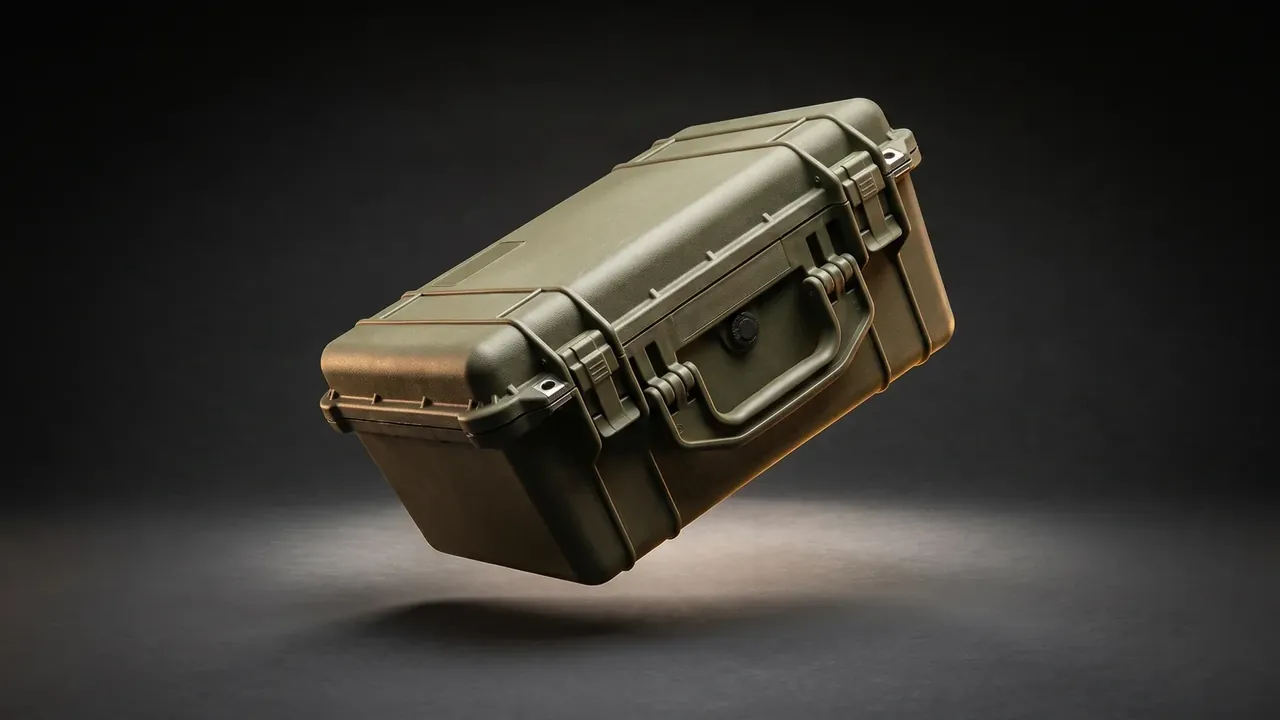
Each layer adds about 0.3 mm of bulge, and past six the lid sags through the liner; warehouse use is four to five layers, pallet transport six. The verdict is residual deformation after 24 hours: under 1 mm passes, 1 to 2 mm drops a layer, over 2 mm voids the specification.
5. IP Rating and Temperature Range
An IP entry needs the code, test condition and pass value. IP67 alone is not enough: one metre for 30 minutes and 20 kPa for 60 seconds judge different things, the case against the gasket.
Line practice uses three rungs: IP54 for splash, IP65 for a 6.3 mm nozzle at 12.5 L/min, IP67 for immersion at one metre. No line immerses every unit, so the pressure hold is the substitute: 0.6 kPa of decay is roughly 0.02 L/min.
Temperature runs in two bands: storage from -25 °C to 65 °C, short transport to 70 °C for 24 hours cumulative. Below -25 °C polypropylene turns brittle, so the drawing moves to PA or adds 0.6 mm to the base.
Conclusion
A specification is worth the load case behind each number. Interior and tolerance settle fit, wall and ribs settle strength, stack height settles height, IP and temperature settle environment. Fix those groups with their proof methods and the drawing stops being reissued, which is when a pistol storage case specification becomes buildable.
This article discusses only the container (case body) side of specifications and design intent, and does not cover any handling, loading or use of the contents.
Related Reading
- How a pistol storage case is built
- Choosing a pistol storage case by lock grade and size
- Acceptance items and verdicts for pistol storage cases
- Specifying a custom foam insert
Related Products
- 8 Series — Gun Cases; Military Equipment Cases; Camera Equipment Cases; Drone Cases; Watch Cases; Knife Cases; First Aid Cases; Electronics Equipment Cases
- WL8-2812 PP Gun Case — model WL8-2812
- All protective cases and toolboxes: 7 series, 158 models