

Quick answer: Whether a plastic carrying case manufacturer can take your order comes down to four numbers: minimum order, mould cavities, lead time and payment terms. This article shows how each one moves, and which three lines test capacity.
Table of contents
- Four Numbers a Plastic Carrying Case Manufacturer Must Quote
- Three Lines to Test Whether Capacity Fits
- Five Numbers to Demand on the Quotation
- How Sampling and Mass Production Dates Are Built
- Tooling Ownership, Audit Records and Payment Terms
- FAQ
1. Four Numbers a Plastic Carrying Case Manufacturer Must Quote
Only four numbers really decide whether the deal works: minimum order, cavities, lead time and payment terms. Every other clause is arithmetic around them.
| Number | Usual value | Who concedes | Cost of getting it wrong |
|---|---|---|---|
| Minimum order | 100, 300 or 500 units | buyer | 100 units with a colour change still pays full cleaning |
| Cavities | 1 or 2 per mould | shared | doubling cavities lifts tooling and minimum alike |
| Lead time | 5 days sample, 20 tooling, 18 production | factory | squeezed to 30 days, one trial shot |
| Payment terms | 30 or 60 days | buyer | longer terms add 1.5% to 3% financing |
Push one to its floor and the other three push back.
The three tiers are not arbitrary. A hundred units suits a stock colour, because the plant runs an existing shade. Three hundred is where a colour change and a clean barrel make sense, and cleaning takes the same time either way, so a hundred units in a custom colour costs as much to set up as three hundred. Above five hundred, a factory opens a new mould, because that is the volume that pays the tooling back. Ask for all three tiers, then check them against annual usage: a buyer moving 1,200 units can order in batches of 300. Of the four, minimum order matters most, because it sets the room left in the other three.
2. Three Lines to Test Whether Capacity Fits
No plastic carrying case manufacturer can prove capacity with a sentence. Measure it on three lines instead.
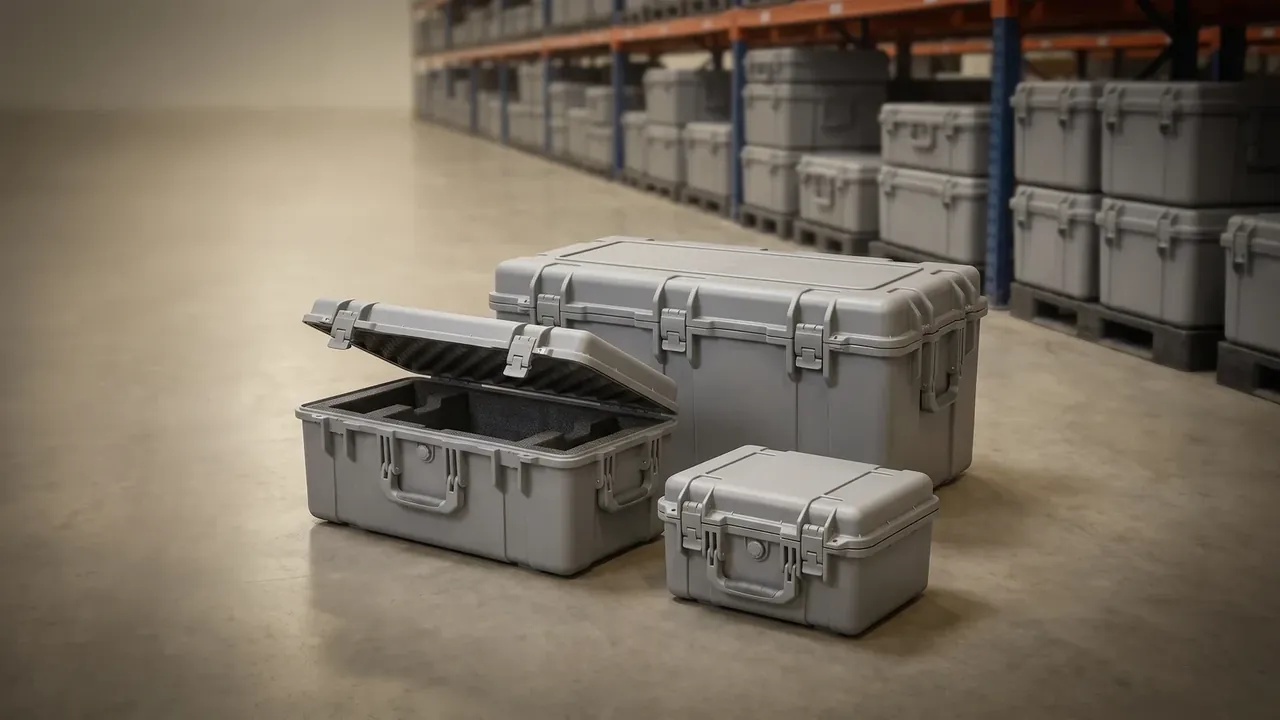
- Machine line: tonnage and cavities. A mid size body at 3.2 mm wall runs on 250 to 380 tonne presses, a two cavity tool cycles in about 85 seconds, and one machine turns out roughly 800 units a day.
- Schedule line: hours already committed. Ask for four weeks of scheduling rather than a verbal yes.
- Finishing line: headcount at assembly, printing and packing. A body that cannot be packed still misses the date.
When the three lines disagree, the usual symptom is a handsome lead time and a first shipment two weeks late, which shows up earlier than any audit report.
3. Five Numbers to Demand on the Quotation
A quotation carries one unit price but five cost sources.
| Item | Unit | Number to demand | The vague version |
|---|---|---|---|
| Resin | kg | 2.1 kg per case, grade, UV package | PP, nothing else |
| Hardware | set | 96 hours salt spray on latches | rust treated |
| Masterbatch | % | 1% to 2% let down | per colour card |
| Packing | unit | carton size, 420 units per 20GP | standard export packing |
| Mould | set | cavities, steel, 300,000 shot life | tooling extra |
Masterbatch is the one that slips through. One percent against two percent is pennies per case and a visible shade shift across a batch, and one rework run eats the negotiation.
4. How Sampling and Mass Production Dates Are Built
Build the date from stages, not from a total. A typical sequence runs five days for the sample, twenty for the mould, three for trial shots, eighteen for production and four for loading, which lands near fifty days.
The sample stage settles three things: whether wall thickness sits at 3.2 mm plus or minus 0.2, whether every latch feels the same, and whether the lid gap stays under 0.8 mm. Sign those off and the rework rate in production usually drops below 3%.
Do not let the mould be cut before the sample is signed.
5. Tooling Ownership, Audit Records and Payment Terms
Tooling is charged per set, and a two cavity steel mould sits in the tens of thousands of yuan. Paying for it does not make it yours, so the contract has to fix ownership, storage and removal.
- Ownership: the tool belongs to the buyer, the plant holds only use rights.
- Storage: free during cooperation, numbered on a rack, protected against rust.
- Removal: available when cooperation ends, freight paid by whoever asks.
- Audit records: twelve months of first article reports, resin receipts and rework logs.
Payment terms and unit price are two sides of one coin. If you want 60 days, put the financing cost into the comparison, or the lowest bid will be the one with the shortest terms. The longer the terms a plastic carrying case manufacturer offers, the more cost hides in the price.
Conclusion
Fix minimum order, cavities, lead time and payment terms, and the rest of the contract has somewhere to stand. Writing those four numbers into the enquiry saves more than arguing over unit price. Most of the spread between quotes from any plastic carrying case manufacturer sits inside them.
This article discusses only the container (case body) side of specifications and design intent, and does not cover any handling, loading or use of the contents.
Related Reading
- How a supplier scorecard is scored
- What to look at in a showroom sample
- Factory tour route and inspection order
- Numbering and rust protection for stored moulds
Related Products
- 8 Series — Gun Cases; Military Equipment Cases; Camera Equipment Cases; Drone Cases; Watch Cases; Knife Cases; First Aid Cases; Electronics Equipment Cases
- WL8-2812 PP Gun Case — model WL8-2812
- All protective cases and toolboxes: 7 series, 158 models