

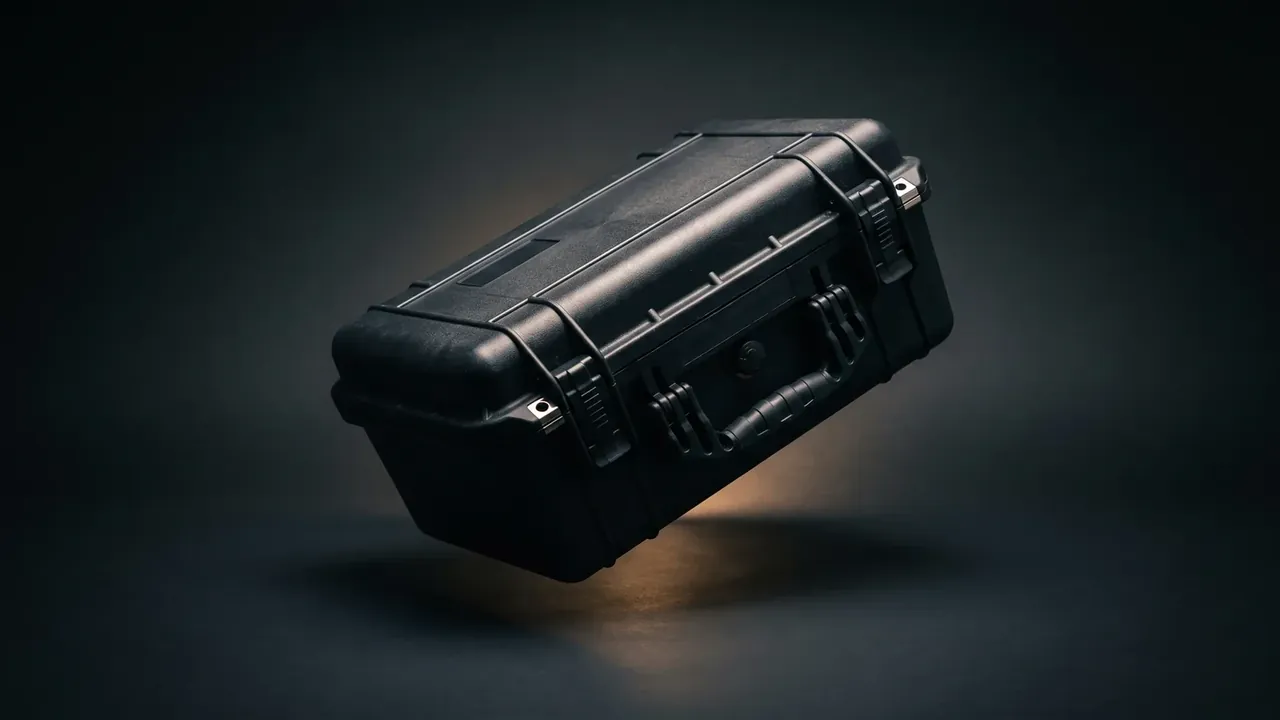
Quick answer: At a 25 L cavity a plastic case weighs 3.1 kg against 6.4 kg for a flight case, seals to IP67 against IP54, and beats a flight case on unit cost past 500 units once tooling is amortised.
Table of contents
- Where the two types diverge
- Weight at 25 L and 60 L
- Tooling versus extrusion and labour
- What IP54 and IP67 actually buy
- Drops, stacking and repair over time
- Five checks that decide the line
- FAQ
1. Where the two types diverge
A flight case is assembled; a plastic case is moulded. The first uses 20 mm aluminium extrusion, riveted corners and a 9 mm plywood panel. The second leaves one tool with lid, body and hinge as one part, sealed by a gasket in a moulded groove.
Joint count decides where water enters and how repairs go.
A flight case wall is frame, panel and corner, so damage is swapped piece by piece, paid for by a gasket that ages. A plastic case carries a continuous 2.8 mm wall, 4.2 mm at the corners, and absorbs a drop by deforming whole, at the price of one tool.
| Item | Flight case | plastic case |
|---|---|---|
| Wall | Extrusion + 9 mm plywood | One shell, 2.8 mm |
| Seal | Foam strip | Two-lip silicone |
| Size | Any, 5 mm steps | Fixed by tool |
| Rating | IP54 | IP67 |
2. Weight at 25 L and 60 L
At 25 L the flight case runs 6.4 kg against 3.1 kg moulded, a 3.3 kg gap; at 60 L, 11.8 kg against 6.2 kg. Per litre that is 0.256 against 0.124 kg and 0.197 against 0.103 kg, so the gap narrows as the case grows.
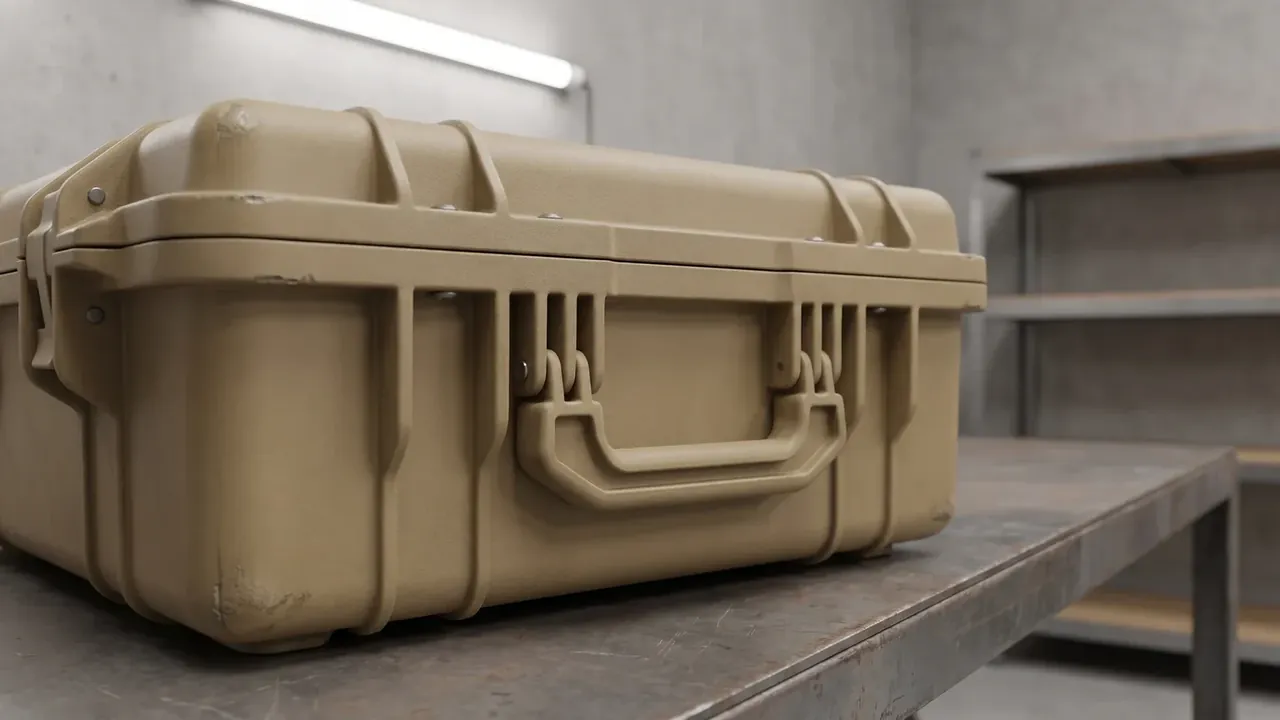
Density explains part: aluminium 2.7, ABS 1.04, PP 0.91 g/cm³, while plywood at 0.65 is no culprit. Hardware is: extrusion, corners, latches and hinges add 4.1 kg on a flight case against 1.2 kg moulded.
On one case 3.3 kg is a rounding error; on forty it is 132 kg, charged every trip. Cube adds a layer: the frame stands proud, the outer box runs 8% larger, so forty units eat 0.6 m³ while a plastic case follows to 22 mm. The return leg separates them again, since a plastic case nests at 1:2.8 while a framed one stacks at 1:1. Four trips a month covers the price gap on a dozen cases in empty return freight alone. None of that shows on a quotation, only on the freight invoice.
| Cavity | Flight case | plastic case | Per litre |
|---|---|---|---|
| 25 L | 6.4 kg | 3.1 kg | 0.256 / 0.124 kg |
| 60 L | 11.8 kg | 6.2 kg | 0.197 / 0.103 kg |
3. Tooling versus extrusion and labour
Cost crosses over with volume, not unit price. Below 100 units the flight case wins: 3.2 m of extrusion, plywood, hardware, CNY 210 of material and CNY 90 of labour, no tool, CNY 300 each. A 25 L mould costs CNY 120,000, so 100 units absorb CNY 1,200 plus CNY 26 of resin and CNY 8 of moulding time, CNY 1,234.
Five hundred units is where the two lines meet.
At 500 the tool drops to CNY 240 and the case lands at CNY 274; at 2,000 it is CNY 60 and the case CNY 94, while the flight case only reaches CNY 285.
| Volume | Flight case | plastic case |
|---|---|---|
| 100 | CNY 300 | CNY 1,234 |
| 500 | CNY 300 | CNY 274 |
| 2,000 | CNY 285 | CNY 94 |
A paid-off tool still locks the cavity: reshape it and another tool is bought. A line changing cavity twice a year belongs with the flight case.
4. What IP54 and IP67 actually buy
IP54 stops solids over 1 mm and splashes; IP67 adds 1 m of water for 30 min. A flight case reaches IP54 with an 8 mm EVA strip that seals only at 30% compression, so a lid not pulled hard leaks.
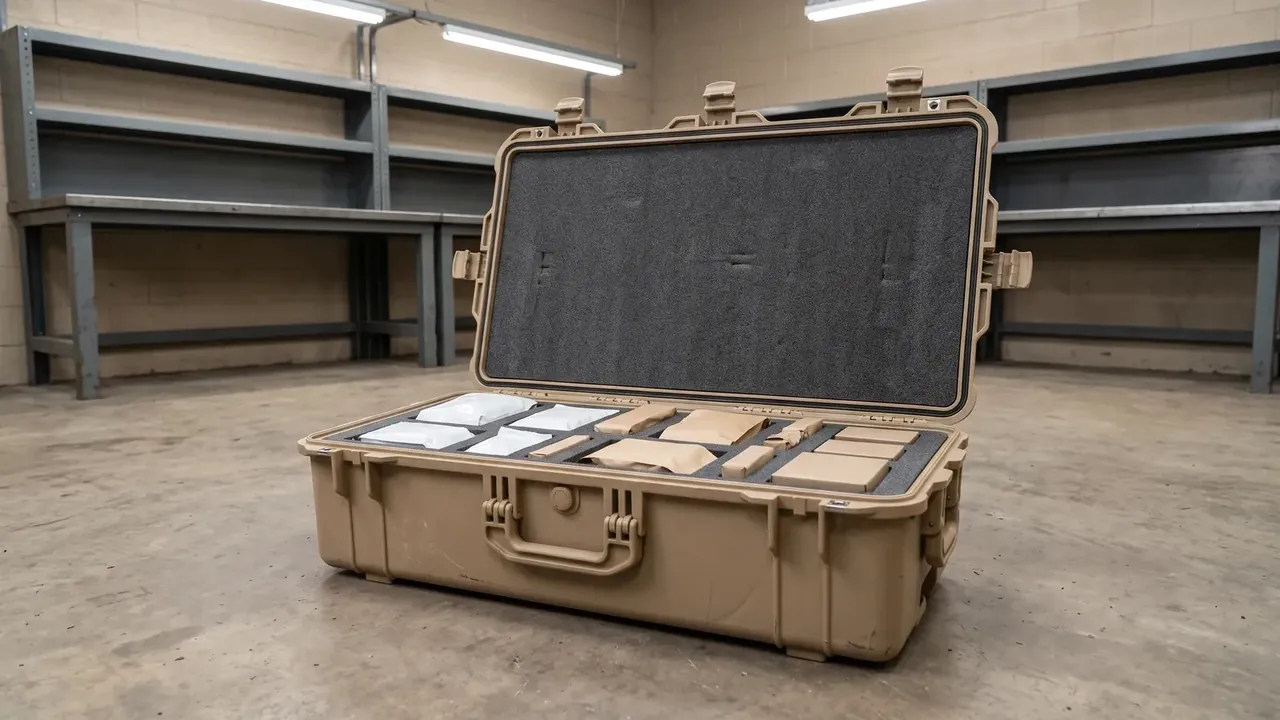
A plastic case reaches IP67 with a two-lip silicone gasket at 50 Shore A and 3.5 mm section, each lip forming its own line contact, plus a valve at 0.05 bar so breathing vents instead of lifting the lips.
EVA takes 18% compression set after 200 h at 60 °C and needs replacing at two years; silicone sets 6% and runs five years.
5. Drops, stacking and repair over time
A 1.5 m corner drop with a 25 kg payload: the aluminium corner feeds 68 g into the frame and deforms 4 mm, while the moulded corner at 4.2 mm absorbs it at 52 g, scuffed, not pierced.
Stacking is a lid test, not a base test.
A 25 L moulded lid carries 120 kg static for 24 h at 1.8 mm deflection, springing back to 0.4 mm; a plywood lid deflects 5 mm and the ABS skin lifts. Six high is the ceiling for both.
Repair splits them. A flight case panel is 40 min and CNY 180, a corner 25 min and CNY 60, strength back to ninety percent; a cracked plastic case is swapped whole at CNY 274 in two minutes. Odd geometry favours the flight case, standard cavities the mould.
6. Five checks that decide the line
Five checks settle most cases.
- Under 100 units, cavity may change: flight case, CNY 300, no tooling risk.
- Over 500 units with a stable cavity: plastic case, under CNY 274.
- Submersion at 1 m: IP67, which foam cannot deliver.
- Empty returns by air or sea: nesting at 1:2.8 pays back within a year.
- On-site repair: a flight case takes a new panel, a moulded case is swapped whole.
One check on the plastic side re-runs the other four, and the reverse holds too.
Conclusion
Three lines, three crossovers. The 3.1 kg against 6.4 kg at 25 L is decided by hardware; CNY 1,234 against CNY 300 at 100 units by tooling; IP67 against IP54 by silicone lips against a foam strip. What remains is the lane itself: volume, how often the cavity changes, whether the case gets submerged, whether empties fly back. The heaviest of the four decides, and the other three confirm it.
This article discusses only the container (case body) side of specifications and design intent, and does not cover any handling, loading or use of the contents.
Related Reading
- How a flight case is built and specified
- Moving from flight cases to moulded cases
- Military flight cases against alternative formats
- Density and cost across case materials
Related Products
- 8 Series — Gun Cases; Military Equipment Cases; Camera Equipment Cases; Drone Cases; Watch Cases; Knife Cases; First Aid Cases; Electronics Equipment Cases
- WL8-2812 PP Gun Case — model WL8-2812
- All protective cases and toolboxes: 7 series, 158 models