

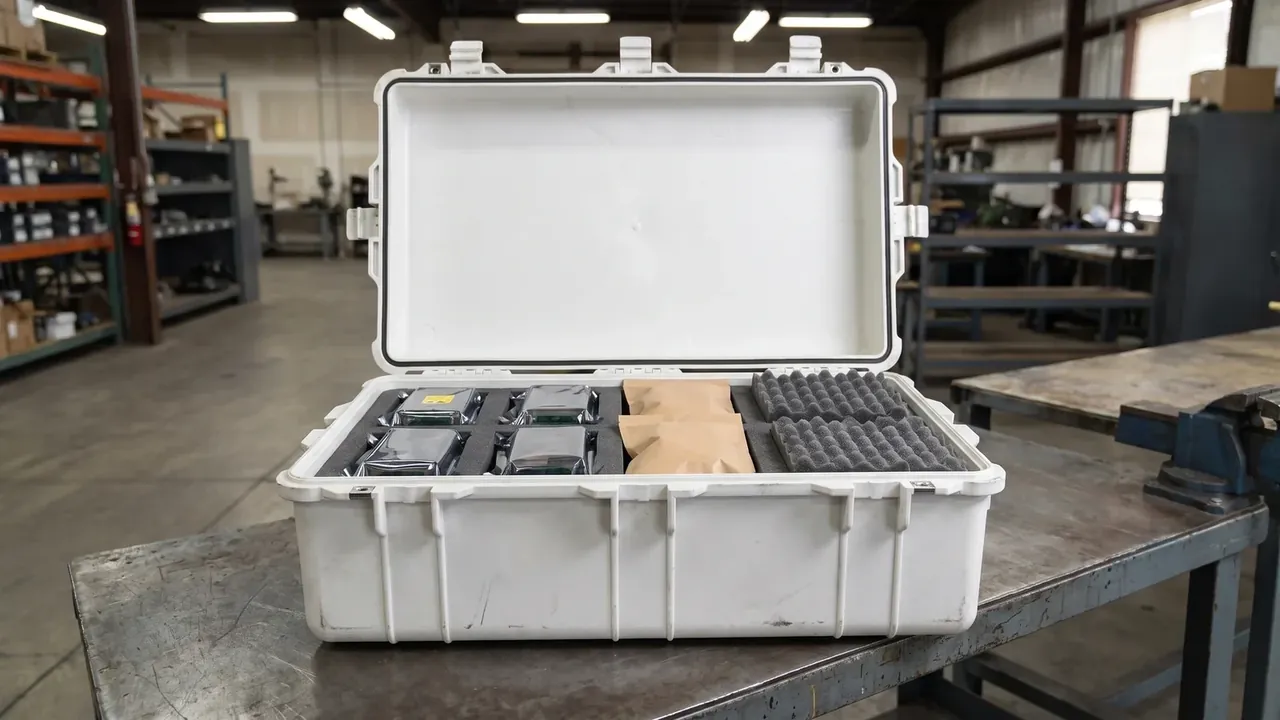
Quick answer: Add 8 to 15 mm per side to the equipment envelope, and treat foam as a separate allowance rather than part of that clearance. A 400 × 300 × 150 mm unit with 20 mm foam lands at a 440 × 340 × 190 mm interior, roughly 462 × 362 × 212 mm outside. Work outwards from the interior, not inwards from a favourite outer size.
Table of contents
- Sizing starts at the interior
- Splitting clearance across four faces
- Foam needs its own space
- Same interior, different outside
- Checking the number before tooling
- FAQ
1. Sizing starts at the interior
Measure the equipment at its extremes, not at the body. A 30 mm circular connector on one side turns a 400 mm unit into a 430 mm one; a folded handle adds 15 mm when raised; an antenna standing 110 mm tall pushes the interior up by two size bands.
Then check what the quoted interior actually refers to. Supplier drawings normally quote the rim, and the wall carries 1 to 2 degrees of draft, so the floor of a 200 mm deep case is 1.5 to 3 mm smaller per side than the mouth. If the unit sits on the floor, use the floor dimension.
| What to measure | Where to take it | Commonly missed |
|---|---|---|
| Length | Across connectors and knobs | Side connector, 30 mm proud |
| Width | Handle in its raised position | 15 mm extra when raised |
| Height | Antenna, knob, feet | 110 mm antenna upright |
| Cable | Coiled outside diameter | 40 mm bend radius at the plug |
2. Splitting clearance across four faces
For a bare case, 8 to 15 mm per side is the working band. At 8 mm the unit still drops in, but fingers will not follow; at 10 mm a hand can grip an edge; at 15 mm gloves fit and an ESD bag can be added. Past 20 mm, move up a case size, because a loosely packed unit shifts on every lift.
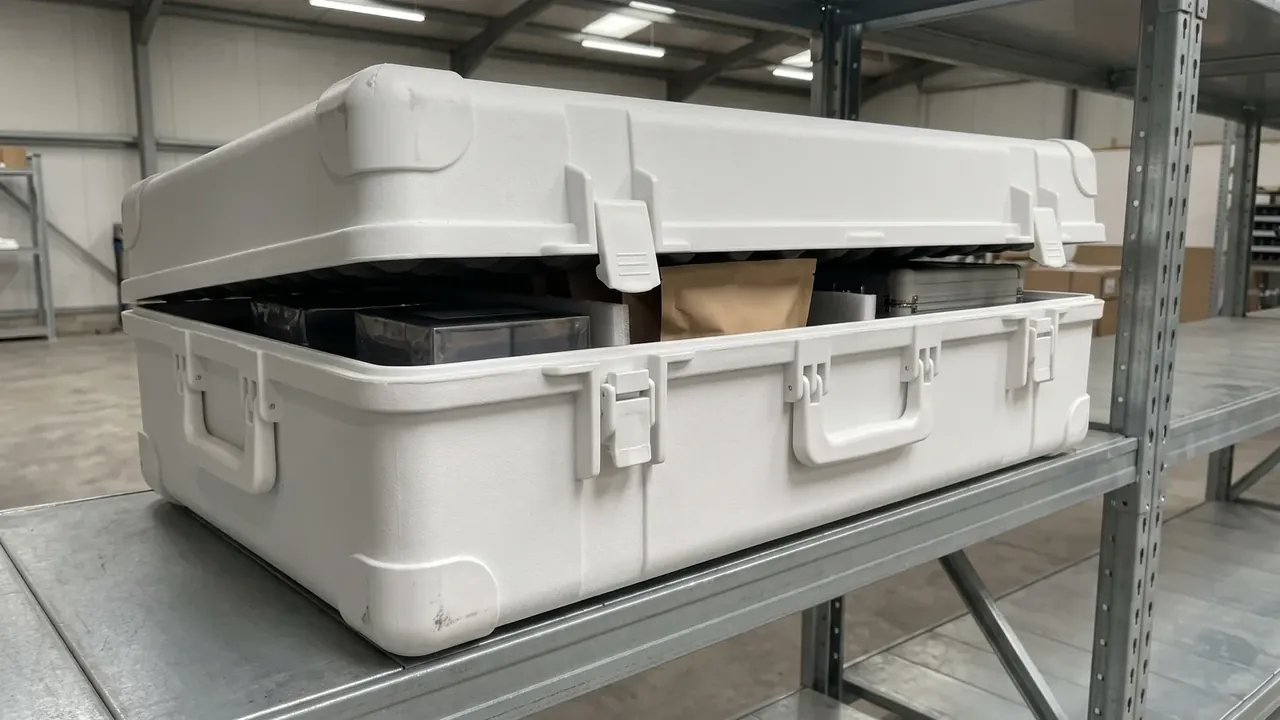
Length and width take the allowance twice, height splits between floor and lid. A 400 mm unit at 10 mm per side gives a 420 mm interior; a 150 mm unit with 10 mm below and 5 mm above gives 165 mm.
| Handling method | Clearance per side | Added to the envelope |
|---|---|---|
| Bare unit, straight drop-in | 8 mm | 16 mm |
| Fingers grip the edge | 10 mm | 20 mm |
| Thick gloves | 15 mm | 30 mm |
| Bagged before loading | 18 mm | 36 mm |
3. Foam needs its own space
Clearance buys handling room; foam buys restraint. They cannot share the same millimetres. Side foam starts at 10 mm and works between 20 and 30 percent compression: enough grip to stop movement, not so much that the lid lifts. EVA at 30 kg/m³ holds its rebound at 25 percent compression and starts losing thickness above 40 percent.
So the interior equals the envelope, plus clearance, plus foam on both sides. Take a 400 × 300 × 150 mm unit with foam straight against the shell at 20 mm a side: 440 × 340 × 190 mm, or 28.4 litres. The nominal volume on the drawing is often computed from the outside and runs 15 percent larger.
| Unit weight | Side foam | Base foam | Lid foam |
|---|---|---|---|
| Under 2 kg | 10 mm | 10 mm | 10 mm |
| 2 to 8 kg | 15 mm | 20 mm | 15 mm |
| 8 to 20 kg | 20 mm | 30 mm | 20 mm |
| Over 20 kg | 25 mm | 40 mm | 25 mm |
Above 20 kg, 40 mm of base foam is still not a load path. Add a 3 mm support plate under the foam so the mass reaches the shell rather than sitting on a compressed block.
4. Same interior, different outside
Two cases with a 440 × 340 × 190 mm interior can differ by a ring on the shelf. An injection moulded body runs 2.5 to 3.5 mm walls stiffened by ribs 6 to 8 mm tall; a rotomoulded body runs 4 to 6 mm walls with fewer ribs. Using the same 8 mm frame on both, the moulded case measures 462 × 362 × 212 mm and the rotomoulded one 466 × 366 × 216 mm.
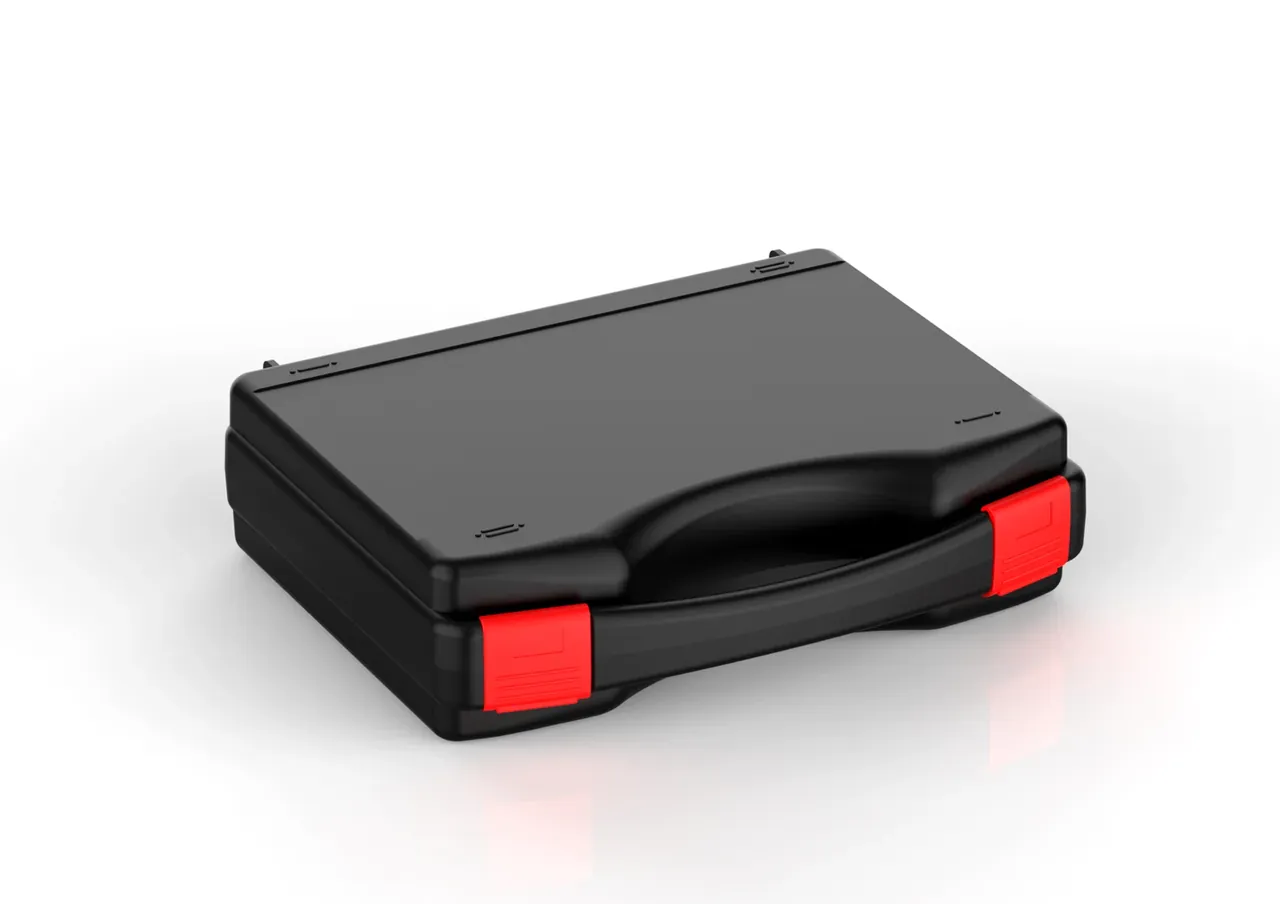
Four millimetres per face is invisible on a bench and visible in a container. Five cases at 466 mm occupy 2330 mm of a 2350 mm floor, leaving 20 mm; at 462 mm the same five leave 40 mm. Mass separates them faster: 5.2 kg moulded against 6.1 kg rotomoulded, or 36 kg across a 40-case pallet.
Wall thickness also sets the tolerance on the interior. Moulded bodies hold ±1.5 mm; rotomoulded ones hold ±3 mm. Order a 440 mm interior and a rotomoulded batch may arrive at 437 mm, so the foam is cut a second time after measurement.
5. Checking the number before tooling
A signed dimension sheet is not a release to cut steel. Build three things first: the unit, a foam sample, and a prototype shell. A 3D printed or aluminium-framed prototype costs 800 to 2000 yuan, against 80,000 yuan for a tool that must be welded back up if the interior is wrong.
- Removal: the unit comes out one-handed within 3 seconds, without rubbing the seal face
- Closure: lid foam compresses 3 mm, one hand closes the latch
- Side standing: 10 minutes on its side, fully loaded, lid stays shut
- Stacking: 3 high for 24 hours, interior floor deflects no more than 2 mm
- All-up weight: 12 kg per case, above which wheels or a two-person lift are needed
Accept on ±2 mm interior and a lid gap no wider than 1.5 mm once latched; both numbers go in the inspection sheet, not just the drawing.
The step most often skipped is lid depth. Catalogue heights usually quote the outside, and ribs plus lid foam consume 12 to 18 mm of it. A 190 mm interior with a 190 mm unit will not close, and the missing millimetres are all in the lid.
Conclusion
The dimensions of a plastic protective case form a chain running outwards: the envelope sets the interior, clearance sets the handling room, foam sets the restraint, and wall plus rib height set the outside. Skip one link and it reappears as thicker foam or a different case size. Put interior, clearance, foam and wall on one drawing before the price conversation, and the rest runs on numbers rather than on the phrase it should fit.
This article discusses only the container (case body) side of specifications and design intent, and does not cover any handling, loading or use of the contents.
Related Reading
- How a custom order is specified
- How case size bands are split
- Foam insert thickness and cutting
- PP versus ABS case bodies
Related Products
- 8 Series — Gun Cases; Military Equipment Cases; Camera Equipment Cases; Drone Cases; Watch Cases; Knife Cases; First Aid Cases; Electronics Equipment Cases
- WL8-2812 PP Gun Case — model WL8-2812
- All protective cases and toolboxes: 7 series, 158 models