

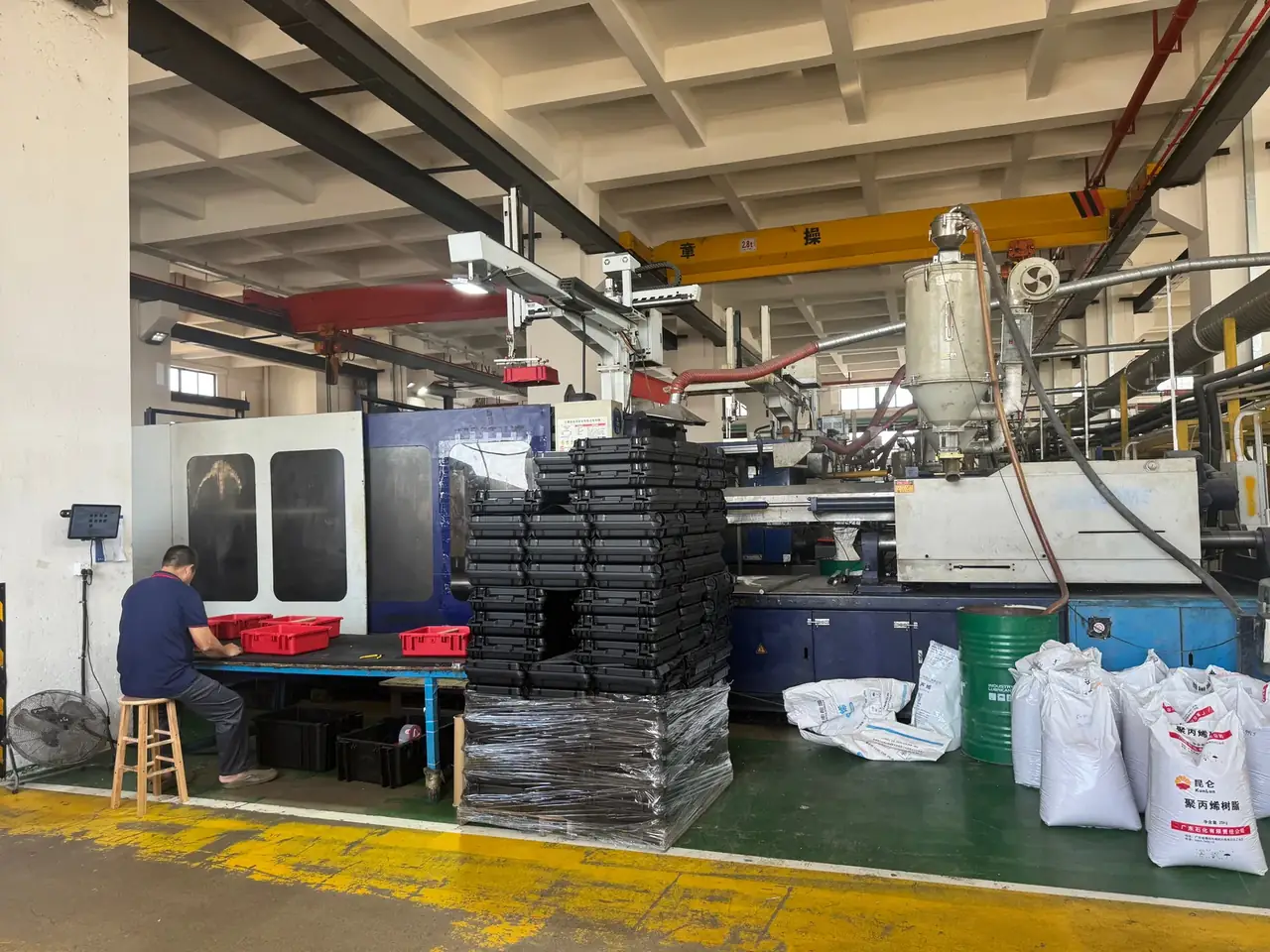
Quick answer: A Plastic Tool Box guards three consistency lines at once: 32 mm cavity pitch, color drift held inside ΔE 1.2, and a 28 N latch within ±4 N.
Table of contents
- Cavity Pitch and Pick-Out Clearance
- Batch Color Shift and the Three Reference Plates
- Quantifying Latch Feel and Its Tolerance Band
- Gate Position and Appearance Grading
- Outgoing Sampling and Retained Samples
- FAQ
1. Cavity Pitch and Pick-Out Clearance
A wrong cavity pitch cannot be rescued by a good latch. Inside a Plastic Tool Box the space is gridded into pockets, and the distance between two neighbouring centrelines is the pitch, 32 mm here. The single-side gap from pocket wall to tool outline is the pick-out clearance, 1.5 mm. Together they decide whether a gloved finger fits and whether a spanner rattles.
Pitch on a Plastic Tool Box cannot be cut straight off the drawing. Unfilled PP shrinks 1.5% to 2.0% along flow and 1.8% to 2.5% across it, then another 0.1% to 0.3% in the first 24 to 48 hours after ejection. A cavity cut at 32 mm lands near 31.4 mm, which eats half the clearance.
| Cavity pitch | Pick-out clearance | Tool shapes it suits |
|---|---|---|
| 28 mm narrow | 1.0 mm | Bits, hex keys, slim shafts |
| 32 mm base | 1.5 mm | Sockets, open-end spanners |
| 36 mm wide | 2.0 mm | Pliers and tapes with sleeves |
Narrow pitch saves space but forces a fingertip grip; wide pitch loads easily but costs a pocket. Once the shell of a Plastic Tool Box is frozen, pocket count is won on pitch, so the grid is laid out against the internal clear size.
Hold pitch to ±0.1 mm. Raising mould temperature from 30 °C to 60 °C adds 0.1% to 0.3% to PP shrinkage, so a 32 mm pitch wanders 0.03 to 0.10 mm across a batch before cutter wear is counted.
2. Batch Color Shift and the Three Reference Plates
Color shift is read as ΔE*ab: the square root of the summed squares of ΔL, Δa and Δb. A Plastic Tool Box closes at ΔE 1.2, inside the band where a careful side-by-side look starts to notice, tight for a visible part yet still producible.
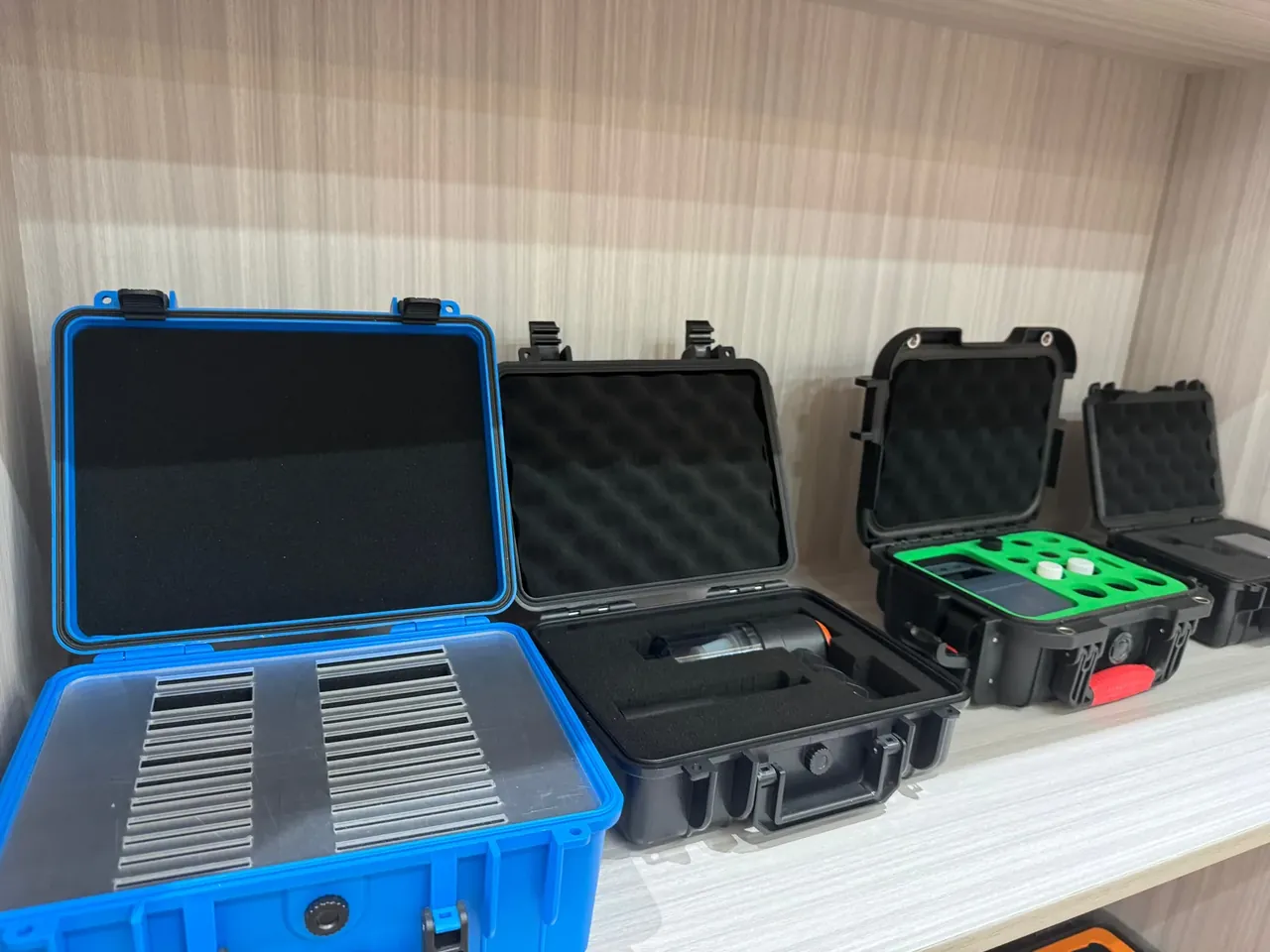
Three plates set the reference for a Plastic Tool Box: standard, light upper limit, dark lower limit, all cut from first articles with Lab values logged on the spot. Per-channel limits run alongside — ΔL ±0.3, Δa ±0.2, Δb ±0.2. Watching only the total misses the case where ΔE sits at 1.0 but b drifts 0.5, which the eye reads as a yellow cast.
| Batch color step | ΔE*ab range | Action on the floor |
|---|---|---|
| First-article plate | 0.5 or less | Sign off, file as standard |
| Routine batch | 0.5 to 1.2 | Release, log all three channels |
| Out-of-band batch | Above 1.2 | Quarantine, rematch colour |
Conditions are locked: D65, 10° observer, 45/0 geometry, 600 to 1,000 lx, repeatability under ΔE 0.1. A new masterbatch lot, short drying or more regrind pushes Δb up, so those three are checked first.
3. Quantifying Latch Feel and Its Tolerance Band
Feel is measured in newtons. The latch on a Plastic Tool Box opens at 28 N with a ±4 N band, so the window is 24 to 32 N. Below 24 N the lid pops under transport vibration; above 32 N a user holding the shell in one hand cannot break the latch with the other and reaches for a lever.
The rig is fixed: a 0 to 500 N push-pull gauge sampling at 1,000 Hz, a room at 23 ±2 °C and 50 ±5% RH, force along the tongue axis. Held 15° off axis by hand, the gauge reads about 10% high, booking a conforming 28 N batch as 31 N.
| Latch feel step | Gauge reading | What the user meets |
|---|---|---|
| Loose | Under 24 N | Pops open in stacks and vibration |
| Accepted | 24 to 32 N | One hand, clear seating click |
| Stiff | Above 32 N | Two hands or a lever |
Tongue-to-seat clearance runs 0.1 to 0.3 mm, and the tongue root wall stays at 1.2 mm or more. Under 0.1 mm the effort climbs as dust packs in; above 0.3 mm the click goes dull and users think it never seated. After 500 cycles, a batch losing more than 20% of its force points at the resin or the regrind ratio.
4. Gate Position and Appearance Grading
Two gates sit symmetrically at one third along the long side of the base, so melt meets in the middle and the last vent point is the mid-edge. Gate depth is 70% of wall; shallower and the gate freezes in 3 to 4 seconds, the packing path closes, and a sink mark appears far from the gate.
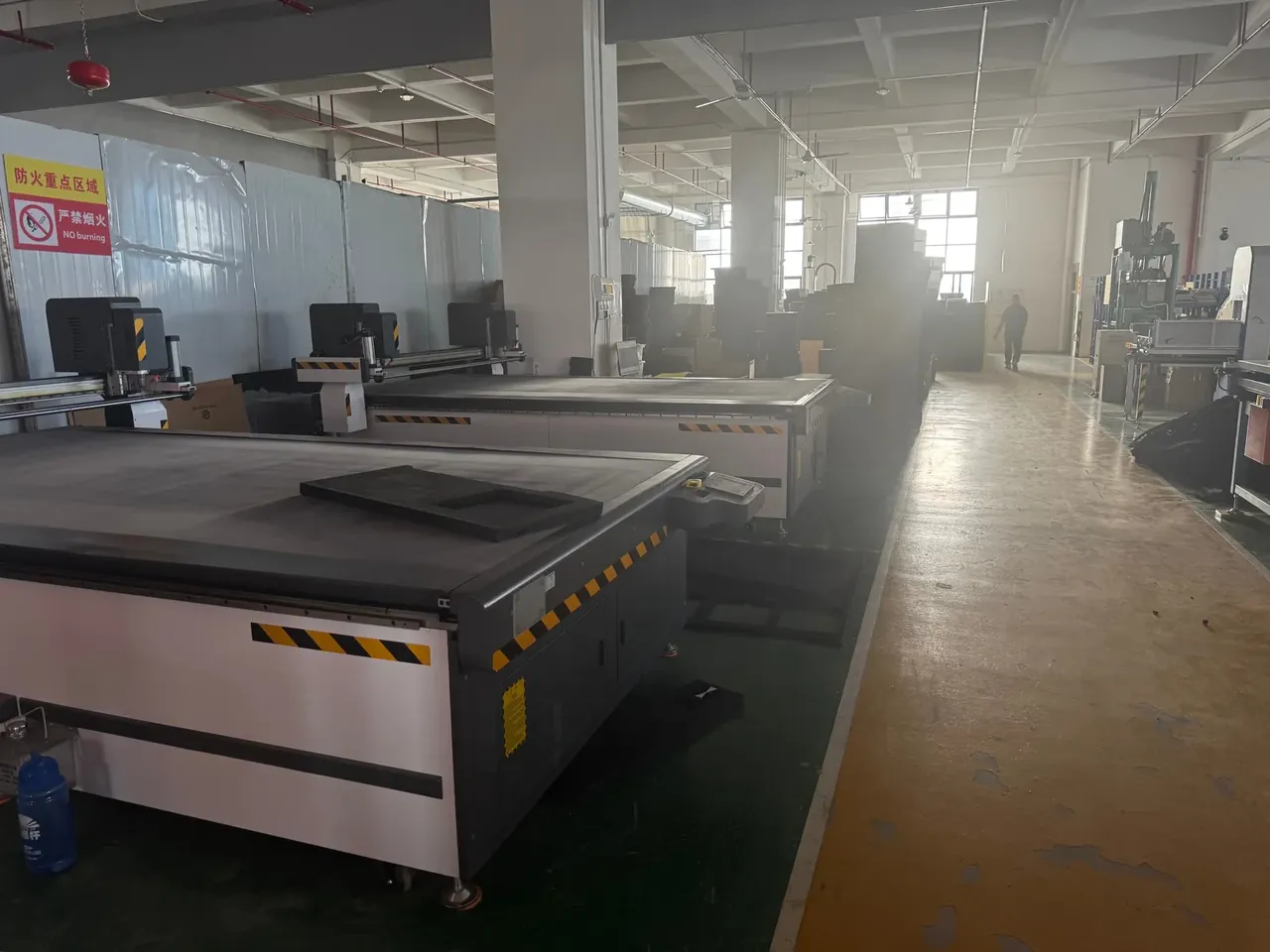
Appearance grades in three steps. Grade A is the front and outer sides seen first at opening: no flow lines, no sink, no vestige. Grade B is internal dividers, where a flow line to 5 mm is tolerated. Grade C is the base and outer bottom, where a vestige under 0.3 mm is allowed if a fingertip cannot feel it.
Vestige control belongs in the tool, not on the bench. A conical gate bush pulls the mark into a shallow dish that a blade shaves flat faster than sanding, without polishing the texture around it. The finer the texture on a Plastic Tool Box, the further the gate sits from the face a hand touches.
5. Outgoing Sampling and Retained Samples
Sampling runs by batch on a Plastic Tool Box: eight cases, three readings each — pitch by caliper in three places, colour at two points, latch force as three pulls averaged. Any item out of band sends the batch to a hold area rather than the day's shipment.
One line is fixed: a batch whose color shift passes ΔE 1.2 or whose latch force leaves ±4 N is not merged into the same shipment. Three samples are kept per batch — first, middle, last — labelled with batch number, plate step and mean force, held 12 months in a dark cabinet at 20 ±5 °C, since PP keeps yellowing.
Expiry is not a bin. Each set is re-read against the current standard, and a drift beyond ΔE 0.5 means the formula was never stable in storage.
Conclusion
Consistency in a Plastic Tool Box sits on three numbers: 32 mm pitch with 1.5 mm clearance, color inside ΔE 1.2, and a latch at 28 N within ±4 N. None is set once at the press; they run from cavity layout through plate comparison to outgoing sampling. Hold the three and the shells really are one batch.
Related Reading
- Latch Force and Opening Feel
- Custom Colour Minimum Order
- Injection Molded Plastic Tool Box Uses
- Usable Cavity Ratio in a Case
Related Products
- 8 Series — Gun Cases; Military Equipment Cases; Camera Equipment Cases; Drone Cases; Watch Cases; Knife Cases; First Aid Cases; Electronics Equipment Cases
- WL8-2812 PP Gun Case — model WL8-2812
- All protective cases and toolboxes: 7 series, 158 models