

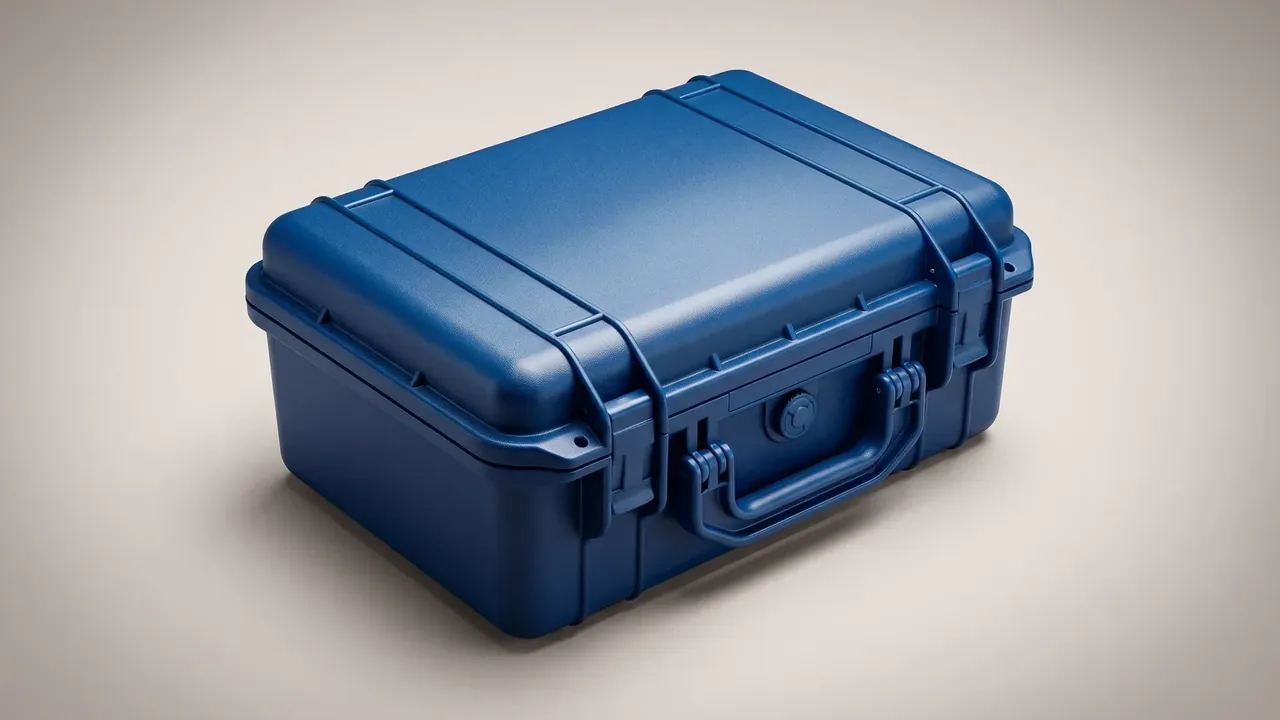
Quick answer: A plastic toolbox with drawers saves reach, not floor space; five drawers, 12 kg per drawer, slides at 0.95 of drawer depth and a six-second pick decide fit.
Table of contents
- How a Plastic Toolbox With Drawers Fits a Repair Bay Pick Path
- Drawer Count and Load per Drawer: The Layer Logic
- Slide Travel and Full Extension: What Changes at the Drawer Front
- Anti-Open Latches and Dividers: Two Failures
- Rolling, Parking Brake and the Six-Second Pick
- FAQ
1. How a Plastic Toolbox With Drawers Fits a Repair Bay Pick Path
At eight, two technicians cover three moulding lines from a bench 6.2 m long. The plastic toolbox with drawers sits at the right end, five drawers split between hex keys, wrenches, a torque wrench, O-ring kits and gauges. Before the change, tools hung 4.2 m away on a pegboard, and one hex key cost a walk, a crouch and a 9.4 second search.
Nothing was added. The case moved to 60 cm at the left hand, and the pick collapsed into turn, pull, take, push back.
| Bay layout | Case position | Usual drawer level | Walk per pick |
|---|---|---|---|
| One technician, fixed bench | Left end, casters locked | Top and second | Under 0.6 m |
| Two technicians, shared bench | Mid bench, opens both sides | Shared parts in third | Under 1.2 m |
| Roaming work | Pushed along, brake off | Wide items on top | None |
2. Drawer Count and Load per Drawer: The Layer Logic
More drawers is not better: each added layer shaves clear height, so a 420 mm torque wrench only lies diagonally, and fewer layers push three tool families together.
Five drawers is the stable compromise:
| Drawer level | Clear height | Rated load | Typical items |
|---|---|---|---|
| Top | 65 mm | 6 kg | Gauges and bits |
| Second and third | 95 mm | 10 kg | Wrenches and hex keys |
| Fourth | 130 mm | 12 kg | O-ring boxes |
| Bottom | 180 mm | 15 kg | Tape and spares |
The case measures 520 × 380 × 620 mm and weighs 21 kg empty.
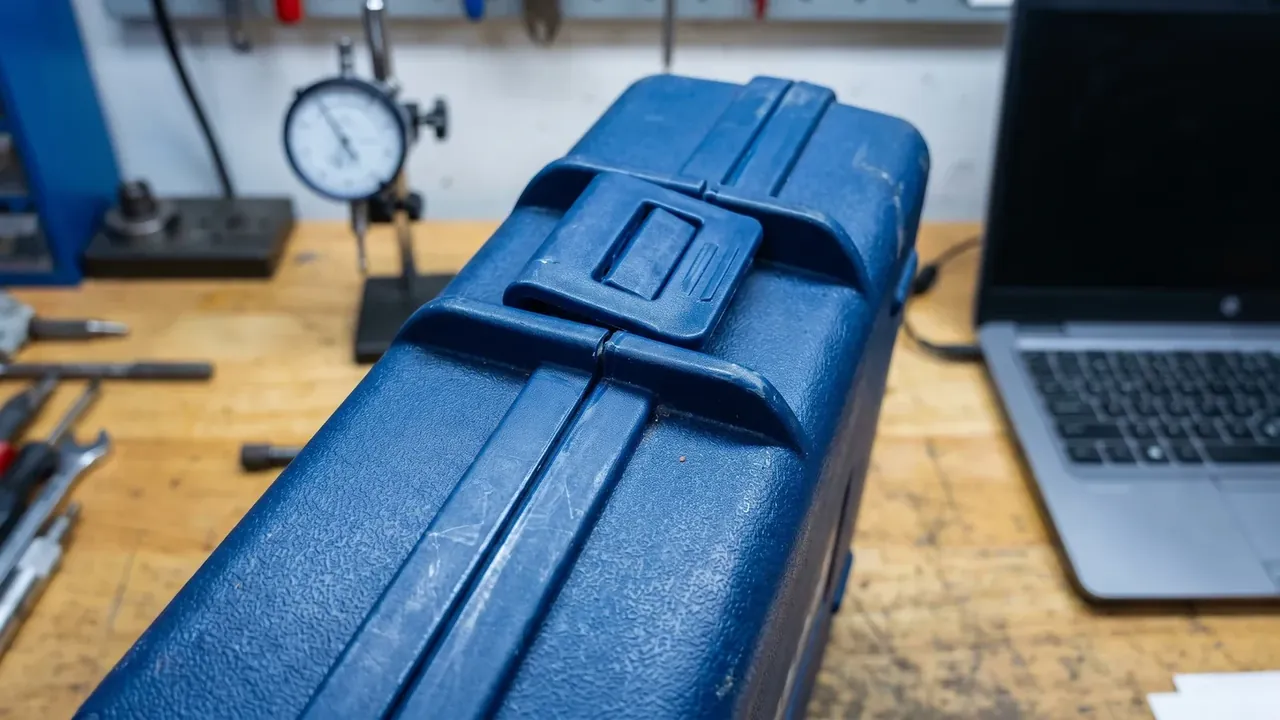
Rate a drawer at 8 to 15 kg and read the slide, not the shell. A ball-bearing slide running 50,000 cycles at 12 kg still holds front-edge droop under 1.5 mm, while a plain roller slide of the same size feels gritty by 20,000 cycles.
Overload shows up as a gap: 18 kg of fittings in the bottom drawer widens the front gap from 2 mm to 4 mm within three months.
3. Slide Travel and Full Extension: What Changes at the Drawer Front
Three-section slides decide whether the drawer clears the shell. At 0.95 of a 380 mm drawer depth the front edge projects 320 mm, the last 30 mm in shadow.
A half-open drawer hides its back row, so the hand that reaches in grabs the wrong item. Full extension drops the eye to the base and lifts first-try accuracy from seven in ten to better than nine. Three details matter more than section count: a travel-to-depth ratio under 0.9 leaves a blind zone, a 2.5 mm end stop eats another 5 mm, and weak damping lets an empty drawer slam home. The plastic toolbox with drawers splits cleanly, two-section slides reaching six tenths of drawer depth, three-section ball slides 0.95.
4. Anti-Open Latches and Dividers: Two Failures
A rolling case will meet a sudden stop. With only magnets or friction detents, a drawer pushed at 0.8 m/s slides open 40 mm when the casters lock.
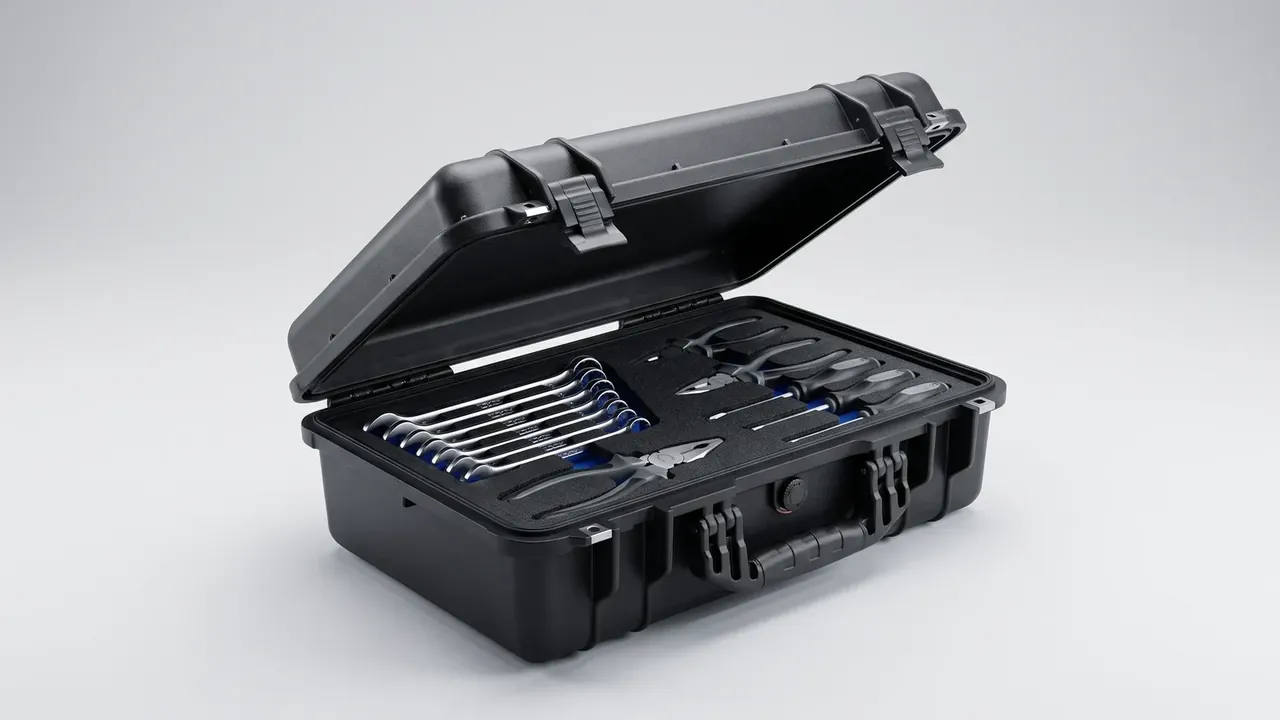
The fix is a 6 mm tab inside the drawer face. Pulling takes about 22 N to deflect it, light enough for a thin glove, firm enough to hold against a stop. Failure one: someone flattens the tab, and two months later the full drawer lands on a boot. Failure two: lengthwise strips only, so wrenches stack and finding a 13 mm means lifting four. Space dividers by tool width: 28 mm for wrenches, 14 mm for bits, 3 mm clearance around O-ring boxes. A 2 mm divider is enough.
5. Rolling, Parking Brake and the Six-Second Pick
Four 75 mm casters, two leading swivel units with brakes. Rolling 21 kg across 6 mm epoxy flooring takes 34 N to start, one hand is enough; an 8 mm threshold pushes that to 61 N.
The brake holds the whole case. A single-side pedal locks two wheels, and the case still creeps 120 mm on a 3 degree slope; a two-pedal version costs about 18 more.
Split the pick into four beats:
- Turn to the case: 0.8 s
- Pull to full extension: 1.2 s
- Take and check: 2.4 s
- Push back and latch: 1.4 s
That totals 5.8 s, matching the stopwatch in section one. Fix the longest beat, not the case, and never skip the latch: an unlatched drawer causes both failures above.
Conclusion
In a repair bay the lost seconds are reach and the walk back; a plastic toolbox with drawers compresses both into under six seconds through layer height, slide travel, latch force and a brake that holds. Set drawer count from the longest tool, slides at 0.95 of drawer depth and dividers by tool width. Then the plastic toolbox with drawers is part of the path, not an object beside it.
This article discusses only the container (case body) side of specifications and design intent, and does not cover any handling, loading or use of the contents.
Related Reading
- How road cases are anchored for field work
- Opening configurations for medical cases in ward transfers
- Transit cases and dock handling
- Equipment cases in rack-room service positions
Related Products
- 8 Series — Gun Cases; Military Equipment Cases; Camera Equipment Cases; Drone Cases; Watch Cases; Knife Cases; First Aid Cases; Electronics Equipment Cases
- WL8-2812 PP Gun Case — model WL8-2812
- All protective cases and toolboxes: 7 series, 158 models