

Quick answer: Police anti-riot gear storage transit box dividers hold when a ±0.25 mm slot and 160 mm strip span keep loosening under 0.45 mm across 30 transfers.
Table of contents
- Divider slot tolerance of a Police anti-riot gear storage transit box
- How far the lid hold-down strip bends
- Loosening tracked across thirty transfers
- Residual set left after divider cycling
- Closing the tolerance band for storage batches
- FAQ
1. Divider slot tolerance of a Police anti-riot gear storage transit box
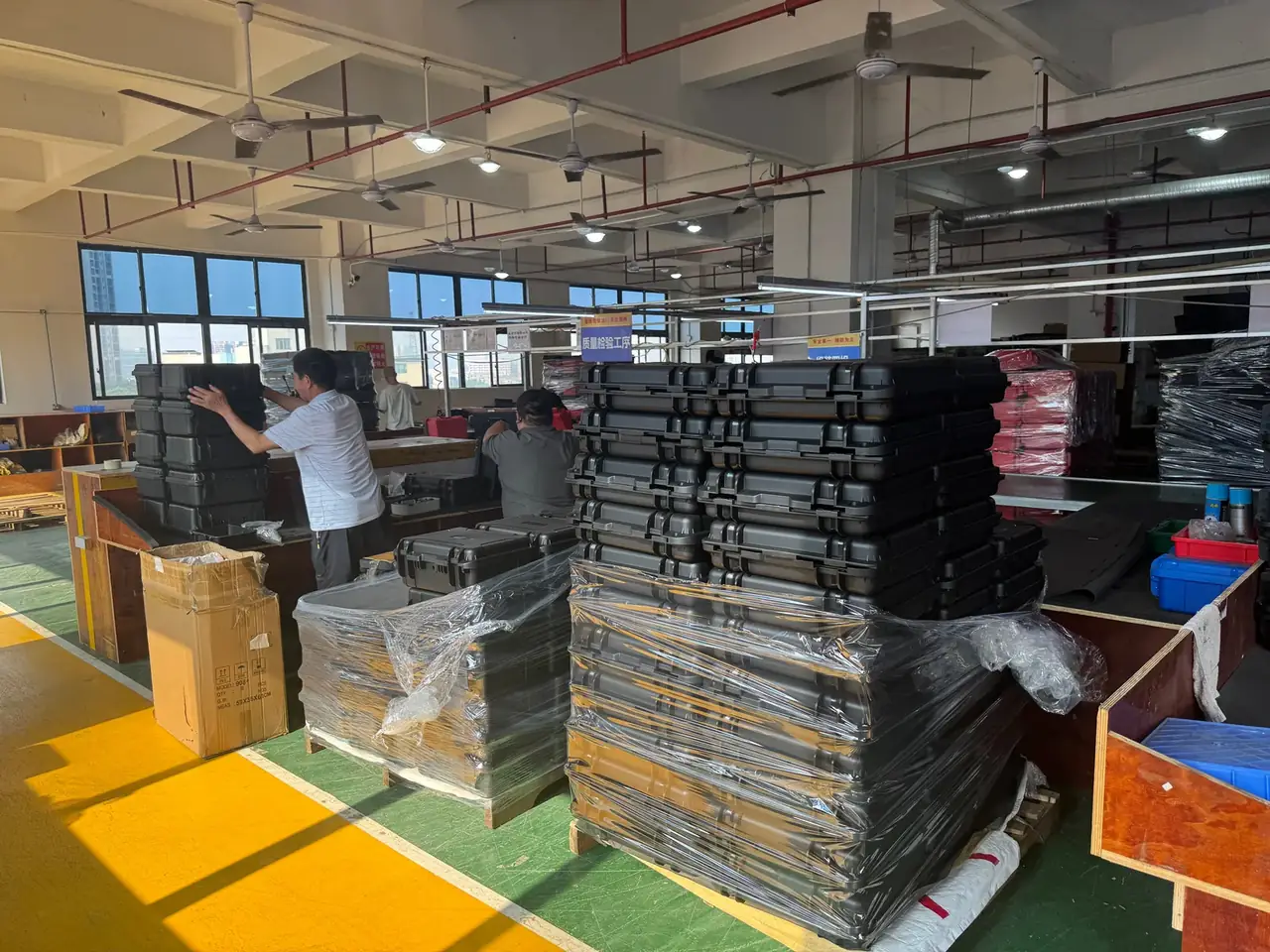
Dividers work loose after the thirtieth loading: the slot tolerance yields first, then the residual bend of the hold-down strip magnifies it. The shell runs 680×470×270 mm outside and 605×400×200 mm inside, with a 4.9 mm wall; milled slots along the base take removable dividers. Slot tolerance is held at ±0.25 mm, the first fit value on the drawing: too tight and the divider will not seat, too loose and it rocks in transit. A Police anti-riot gear storage transit box treats this slot as the location datum, checked with a go/no-go gauge along both walls.
Trial tiers of ±0.15 mm, ±0.25 mm and ±0.35 mm do not scale evenly: the tight one scuffs the slot white, the loose one lets a divider knock the wall, and only the middle holds both. Inspectors gauge slot width empty, then with dividers fitted for a Police anti-riot gear storage transit box; a disagreement sends the cutter back for a deflection check.
| Tolerance tier | Empty-slot width | Fitted divider play |
|---|---|---|
| ±0.15 mm tier | 0.13 mm | 0.05 mm |
| ±0.25 mm tier | 0.24 mm | 0.12 mm |
| ±0.35 mm tier | 0.34 mm | 0.31 mm |
2. How far the lid hold-down strip bends
A soft lid strip presses on the divider tops to stop them jumping in transit. Its span is 160 mm: longer sags at midspan, shorter misses the edges, and a shifted contact drags the loosening reading. The strip is trimmed to the full bay length so no divider top sits under an unsupported stretch, and its ends are tucked under the end walls before the lid closes.
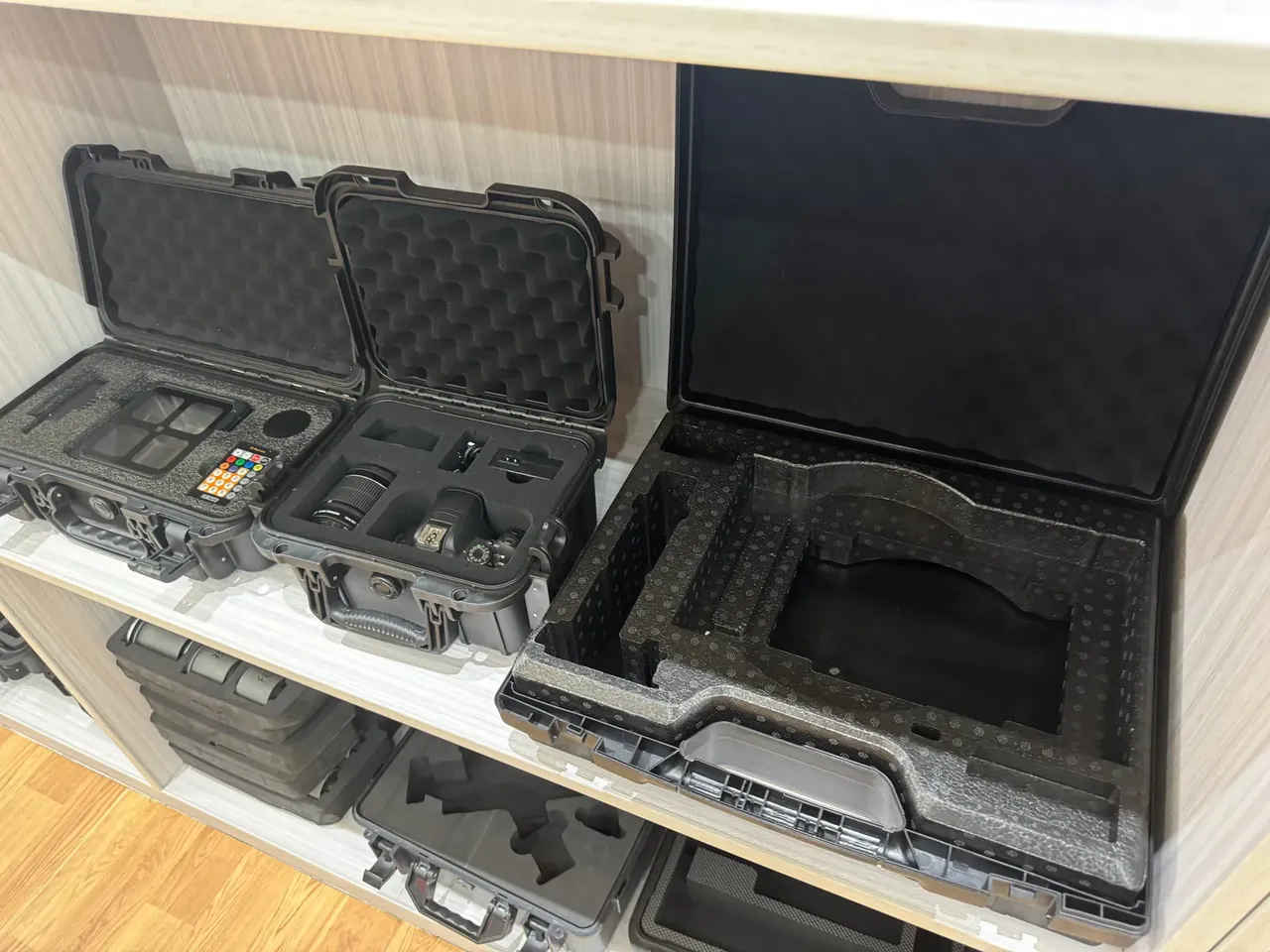
A closed-cell strip is bonded with adhesive and clips, and replaced if rebound falls below nine tenths of its thickness. The four latches, 440 N each, are pulled back one by one; lost clamp force shows as a gap at the top. Before a Police anti-riot gear storage transit box leaves the line, the lid check logs span, rebound rate and latch recovery on one card.
3. Loosening tracked across thirty transfers
The condition is 30 loadings, ballasted to 21 kg against an 8.4 kg empty shell, with the lid opened between runs on a level pallet. A feeler gauge reads the largest bay gap; once loosening passes 0.45 mm, this Police anti-riot gear storage transit box batch is kept for single-layer storage.
| Transfer number | Loosening added | Cumulative maximum |
|---|---|---|
| Run 10 | 0.10 mm | 0.14 mm |
| Run 20 | 0.16 mm | 0.30 mm |
| Run 30 | 0.15 mm | 0.45 mm |
Loosening is no steady climb: the stretch after run twenty rises fastest as the strip's permanent set eats the slot play. After 4000 open-close cycles the hinge presses less, so the feeler re-check waits until it settles. The transfer log of a Police anti-riot gear storage transit box keeps off-truck figures separate from post-rebound ones. Two inspectors gauge the same run, and a spread over 0.05 mm means one more reading. Run thirty sits at 0.45 mm; run twenty-nine is a trend marker.
4. Residual set left after divider cycling
Dividers are drawn out and re-inserted, and the bend left in the strip is measured. Residual deflection is capped at 0.25 mm, read as midpoint height against an untouched section. Police anti-riot gear storage transit box drawings place this re-check after the transfers, since a set strip biases the next loading. A depth gauge zeroed on the unpressed lid gives the midpoint sink.
| Loosening reading | Matching residual set | Action for the tier |
|---|---|---|
| Below 0.30 mm | 0.15 mm | Into circulation |
| Around 0.40 mm | 0.21 mm | One more check |
| At 0.45 mm | 0.25 mm | Seal a sample |
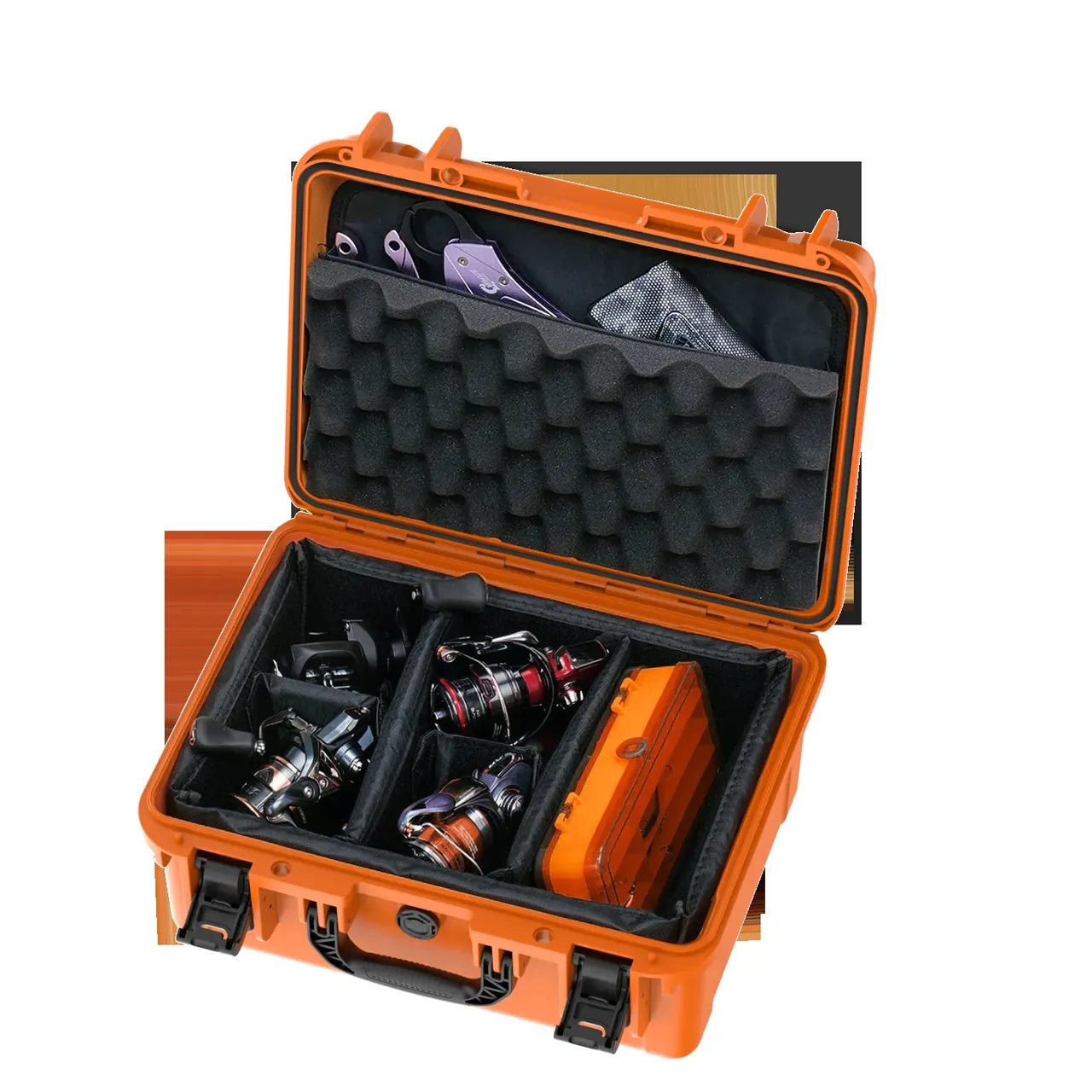
The two lid seals at 22 % squeeze, checked against IP66, are reviewed too: a cocked lid makes squeeze uneven, so compression is measured section by section. The strip reading counts only after the lid is flat again. The same pass confirms that no fixing clip has lifted away from the lid after the cycling.
5. Closing the tolerance band for storage batches
The closure takes the widest tier still below 0.45 mm after run thirty; wider slots are sent back for mould correction. Rather than averaging the three tiers, it takes the widest passing one, since store dividers are pulled often and some slack beats hand-fitting each shell. The drawing gathers ±0.25 mm slot tolerance, 160 mm span and lid flatness into one band; each cutter regrind is trial-fitted, and a drift beyond 0.03 mm reopens the tiers. A reference divider on the rig confirms the fixture has not moved before each batch. Records for a Police anti-riot gear storage transit box split into empty-slot widths and thirty-run loosening, and both must pass. Tolerance tier, transfer number and loosening reading sit in three columns, so a drift is traced down that column to its run. The release line of a Police anti-riot gear storage transit box accepts only that widest tier.
Conclusion
A Police anti-riot gear storage transit box is judged on the shell side by three figures, ±0.25 mm slot tolerance, 160 mm strip span and 0.45 mm loosening across thirty runs. Residual deflection under 0.25 mm and a flat lid after 4000 cycles decide if dividers return to their slots. Tolerance tier, transfer number and loosening reading in one table show which run drifts. Only when all three sit inside one band does the shell stand repeated insertion.
Related Reading
- Police gear hard case with custom foam insert
- Traffic enforcement evidence case
- Emergency supply case selection guide
- Emergency response command case
Related Products
- 8 Series — Gun Cases; Military Equipment Cases; Camera Equipment Cases; Drone Cases; Watch Cases; Knife Cases; First Aid Cases; Electronics Equipment Cases
- WL8-2812 PP Gun Case — model WL8-2812
- All protective cases and toolboxes: 7 series, 158 models