

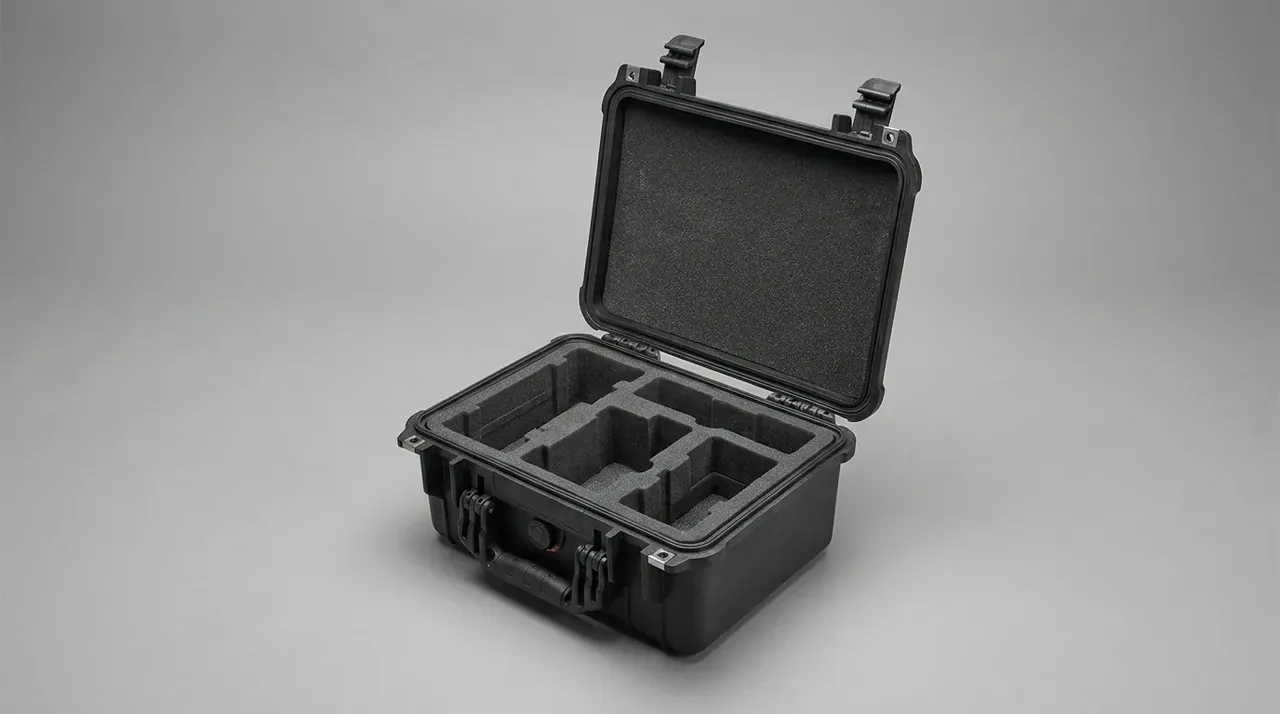
Quick answer: A Police gear hard case with custom foam insert splits 205 mm into 25 mm egg crate, 50 mm pre-cut and 10 mm base pad, so 10 slots return gear in 8 s.
Table of contents
- Why a Police gear hard case with custom foam insert uses three layers
- 25 mm egg crate: contact, not clamping
- 50 mm pre-cut layer and 10 slots: where 8 s comes from
- The 10 mm base pad, four 400 N latches and a 1.2 m drop
- 45 kg/m³ and 5 percent: what is left in year three
- FAQ
1. Why a Police gear hard case with custom foam insert uses three layers
Two demands pull against each other: fit everything, and get it out fast. A block cut to the floor leaves no room for fingers; a thin sheet lets gear shift. A Police gear hard case with custom foam insert splits the job into three layers.
Inside 505×365×205 mm the split is fixed: 60 mm at the bottom from the 50 mm pre-cut layer and 10 mm pad, 25 mm of egg crate in the lid, 120 mm clear between them. That 120 mm sets how tall the contents can be.
Outside it measures 560×420×250 mm with a 3.8 mm wall, 5.8 kg empty, 12 kg loaded; at 45 kg/m³ the layers add 0.7 kg.
| Insert layer | Thickness | Job |
|---|---|---|
| Egg crate, lid | 25 mm | Contact, stops lift |
| Pre-cut layer, base | 50 mm | 10 slots, limits travel |
| Base pad | 10 mm | Slot support, second cushion |
2. 25 mm egg crate: contact, not clamping
The crate makes contact; it does not clamp. A 25 mm peak closes to 21 mm, 16 percent compression, enough to stop lift without prizing the lid up. Clamp harder and the latches must beat the foam back to reach the catch.
Above 30 percent, every opening fights a spring. Below 10 percent, gear lifts and lands elsewhere on a rough road and slot edges fray. A Police gear hard case with custom foam insert writes the number on the drawing because it decides feel and life, not looks.
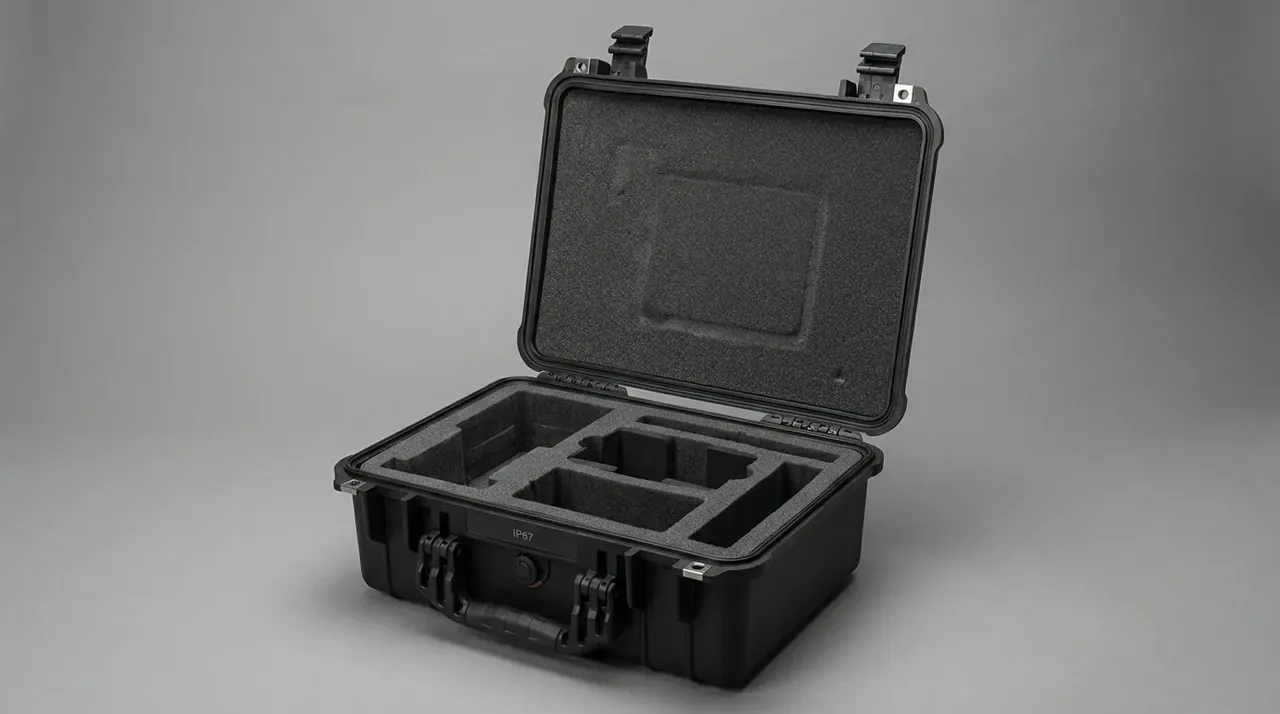
Peaks sit at 18 mm pitch with a 3 mm land, and the cut stops short of going through, so the crate keeps a skin.
Temperature is left out most often. At −25 ℃ the foam stiffens and 16 percent costs more force; at 60 ℃ it returns slowly and the lid needs two seconds to settle.
3. 50 mm pre-cut layer and 10 slots: where 8 s comes from
The 8 s figure for a Police gear hard case with custom foam insert is a sum: 2 s to open, 1 s to locate, 3 s to pull, 2 s to close.
Slot width runs 2 mm over the outline; depth runs 5 mm under the height, so the edge stands 5 mm proud. The 10 slots follow use frequency, the busiest nearest the hinge.
Depth tolerance of ±1 mm is waved through most often. Cut three slots 2 mm deep and the reveal drops to 3 mm, a gloved hand cannot grip, and 8 s becomes 12 s. Acceptance is on ±1 mm, not on looks.
Between slots sits an 8 mm rib. Remove it and two items knock together; widen it to 15 mm and the area no longer carries 10 slots.
| Thickness | Where it sits | Relation to the 205 mm cavity |
|---|---|---|
| 25 mm | Egg crate in the lid | Closes to 21 mm |
| 50 mm | Pre-cut layer | 45 mm slots, 5 mm skin |
| 10 mm | Base pad | Margin under the slot floor |
| 120 mm | Clear height | Space before the crate compresses |
4. The 10 mm base pad, four 400 N latches and a 1.2 m drop
The pad of a Police gear hard case with custom foam insert is 10 mm and its job is the second stage, sitting under the 5 mm of skin that already carries load. In a 1.2 m drop these 10 mm shave the peak.
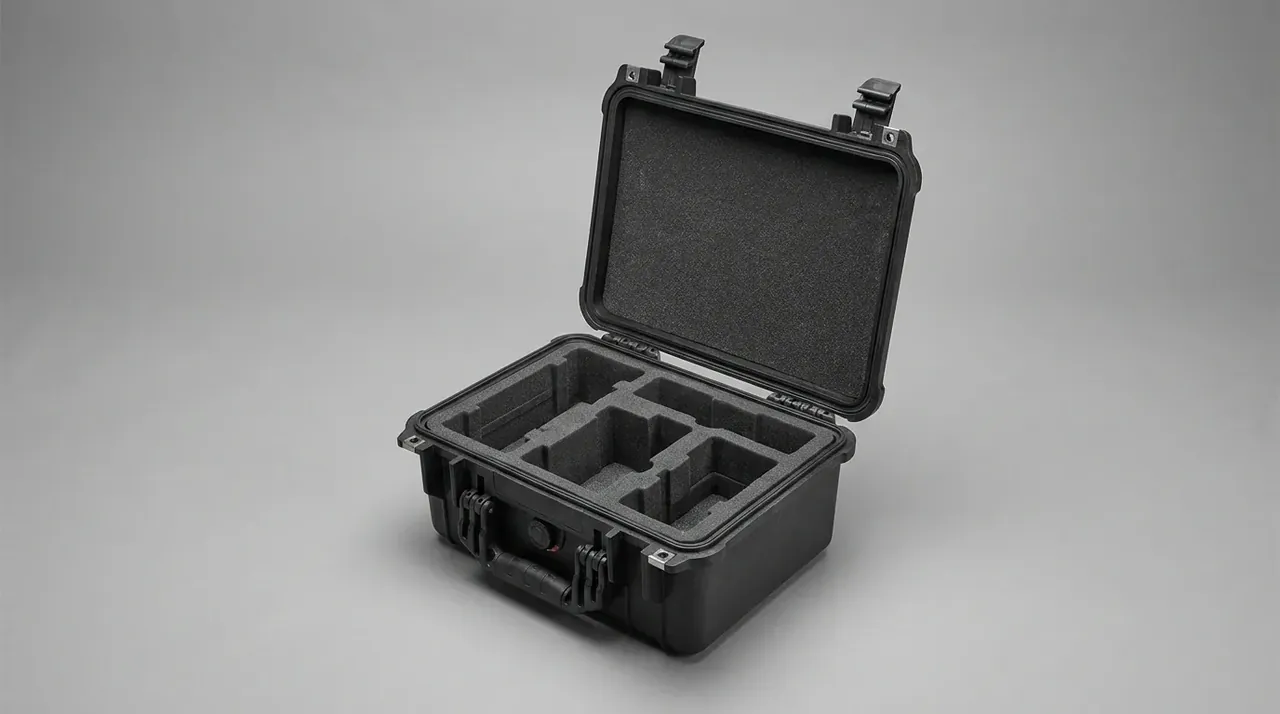
A 12 kg load in a 1.2 m drop lands at 4.9 m/s. The layers offer about 19 mm of stroke: 4 mm of crate, 5 mm of skin, 10 mm of pad, roughly 63 g. Cut it to 10 mm and the same speed needs 120 g, straight into the contents.
Four latches at 400 N each, 1600 N together, press one gasket at the rim. Closing first beats the crate back; only what is left reaches the gasket. Push compression from 16 to 30 percent and net gasket load drops, where IP67 starts to hang.
Across −25 ℃ to 60 ℃ there is one item at each end. Cold stiffens the foam, so 400 N feels heavier. Heat softens it, slot walls spread 0.3 mm under 12 kg, and 2 mm of clearance becomes 1.7 mm.
| Job | What carries it | Failure signal |
|---|---|---|
| Contact | Crate, 25 mm closed to 21 mm | Contents lift, edges fray |
| Location | 10 slots, 2 mm clearance | Contents shift, reveal shallow |
| Cushion | 10 mm pad, longest part of 19 mm | Slot floor crushes, drop sounds flat |
5. 45 kg/m³ and 5 percent: what is left in year three
Density of 45 kg/m³ is shared by all three layers: under 40, walls collapse under grip load; over 55, the knife edge turns brittle and the cut face goes ragged.
Compression set is measured at 70 ℃ for 22 h at 50 percent compression, with a 5 percent limit. Past that, walls never return and the second fit is loose.
By year three the crate of a Police gear hard case with custom foam insert moves first. Pressed and released daily, 25 mm of peak falls to 23 mm and compression slides from 16 to 8 percent, onto the side that lets gear lift. The pre-cut layer is cut once and keeps its shape.
Maintenance runs on two clocks: the crate by feel, when it stops springing back; the pre-cut layer by width, when clearance grows to 3 mm.
Conclusion
A Police gear hard case with custom foam insert works in three parts: 25 mm of contact, 50 mm of location, 10 mm of cushioning. Stacked into 205 mm they leave 120 mm clear and bring 10 slots to 8 s. Density at 45 kg/m³ and set under 5 percent decide year three; four 400 N latches decide IP67.
Related Reading
- How to write specs for a custom foam insert case
- Custom case insert specs and drawing approval
- Filling in a custom foam insert spec sheet
- The EVA foam insert custom process
Related Products
- 8 Series — Gun Cases; Military Equipment Cases; Camera Equipment Cases; Drone Cases; Watch Cases; Knife Cases; First Aid Cases; Electronics Equipment Cases
- WL8-2812 PP Gun Case — model WL8-2812
- All protective cases and toolboxes: 7 series, 158 models