

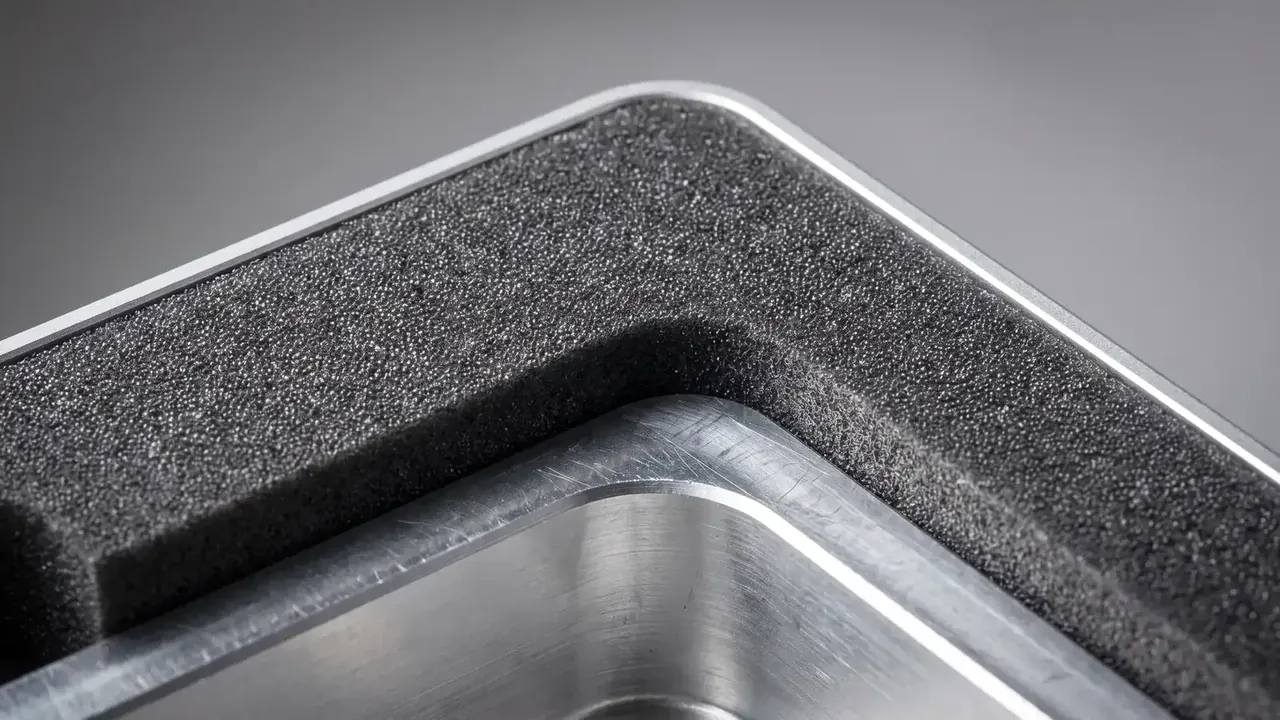
Quick answer: A custom foam insert case is specified by six measurable numbers: density, hardness, cutting tolerance, die clearance, layer count and compression set. Fix density and hardness from unit weight and contact area, hold pockets with a ±1 mm tolerance, then close with 5% compression set plus flame and RoHS reports.
Table of contents
- The Six Parameters of a Custom Foam Insert Case
- Density and Hardness Are Separate Decisions
- Cutting Tolerance and Die Clearance
- Layer Count From One to Four
- The Five Percent Compression Set
- Flame Retardance and RoHS
- FAQ
1. The Six Parameters of a Custom Foam Insert Case
An insert specification is not negotiated by feel. Six parameters can be drawn and re-checked: density, hardness, cutting tolerance, die clearance, layer count and compression set. Soft, springy and snug must each become one of those six.
Order runs weight, contact area, allowed sink, then density and hardness, then layer split, then tolerance. Table 1 is read by unit weight, not case size.
| Material | Density (kg/m³) | Hardness (Shore A) | Working load (kg) |
|---|---|---|---|
| Low density EPE | 25-35 | 25-35 | 0.5-3 |
| Medium density EPE | 40-55 | 35-45 | 3-8 |
| EVA | 45-70 | 40-60 | 8-20 |
| PU | 30-60 | 25-50 | 2-12 |
A 2.4 kg rangefinder on four 25 mm pads gives 2500 mm² of contact at 0.009 MPa; 30 kg/m³ EPE sinks 2 mm, 55 kg/m³ stays under 0.8 mm.
2. Density and Hardness Are Separate Decisions
Writing density and hardness as one number is why a custom foam insert case arrives feeling wrong. Density governs sinking under load and repeated compression; hardness governs contact pressure and finish marking. The same 45 kg/m³ block sits at 30 or 50 Shore A.
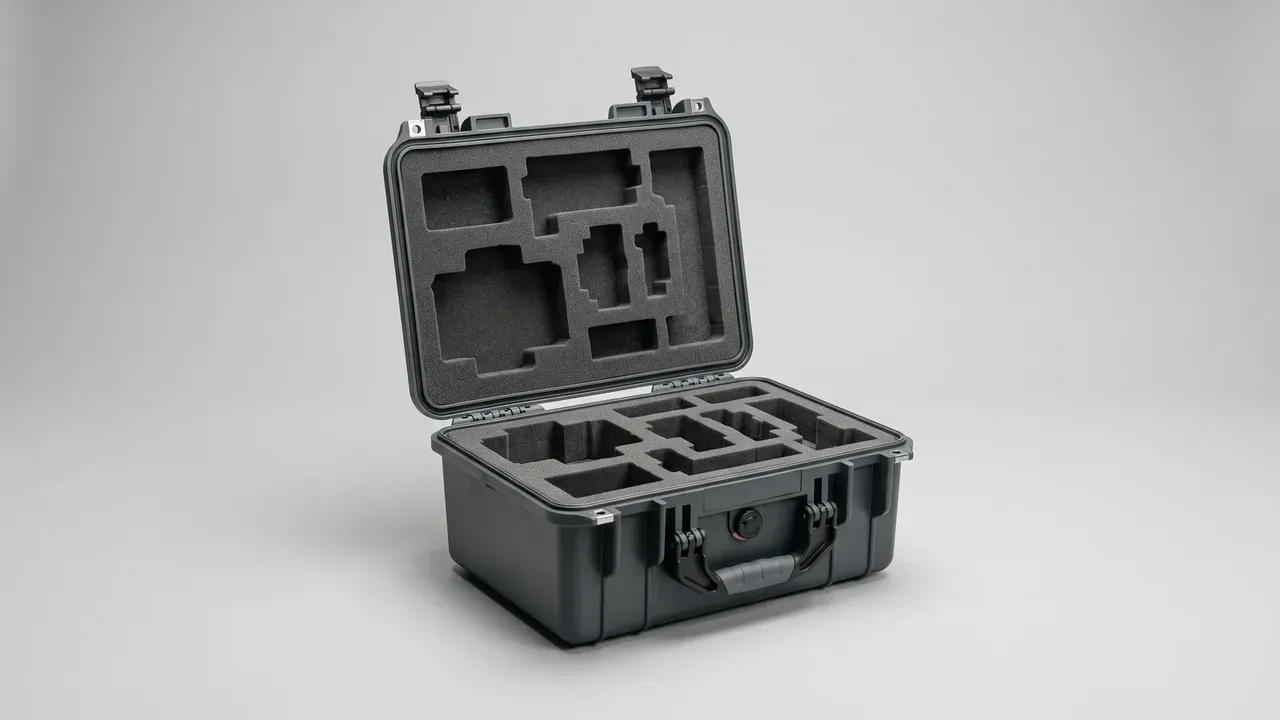
At 0.005 MPa, 25 kg/m³ EPE sinks 8%, 45 kg/m³ 3%, 70 kg/m³ EVA 1.5%. Density moves capacity in multiples; hardness trims within a band.
Optics take 25-30 Shore A, where a deeper sink beats a pressure mark. Edged metal takes 45-60 Shore A with a 2 mm relief opposite each edge. Above 8 kg per unit, stay above 40 Shore A or the pocket wall collapses.
3. Cutting Tolerance and Die Clearance
Tolerance placement decides who proves what. CNC reciprocating cutting holds ±1 mm over a 300 mm stroke; past 600 mm the middle drifts about 0.5 mm from wire tension.
Six lines cover the block:
- Outer profile: ±1.0 mm from the cavity minus edge allowance
- Pocket length and width: ±1.0 mm at the narrowest point
- Pocket depth: ±1.5 mm including adhesive build-up
- Pocket centre distance: ±1.2 mm from the datum pocket
- Wall between pockets: not under 8 mm, or the foam slumps
- Die clearance per side: 0.5 mm, down to 0.3 mm below 20 mm
Die cutting differs. A steel rule severs the foam, so clearance controls the edge: too much and the cut sheds crumbs, too little and the foam springs back 0.6 mm small.
4. Layer Count From One to Four
A custom foam insert case uses one to four layers, following the changeover plan rather than pocket depth. What decides it is whether depth exceeds one stable block, whether a middle layer swaps by variant, and whether the lid needs compression.
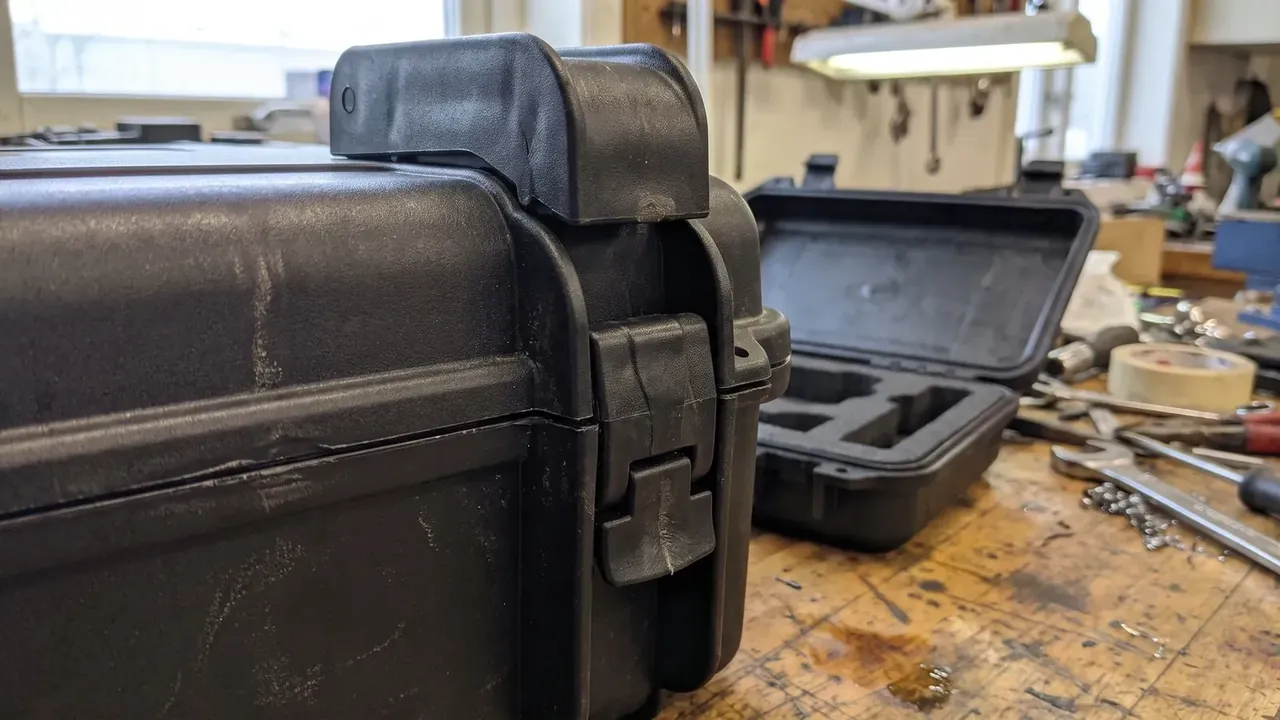
One layer suits 20-30 mm pockets at the lowest cost. Two layers, 20+20 or 30+30, carry load below and profile above. Three cover 50-70 mm with a 20 mm base, 30 mm pocket layer and 10 mm facing. Four appear only where a whole layer is replaced.
Keep glue lines under 0.1 mm. A thicker line makes a hard spot that shows up first in a 1 m six-face drop.
5. The Five Percent Compression Set
Compression set is the only parameter that worsens with time, and the one most often skipped. Compress a sample to 50% of its thickness, hold 24 h at temperature, rest 30 min, measure the loss. GB/T 6669 asks 5% or less at 23 °C and 8% or less at 70 °C. Read both: a grade that passes cold and fails hot thins visibly after two weeks in a summer cabin. The loss does not break the case, it loosens the pocket, where 1.5 mm of interference per side falls to 0.4 mm at 8% set, the unit shifts and its edges strike the wall. Design interference from the hot figure.
6. Flame Retardance and RoHS
The insert is the only part using a large volume of expanded material, so flame and hazardous substance reports belong to the insert, not the case body.
| Item | Criterion | Test condition |
|---|---|---|
| Burning behaviour | GB 8624 class B1 | 30 s horizontal burn, 0 s afterflame |
| Oxygen index | 26% minimum | GB/T 2406.2 |
| Heavy metals | Pb, Cd, Hg, Cr(VI) each under 100 mg/kg | RoHS homogeneous split |
| Phthalates | Four items each under 0.1% | RoHS 2.0 amendment |
| PAHs | Benzo[a]pyrene under 1 mg/kg | AfPS GS 2019 method |
Retardants cost resilience: a B1 grade runs 1-2 points higher in compression set, so specify against retardant data.
Conclusion
The insert side of a custom foam insert case reduces to six lines: density, hardness, cutting tolerance, die clearance, layer count and compression set. Keep flame and RoHS on a separate report for the foam. Put those lines on the drawing and a custom foam insert case is accepted against a shared ruler.
This article discusses only the container (case body) side of specifications and design intent, and does not cover any handling, loading or use of the contents.
Related Reading
- Foam insert specifications: thickness, compression ratio and tolerance
- Custom foam inserts explained from material to finished part
- Foam cutting processes and cut edge quality
- Fitting an insert into a case and checking the bond line
- Specification system and insert requirements for missile boxes
Related Products
- 8 Series — Gun Cases; Military Equipment Cases; Camera Equipment Cases; Drone Cases; Watch Cases; Knife Cases; First Aid Cases; Electronics Equipment Cases
- WL8-2812 PP Gun Case — model WL8-2812
- All protective cases and toolboxes: 7 series, 158 models