

Quick answer: Portable power tool plastic latch case opens via a 6 mm two-stage travel and button lock, holding ≤42 N release and a ≤0.5 mm gap after 5000 cycles.
Table of contents
- Two-stage locking travel of the Portable power tool plastic latch case
- Latch force and the one-hand opening envelope
- Stress spreading at the latch-seat insert and shell wall
- Cycle settings on the open-close life rig
- Drop no-release judgement and recheck
- FAQ
1. Two-stage locking travel of the Portable power tool plastic latch case
The Portable power tool plastic latch case is sized at 470×350×200 mm outside, 415×295×155 mm inside, with a 3.4 mm wall and 3.9 kg empty mass. Two main catches on the lid long edge each hold 360 N. The catch seats in two moves: the lever lifts the hook clear of the seat, then a button slides across to press the lever into lock. The 6 mm two-stage travel is the window from closed face to full release, with free travel first and the button reached only at the tail.
Splitting the travel serves one-hand opening and knock resistance together. If the shell is knocked and the lever tilts, the button stays locked until the 6 mm is complete, so the hook springs back and the lid stays shut. Across −15 ℃ to 55 ℃ the plastic expands, so the travel margin avoids cold-end binding and hot-end slack; the rig runs 200 cycles at each end to confirm button return.
| Latch travel | Locking stage | Reading |
|---|---|---|
| 0–3 mm | lever lifted | free travel |
| 3–6 mm | second step | button armed |
| 6 mm | fully locked | gap ≤0.5 mm |
| return | hook resets | self-closing |
2. Latch force and the one-hand opening envelope
An opening force of ≤42 N is the ceiling a single thumb can hold steadily. A force sensor on the lever tip loads along the lid normal and records the peak as the hook clears. This differs from the 360 N per catch: that is the hold resisting a pried lid once locked, while ≤42 N is spring preload plus friction at release. One holds, the other lets go.
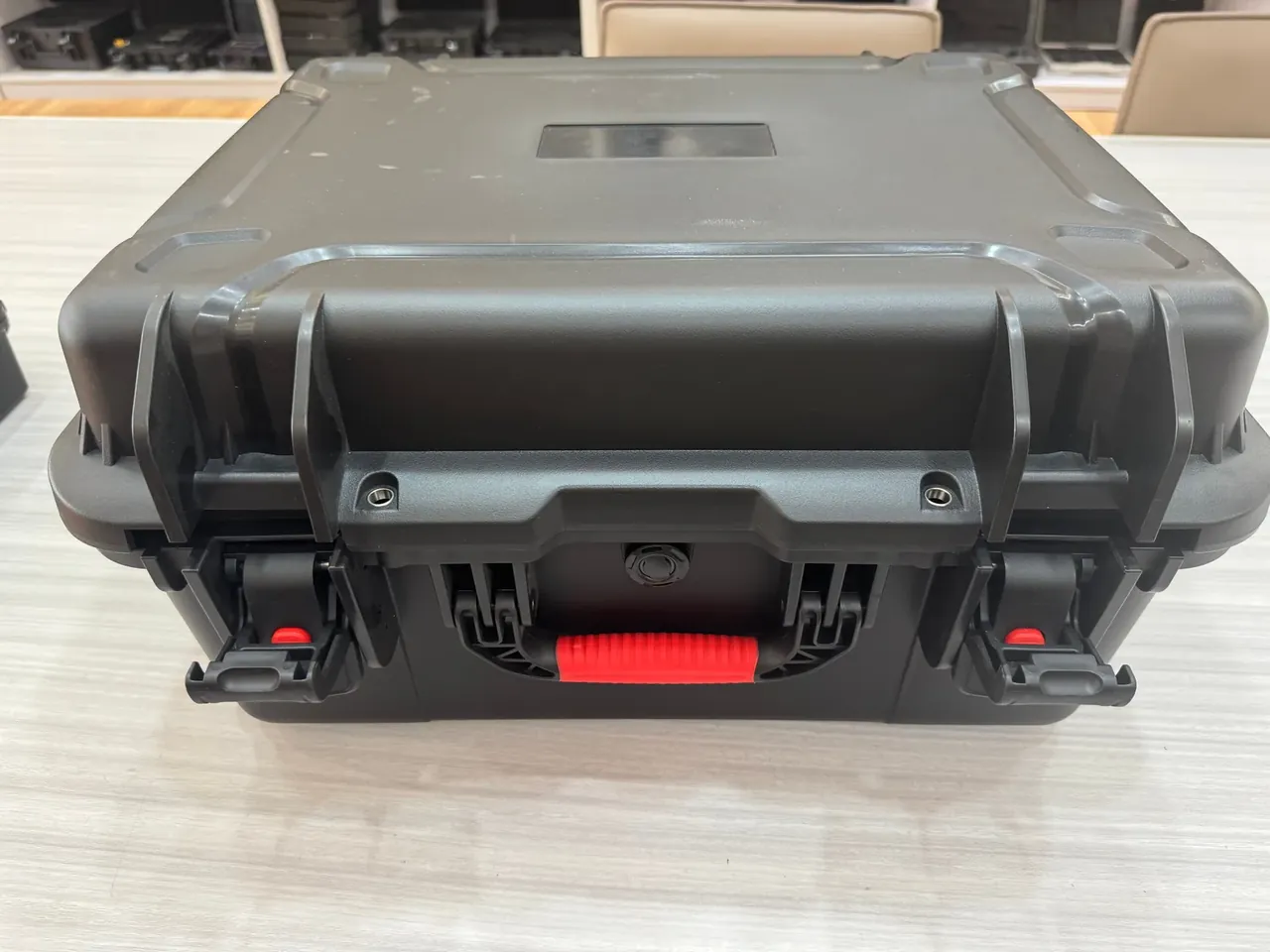
Gross mass of 12.9 kg is the 3.9 kg case plus 9 kg payload, so carrying and opening split between two hands and one hand must finish the release. Force is logged at both ends of −15 ℃ to 55 ℃; the spring stiffens at the cold end and friction falls at the hot end, with both readings required under ≤42 N.
| Force band | Triggering action | Criterion |
|---|---|---|
| ≤42 N | one-hand opening | force ceiling |
| 360 N | main catch hold | per-unit clamping |
| 12.9 kg | gross carrying | empty plus payload |
| 300 wipes | ethanol cleaning | appearance recheck |
3. Stress spreading at the latch-seat insert and shell wall
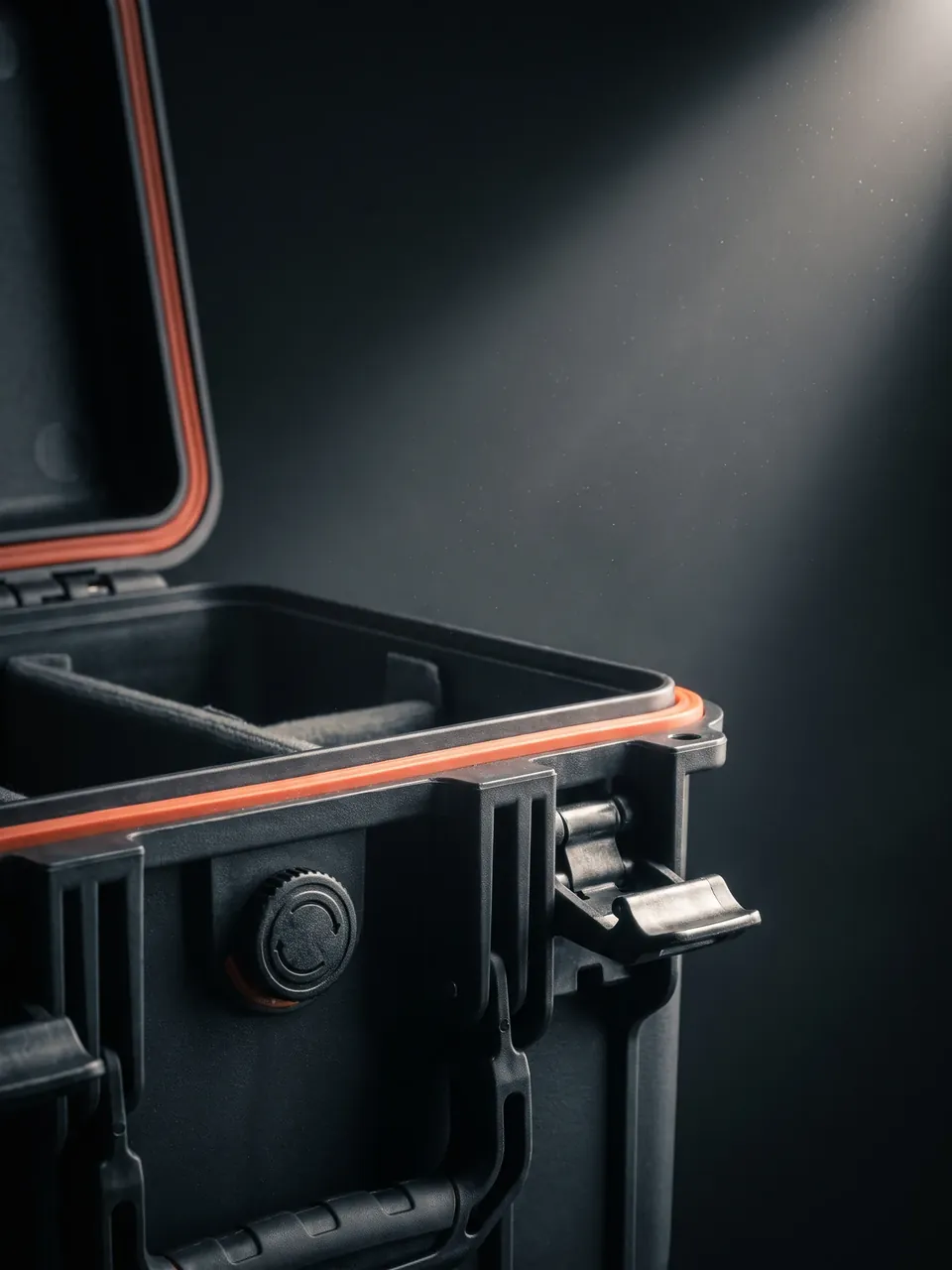
The latch seat of the Portable power tool plastic latch case is not threaded into the 3.4 mm wall; a metal insert spreads the 360 N clamp over a wider shell area. A drop load passes through lid, hook, and seat, so stress crowded at the hole edge would open play after a few cycles and make the lid rattle.
The ≤0.5 mm latch-gap criterion watches this area. A growing gap means the insert has worked loose against the shell, not that the lever bent, so measuring the gap before pulling the seat saves a recheck step. The IP65 sealing face sits apart from the latch seat: the gasket presses on the rim flange, seat bolts carry no torque into the seal, and wiping drives no moisture into the insert joint.
4. Cycle settings on the open-close life rig
A 5000-cycle open-close run is the rig baseline, one cycle covering closing, button locking, release, and lever return at a fixed rate. Force and gap are measured before and after the 5000 cycles; drift must stay inside ≤42 N and gap growth must not consume the ≤0.5 mm margin.
A 70% ethanol wipe of 300 passes follows the cycles to check whether the button face and seat insert look or feel sticky; it is not a life test and does not replace the drop. The pressure valve and rim gasket of the Portable power tool plastic latch case sit out of this loop and are rechecked against IP65 separately.
| Load-bearing hardware | Mounting point | Per-unit or per-pass load |
|---|---|---|
| main catch | lid long edge | 360 N |
| seat insert | inner shell wall | spreads 360 N |
| button spring | lever root | 6 mm travel |
| pressure valve | shell wall | IP65 recheck |
5. Drop no-release judgement and recheck
The 1.2 m drop of the Portable power tool plastic latch case runs on six faces, eight corners, and twelve edges, watching whether the catch releases at impact. Release means the hook leaves the seat and the lid shows a visible gap, not a shell dent or scuff, which belong to appearance. Mass stays at 9 kg payload and 12.9 kg gross, and the button is locked before each drop.
Recheck runs appearance, then latch gap, then opening force; the unit passes if the gap is still ≤0.5 mm and force under ≤42 N. The drop pass record is filed with the 5000-cycle record, and both must clear before release.
In short, travel, force, life, and drop are four independent lines; any line out of bounds sends the check back to the lever and seat fit.
Conclusion
The Portable power tool plastic latch case puts one-hand opening and knock resistance into a 6 mm two-stage travel and button lock, with ≤42 N opening force and ≤0.5 mm latch gap as the two hard criteria. The 5000 cycles and 1.2 m drop watch wear and impact separately, and the 360 N per-catch hold is spread into the shell wall by the seat insert. JUNZHIJIA keeps these readings together in the release file for later batches.
Related Reading
- How latch opening force is measured
- Force and travel in latch selection
- Case latch hardware and assembly
- Plastic tool cases for electrical work
Related Products
- 8 Series — Gun Cases; Military Equipment Cases; Camera Equipment Cases; Drone Cases; Watch Cases; Knife Cases; First Aid Cases; Electronics Equipment Cases
- WL8-2812 PP Gun Case — model WL8-2812
- All protective cases and toolboxes: 7 series, 158 models