

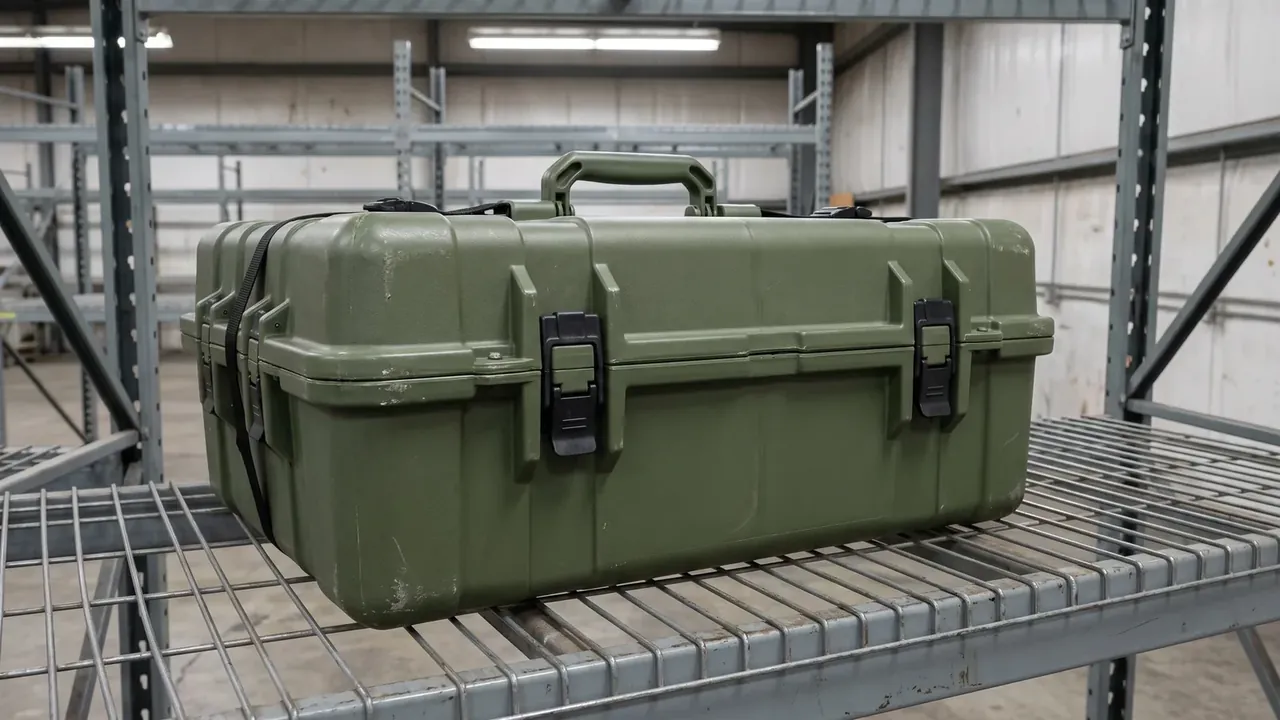
Quick answer: A Portable studio all-in-one machine case holds rib sag under 0.62 mm after 96 h at 72 kg, and lid flatness under 0.38 mm, to fix the 96 mm pitch.
Table of contents
- Tray rib pitch in a Portable studio all-in-one machine case
- Lid compression strip thickness
- Rib sag after ninety-six hours of stacking
- Lid flatness rechecked after unloading
- Rib pitch value for the protective batch
- FAQ
1. Tray rib pitch in a Portable studio all-in-one machine case
Four days under a three-tier stack tell you whether the tray ribs droop: unload it, then read the lid. The Portable studio all-in-one machine case carries load through a row of support ribs molded into the tray floor, set at a 96 mm pitch in this drawing revision. Outer dimensions 680×470×270 mm, inner cavity 610×405×200 mm and a 5.0 mm wall leave only so much room for those ribs. A 6.4 mm compression strip clamps the tray rim along the lid opening and shares the load path with the ribs, so the two cannot be specified apart.
Rib pitch is not one number picked at random; three bands go to trial fit first.
| Rib pitch band | Compression strip | Rig destination |
|---|---|---|
| Narrow band | 6.4 mm | keep as reference sample |
| 96 mm baseline band | 6.4 mm | onto the three-tier stack rig |
| Wide band | 6.4 mm | returned for mold rework |
2. Lid compression strip thickness
The 6.4 mm strip in a Portable studio all-in-one machine case holds more than the sealing face; it also presses the tray rim into one plane, which is why rechecked lid flatness of 0.38 mm ties straight back to it. Two seal rings at 22% compression give the lid its rebound margin, checked against the IP66 test method rather than claimed as a granted certificate. Four latches, each rated 445 N, spread clamping force evenly along the opening so the strip is not lifted locally. Empty shell 8.2 kg and loaded 21 kg bracket the test weights, and after 3600 open-close cycles the strip is inspected for a permanent dent; every reading belongs to the shell, lid and latch, nowhere else.
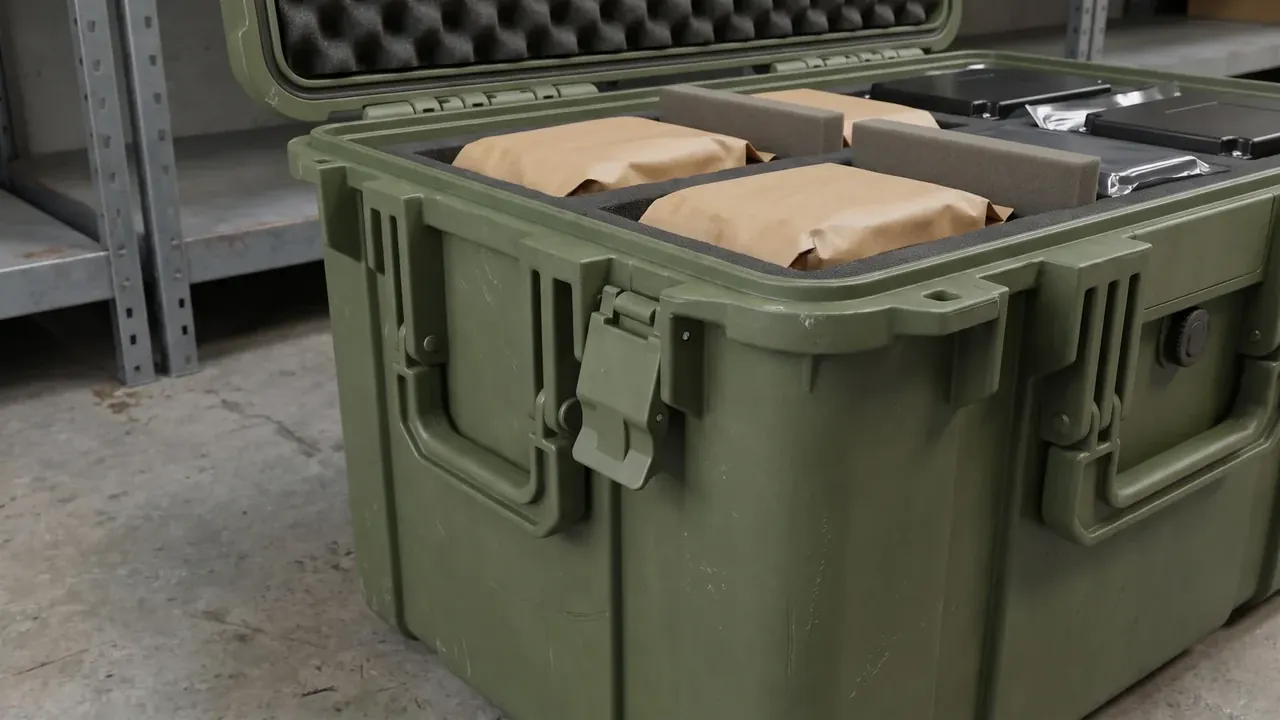
The next move puts strip and rib pitch under one stacking condition. Under a 3-tier, 72 kg, 96 h load curve, the tray and lid of a Portable studio all-in-one machine case deform together, so measuring either alone hides half the picture.
3. Rib sag after ninety-six hours of stacking
Once 96 h at 3 tiers and 72 kg has run its course, the tray ribs of a Portable studio all-in-one machine case leave a slow downward trace, judged against rib sag of 0.62 mm or less. The start interval sets a zero baseline, the full interval shows whether the slope flattens, and the band that lifts earliest is almost always the one with ribs set too wide. The rig measures only relative movement between two ribs on the shell-side tray; how the weights are arranged and what sits inside never enter the log.
The table lays the readings out by stacking interval, each under the same 3-tier, 72 kg load with no condition changes midway.
| Stacking interval | Load condition | Rib sag |
|---|---|---|
| Start of loading | 3 tiers / 72 kg | zero baseline |
| Full 96 h | 3 tiers / 72 kg | <=0.62 mm |
| Unloaded recheck | weights removed | lid flatness <=0.38 mm |
4. Lid flatness rechecked after unloading
Take the weights off and the lid of a Portable studio all-in-one machine case is measured again on its own; flatness of 0.38 mm or less is the line that keeps a band in play. The recheck therefore waits until the shell settles, then a feeler gauge walks the opening for the largest step. This is a separate account from the sag reading: one records the tray between ribs, the other the whole lid face, and neither signs for the other.
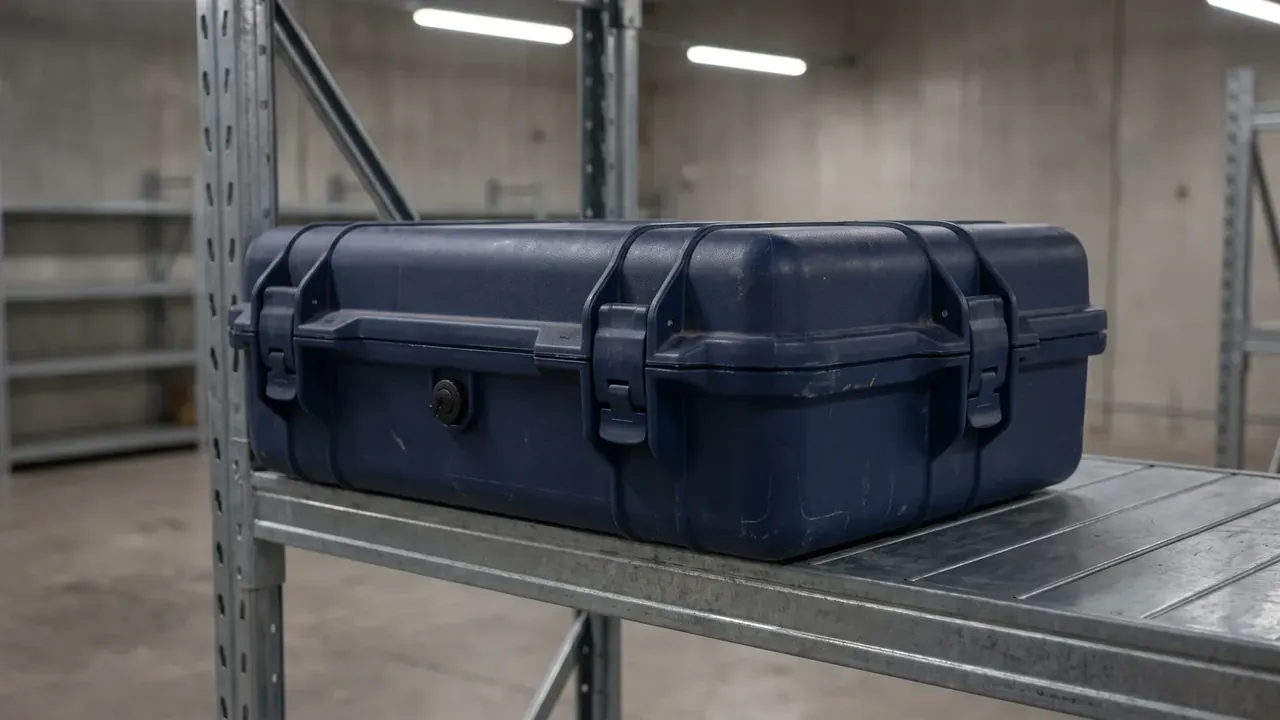
Put the three sag readings into one table and the judgment reduces to a line. A Portable studio all-in-one machine case leaves no gray zone on this sheet: whichever line a number touches decides its disposal.
| Sag reading | How it is taken | Disposal |
|---|---|---|
| Under 0.62 mm | ninety-sixth hour, within line | keep this rib pitch |
| Exactly 0.62 mm | sitting on the reject line | add one more trial round |
| Beyond 0.62 mm | already over the line | return the whole batch for mold rework |
5. Rib pitch value for the protective batch
The reject line comes down to one sentence: the rib pitch value is the widest band whose ninety-sixth-hour sag stays under 0.62 mm, and any wider support rib goes back for mold rework. A Portable studio all-in-one machine case closes on that wording, with the 96 mm baseline band qualifying only if both the ninety-sixth-hour cell and the unloaded recheck cell hold.
Once the value is written into the drawing, rib pitch, the 6.4 mm strip, two seal rings at 22% compression and 445 N latches lock into one tolerance revision, so later batches are checked against it instead of being re-banded each time. From here the Portable studio all-in-one machine case is pure tolerance management on the shell side, unrelated to whatever rests above the tray.
Conclusion
A Portable studio all-in-one machine case closes its stack qualification only when 96 mm rib pitch, the 6.4 mm strip and the two unloaded readings sit on one drawing. JUNZHIJIA signs off only after rib sag and lid flatness have both cleared their lines. With the numbers pinned to tray, stiffener, seal and latch, the drawing tolerance finally has somewhere to land.
Related Reading
- Custom foam insert case specs: 25-70 kg/m³, Shore A, ±1 mm
- Custom Foam Insert Protective Case: Size, Wall Thickness, Load
- Custom Foam Inserts: EVA vs EPE vs PU, and How to Spec the Right One
- How to Customize an EVA Foam Insert: The Full Process from Measurement to CNC Cutting
Related Products
- 8 Series — Gun Cases; Military Equipment Cases; Camera Equipment Cases; Drone Cases; Watch Cases; Knife Cases; First Aid Cases; Electronics Equipment Cases
- WL8-2812 PP Gun Case — model WL8-2812
- All protective cases and toolboxes: 7 series, 158 models