

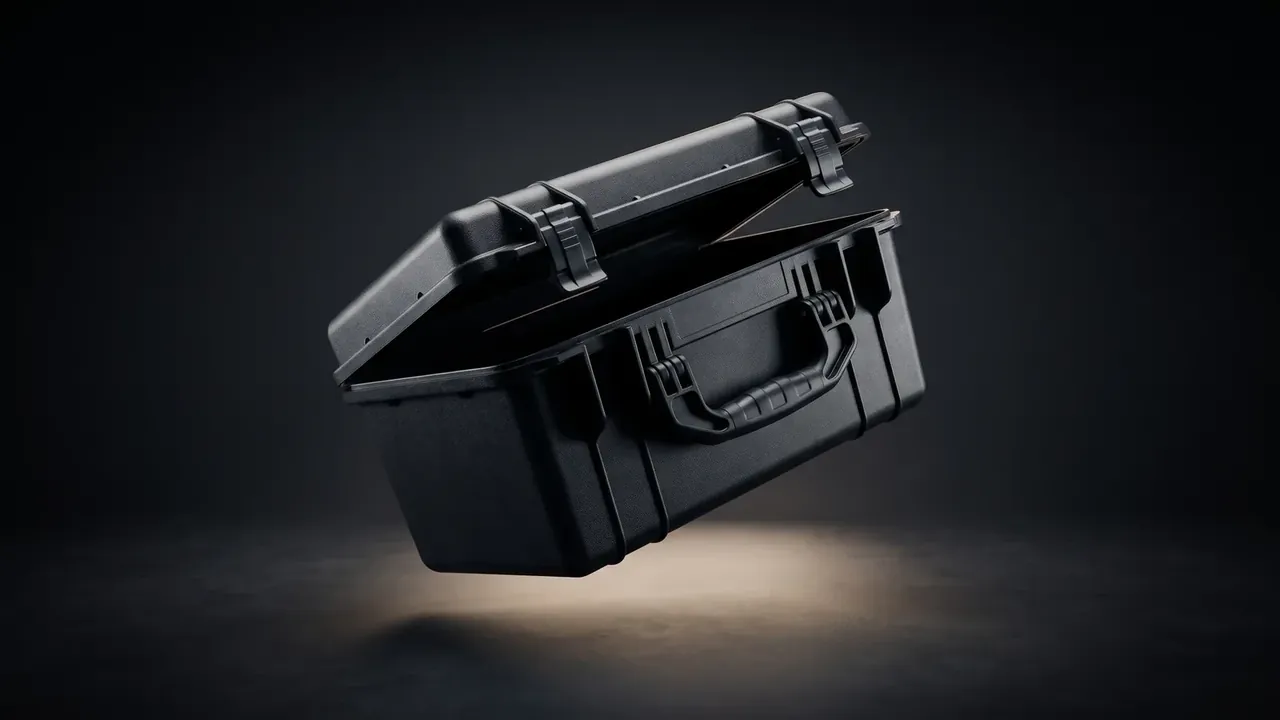
Quick answer: Portable Test Instrument Case at 2.6 kg empty carries 9.5 kg through a 120 mm handle span and 8 mm root ribs, pulled to 190 N for 30 min.
Table of contents
- How Load Travels from Handle to Wall in a Portable Test Instrument Case
- Two Sling Anchors and the Swing Arc of a Walking Carrier
- Hanging and Hand-Swapping on a Stepladder
- Which Corner Lands First After a Slip
- Empty Weight Against Loaded Centre of Gravity
- FAQ
1. How Load Travels from Handle to Wall in a Portable Test Instrument Case
Inside 380×285×145 mm at 2.6 kg empty, the Portable Test Instrument Case holds 9.5 kg behind a 120 mm span. The handle is an arch moulded into the lid, each end dropping into a 60×40 mm boss, so the load becomes 46.5 N per root and 70 N with a 1.5 walking factor.
The trouble sits at the arch foot. The rib is 8 mm thick and fills last during injection; polypropylene shrinks 1.5% to 2.0%, so where that rib meets a 2.8 mm wall the cooling rate splits and a 0.3 mm sink mark lands inside the foot.
That mark is invisible but starts a stress line: 190 N for 30 min will not open it, while thirty thousand lifts raise a 5 mm hairline. An 8 mm rib blending into 12 mm flanks spreads the shrinkage and lifts the static margin from 1.3 to better than 2.
The grip runs 25 mm wide with R3 edges: across four fingers the load is roughly 23 N each, leaving an 8 to 12 mm palm mark, while 18 mm prints an 18 mm band and forces a hand change every 200 m.
2. Two Sling Anchors and the Swing Arc of a Walking Carrier
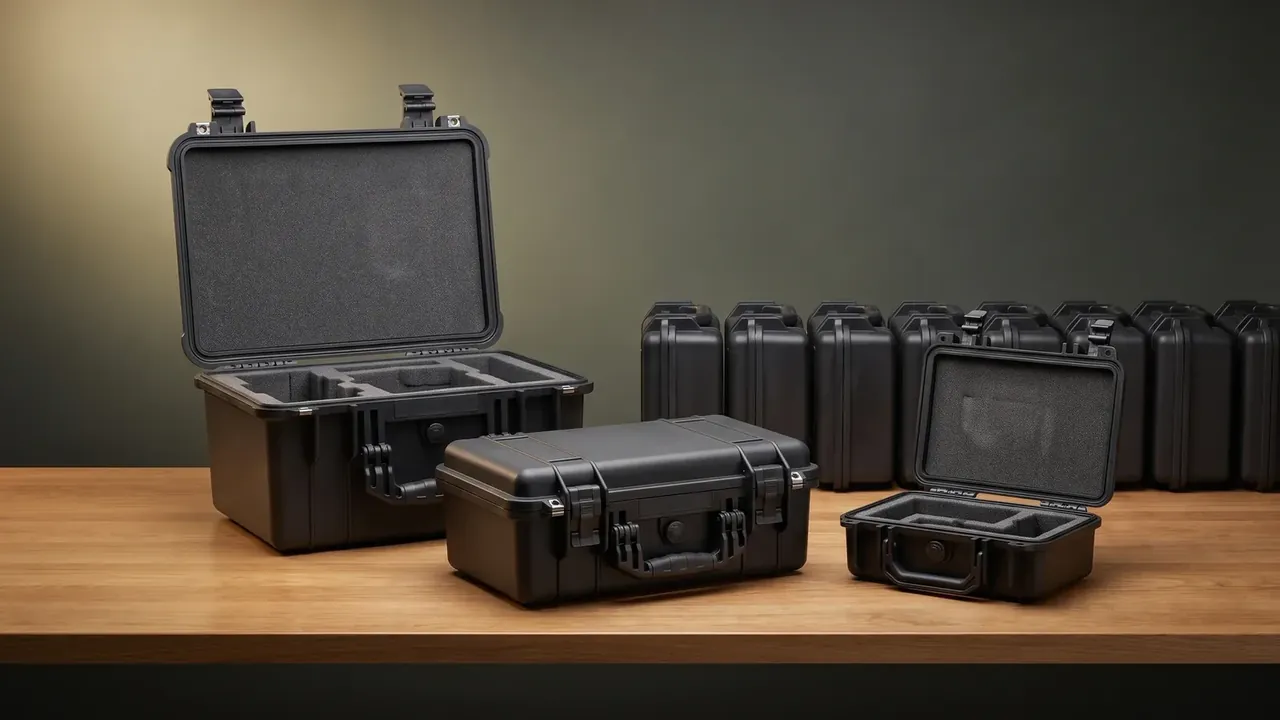
Two φ6 mm stainless rings are riveted into wall pads 90 mm above the base, 15 mm below the loaded centre of gravity at 105 mm, so the case swings on the hip rather than rolling over it.
| Anchor height | Above base | Measured swing |
|---|---|---|
| Wall pad | 90 mm | ±8° |
| One step higher | 130 mm | ±14° |
| Through the lid rim | 160 mm | ±20°, rim gap 1 mm |
At 2 Hz and a 0.7 m stride the shell swings through ±8°, pulls 0.3 g laterally and loads the rings with 28 N; at ±14° that rises to 50 N and drags the strap across the collarbone. A 900 mm strap parks the Portable Test Instrument Case 150 mm above the hip bone, while 1100 mm drops it to the thigh for one impact per step.
The insert is routed to a 380×285 mm pocket 30 mm deep, leaving 8 mm of wall clearance; below 5 mm every swing goes into the shell and the rivets loosen first. EVA at 45 kg/m³ gives about 30 kPa at 25% compression, enough for 9.5 kg.
3. Hanging and Hand-Swapping on a Stepladder
The three-step platform tops out at 900 mm with a 300×250 mm tread, 120 mm short of the 420 mm long side, so the case stands on edge or hangs rather than lying flat.
The hook is rated 40 N and is not load-bearing: half the weight, 47 N, passes that during a two-second hand swap. What it buys is a save if the grip opens, not a rest.
Hanging the Portable Test Instrument Case from its lid handle is the worst option: an 8 mm arch tears sideways and the lid face whitens first. Set it against the inner edge instead, where the 180 mm side gives a 180×320 mm footprint with the mass 40 mm inside.
Rain takes tread friction from 0.6 to 0.35, leaving four 8 mm feet as the only grip; worn to 4 mm they let a tilted case slide 30 mm. The feet are a service part, cheaper to change than to patch a shell.
4. Which Corner Lands First After a Slip
A 1.2 m drop falls 0.49 s and lands at 4.85 m/s. The corner opposite the handle arrives first on a Portable Test Instrument Case, since the shell leans 5° toward the carrying hand at release.
Corners are moulded at R12 with wall thickened locally from 2.8 mm to 4.0 mm and three ribs bracing the inside as a triangle. At 4.85 m/s an R12 corner buys 0.8 ms more deceleration than a square one, cutting peak acceleration from 900 m/s² to 640 m/s².
MIL-STD-810H Method 516.8 Procedure IV scales drop height by mass: about 90 cm at the 20 kg band and 76 cm at 30 kg. A 9.5 kg load sits above the top band, so 1.2 m is an aggravated check rather than a routine pass line.
| Drop height | Impact speed | Corner result |
|---|---|---|
| 0.9 m | 4.20 m/s | Whitened radius, no crack |
| 1.2 m | 4.85 m/s | 12 mm white mark, rib root hairline |
| 1.5 m | 5.42 m/s | Corner splits, rim shifts 2 mm |
At -25 ℃ the notched impact of polypropylene falls from 2 to 4 kJ/m² at room temperature to roughly 1.5 kJ/m², so the same corner cracks more readily in winter. Bring the portable test instrument case from a -25 ℃ trailer into a 20 ℃ room and wait 40 min before touching a latch.
5. Empty Weight Against Loaded Centre of Gravity
Of the 2.6 kg empty, the 30 mm EVA insert takes 0.35 kg, the 2.8 mm shell 1.4 kg and the hardware 0.5 kg; each extra 0.5 mm of wall adds 0.4 kg.
Going to 3.5 mm walls buys little drop margin and costs comfort, since at 3.1 kg the palm mark grows to 16 mm. The budget belongs to insert and hardware, with wall added only at corners and arch feet.
The loaded centre of gravity of a Portable Test Instrument Case sits 105 mm above the geometric centre, so the shell wants to roll, held only by the 120 mm span; at 90 mm a 5° lean grows into a swing.
Closed, the seal runs to IP65, a 6.3 mm nozzle at 12.5 L/min for 3 min, gasket compressed 25% at Shore A 55. IP67 at 1 m for 30 min costs weight rarely worth paying on a case that rides inside a dry bag.
Conclusion
Three details carry the design: an 8 mm rib blending into 12 mm flanks moves the shrinkage of polypropylene out of sight, anchors 90 mm above the base hold the swing to ±8°, and R12 corners at 4.0 mm cut the 4.85 m/s of a 1.2 m slip by a third in peak acceleration. Inside the 2.6 kg budget the insert and hardware come first, and what remains buys grip width.
This article covers the specification and design meaning of the container (case) only, and does not address any handling, loading or use of the contents.
Related Reading
- Carton or Hard Case for E-commerce Shipping
- Shockproof Latch Case for a Portable Flaw Detector
- Matching Inner Height to Foam Thickness
- Cavity, Corner Radius and Usable Volume
Related Products
- 8 Series — Gun Cases; Military Equipment Cases; Camera Equipment Cases; Drone Cases; Watch Cases; Knife Cases; First Aid Cases; Electronics Equipment Cases
- WL8-2812 PP Gun Case — model WL8-2812
- All protective cases and toolboxes: 7 series, 158 models