

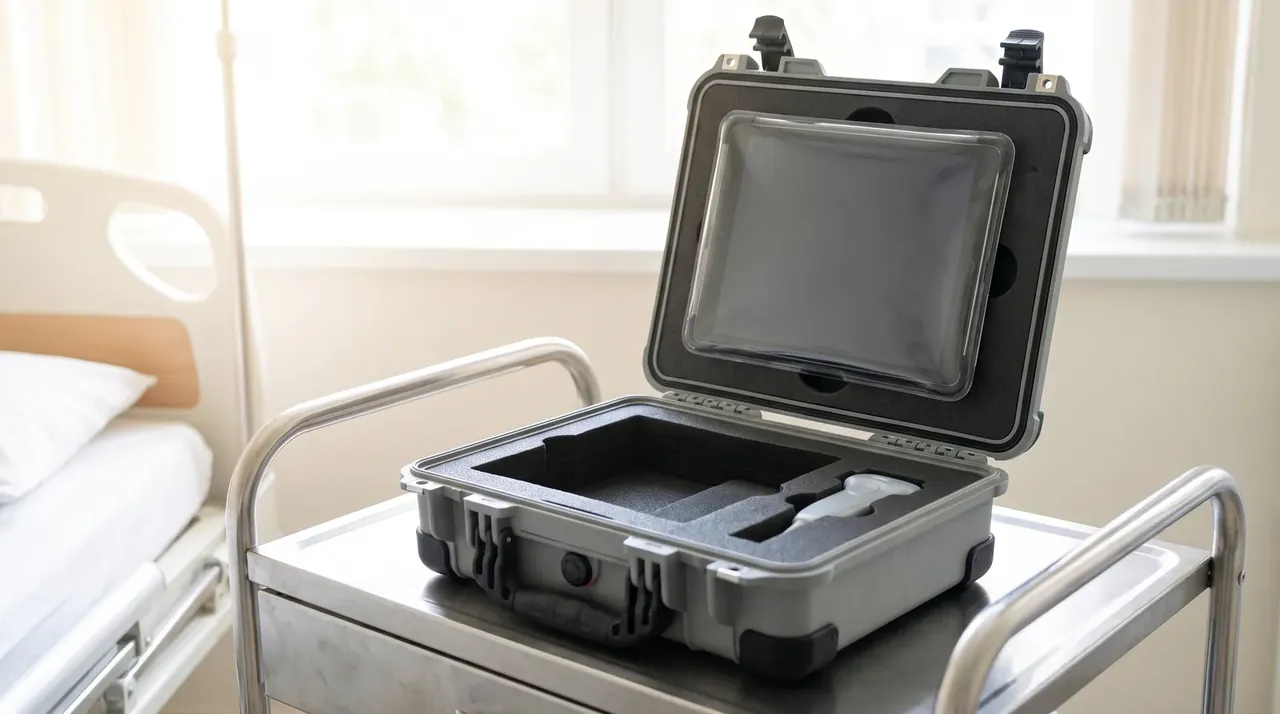
Quick answer: Portable ventilator/suction pump hard case runs with tubing on: two 30 mm ports through a 3.8 mm wall at 30% bushing squeeze, and a 100° lid stop.
Table of contents
- Why a portable ventilator/suction pump hard case lets tubing through the wall
- Two 30 mm ports and a bushing compressed 30 percent
- A 100° lid that keeps tubing from kinking
- A 3.8 mm wall, two 380 N latches and a 350 N handle
- A 1.0 m drop, IP65 and three-high stacking
- FAQ
1. Why a portable ventilator/suction pump hard case lets tubing through the wall
Most hard cases treat an opening as a weakness; a portable ventilator/suction pump hard case needs two, since the unit stays inside while the case travels closed.
Each port on a portable ventilator/suction pump hard case passes a 30 mm tube, holds IP65 with that tube undisturbed, and survives a drop without the tube pulling the bushing out. The second job is the hard one: a soft tube cannot carry the seal, so the face sits between bushing and wall.
Tolerance at the port decides more than the port size.
2. Two 30 mm ports and a bushing compressed 30 percent
The hole is 34 mm and the bushing runs 34 mm outside, 30 mm inside and 5 mm on the wall. Fitted, the outer wall is pressed 1.5 mm by the hole and the inner wall stretched 1.5 mm by the tube, which is 30% at both faces with 2 mm of sealing stock between them. Below 20% a jet at 1 m creeps along the interface; above 40% the bushing will not enter and forcing it splits the rim.
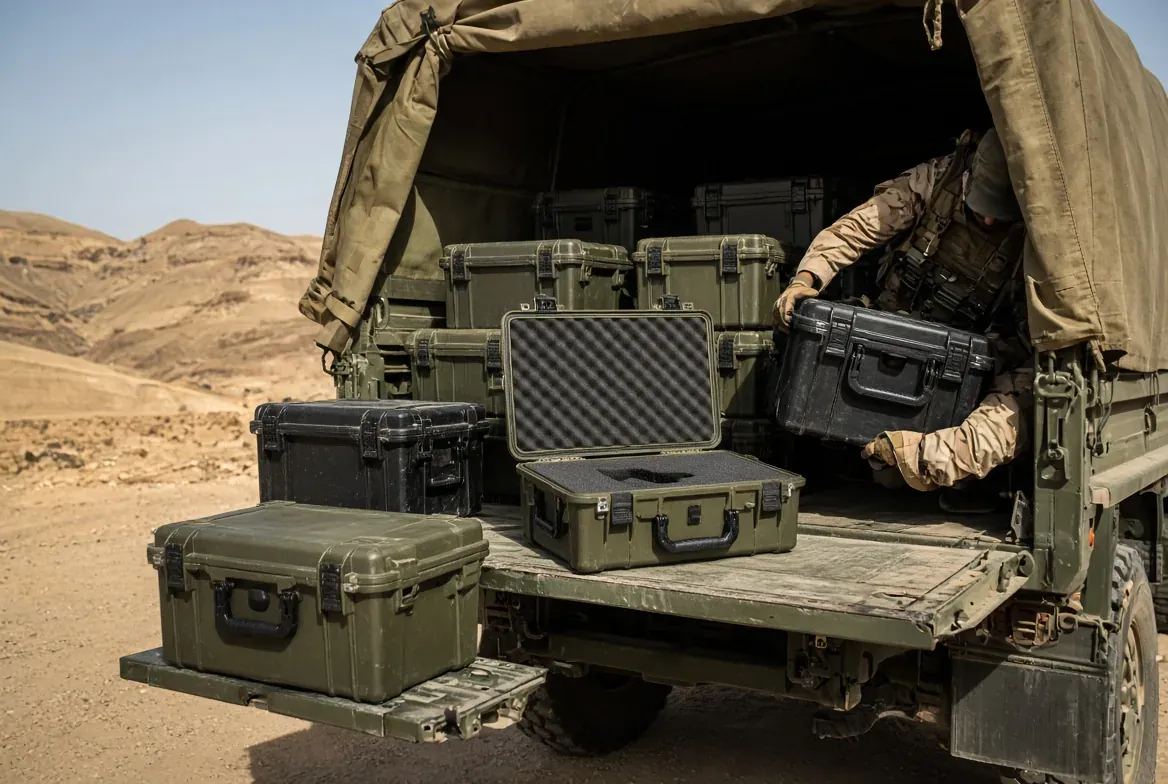
On a portable ventilator/suction pump hard case both ports sit on one side wall, 240 mm apart, 80 mm above the base and 45 mm in from the edge. Closer than 150 mm and the tubes cross inside; wider than 300 mm and the span becomes an unsupported long edge that a 1.0 m side impact bulges first.
| Port | Hole and bushing | Fixing |
|---|---|---|
| Port A, main | 34 mm hole, 30 mm bore | Flange plate, 4 × M4, 180 N |
| Port B, second | 34 mm hole, 30 mm bore | Locknut, 120 N |
A flange spreads a tug over four M4 screws and holds 50% more than a locknut.
3. A 100° lid that keeps tubing from kinking
On a portable ventilator/suction pump hard case the lid reaches 100° when its centre of mass crosses the hinge axis, so it stays where it is put and one hand is free for the tubing. The angle matters: rotating 100° about the rear hinge moves the front edge back 240 mm, straightening a tube left with 60 mm of slack.
A 30 mm hose at a 90° fold drops from 707 mm² of bore to under 300 mm², and 3000 folds wrinkle the wall from 3 mm to 2 mm. The lid of a portable ventilator/suction pump hard case therefore carries a 40 mm band without foam where the tube bends.
| Transit step | Part crossing the wall | Treatment |
|---|---|---|
| Flat in an ambulance | Two 30 mm hoses | Ports up, 80 mm slack inside |
| Tailgate load in rain | Two hoses | Bushing lip 3 mm proud, drip edge |
| Cold transfer | Two hoses | Slack raised to 100 mm at −15 °C |
| Long stacking | None | Three high, port side out |
At 80 mm to 100 mm the tube bends without coiling; past 120 mm it packs 5 mm over the gasket.
4. A 3.8 mm wall, two 380 N latches and a 350 N handle
A hole changes the load path. A closed side wall bends as one plate; with a 34 mm hole the stress concentration within 45 mm of the edge is about 2.6, and 3.8 mm keeps that patch intact after a 1.0 m drop, with a 1.5 mm upstand spreading the factor over a 3 mm ring.
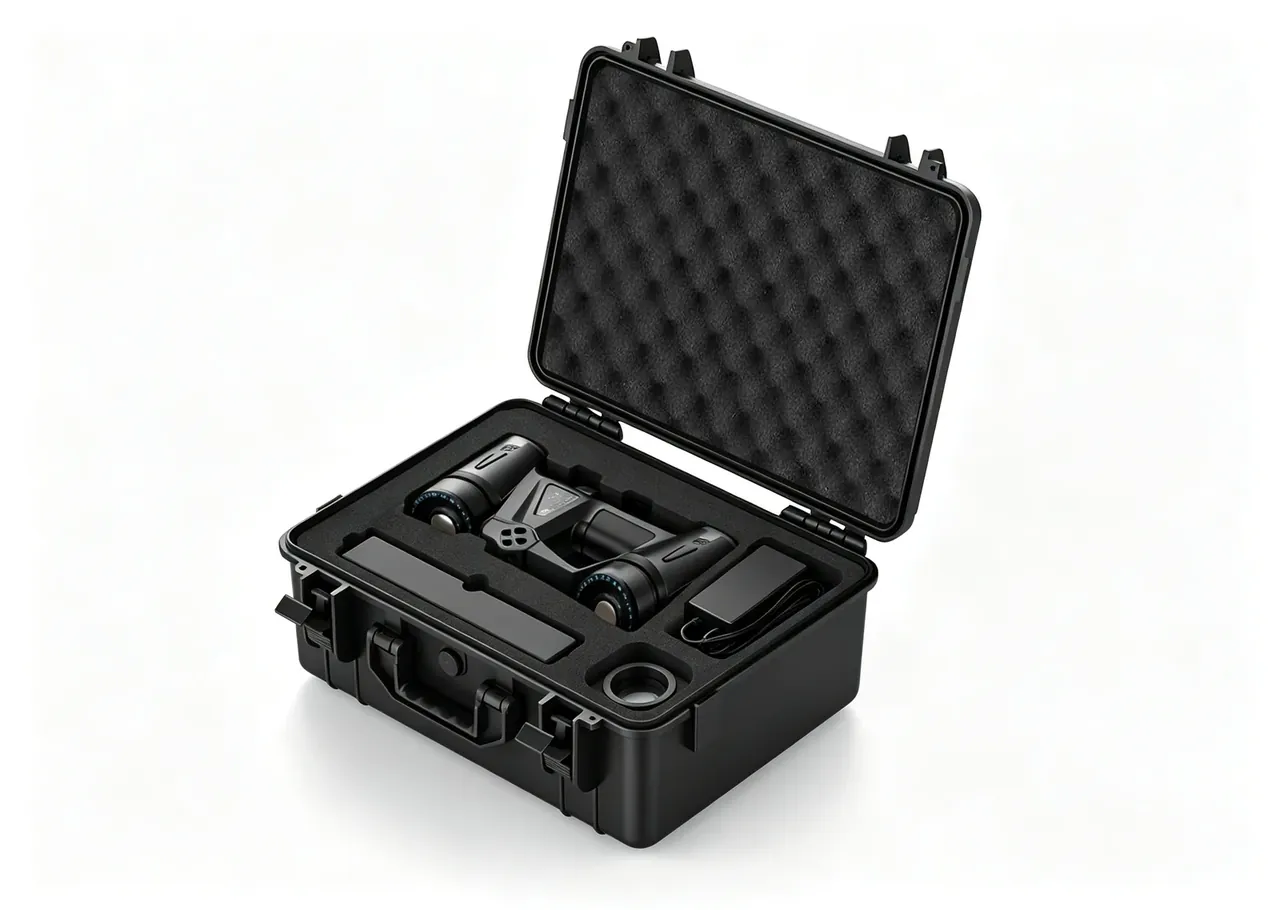
On a portable ventilator/suction pump hard case two latches at 380 N are sized by sealing, not by the 9.6 kg load: clamp points sit 300 mm apart, the lid middle relies on its own stiffness, and 380 N is four times the gasket reaction. The 350 N handle sits against 145 N of static load from a 14.8 kg all-up weight, a 2.4× margin; with a 1.6 factor for a carry swing the peak is about 232 N.
5. A 1.0 m drop, IP65 and three-high stacking
On a portable ventilator/suction pump hard case the 1.0 m figure matches the handle height of a one-hand carry. Port side down is worst: impact lands on the 1.5 mm bushing lip, which rolls out 0.4 mm and drops squeeze from 30% to 22%, still above the sealing line but a third of the interference face gone, so a second drop can pull the bushing out.
The criterion is displacement, not leakage: under 0.5 mm passes, over 1 mm means replacement, and a whitened rim means yield.
| Check | Condition | Criterion |
|---|---|---|
| Bushing squeeze | Fitted, room temperature | 30% ±3% at the lip |
| Seal | IP65 jet, 12.5 L/min, 3 min | No water inside, gain ≤2 g |
| Drop | 1.0 m, port side down | Movement ≤0.5 mm, no pull-out |
| Stacking | Three high, 72 h | Lid bow ≤0.5 mm on the bottom case |
At −15 °C the bushing hardens to 60 Shore A and recovers slowly, so tubing needs a warm soak; at 55 °C set reaches 14% and squeeze is rechecked at 3000 cycles, or 750 days at four a day.
Conclusion
A portable ventilator/suction pump hard case is designed from the tubing back to the wall: two 30 mm ports at 30% squeeze decide whether IP65 holds, a 100° lid stop decides whether tubes kink, and the 3.8 mm wall only makes room for both. Measure port spacing, squeeze and movement after a drop.
Related Reading
- Case layouts and insert zoning for portable diagnostic devices
- Hose and rotor protection inside peristaltic pump cases
- Five criteria for choosing a portable case
- Cooling and carry structure of outdoor power station cases
Related Products
- 8 Series — Gun Cases; Military Equipment Cases; Camera Equipment Cases; Drone Cases; Watch Cases; Knife Cases; First Aid Cases; Electronics Equipment Cases
- WL8-2812 PP Gun Case — model WL8-2812
- All protective cases and toolboxes: 7 series, 158 models