

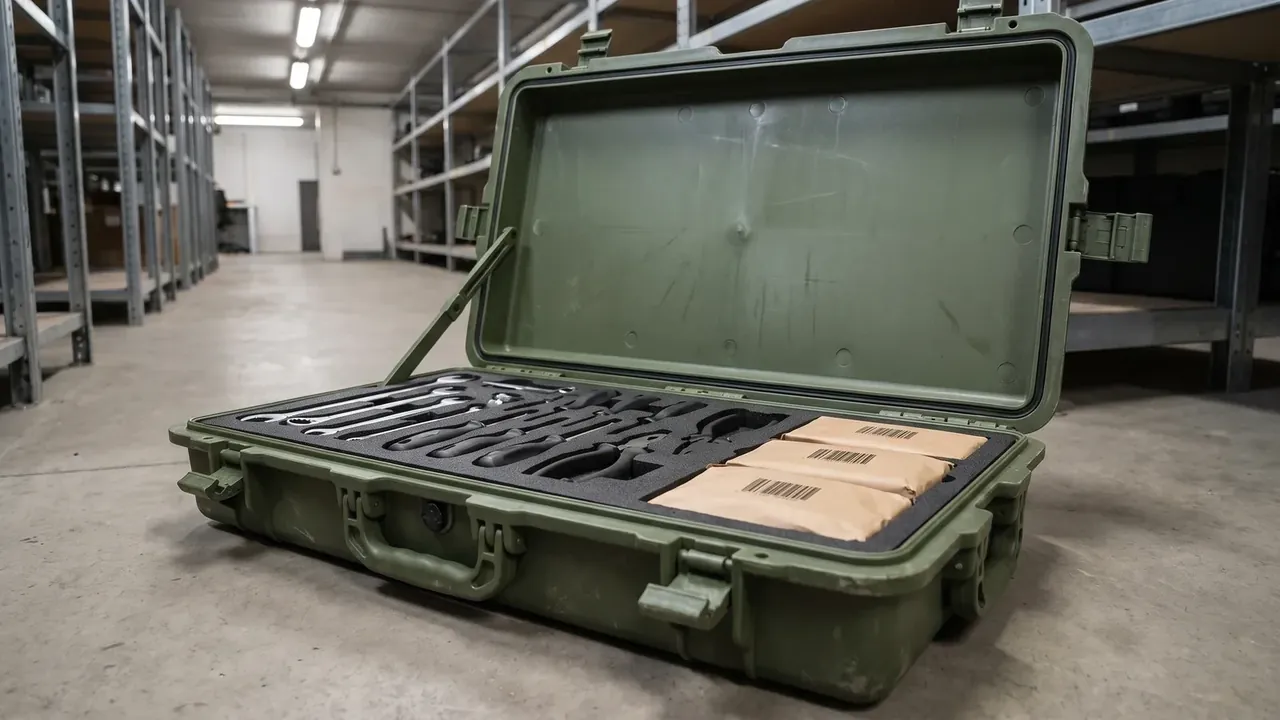
Quick answer: A Power construction high voltage insulated tool box pairs a 3.0 mm specimen with 120 mm lid inserts, judging five samples after 48 h of conditioning.
Table of contents
- Specimen thickness of a Power construction high voltage insulated tool box
- Spacing of the lid metal inserts
- Surface resistance readings after conditioning
- Spread recheck across five specimens
- Thickness setting for the electrical batch
- FAQ
1. Specimen thickness of a Power construction high voltage insulated tool box
Surface resistance scatters after conditioning by specimen thickness first, then by how far the lid inserts pull the field apart. This shell is 560 by 400 by 230 mm outside, 490 by 335 by 165 mm inside, with a 4.5 mm wall, while insulation coupons are cut at 3.0 mm on their own. A thickness error bends the reading before the insert spacing does, so the material ledger for a Power construction high voltage insulated tool box puts thickness in its first column and starts a fresh grade for each new mould or resin lot.
Three grades from one mould and one chamber run side by side: thin 2.6 mm, nominal 3.0 mm, thick 3.4 mm, five pieces each. Beyond the moulding tolerance the spread adds a preparation error to moisture uptake and stops meaning anything, so a piece missing its lot number stays out of the ledger for a Power construction high voltage insulated tool box.
| Specimen grade | Coupon thickness | Five-piece spread (decades) |
|---|---|---|
| Thin | 2.6 mm | 0.7 |
| Nominal | 3.0 mm | 0.3 |
| Thick | 3.4 mm | 0.5 |
The thin grade reaches 0.7 of a decade and the thick 0.5; only nominal 3.0 mm pulls the spread inside 0.4 on one electrode under one rig. A Power construction high voltage insulated tool box reads thin pieces further apart because their damp layer varies more.
2. Spacing of the lid metal inserts
A 120 mm pitch between lid metal inserts is the second grading quantity. The inserts form an evenly spaced ring along the rim, and the pitch sets how far the surface field stretches between neighbours: tighten it below 120 mm and the gradient rises, so conditioned resistance falls first; widen it and the field crowds at each insert, growing the spread. A calliper reads four centre distances per lid, with the largest checked against the drawing.
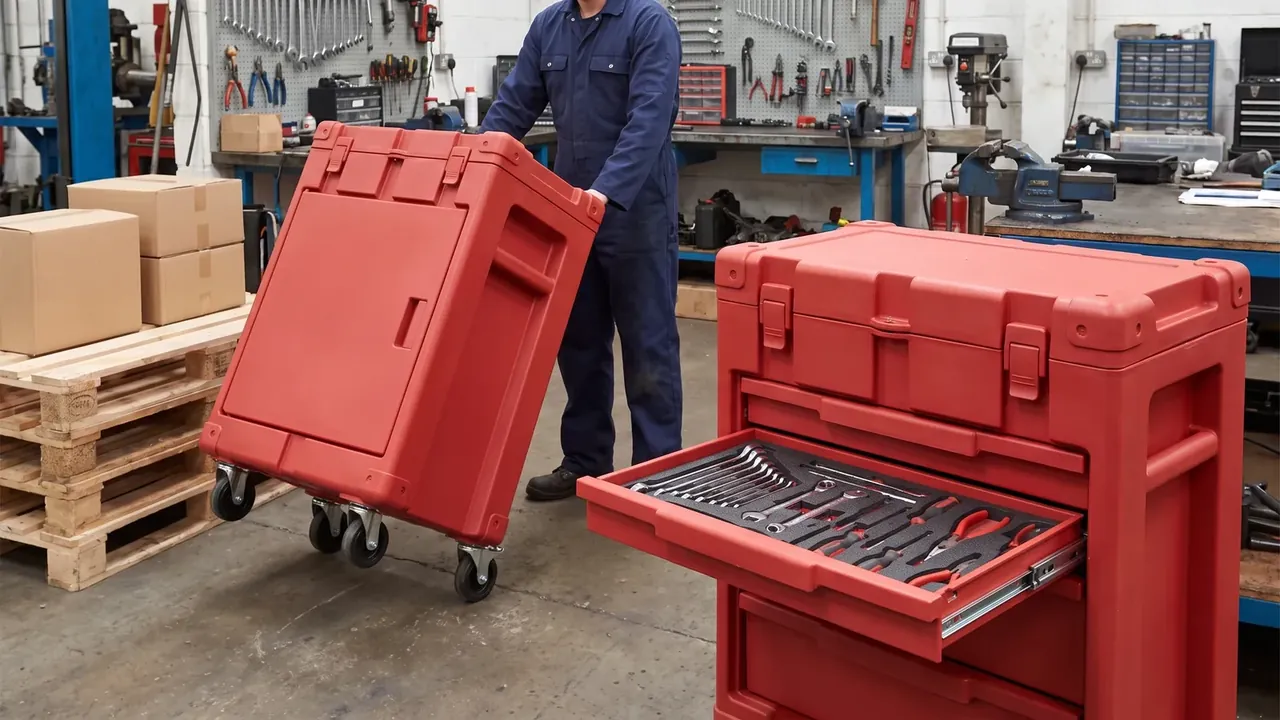
Four latches at 415 N are logged with it, since they decide whether the rim seats on 2 seals at 20% compression. Pitch and latch force work as a pair: loose latches make a resistance drop look like a resin fault rather than an unseated rim, so the lid sheet for a Power construction high voltage insulated tool box carries both and tags a shell that misses either.
3. Surface resistance readings after conditioning
Conditioning is fixed at 23 °C / 50% RH / 48 h, and coupons meet the electrode within 10 min of leaving the chamber. Readings are logged by decade, not absolute ohms, because the criterion watches the spread across five pieces rather than a stray peak. The release line for a Power construction high voltage insulated tool box sits at 48 h; earlier data is a trend only.
| Conditioning stage | Surface resistance (ohm) | Five-piece spread |
|---|---|---|
| 0 h | 3.2x10^11 | 0.2 decade |
| 24 h | 1.8x10^11 | 0.3 decade |
| 48 h | 1.0x10^11 | 0.4 decade |
From 0 h to 48 h resistance slides from 3.2x10^11 ohm to 1.0x10^11 ohm while the spread climbs from 0.2 to 0.4 of a decade, so both lines meet the criterion together. A Power construction high voltage insulated tool box enters the electrical specification only when 1.0x10^11 ohm and the 0.4 decade spread hold at once; conditioning past 48 h is logged without a verdict.
4. Spread recheck across five specimens
Five specimens come from different shells of one lot, each numbered and rechecked on one electrode. The spread is the base-ten log gap between highest and lowest resistance, so 0.4 of a decade is roughly a 2.5-fold ratio printed on the check card.
| Resistance value | Specimen number | Ratio to base piece |
|---|---|---|
| 1.0x10^11 ohm | Piece 1 | 1.00 |
| 1.3x10^11 ohm | Piece 2 | 1.30 |
| 1.6x10^11 ohm | Piece 3 | 1.60 |
| 2.0x10^11 ohm | Piece 4 | 2.00 |
| 2.5x10^11 ohm | Piece 5 | 2.50 |
The five run from 1.0x10^11 ohm to 2.5x10^11 ohm, exactly 0.4 of a decade with no margin left. A crossing piece is never covered by the others: its shell is tagged for its own recheck, and a coupon from a shell after 4200 open-close cycles joins only as a reference.
5. Thickness setting for the electrical batch
The electrical batch closes on one line: the thinnest grade whose five-piece spread stays within 0.4 of a decade becomes the thickness setting, and anything thinner stays off that batch's insulation ledger. The empty 6.4 kg, loaded 15 kg, 4200 cycles and four latches at 415 N are frozen boundary conditions, so a new mould reruns conditioning and the recheck.
Every sampled shell reports specimen grade, insert pitch, conditioned resistance and five-piece spread; only when all four land in one grade does it join the specification, and a crossed line sends that shell to its own recheck. Records for a Power construction high voltage insulated tool box are filed by rig condition, with moulding parameters apart from insulation readings, and drawing tolerances follow.
Conclusion
A Power construction high voltage insulated tool box is set not by one resistance figure but by the loop of specimen thickness, insert pitch and conditioned spread. The 3.0 mm coupon, 120 mm pitch and 48 h conditioning sit on one insulation ledger, where 1.0x10^11 ohm is the floor and 0.4 of a decade the allowed width. JUNZHIJIA keeps rig records of 4200 open-close cycles for the electrical batch, and Kexin New Materials (Guangdong) Co., Ltd. issues drawing tolerances from them.
Related Reading
- Battery swap station tool case: insulation configuration
- An insulated case is not universal: material and safety limits of plastic electrician tool cases
- How to choose a power inspection equipment case: insulation and protection for outdoor work
- Power inspection instrument case: insulation protection for live-line tools
Related Products
- 8 Series — Gun Cases; Military Equipment Cases; Camera Equipment Cases; Drone Cases; Watch Cases; Knife Cases; First Aid Cases; Electronics Equipment Cases
- WL8-2812 PP Gun Case — model WL8-2812
- All protective cases and toolboxes: 7 series, 158 models