

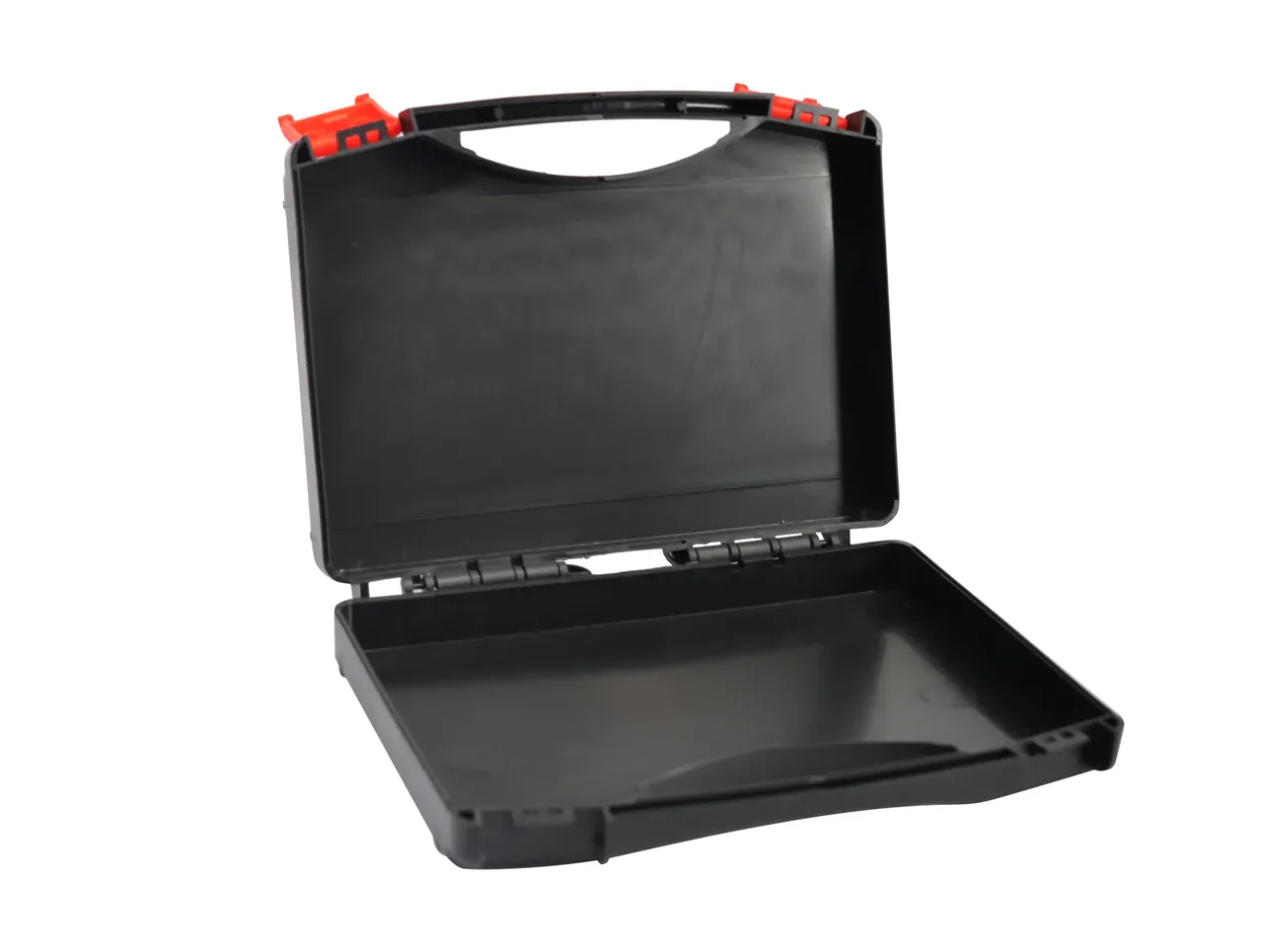
Quick answer: A PP Plastic Case is serviced against three measured quantities, not a calendar: the pH and dwell time of the cleaning agent, the ultraviolet dose the surface has absorbed, and the holding force of the latches. Clean between pH 4 and 11, below 50 °C, for no more than 30 minutes; re-check chalking every 12 months outdoors; replace a latch once holding force falls under 180 N. Any one crossing its line triggers action, long before a crack appears.
Table of contents
- Cleaning Agents: What a PP Plastic Case Tolerates
- Inspection Order and Frequency: Six Looks, Two Measurements
- UV Ageing and Chalking: Counting Irradiance Instead of Months
- Cycle Counts for Hinges and Latches
- Stacking Deflection and the Retirement Line
- FAQ
1. Cleaning Agents: What a PP Plastic Case Tolerates
A PP Plastic Case resists acids and alkalis because the polypropylene backbone carries no polar group that water can hydrolyse. It fails against strong oxidisers and aromatic solvents for the opposite reason: every repeat unit carries a tertiary hydrogen that is easy to attack.
IEC 60529 answers only how well an enclosure keeps dust and water out, never how it survives chemistry. That comes from the immersion method of ISO 175: a 50 mm square, 2 mm thick specimen, 24 hours at 23 °C, judged on mass and volume change, with anything above 1 percent classed as unsuitable.
| Cleaning agent | Permitted condition | Mass change, 24 h | Verdict |
|---|---|---|---|
| Neutral detergent, pH 6 to 8 | 40 °C, 30 minutes | under 0.2 percent | Routine use |
| Alkaline cleaner, pH 10 to 11 | 50 °C, 30 minutes | 0.3 to 0.6 percent | Allowed, rinse well |
| Sulphuric acid 10 percent | 23 °C, 24 hours | under 0.5 percent | Allowed |
| Sodium hydroxide 20 percent | 40 °C, 24 hours | under 1 percent | Allowed, not prolonged |
| Isopropanol 75 percent | Wipe only | swelling under 0.2 mm | Wipe only |
| Sodium hypochlorite 5 percent | Not advised | surface crazing | No long contact |
| Toluene, acetone, dichloromethane | None | swelling, whitening | Prohibited |
Strong oxidisers are the easiest cell to get wrong. Hypochlorite, hydrogen peroxide and concentrated nitric acid turn that tertiary hydrogen into a carbonyl, and the chain scission stays within tens of microns of the surface. A sanitiser at 500 ppm available chlorine looks harmless after one wipe and still finds hairline cracks along the rim after two months of routine wiping.
Solvents fail by another route. Toluene and dichloromethane leave the chain intact and swell the amorphous regions instead, so the part grows, whitens and locks in stress as it dries.
Rinse pressure is a cleaning parameter too. Above 2 MPa with the nozzle nearer than 20 cm, water is driven through the gap between insert and wall and stays trapped in the sandwich.
2. Inspection Order and Frequency: Six Looks, Two Measurements
The order is fixed: exterior, rim, hinges, latches, lining, markings. The first four are visual and tactile, the last two require opening up.
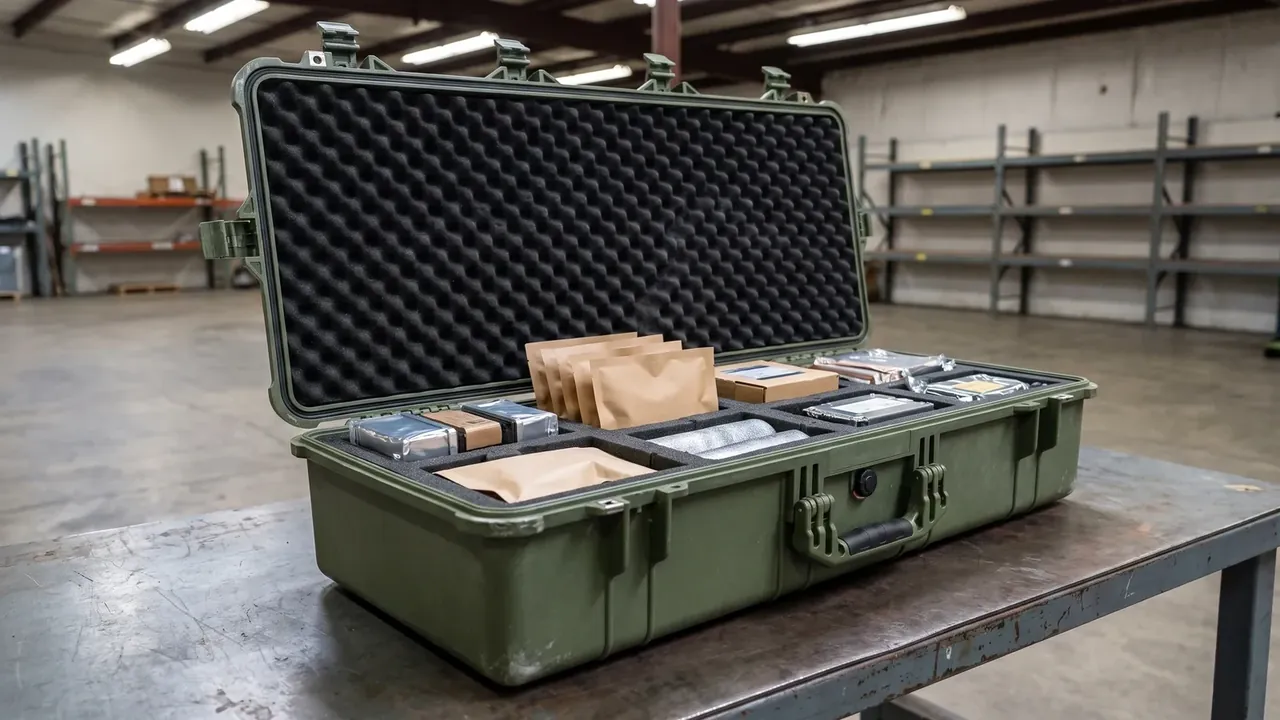
Outside, look for two findings. Rub with a clean white cloth; powder on the cloth means the surface has begun to chalk. Cracks start at the rim flange and hinge roots, both at the end of the flow path where weld lines concentrate. At the rim, confirm the seal sits fully in its groove, because the IP67 rating of IEC 60529 rests on that ring alone, and a seal compressed by more than 30 percent has already lost it.
Frequency follows the environment. Indoors, inspect quarterly and check the seal every twelve months. Under a canopy or inside a container, halve both intervals. Outdoors or on a vehicle, inspect monthly and check the seal every six months. Record three numbers each time: chalking grade, seal compression, latch holding force. Three numbers in series beat any single verdict. When the curve bends down sharply, one event has touched the whole batch at once, such as a change of cleaning agent or a row moved into afternoon sun. A single reading cannot separate natural ageing from handling damage, and without the inspector and ambient temperature in the record, nobody can reconstruct the conditions two years later.
3. UV Ageing and Chalking: Counting Irradiance Instead of Months
UV ageing is never uniform. The lid top and a west-facing wall can take four times the annual dose of a shaded face, so units of one batch age at different rates in the same year.
| Service environment | Annual irradiance | Re-check | Criterion |
|---|---|---|---|
| Indoor store | under 300 MJ/m² | 24 months | colour shift within ΔE 2 |
| Canopy or shed | 800 to 1500 MJ/m² | 12 months | chalking within grade 1 |
| Open air | 4000 to 5500 MJ/m² | 6 months | chalking within grade 2, no cracks |
Xenon-arc parameters come from ISO 4892-2: 0.51 W/m² at 340 nm, black panel at 65 °C, 50 percent relative humidity, and a cycle of 102 minutes light plus 18 minutes spray. Under that cycle 1000 hours approximates twelve months of horizontal outdoor exposure, and three times as long under a roof.
Two criteria carry the decision. Grade chalk against the reference cards of ISO 4628-6, where 0 is none and 5 severe, and treat anything past grade 2 as aged; a colour shift beyond ΔE 3 is already visible. The chalk layer is only tens of microns thick, yet once it forms, the fresh material below is exposed and the wall loses 0.03 to 0.06 mm a year. Wall loss matters less than the microcracks beneath the chalk, which become the starting point for drop impact.
There is one way to extend life: move the PP Plastic Case out of direct sun. Coatings block part of the UV and hide cracks at the same time.
4. Cycle Counts for Hinges and Latches
Hinges and latches are the only parts with reciprocating motion, and the only parts that fail by count rather than by year.
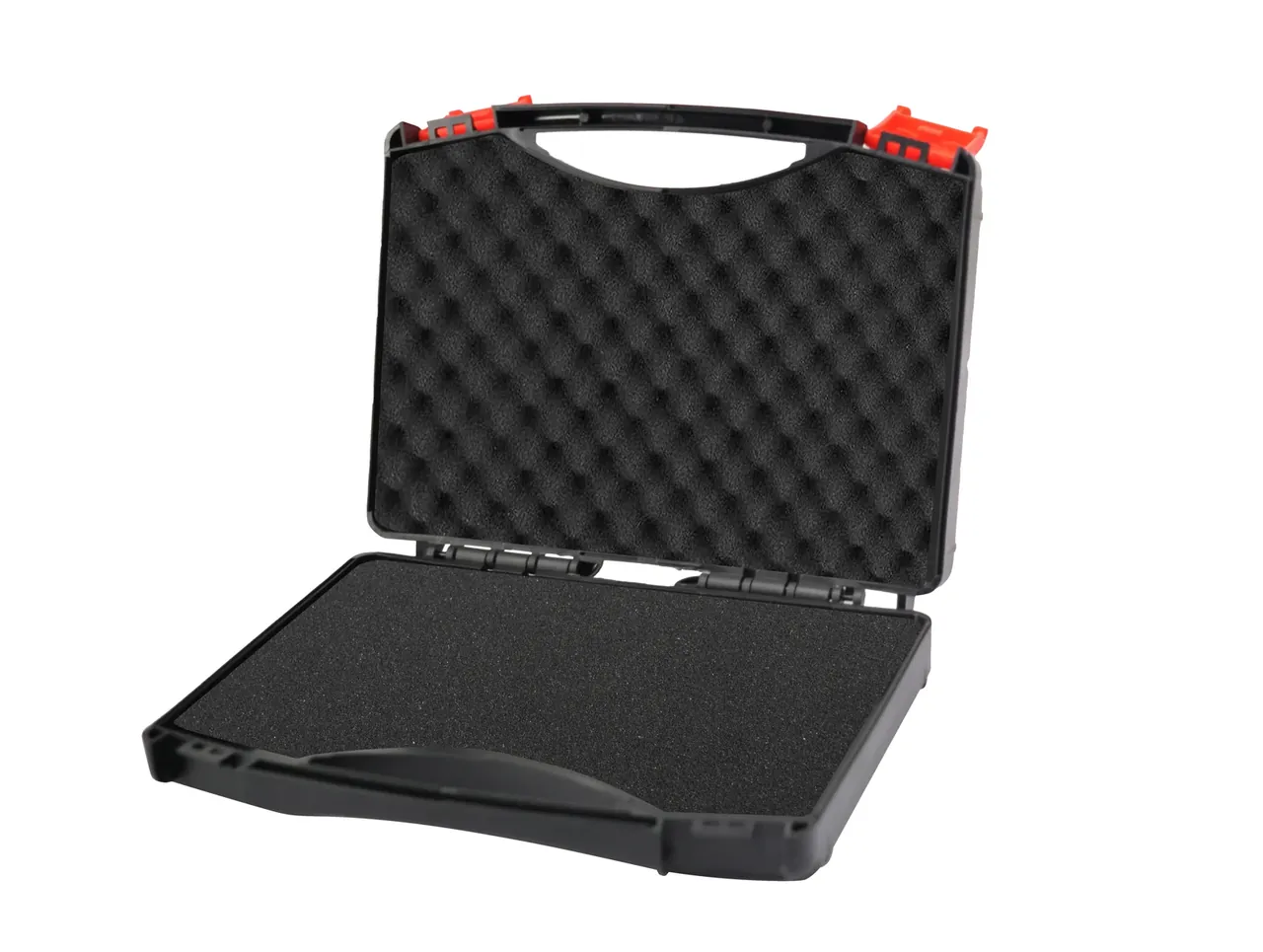
- Closing force: 60 to 90 N peak when new; below 40 N the preload is gone
- Holding force: 250 N static pull-off or better, replace below 180 N
- Hinge clearance: past 0.4 mm between pin and bush, the lid starts to rock
- Cycle count: 4 closures a day is about 7000 in five years, so check clearance quarterly after 8000
Holding force does not decay linearly. An over-centre spring loses 12 to 18 percent over the first 2000 closures, then flattens for a long stretch; once the plateau ends, the margin goes in a few hundred cycles. That is why the latch criterion is an absolute number.
A living hinge has no pin, so whitening along the fold replaces the clearance check. White lines mean the molecules are over-oriented and the next folds will break it.
5. Stacking Deflection and the Retirement Line
Deflection has to be measured. Set the empty case on a surface plate, span two rim diagonals with a steel rule, feel the largest gap with a feeler gauge, and take the difference of the two readings as flatness. Load 25 kg inside, hold 72 hours at 40 °C, then read base sag against the plate as soon as the case comes out.
Four limits retire a case from stacking:
- Base sag beyond 5 mm
- Rim flatness beyond 2 mm
- Wall thinner than 85 percent of original, averaged over five ultrasonic readings
- A crack longer than 10 mm at the rim or a hinge root
The last one is the most often waived. A rim crack is held shut by the load above it and shows no gap until the stack comes down, and then it opens. There is no middle state: in a reinforced zone a crack can be welded, on a sealing face the case is finished.
Hot-air welding runs at 210 to 230 °C with a rod of the same material and slow cooling, and the seam reaches about 60 percent of parent strength. A repaired PP Plastic Case returns to indoor handling only, never outdoors and never to the top of a stack.
Conclusion
Servicing a PP Plastic Case comes down to three numbers: the pH and dwell time of the cleaning agent, the accumulated irradiance, and the holding force of the latches. All three can be measured, logged and plotted, and once the curves are controlled, service life stops being a matter of luck. Judging a PP Plastic Case by eye alone hands the retirement decision to the mood of the day.
This article discusses only the container (case body) side of specifications and design intent, and does not cover any handling, loading or use of the contents.
Related Reading
- Long-term sealing and reopening of war reserve cases
- Hinge and seal care on hard-shell suitcases
- Coating repair and corrosion on metal ammunition boxes
- Servicing the running gear of wheeled protective cases
Related Products
- 8 Series — Gun Cases; Military Equipment Cases; Camera Equipment Cases; Drone Cases; Watch Cases; Knife Cases; First Aid Cases; Electronics Equipment Cases
- WL8-2812 PP Gun Case — model WL8-2812
- All protective cases and toolboxes: 7 series, 158 models