

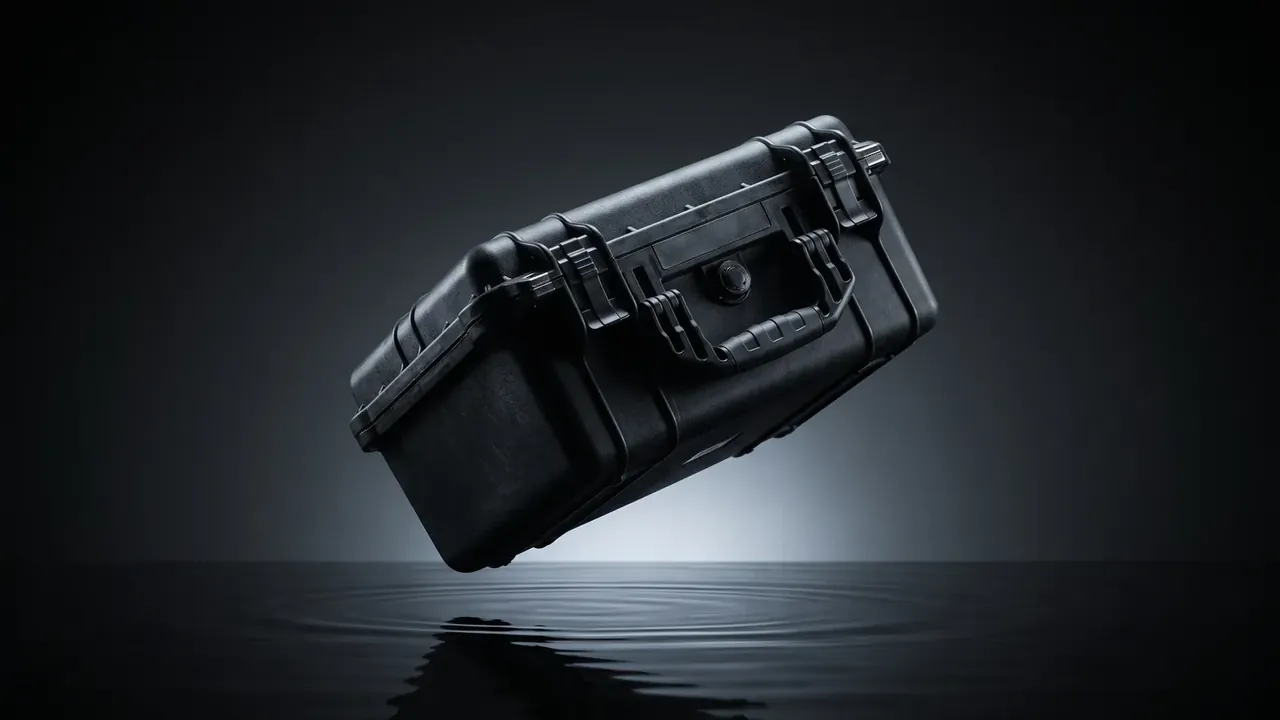
Quick answer: PP vs ABS for Industrial Cases turns on shrinkage of 0.4 to 0.9 against 1.0 to 2.5 percent, impact at -20 °C, and a 15 to 25 percent cost gap.
Table of contents
- Service temperature before material names
- A threefold shrinkage gap and what it does to tool compensation
- Low-temperature drops at minus twenty
- Chemical resistance and weathering: oil, cleaners, UV
- The cost gap and what changing grade does to structure
- FAQ
1. Service temperature before material names
The same case moulded in PP sheds about a tenth of its weight, but the cavity has to be cut for 1.5 percent shrinkage instead of 0.6. That sets the order of selection: the grade is the last decision, behind service temperature, drop height and chemical exposure.
Temperature comes first because heat deflection draws the usable envelope. ABS sits at 80 °C to 105 °C and homopolymer PP near 100 °C, close enough that a bench test shows nothing; park the case beside an engine bay and the difference becomes sag. Above 60 °C, ABS still holds modulus while PP depends on the grade.
Water uptake is the second hidden variable: ABS absorbs 0.2 to 0.45 percent, PP an order of magnitude less, and an ABS part creeps in size in a damp room.
| Material | Shrinkage | Density | Notched impact | HDT |
|---|---|---|---|---|
| ABS | 0.4%–0.9% | 1.04–1.06 g/cm³ | 100–400 J/m | 80–105 °C |
| PP | 1.0%–2.5% | 0.90–0.91 g/cm³ | 40–120 J/m at -20 °C | near 100 °C |
PP vs ABS for Industrial Cases goes wrong here whenever a cold impact figure meets a room-temperature one: the two were never measured under the same condition.
2. A threefold shrinkage gap and what it does to tool compensation
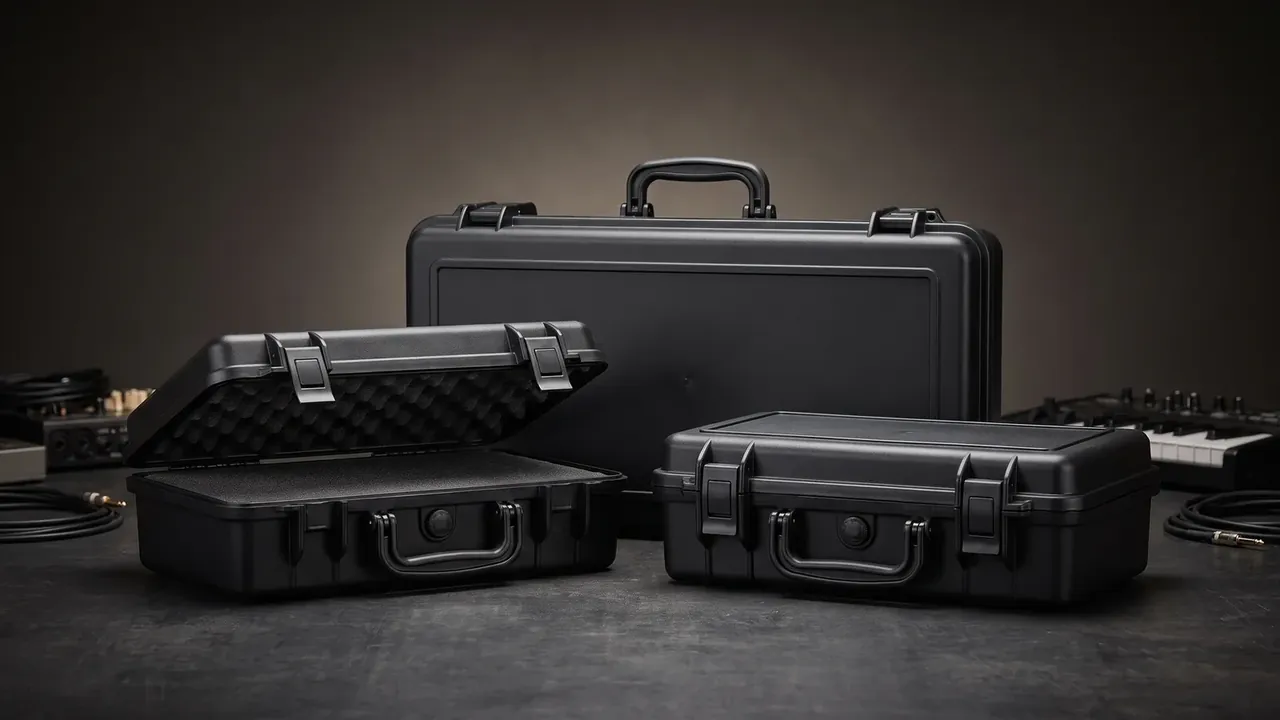
Shrinkage is the least negotiable line in PP vs ABS for Industrial Cases. ABS runs 0.4 to 0.9 percent, PP 1.0 to 2.5, and the midpoints differ threefold; on a 200 mm panel one percent is 2 mm, while a latch engages by only 3 mm to 5 mm.
Compensation cannot be a single factor. PP is semi-crystalline, so cooling rate sets crystallinity: a hot tool shrinks more, and the long side, short side, thick wall and ribbed wall all pull differently. Flow and cross-flow can part by 0.3 to 0.5 percent, which is why PP vs ABS for Industrial Cases asks for per-direction allowance, 1.5 percent along the flow and 1.2 across it.
An existing tool is the trap. Drop PP into a cavity cut for ABS and there is no allowance to give back; gates and cooling recover perhaps 0.3 percent, and anything beyond that means a new cavity.
Linear expansion of 70 to 90×10⁻⁶/K belongs here too: a 60 K swing from a -20 °C store to a 40 °C shop stretches 500 mm of shell by 2 mm to 3 mm.
3. Low-temperature drops at minus twenty
At room temperature the two look alike; at -20 °C they separate. ABS falls from 100–400 J/m notched to 40–120 J/m, while PP drops to single digits unless the grade is toughened.
How the drop is run decides the answer: a corner drop concentrates stress an order of magnitude above a face drop, and six faces accumulate damage one never shows. PP vs ABS for Industrial Cases compares fairly only at -20 °C, 1.2 m and six faces.
| Service temperature | Recommended material | Wall thickness | Risk |
|---|---|---|---|
| 0 °C to 60 °C | ABS | 2.5–3.0 mm | Modulus falls under long heat |
| -10 °C to 40 °C | ABS or copolymer PP | 3.0–3.5 mm | Corner cracks when cold |
| -20 °C to 30 °C | Toughened copolymer PP | 3.0–3.5 mm | Notch sensitive, rib root cracks first |
Wall thickness is not the place to save. Impact at -20 °C depends on how far the shell flexes before it fractures, and a 2.5 mm wall hit on a corner usually cracks at the rib root, where three surfaces meet. At 3.0 mm with an R2 fillet it stops being a through-crack.
Decision rule: a part that shows a single through-crack after a -20 °C, 1.2 m six-face drop fails that grade for this case type.
4. Chemical resistance and weathering: oil, cleaners, UV
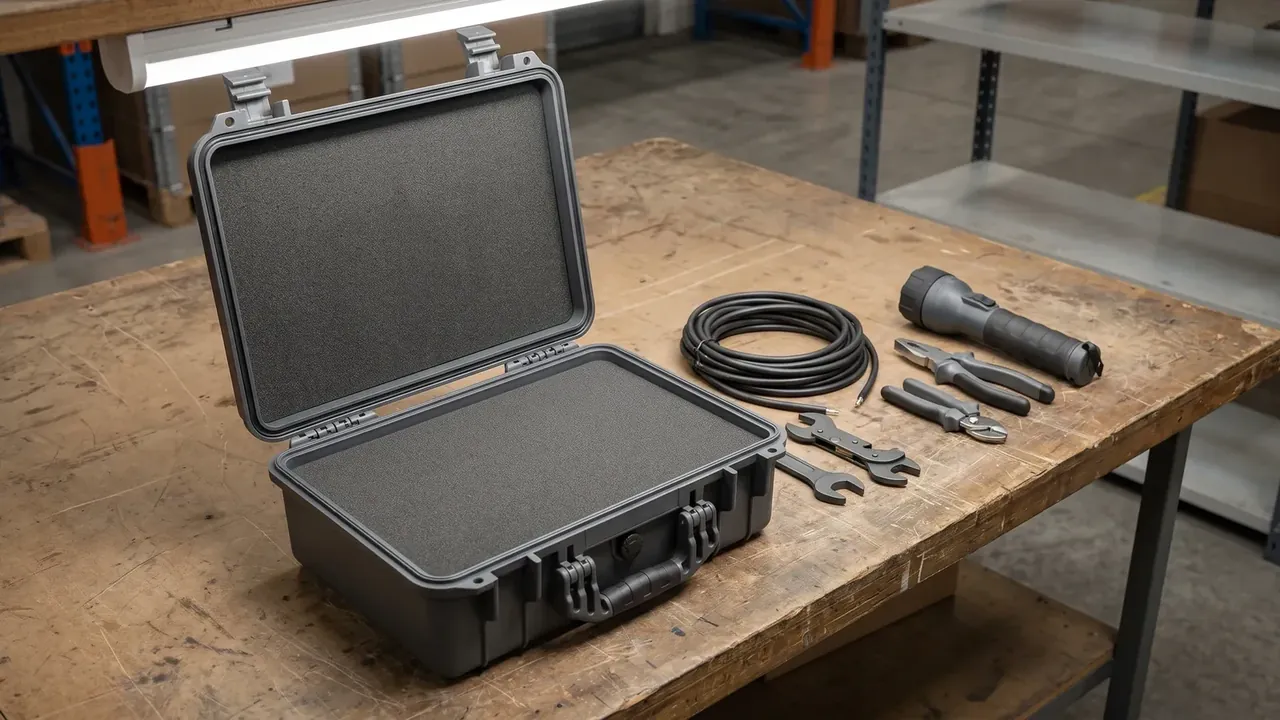
The chemical gap is polarity, not degree. PP is non-polar, so engine oil, hydraulic fluid and weak acids barely swell it; ABS carries a butadiene phase that ketones, esters and aromatics attack, first as a white blush, then as flaking skin.
Cleaners cause most field failures. A solvent cleaner takes the gloss off ABS in minutes, and repeated wiping flattens the grain; PP survives but blushes where stressed. Test the actual bottle on an unseen area and wait 24 hours.
UV is the other ABS weakness: the butadiene phase breaks down in sunlight, so an outdoor ABS case chalks, lightens and loses strength inside a year. PP suffers too, but carbon black or a hindered-amine package pushes outdoor life to three to five years, which makes PP vs ABS for Industrial Cases a question about additives.
Water uptake of 0.2 to 0.45 percent returns here: damp ABS is more brittle when cold, since water plasticises the network, so a case shuttling between freezer and wash bay needs that figure.
5. The cost gap and what changing grade does to structure
In PP vs ABS for Industrial Cases the price gap is 15 to 25 percent, and it arrives twice: resin price and density. At 0.90–0.91 g/cm³ against 1.04–1.06 the same volume weighs 13 percent less.
| Item | PP | ABS | What to choose |
|---|---|---|---|
| Cold impact | Needs a toughened grade | Plenty warm, weaker cold | Copolymer PP for -20 °C work |
| Chemical resistance | Oil and solvent tolerant | Attacks from ketones, esters | PP where oil is present |
| Dimensional stability | High shrinkage, directional | Low, even shrinkage | ABS for tight cavities |
| Appearance | Semi-crystalline, lower gloss | High gloss and grain | ABS for visible shells |
In PP vs ABS for Industrial Cases a grade change moves three structural features: wall thickness rises 10 to 15 percent to match ABS stiffness, rib thickness drops to six tenths of the main wall, and every internal corner goes to R2.
The first samples need their own drop test: a corner drop ABS survives often cracks PP at the rib root, because elongation at break collapses when cold.
In the end PP vs ABS for Industrial Cases is settled by service conditions: fix temperature, drop height and chemical exposure, and the grade becomes a tick-box. Pick the cheaper grade first and pay for it again in tooling. JUNZHIJIA confirms the drop condition and the temperature before a grade is named.
Related Reading
- ABS and PP cases: cold brittleness and cost
- Choosing between ABS and PP protective cases
- Wall thickness and how much strength it buys
- Plastic case or wooden crate
Related Products
- 8 Series — Gun Cases; Military Equipment Cases; Camera Equipment Cases; Drone Cases; Watch Cases; Knife Cases; First Aid Cases; Electronics Equipment Cases
- WL8-2812 PP Gun Case — model WL8-2812
- All protective cases and toolboxes: 7 series, 158 models