

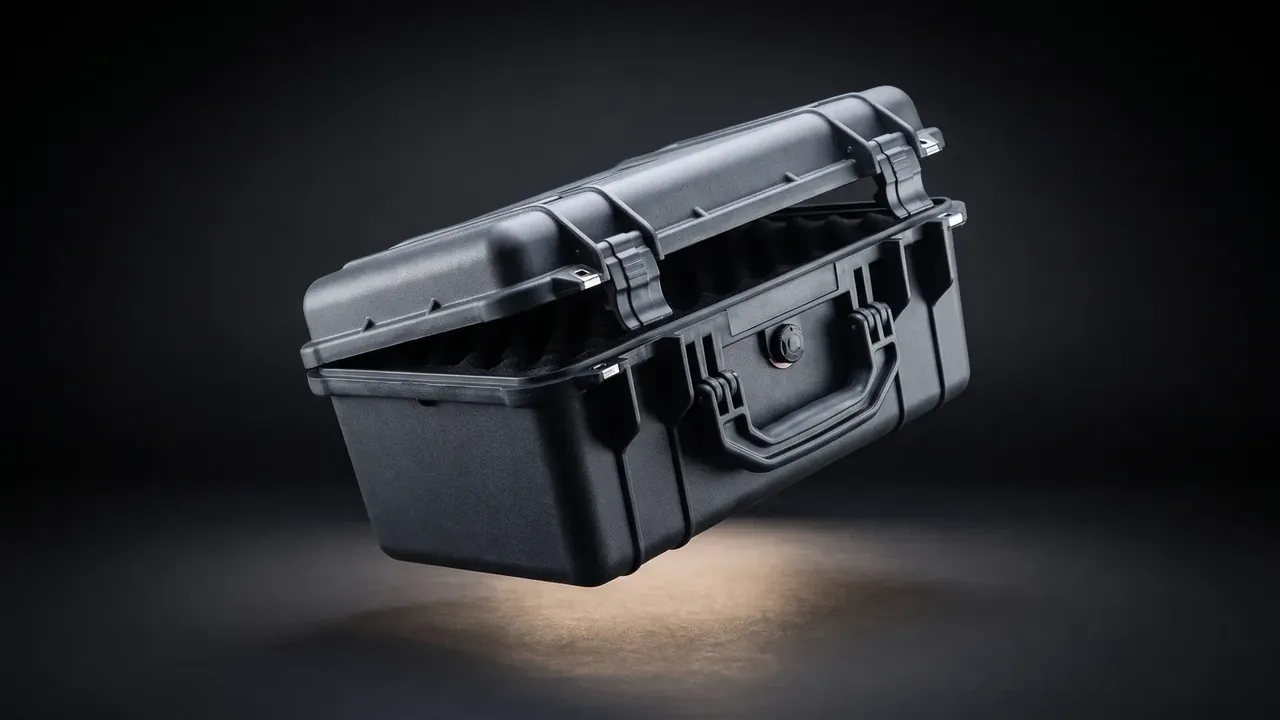
Quick answer: PP vs ABS for Instrument Cases turns on one datasheet row. At 23 °C notched impact runs 4 to 15 kJ/m² for PP against 15 to 35 for ABS; at minus 20 °C PP falls to 2 to 4 while ABS holds 8 to 15. Shrinkage splits the same way, 1.0 to 2.5 percent against 0.4 to 0.7, and resin costs 8 to 12 CNY a kilo against 14 to 22. Both mould near 2.5 mm walls, so the comparison is like for like. Fix the resin by service temperature, size the tool by shrinkage, price the case last.
Table of contents
- Notched Impact: 4 to 15 Against 15 to 35
- Brittle Transition at Minus Twenty
- Shrinkage at 1.0 to 2.5 Percent Against 0.4 to 0.7
- Eight to Twelve Yuan Against Fourteen to Twenty-Two
- Chemicals, UV and Cleaning Agents
- FAQ
1. Notched Impact: 4 to 15 Against 15 to 35
PP vs ABS for Instrument Cases turns on rows that only matter in the cold: PP and ABS differ by a few lines on a room-temperature datasheet, and by cracked or intact at minus twenty. PP vs ABS for Instrument Cases starts at notched impact, where the two bands barely touch: 4 to 15 kJ/m² for PP, 15 to 35 for ABS at 23 °C.
A number without its specimen means nothing: those bands describe a 1eA Charpy bar, 4 mm thick, 0.25 mm notch radius. A 1.5 to 3 mm wall is thinner, so read the table at 80 percent.
ABS earns its figure from butadiene rubber, whose particles trigger crazes that spread energy across an area rather than one crack tip. PP is semi-crystalline: once a notch cannot blunt, the crack runs along crystal boundaries.
Geometry has to help: radius latch seats and handle roots to R3 or more, and keep weld lines out of the load path.
| Property | PP | ABS |
|---|---|---|
| Density, g/cm³ | 0.90–0.91 | 1.04–1.06 |
| Notched impact at 23 °C, kJ/m² | 4–15 | 15–35 |
| Notched impact at −20 °C, kJ/m² | 2–4 | 8–15 |
| Tensile strength, MPa | 25–40 | 40–55 |
| HDT at 1.8 MPa | 50–60 °C | 85–95 °C |
| Mould shrinkage | 1.0–2.5% | 0.4–0.7% |
2. Brittle Transition at Minus Twenty
PP vs ABS for Instrument Cases only settles in the cold: at minus 20 °C notched impact drops to 2 to 4 kJ/m² for PP, a quarter of its room value, and to 8 to 15 for ABS, about half.
The mechanism is glass transition: butadiene in ABS sits near its own transition at minus 20 °C, so absorption shifts from rubber stretching to crazing. PP holds a lower transition in its ethylene-propylene segments, yet crystallinity leaves it notch-sensitive.
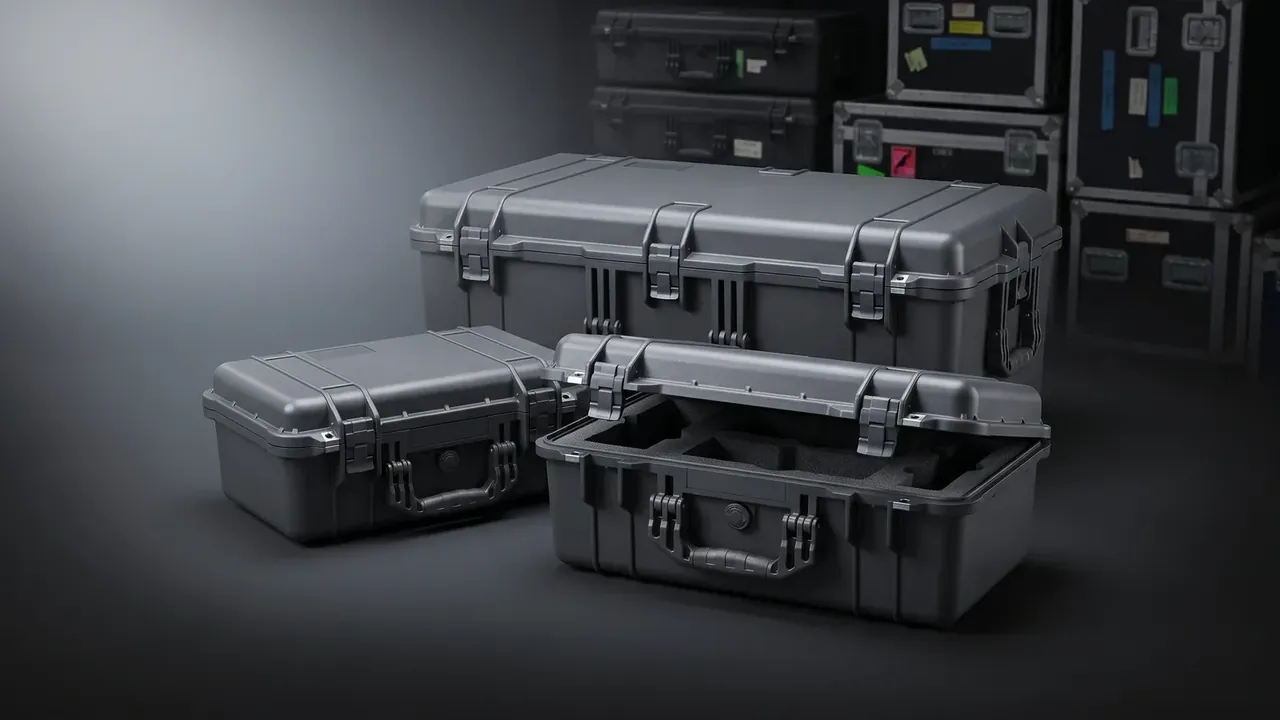
Failure starts at corners, latch seats and hinge roots, where wall thickness changes and residual stress collects; R5 corners with a 10 mm wall transition buy cold margin. Above 0 °C homopolymer PP at 2.0 to 2.5 mm suffices, from 0 to −20 °C ABS or toughened PP at 3.0 mm, below −20 °C 3.5 mm with R5 corners.
For PP vs ABS for Instrument Cases, drying is the hidden cost: ABS needs 2 to 4 hours at 80 °C; moisture above 0.1 percent leaves splay at the gate that becomes the crack origin. PP skips the dryer, and both run a 200 to 250 °C melt, so PP vs ABS for Instrument Cases shares one press.
3. Shrinkage at 1.0 to 2.5 Percent Against 0.4 to 0.7
On the tool, PP vs ABS for Instrument Cases becomes two sets of scale factors. A 300 mm outline needs a cavity at 303 to 307.5 mm for PP and 301.2 to 302.1 mm for ABS, a spread beyond 4 mm.
PP also shrinks directionally, 0.3 to 0.5 points between flow and cross-flow, moving a 300 mm case 0.9 to 1.5 mm and forcing 0.8 mm clearance on the lid joint, where ABS needs 0.3 mm.
Warpage takes another route: crystalline shrinkage varies through a PP wall, and a 2.5 to 3.2 mm step cooled at two rates warps from 0.2 mm up, cured by a 15 mm transition. ABS warps from pressure imbalance.
Mould temperature must be set apart: 40 to 60 °C for PP to crystallise, 60 to 80 °C for ABS with denser water lines.
4. Eight to Twelve Yuan Against Fourteen to Twenty-Two
The ledger opens at 8 to 12 CNY a kilo for PP and 14 to 22 for ABS, though density, 0.90 to 0.91 against 1.04 to 1.06 g/cm³, narrows it: the same volume carries 15 percent more ABS.
A 22 L shell weighs 2.0 kg in PP and 2.4 kg in ABS, so material lands at 16 to 24 CNY against 34 to 53, an 18 CNY gap. Moulding is close, both near a 45-second cycle.
Downstream means finish: ABS leaves a polished tool glossy with no paint, while PP moulds matt and needs primer and clear coat for 80 gloss units, adding 4 to 6 CNY.
| Item | PP | ABS |
|---|---|---|
| Resin, CNY/kg | 8–12 | 14–22 |
| Shell weight, kg | 2.0 | 2.4 |
| Material per case, CNY | 16–24 | 34–53 |
| Surface, CNY per case | 0 matt, 4–6 gloss | 0 |
| Pre-drying | none | 2–4 h at 80 °C |
Amortise over a year: at 5,000 cases the 18 CNY gap totals 90,000 CNY, while gloss on the PP version claws back 20,000 to 30,000.
5. Chemicals, UV and Cleaning Agents
PP vs ABS for Instrument Cases is lopsided on chemicals. PP shrugs off pH 1 to 13 acids and alkalis, alcohols and alkaline cleaners; ABS fears ketones, esters and dichloromethane, whitening under acetone and softening under ethyl acetate.
After 24 hours in petrol PP loses under 0.5 percent of its weight and ABS about 3 percent with fine cracks; thirty hypochlorite wipes leave both intact, though ABS drops 8 gloss units.
Weathering splits: PP chalks within half a year outdoors as UV attacks its tertiary hydrogen, while butadiene in ABS yellows more visibly; carbon black or a coating solves both.
Heat deflection caps the job: ABS holds 85 to 95 °C at 1.8 MPa against 50 to 60 for PP, so a lid at 70 °C in a parked vehicle leaves PP about 10 K of margin.
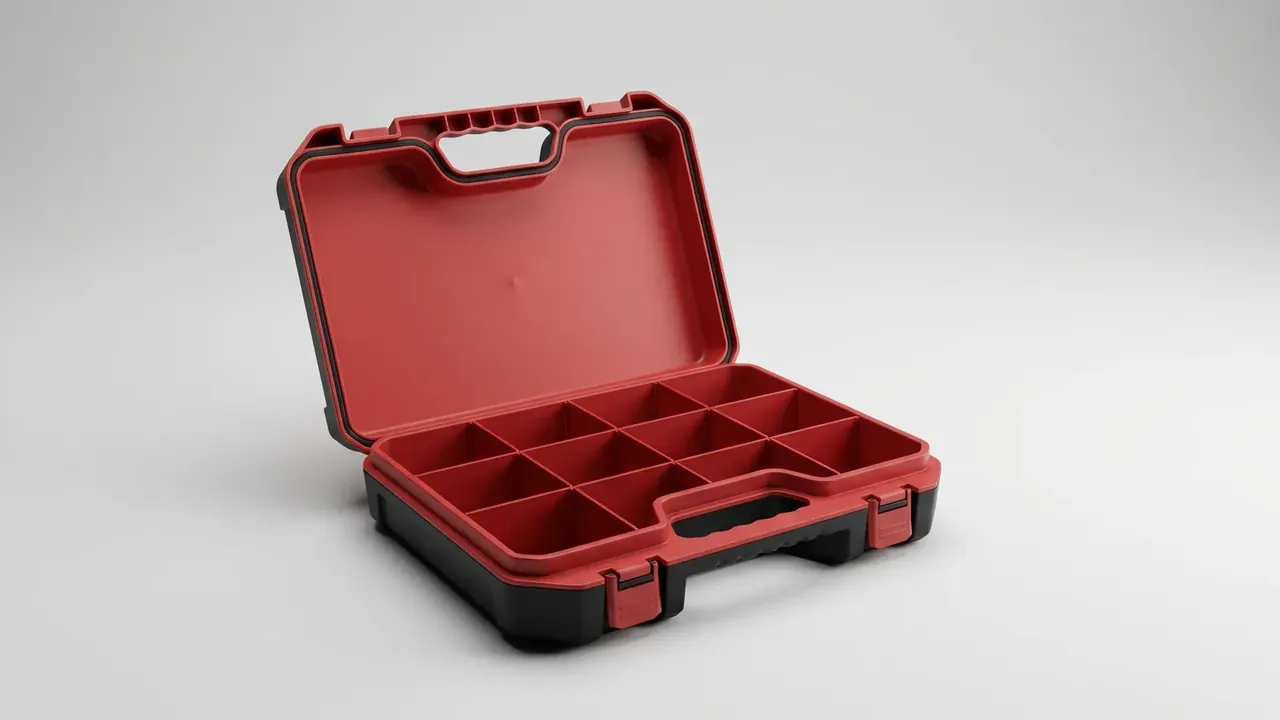
A repeatable test settles it: engine oil and cutting fluid left 24 hours, wiped, then checked for gloss loss.
Related Reading
- ABS against PP for cases
- ABS protective case selection
- Foam inserts for instrument cases
- Drop test sequence and criteria
JUNZHIJIA
Related Products
- 8 Series — Gun Cases; Military Equipment Cases; Camera Equipment Cases; Drone Cases; Watch Cases; Knife Cases; First Aid Cases; Electronics Equipment Cases
- WL8-2812 PP Gun Case — model WL8-2812
- All protective cases and toolboxes: 7 series, 158 models