

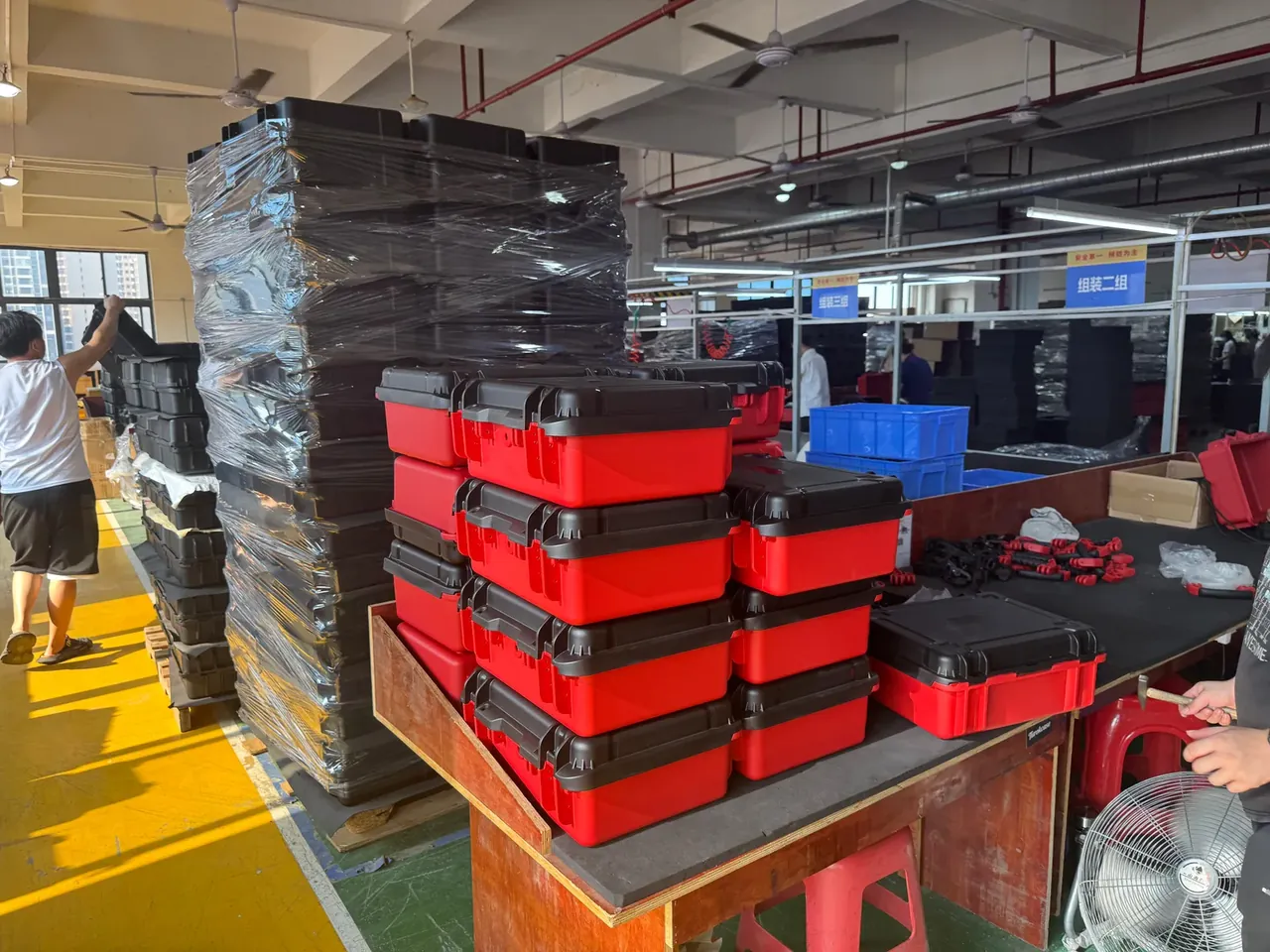
Quick answer: At -20 °C a PP vs PE case splits 4.4 times on notched impact: homo-PP 2.4 kJ/m², HDPE 10.5, copolymer 18, while at 20 °C stiffness reverses.
Table of contents
- Impact at -20 °C
- Room-temperature stiffness
- Shrinkage and warp
- Chemical resistance
- Selection criteria
- First-article approval
- FAQ
1. Impact at -20 °C
Strips conditioned 4 hours at -20 °C and notched to GB/T 1843 type 1eA read 2.4 kJ/m² for homo-PP, 10.5 for HDPE and 18 for copolymer PP; the faces confirm the order.
Slope matters more than the absolute figure. HDPE still yields at -20 °C with 320% elongation, homo-PP only crazes at 8%, and copolymer PP blunts the notch with a rubber phase to 45%.
A 6.8 kg tup from 1.2 m dents HDPE 7 mm, cracks copolymer PP 18 mm and splits homo-PP 45 mm into the latch boss, and an R12 corner only cuts that to 22 mm.
Brittleness temperatures run -75 °C, -28 °C and -8 °C, leaving homo-PP 12 K of margin under a -20 °C specification.
| Property | HDPE | Homo-PP | Copolymer PP |
|---|---|---|---|
| Density g/cm³ | 0.95–0.96 | 0.90–0.91 | 0.90–0.91 |
| Notched impact 23 °C, kJ/m² | 14 | 6.5 | 48 |
| Notched impact -20 °C, kJ/m² | 10.5 | 2.4 | 18 |
| Elongation at -20 °C, % | 320 | 8 | 45 |
| Brittleness temp, °C | -75 | -8 | -28 |
| Flexural modulus, GPa | 0.95–1.25 | 1.45–1.75 | 1.05–1.35 |
Copolymer PP loses 62% between the two impact rows, HDPE only 25%.
2. Room-temperature stiffness
Flexural modulus to GB/T 9341 spreads 0.8 GPa, from 0.95–1.25 for HDPE to 1.45–1.75 for homo-PP. On a 520 mm × 360 mm lid with 4 mm walls, a uniform 45 kg load for an hour sags HDPE 2.8 mm against 1.9 mm.
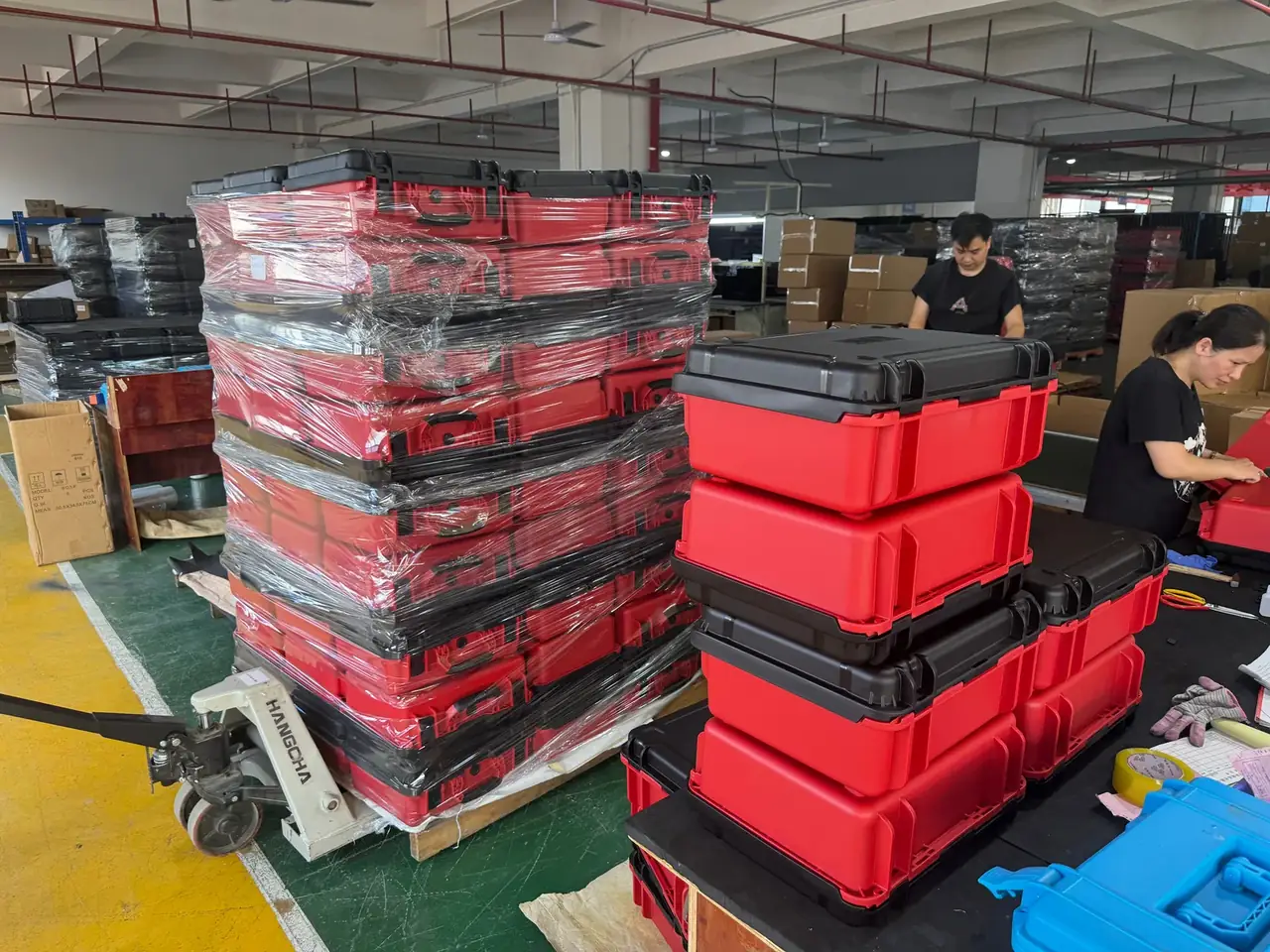
At 40 °C, 25 kg for 24 hours deforms HDPE 3.6 mm and homo-PP 2.4 mm, recovering 68% and 82%.
Ribs at 2.5–3 times wall height recover 0.5 mm on PP and 0.9 mm on HDPE, at the cost of a sink groove near 0.1 mm that texture hides on PE and leaves a line on PP.
3. Shrinkage and warp
Shrinkage sets the cavity: 1.8%–3.2% for HDPE, 1.4%–2.0% for homo-PP and 1.2%–1.8% for copolymer PP, so one tool opens 2.2% for PE against 1.5% for PP.
Directional shrinkage drives warp: a 0.5% flow gap lifts a 600 mm base edge 3.4 mm, against 1.9 mm and 1.6 mm for the two PP grades. A base past 3 mm rocks 1.5 mm at the far corner and the gasket never seats.
| Item | HDPE | Homo-PP | Copolymer PP |
|---|---|---|---|
| Shrinkage, % | 1.8–3.2 | 1.4–2.0 | 1.2–1.8 |
| Flow vs cross-flow, % | 0.5 | 0.3 | 0.25 |
| Warp on 600 mm edge, mm | 3.4 | 1.9 | 1.6 |
| Cavity allowance, % | 2.2 | 1.7 | 1.5 |
| Cooling time, s | 45 | 38 | 40 |
Compensation means opening the cavity by measured shrinkage or evening out cooling: 30 °C to 45 °C adds 0.2% to PP shrinkage yet removes 0.4 mm of warp.
Write flatness as a number: on a 600 mm × 400 mm base, a 0.5 mm feeler must not enter beyond 20 mm.
4. Chemical resistance
A PP vs PE case does not rank alike across diesel, oil and detergent. After 72 hours in diesel at 40 °C, HDPE gains 2.1% in mass against 8.6% for homo-PP, a fourfold swelling gap.
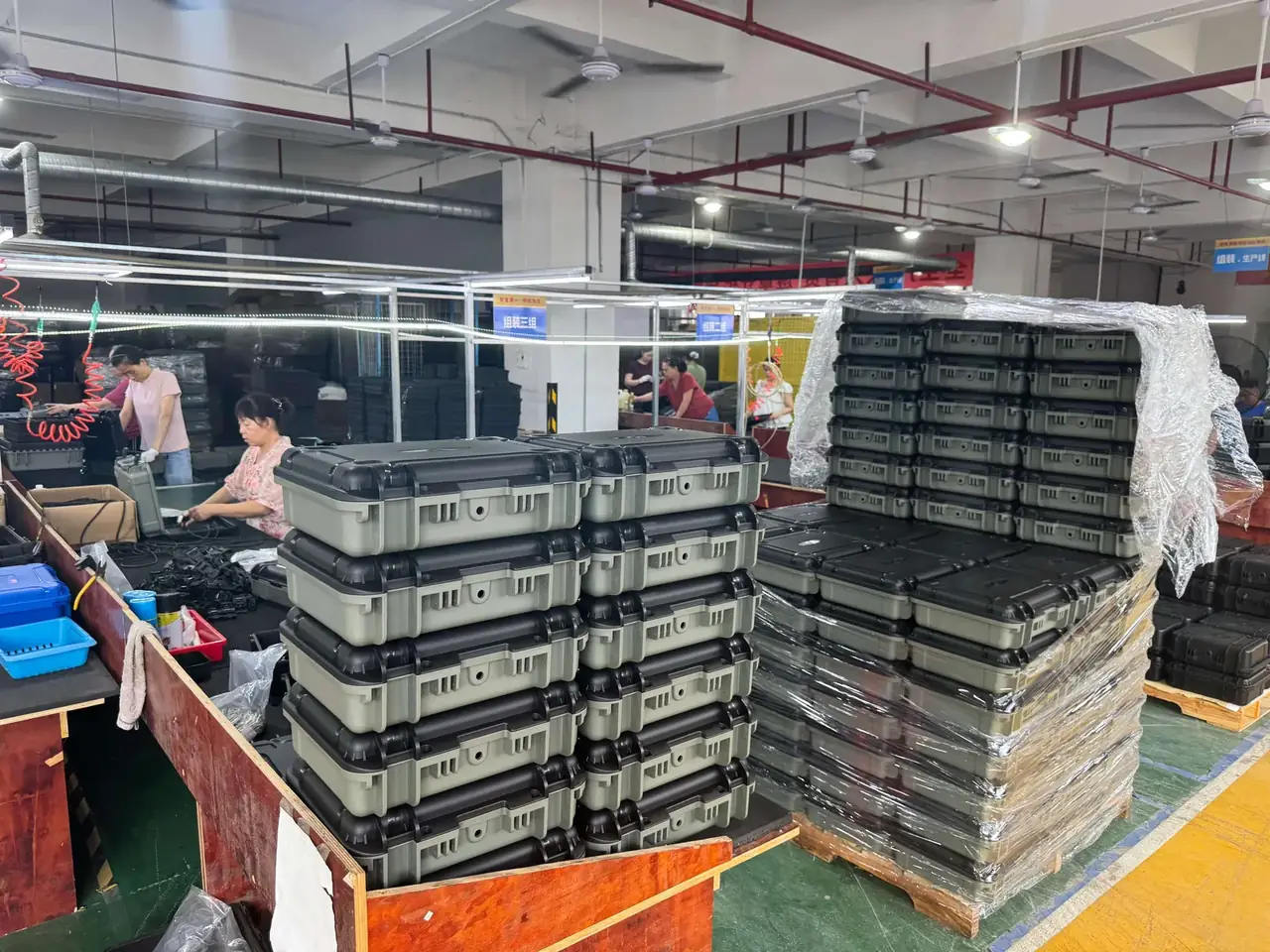
Alkalis reverse it: 30 days in 10% caustic at 40 °C adds 0.4% to homo-PP and 0.3% to HDPE.
Stress cracking opens the real gap. Soaking 500 hours at 50 °C in 5% alkylbenzene sulphonate cracks the homo-PP latch boss three times over 12 mm, leaves HDPE intact and copolymer PP with a single 4 mm crack.
Rinse water matters too, since PP hydrolyses above 80 °C and HDPE softens near 60 °C.
5. Selection criteria
Write down temperature, load and medium, and selection becomes a lookup.
- At or below -25 °C: HDPE, brittleness -75 °C, 50 K of margin.
- -25 °C to -15 °C: copolymer PP, if notched impact at -20 °C reaches 15 kJ/m².
- -10 °C to 0 °C: homo-PP, with lid sag checked against 2 mm.
- Load above 25 kg per case: latch boss to 4 mm whatever the resin.
- Diesel or detergent residue: HDPE first, PP for short contact only.
When two criteria conflict, temperature wins. A sagging lid is a nuisance; a cold crack is total failure, and a 48 L case split at -20 °C costs three replacements before downtime is counted.
Cost belongs in the same pass: homo-PP runs 8%–12% cheaper than HDPE on density alone, while copolymer PP carries a 6% premium that shrinks to 3% at case level.
6. First-article approval
A test condition on the drawing beats a clause that says cold resistant: 4 hours at -20 °C, a 6.8 kg ball from 1.2 m within 30 seconds, no penetration, no latch release, no hinge offset. The same limits cover a PP vs PE case.
Run three first articles through the cold drop and pull one for a 24-hour immersion, then sample each 500-unit lot at three pieces, freezing one for 8 hours.
Keep the fracture faces: PP breaks mirror-smooth with radial lines, PE draws whitened strands, and a photographed pair exposes a substituted resin at a glance.
Conclusion
Choosing a PP vs PE case is a balance of three ledgers rather than a ranking of materials. Below -25 °C take HDPE and treat the -75 °C brittleness point as margin. From -25 °C to -15 °C take copolymer PP and hold the 18 kJ/m² line, accepting around 2.5 mm of lid sag under 45 kg. For cases that never see frost, use homo-PP to buy stiffness. Then check three numbers before talking price: lid sag under 2 mm, warp on a 600 mm edge under 1.5 mm, and no cracking at the latch boss after 500 hours in the medium, which is the test a loading dock runs every winter.
| Minimum service temperature | First choice | Alternative | Control point |
|---|---|---|---|
| -40 °C to -30 °C | HDPE | — | Latch boss 4 mm, corner R12 |
| -25 °C to -15 °C | Copolymer PP | HDPE | Impact at -20 °C ≥15 kJ/m² |
| -10 °C to 0 °C | Homo-PP | Copolymer PP | Cavity +1.6%, warp ≤1.5 mm |
| Above 0 °C | Homo-PP | Copolymer PP | Lid sag ≤2 mm |
This article discusses container-side specifications and design implications only, and does not cover any handling, loading or use of the contents.
Related Reading
- How ABS and PP bodies differ
- Gasket materials and cold rebound
- Setting drop height by packed weight
- Ribs and corner radii in case structure
Related Products
- 8 Series — Gun Cases; Military Equipment Cases; Camera Equipment Cases; Drone Cases; Watch Cases; Knife Cases; First Aid Cases; Electronics Equipment Cases
- WL8-2812 PP Gun Case — model WL8-2812
- All protective cases and toolboxes: 7 series, 158 models