

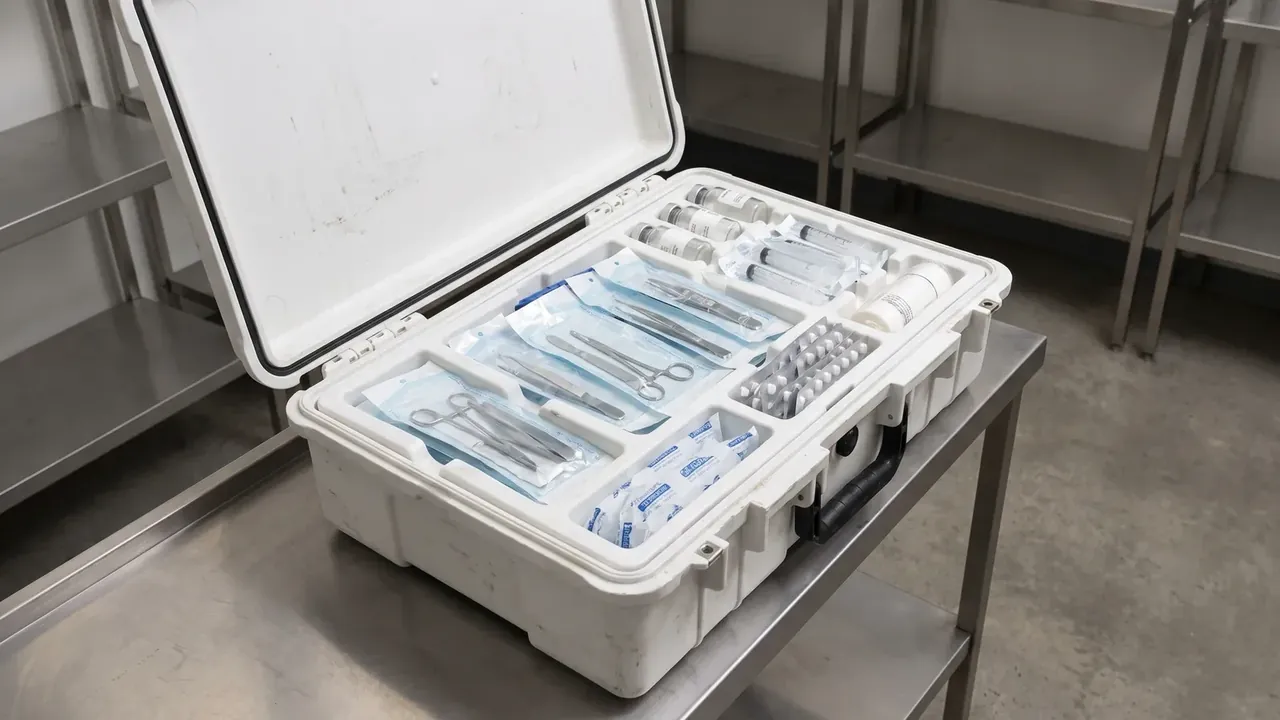
Quick answer: A 12 mm lid frame and 0.9 mm divider restraint let the Pre-hospital emergency medication classified box hold drift to 0.68 mm after a 1.0 m drop.
Table of contents
- Hold-down frame height of the Pre-hospital emergency medication classified box
- How divider restraint clearance is allocated
- Reading divider drift after a six-face drop sequence
- Sag assessment on the open-close endurance rig
- Divider scrap line for classified lots
- FAQ
1. Hold-down frame height of the Pre-hospital emergency medication classified box
A hold-down frame runs as one unbroken rib around the inner mouth of the lid, bearing on divider and liner top edges once the shell shuts. This unit takes the rib to 12 mm because a 560×400×230 mm outer size against a 495×340×165 mm cavity still houses five dividers; taller dividers push back harder against the frame when they drift. Set it low and a 1.0 m six-face drop lets dividers travel upward beyond 0.9 mm of restraint, so divider offset passes 0.68 mm; set it high and the closing stroke shortens, spending part of the 355 N preload from each of the two latches on interference. Trial work at JUNZHIJIA mated three lid variants to a 3.9 mm wall shell. At 12 mm the dividers stayed still at 5.1 kg empty and 11 kg loaded, with post-drop movement inside 0.68 mm on the rig. Rib and lid share one mould, with a root fillet outside the dimension chain that governs how evenly the ring recovers.
Datums first, then the clearance split has a basis.
2. How divider restraint clearance is allocated
The Pre-hospital emergency medication classified box gives all five dividers a common 0.9 mm restraint clearance, worked back from the 0.68 mm divider offset and the 12 mm frame height. Tighter leaves no give in a 1.0 m drop and drives shock into the root slot; looser lets the six-face reading reach 0.68 mm before the frame can catch it.
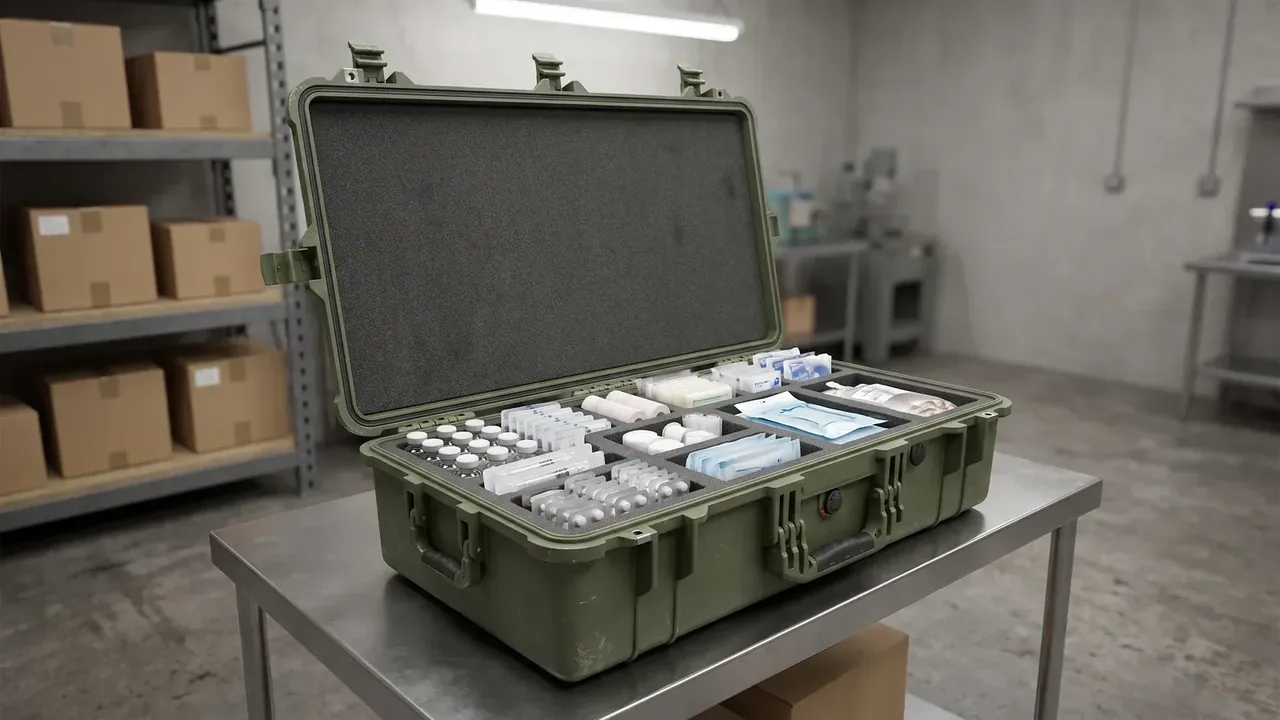
The five dividers do not share one slot tolerance. Each grade is milled on its own station and re-checked with a feeler gauge after assembly. JUNZHIJIA records the grade on the inspection card, grades one through five each get one clearance entry, and any divider outside 0.9 mm sends the whole base back for rework. On the Pre-hospital emergency medication classified box, divider grades and clearance entries share one table, so a re-check by grade traces a drift to one fixture faster than sampling by lot.
| Divider grade | Slot clearance | Six-face rig reading |
|---|---|---|
| Grade one | 0.9 mm | within 0.68 mm |
| Grade two | 0.9 mm | within 0.68 mm |
| Grade three | 0.9 mm | within 0.68 mm |
| Grade four | 0.9 mm | within 0.68 mm |
| Grade five | 0.9 mm | within 0.68 mm |
3. Reading divider drift after a six-face drop sequence
The drop stand places the shell on each of six faces at a common 1.0 m with no external cushioning. For the Pre-hospital emergency medication classified box every landing returns to the same coordinate measuring machine, reading the lateral offset of the divider top edge against the base datum plane, not shell warp. The 0.68 mm line is what remains after subtracting divider elastic give from the 0.9 mm restraint clearance; beyond it the divider reaches the 12 mm bearing edge.
| Drop face | Release height | Divider cap |
|---|---|---|
| Base | 1.0 m | ≤0.68 mm |
| Lid | 1.0 m | ≤0.68 mm |
| Left side | 1.0 m | ≤0.68 mm |
| Right side | 1.0 m | ≤0.68 mm |
| Front end | 1.0 m | ≤0.68 mm |
| Rear end | 1.0 m | ≤0.68 mm |
Release is never based on a mean: the worst of the six readings is lined up against 0.68 mm, and one face over the line sends that batch back. The 5.1 kg empty and 11 kg loaded states each run a full round, and both must fall inside the limit.
4. Sag assessment on the open-close endurance rig
On the endurance rig the lid opens and shuts on a fixed cadence, stops after 4600 cycles, and the frame is measured for sink from its start. The Pre-hospital emergency medication classified box sets this limit at 0.26 mm, tighter than the 0.68 mm divider offset, because every bit of sink eats into the 12 mm clamping travel and lets dividers work loose again. The 355 N preload from each of the two latches stays untouched, and the single seal ring at 22% compression is re-logged at its initial value.
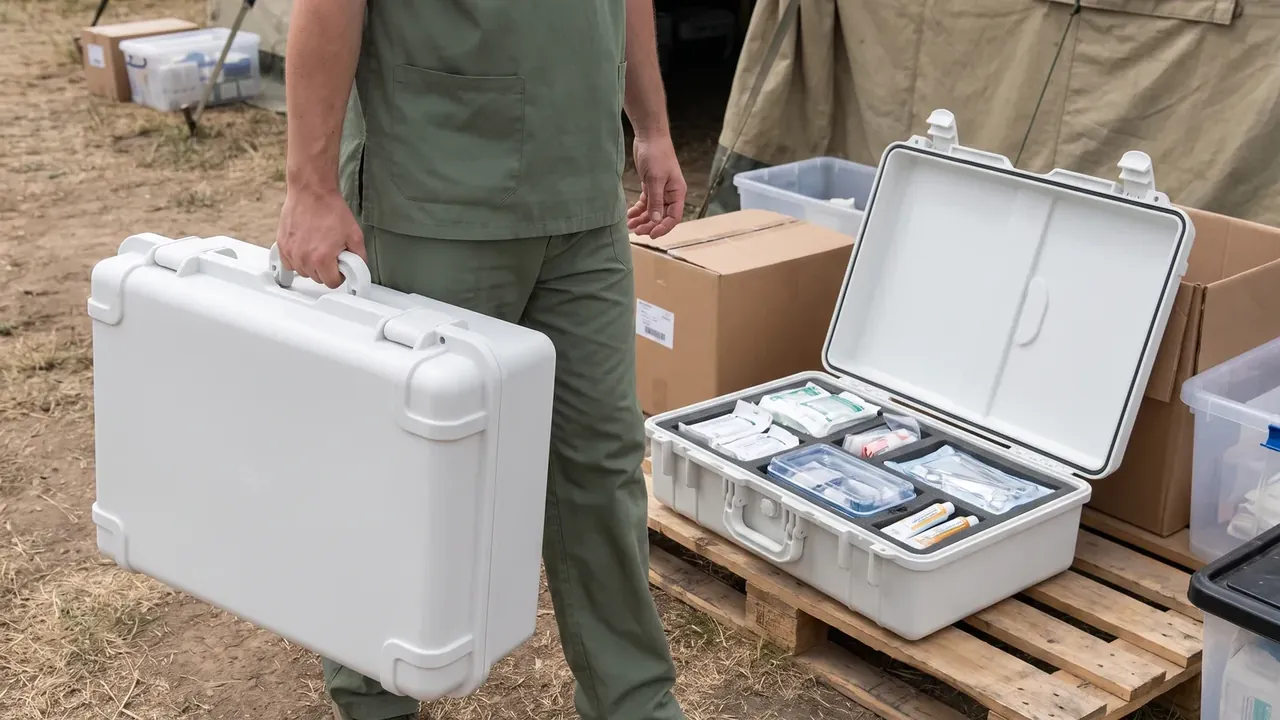
The rig samples sink at a fixed interval and files the curve slope beside the final number.
| Shift value | Cycles | Outcome |
|---|---|---|
| 0 mm | 0 cycles | zero baseline |
| ≤0.26 mm | 4600 cycles | frame item ok |
| ≤0.68 mm | 4600 cycles | divider item ok |
| beyond 0.68 mm | any face | whole unit returned |
Liner thickness is back-calculated from the 560×400×230 mm outer size so the frame still bears on all five dividers after 0.26 mm of sink; both entries are signed before the rig item closes.
5. Divider scrap line for classified lots
Release is decided per lot, and one flattering reading never carries it. The Pre-hospital emergency medication classified box folds four figures onto a single release card: 0.9 mm restraint clearance, 0.68 mm divider offset, 0.26 mm frame sink and 355 N latch preload. Every one must pass or the stamp is withheld; a single crossed figure sends the whole lot back to divider slot milling and lid-frame forming.
In volume production JUNZHIJIA sends a fixed share of shells to the coordinate machine, and each sampled shell still takes a 1.0 m drop on all six faces under the same reading method as trial parts. An IP65 spray check follows its own re-check path, with seal condition and divider drift filed apart.
Conclusion
The Pre-hospital emergency medication classified box pairs a 12 mm frame height with 0.9 mm divider restraint, then closes the specification chain by holding divider offset to 0.68 mm after a 1.0 m six-face drop and frame sink to 0.26 mm after 4600 cycles. JUNZHIJIA writes all four thresholds onto one release card and compares them lot by lot. When choosing such a shell, check that frame and divider datums both stand before splitting seal and liner allowance.
Related Reading
- Emergency Kit Cases: Disaster Supply Storage and Long-Term Readiness
- First Aid Cases: Medical Emergency Supply Storage & Protection
- First Aid Kit Case in Six Settings: IP and MIL-STD-810 Checks
- Emergency Supply Case: Zoning, Weight, Labels, Rotation
Related Products
- 8 Series — Gun Cases; Military Equipment Cases; Camera Equipment Cases; Drone Cases; Watch Cases; Knife Cases; First Aid Cases; Electronics Equipment Cases
- WL8-2812 PP Gun Case — model WL8-2812
- All protective cases and toolboxes: 7 series, 158 models