

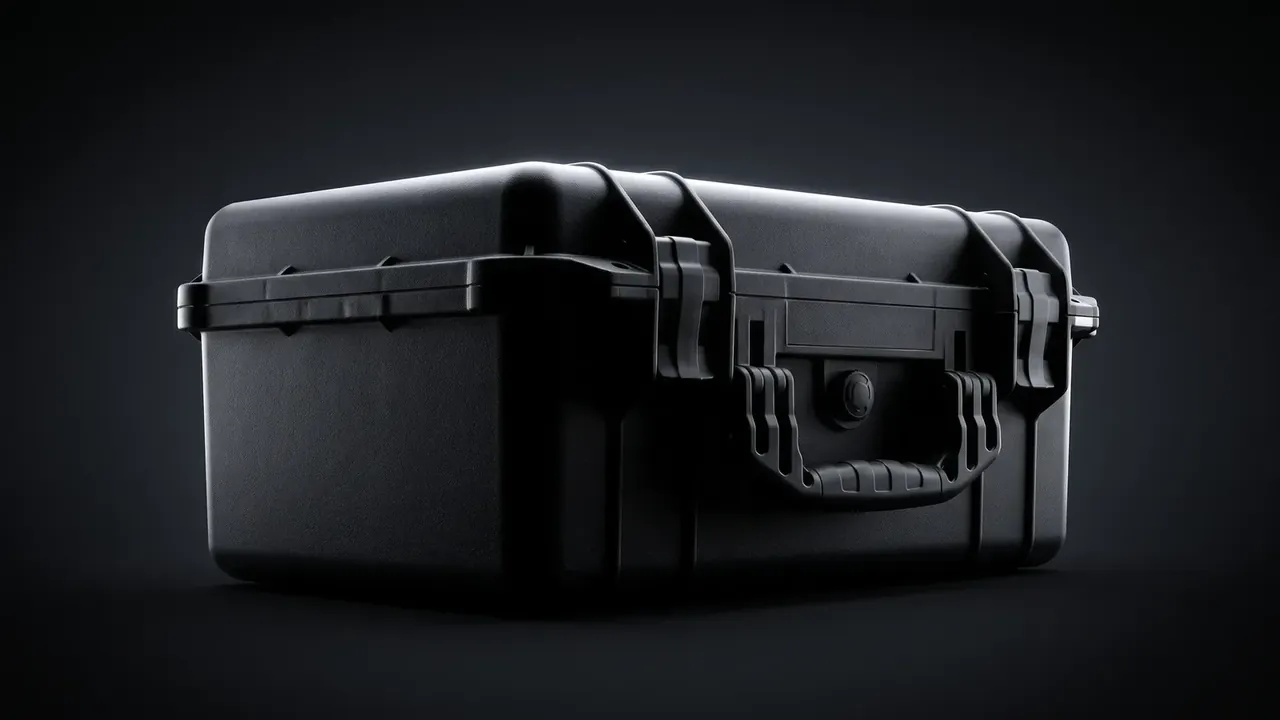
Quick answer: A Precision Instrument Transport Case at 800×600×450 mm, 6 mm PP walls, 11.5 kg empty, two per pallet layer and four layers high.
Table of contents
- Load Path at the Pickup Dock
- Pallet Math and Stack Load on the Trunk Haul
- Second Handling at the Hub and Corner Impacts
- Holding the Seal Through Wet-Dry Cycling
- Last-Mile Delivery and Pre-Open Checks
- FAQ
1. Load Path at the Pickup Dock
A 15 kg spectrum analyzer rolls 40 m from a third-floor lab to a tail lift over two speed bumps. The operator watches the door frame; the Precision Instrument Transport Case absorbs three load events in that distance.
At the bumps the analyzer rises and falls at about 2 g, three times per bump. At the lift an 800 mm stroke ends in a 150 mm free drop. At the truck the forklift pushes the pallet aboard, forks at 1.2 m centres.
Each event pushes differently: vertical at the bump, vertical with tilt at the lift, horizontal at the forks. A Precision Instrument Transport Case with a 740×540×390 mm cavity around a 420×340×180 mm instrument leaves 40 mm per side for those three directions.
The shell runs 11.5 kg empty and 28 kg loaded: two people carry it 30 m, one person 10 m. Keep the handle load line within 20 mm of the centre of gravity, or a one-handed lift tilts a Precision Instrument Transport Case 3° to 5° and the low latch takes the moment.
2. Pallet Math and Stack Load on the Trunk Haul
A 1200 km trunk run in a box van offers 2.4 m of internal height: four layers, eight pallets per vehicle.
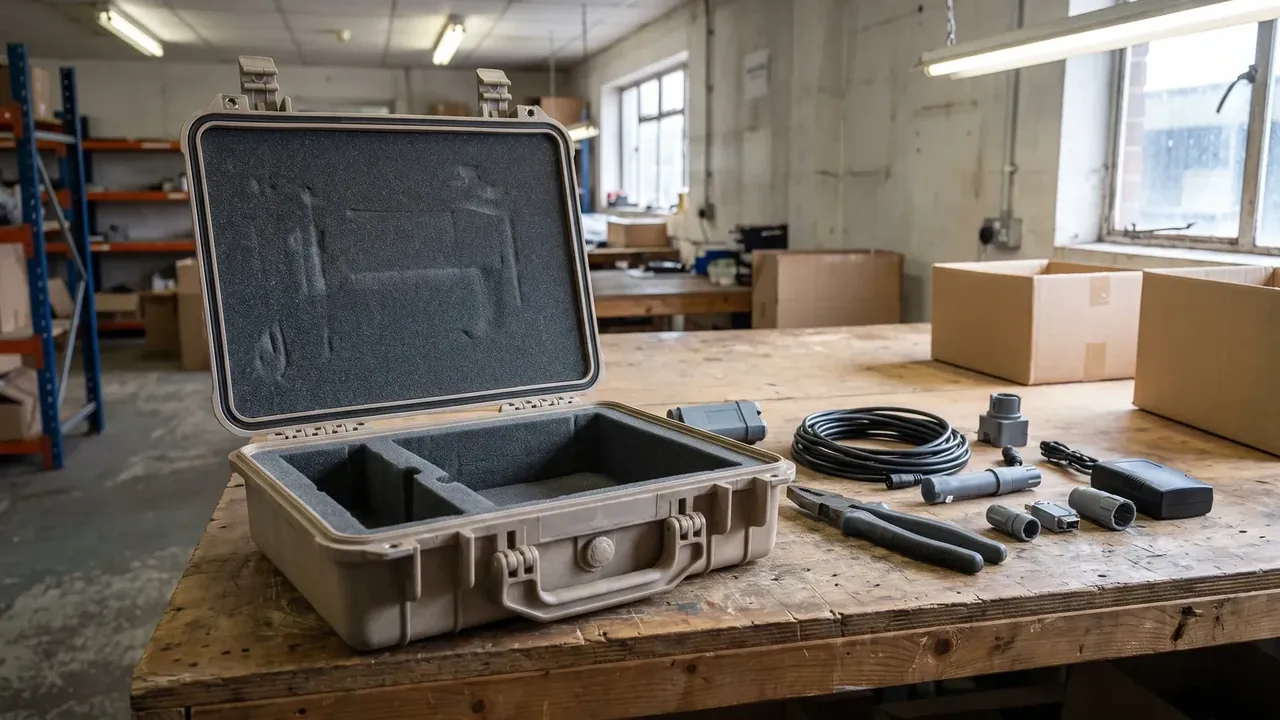
The pallet is 1200×1000 mm. Each case footprint is 800×600 mm, so two make a 1200×800 mm layer and leave a 200 mm strip for straps and corner boards. Eight cases at 28 kg comes to 224 kg, plus 15 kg of pallet. The bottom Precision Instrument Transport Case carries the three above it: 84 kg over a 0.48 m² lid, or 1.75 kPa uniform.
| Item | Value | Note |
|---|---|---|
| Case outside | 800×600×450 mm | latches and handle included |
| Units per layer | 2 | side by side across 1200 mm |
| Layers | 4 | inside 2.4 m height |
| Pallet load | 239 kg | 8×28 kg plus 15 kg |
| Bottom case | 84 kg, 1.75 kPa | three cases above |
The pressure is small; the duration is not. PP creeps above 40 °C, and 84 kg for 72 h sinks the lid centre 1 mm to 2 mm. Ribs at 120 mm centres, 8 mm deep, hold deflection under 1.5 mm.
Road input outweighs the stack: highway vibration runs 3 Hz to 20 Hz at peaks near 1.0 g, broken asphalt pushes energy into 20 Hz to 50 Hz, and hump shunting delivers up to 4 g longitudinal, carried by the fore-and-aft stops rather than the base.
3. Second Handling at the Hub and Corner Impacts
A hub chute drops parcels 800 mm onto a belt, landing anywhere; manual lines add a 1.2 m toss. A 28 kg Precision Instrument Transport Case spends two hours there and takes more knocks than across the 1200 km leg.
| Attitude | Drop | First failure | What you see |
|---|---|---|---|
| Corner first | 1.2 m | R12 corner arc | whitening, cracks in two weeks |
| Edge first | 1.0 m | middle of long edge | rib separates from wall |
| Face first | 800 mm | lid panel | 2 mm dent in the foam |
Corners go first because of curvature, not gauge. A square transition concentrates stress more than an arc, so an R12 radius with a 3.5 mm gusset spreads the hit; whitening falls from 30 mm to 12 mm.
One detail gets missed: hub scan labels go on the front of the lid, and each peel takes 0.1 mm of surface with it. A Precision Instrument Transport Case keeps a 60×40 mm pad recessed 0.5 mm into the side wall, where tape holds and removal never touches the sealing land.
4. Holding the Seal Through Wet-Dry Cycling
A container parked at noon in July reaches 65 °C inside; by midnight in the hills the same case sits at -5 °C, so the gasket follows a 70 °C swing in a day.
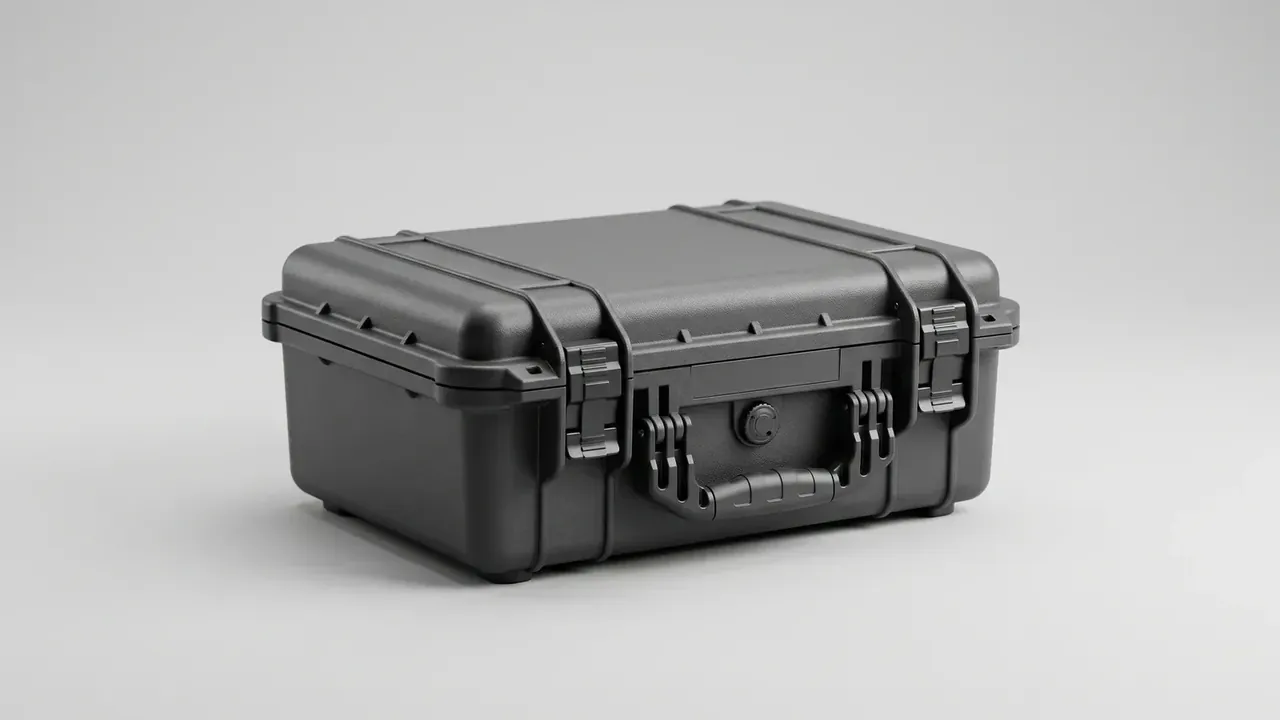
The seal is a silicone O-ring of 8 mm cord in a groove 6 mm deep and 10 mm wide, giving 25% compression and 78% fill. Push fill past 85% and the rubber has nowhere to expand when hot; it lifts the lid by 0.2 mm instead, and that gap leaks faster than anything else on the case.
| Leg | Temperature | RH | Gasket state |
|---|---|---|---|
| Staged at dock | 25 to 35 °C | 60% | 25% compression, full rebound |
| Trunk in sun | 55 to 65 °C | 30% | hardness down ~5 points |
| Hub in monsoon | 28 to 32 °C | 90% | water may pool in groove |
| Hill at night | -10 to -5 °C | 70% | slow rebound, open slowly |
Silicone spans -40 °C to 200 °C and EPDM -40 °C to 120 °C; both survive this route. After ten cycles at 40 °C and 90% RH a silicone ring shows about 12% set.
A 100 g desiccant pack handles the 60 L of free air on a 30-day cycle and pulls 90% RH below 50%; it stops condensation, not water. Air freight can build 15 kPa across the shell, so the Precision Instrument Transport Case relief valve opens between 15 kPa and 25 kPa and keeps water out.
5. Last-Mile Delivery and Pre-Open Checks
The last 8 km runs on an electric cart over paving with 20 mm joints; at 15 km/h a Precision Instrument Transport Case bounces twice a second. Energy is low, frequency is the highest of the journey, and the latches loosen first.
Two manual lifts remain for a Precision Instrument Transport Case: off the vehicle with a 300 mm drop, then through a door into a lift with one side raised to 45°. Both load the handle and latch seats rather than the walls.
Five checks belong before the lid comes up. Confirm the tamper seal. Press the relief valve and listen for air; silence means a stuck membrane. Look for whitening at the corners. Read the humidity card against its 60% mark. Let it sit 2 h to reach room temperature, since a case moved from a -5 °C truck into a 25 °C room coats itself in water.
Conclusion
Four numbers decide whether a Precision Instrument Transport Case survives 1200 km: pallet division, stack duration, hub drops, temperature swing. Settle those first, and wall, rib and cord dimensions follow.
This article covers the container (case) side of specifications and design intent only; it does not address any handling, loading or use of the contents.
Related Reading
- Usable volume and cavity ratio of a case
- EVA foam linings for precision instrument cases
- ABS versus PP for instrument cases
- Plastic case versus wooden crate
Related Products
- 8 Series — Gun Cases; Military Equipment Cases; Camera Equipment Cases; Drone Cases; Watch Cases; Knife Cases; First Aid Cases; Electronics Equipment Cases
- WL8-2812 PP Gun Case — model WL8-2812
- All protective cases and toolboxes: 7 series, 158 models