

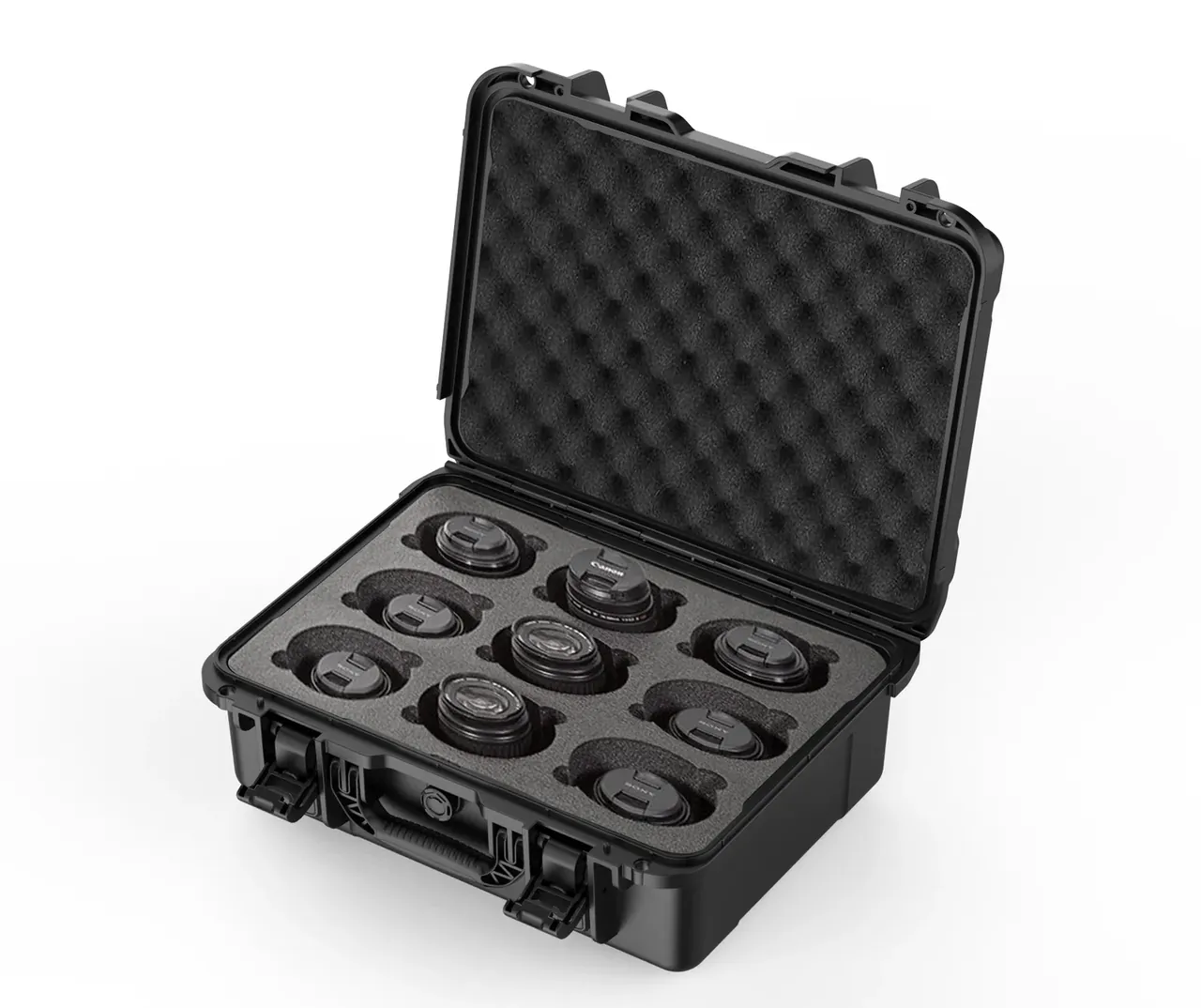
Quick answer: A professional photo equipment waterproof shockproof box usually fails at the 1 mm gap between lens barrel and pocket wall, not at the shell. A 3.5 mm main wall, 1.0 mm pocket interference and a valve that opens at 3 kPa keep a lens seated through a 1.5 m drop and a 26 kPa cabin differential.
Table of contents
- Wall stiffness and lens support
- Pressure equalisation and the 26 kPa cabin delta
- Foam cutting: standing lenses and die tolerance
- Drop, vibration and sensor limits
- Weight, handles and wheels on the road
- FAQ
1. Wall stiffness and lens support
The shell of a professional photo equipment waterproof shockproof box is sized from the way lenses sit. On a 560×350×230 mm body, use a 3.5 mm main wall, 3.0 mm lid and 4.0 mm base with a 55 mm rib grid. A body plus telephoto weighs about 3.2 kg, so the pocket floor carries an 8 mm ring boss, 10 mm wide, sitting 6 mm wider than the barrel. The barrel lands on the boss instead of the flat.
| Part | Size | Structure | Load |
|---|---|---|---|
| Main wall | 3.5 mm | Two vertical ribs at 110 mm | 60 kg side squeeze |
| Base | 4.0 mm | Rib grid at 55 mm | 3.2 kg point load |
| Lid | 3.0 mm | Two rows of 5 mm ribs | 3-high stack, 42 kg |
| Pocket boss | 8 mm high | 10 mm ring width | Drop cushion under barrel |
| Latch seat | 9 mm local | φ5 mm stainless pin | 8000 cycles |
Lengthwise deflection is the quiet failure. Two ribs over 560 mm let a 12 kg load laid on its side sink the lid 2.2 mm in 48 hours; the gasket then stops seating and rain enters along the seam within 10 minutes. A third rib at 110 mm pitch brings that to 0.9 mm.
2. Pressure equalisation and the 26 kPa cabin delta
The better a professional photo equipment waterproof shockproof box seals, the more the pressure delta matters. Cabin pressure at cruise equals about 2400 m of altitude, roughly 75 kPa against 101 kPa on the ground, or 26 kPa per return trip. That delta has to pass through the valve: 3 kPa cracking pressure, 200 mL/min flow, and the case still holds 1 m of water for 30 minutes.
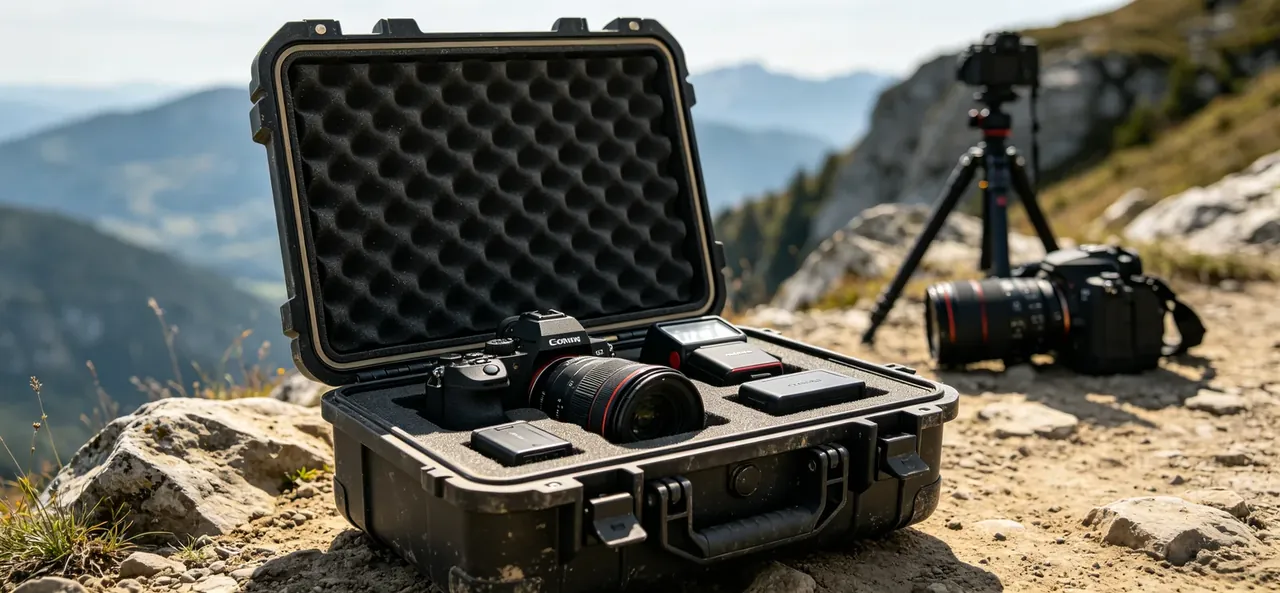
Without a valve the case must be forced open after landing, and the latch releases with a sheet of water across the rim; at high-altitude airports the lid also dishes 1.5 mm. The vent membrane sits near 0.2 μm and passes air but not water, yet oil and sunscreen clog it, so flush the port every 12 months.
| Route | Delta | Cracking pressure | Lid deflection | Action |
|---|---|---|---|---|
| Storage | 0 | Closed | 0 | None |
| Cabin return | 26 kPa | 3 kPa | 0.4 mm | Standard valve |
| High-altitude airport | 35 kPa | 3 kPa | 0.6 mm | Flow raised to 300 mL/min |
| Sea container | 20 kPa | 3 kPa | 0.3 mm | Vent every 7 days |
3. Foam cutting: standing lenses and die tolerance
The insert decides whether lenses stand or lie down. For a telephoto standing upright, cut the pocket to 60% of the barrel diameter with 1.0 mm interference. Under 0.5 mm the lens rotates in transit and the mount picks up rub marks; over 1.5 mm the whole insert lifts with the lens.
Use EVA at 45 kg/m³, one grade above the 30 kg/m³ common in tool inserts, at 20 mm thick and ±0.5 mm die tolerance. Lower-density foam takes a permanent 3 mm dent after two 1.5 m drops, and the third drop puts the body onto the pocket floor. A 15 mm convoluted pad in the lid gives 2 mm of interference on the lens tail and holds vertical travel under 0.5 mm.
| Insert | Density | Thickness | Die tolerance | Best for | Cost |
|---|---|---|---|---|---|
| Cut EVA | 45 kg/m³ | 20 mm | ±0.5 mm | Fixed prime and zoom sets | High |
| Pick-and-pluck | 38 kg/m³ | 25 mm | ±1.0 mm | Crews swapping gear | Medium |
| PP hollow-sheet | — | 5 mm | ±2.0 mm | One body type in volume | Low |
Pick-and-pluck suits crews whose kit changes weekly, at the price of square walls that scuff hoods. Cut foam suits a fixed set; a new body means a new die and about 4 days. Leave 4 mm at the four inner walls so the insert never loads the latch stroke.
4. Drop, vibration and sensor limits
Drop testing for a professional photo equipment waterproof shockproof box runs one grade above a tool case. At 12 kg loaded, six faces from 1.5 m onto concrete, with a triaxial accelerometer inside, peak acceleration stays under 60 g; after the drop the lid shifts no more than 1.0 mm and no pocket wall cracks through.
Vibration runs as two profiles: road at 5 to 200 Hz and 1.0 g for 30 minutes per axis, cabin random at 10 to 500 Hz and 1.5 g rms for 20 minutes per axis. Re-check latch force afterwards; a drop from 100 N to 85 N means the seat has worn loose. Sensors react to high-frequency shock, so 20 mm EVA plus a 15 mm pad pulled a 1.5 m drop from 180 g to 52 g, while cutting the foam to 12 mm sent it back to 96 g.
5. Weight, handles and wheels on the road
Empty weight decides whether the case leaves the studio. A 560×350×230 mm body runs 4.6 kg empty and 12 kg loaded; the handle holds 40 kg static, wheels are 50 mm and the telescopic handle is rated 20 kg. Above 5.5 kg empty, most shooters check a soft bag instead.
Wheel life is a cost line. A 50 mm PU wheel loses about 0.8 mm of tread over 8 km of terminal flooring; a 40 mm wheel loses 1.6 mm over the same distance and needs replacing in 10 months. Four M4 stainless screws per housing carry 12 kg more than self-tapping screws, at 6 mm of inner corner space.
Conclusion
The selection order runs cavity length from the longest lens, foam density and pocket depth from lens weight, valve from whether it flies, wheels and handle from transit distance. The valve is cut most often and shows up the moment the lid opens after landing.
This article covers container-side specifications and design implications only.
Related Reading
- Camera case selection and divider layout
- Cutting and tolerances for custom foam inserts
- How latch holding force is tested
- Structural requirements for air-transport cases
Related Products
- 8 Series — Gun Cases; Military Equipment Cases; Camera Equipment Cases; Drone Cases; Watch Cases; Knife Cases; First Aid Cases; Electronics Equipment Cases
- WL8-2812 PP Gun Case — model WL8-2812
- All protective cases and toolboxes: 7 series, 158 models