

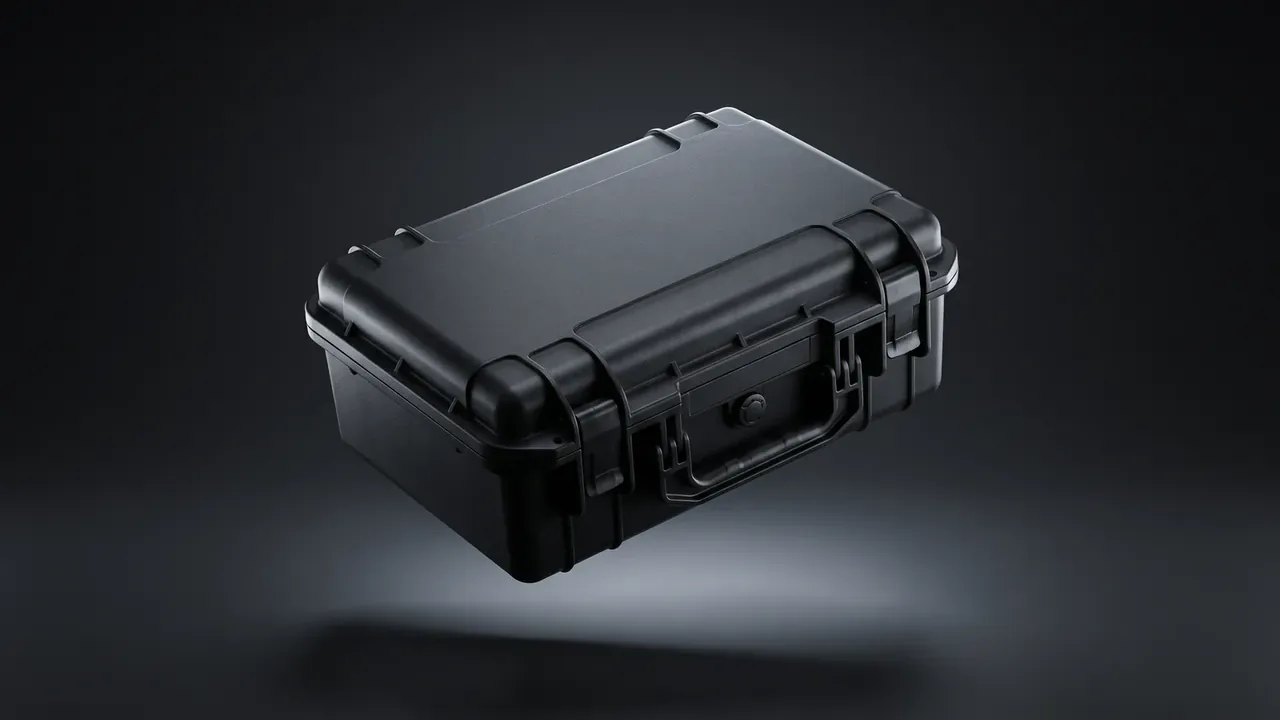
Quick answer: A Prop Charge Container is judged in five steps — cavity, seal, stacking, location, static — each with a number read on site: 1.0 to 1.5 mm per side, a 0.05 mm feeler that will not enter the joint, under 3 mm of bulge after five tiers, and surface resistance between 10^6 and 10^9 ohms.
Table of contents
- Five Benchmarks Before Any Price Talk
- Ingress Ratings: When the Label Outruns the Report
- Stacking and Vibration: Methods Given, Layers Not
- Cavity and Location: Channels, Clearance, Pull Force
- Static Dissipation: Three Readings, One Condition
- Sample Arrival: Five Actions, One Page
- FAQ
1. Five Benchmarks Before Any Price Talk
A catalogue sheet reports what a mould can do, not whether the box suits your rounds. Until the cavity is fixed, liner thickness means nothing; until the seal is proven, static work only traps moisture. Buyers reverse that order and find out at inspection.
| Benchmark | Reference | On-site check | Failure reading |
|---|---|---|---|
| Cavity | ISO 2768, class m | Tape length, width, depth | Under 1 mm per side |
| Seal | IEC 60529, IPX7 | 0.05 mm feeler at the joint | Feeler enters anywhere |
| Stacking | ISO 2234, 24 h static | Five tiers, measure bulge | Bulge over 3 mm |
| Location | Tooling drawing | Shake the empty case | Rattle, rub marks |
| Static | ANSI/ESD S541 | Five resistance points | Above 10^9 ohms |
Only two need the lid open, so a sample Prop Charge Container clears a loading bay.
2. Ingress Ratings: When the Label Outruns the Report
An IP code answers two questions: can solids get in, can water get in. IP6X is dust-tight; IPX7 is one metre of water for thirty minutes. In a storehouse a Prop Charge Container meets condensation and road spray, not a lake.
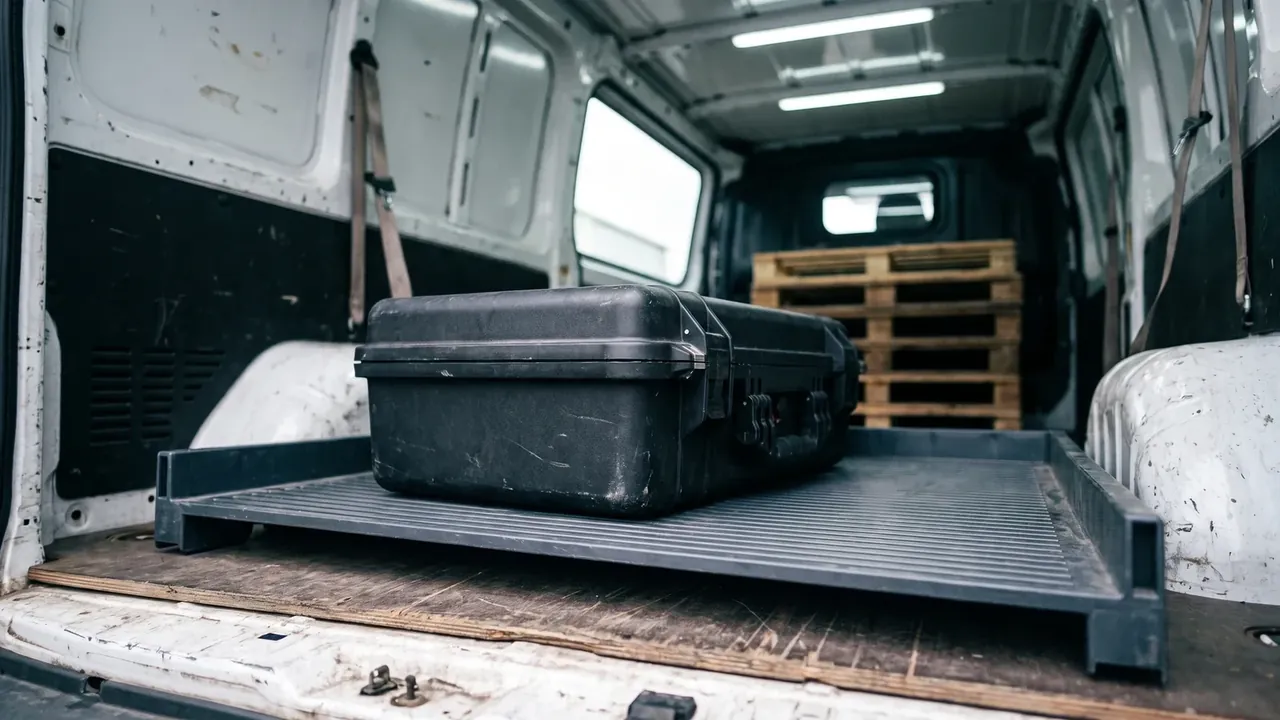
Reports drift from labels: an IPX4 sheet sits behind a box marked IP67.
Pressure is the second blind spot. A climb or a hot afternoon pushes the differential to 20 kPa, enough to lift the lid and release gasket compression. Fit a vent, or vacuum-hold at minus 20 kPa.
3. Stacking and Vibration: Methods Given, Layers Not
ISO 2234 gives the method, not the tier count. A loaded Prop Charge Container weighs 22 kg, so five tiers load the bottom unit with 88 kg; a 1.6 factor makes the design check 141 kg.
| Tiers | Load on bottom case | Advised at 40 °C | Check |
|---|---|---|---|
| 3 | 44 kg | 3 | Side-wall bulge |
| 5 | 88 kg | 4 | Bulge and lid offset |
| 7 | 132 kg | 5 | Re-measure with a board |
Tiers are calculated, not printed: polyethylene loses modulus at 40 °C, so a summer tier drops one.
Method 514 of MIL-STD-810H matters for one reason: ribs above the feet carry load down the wall, offset ribs bend it and let water in.
4. Cavity and Location: Channels, Clearance, Pull Force
The cavity is the only part of a Prop Charge Container cut from a real sample. Moulded channels beat glued foam because the channel wall is the locating face.
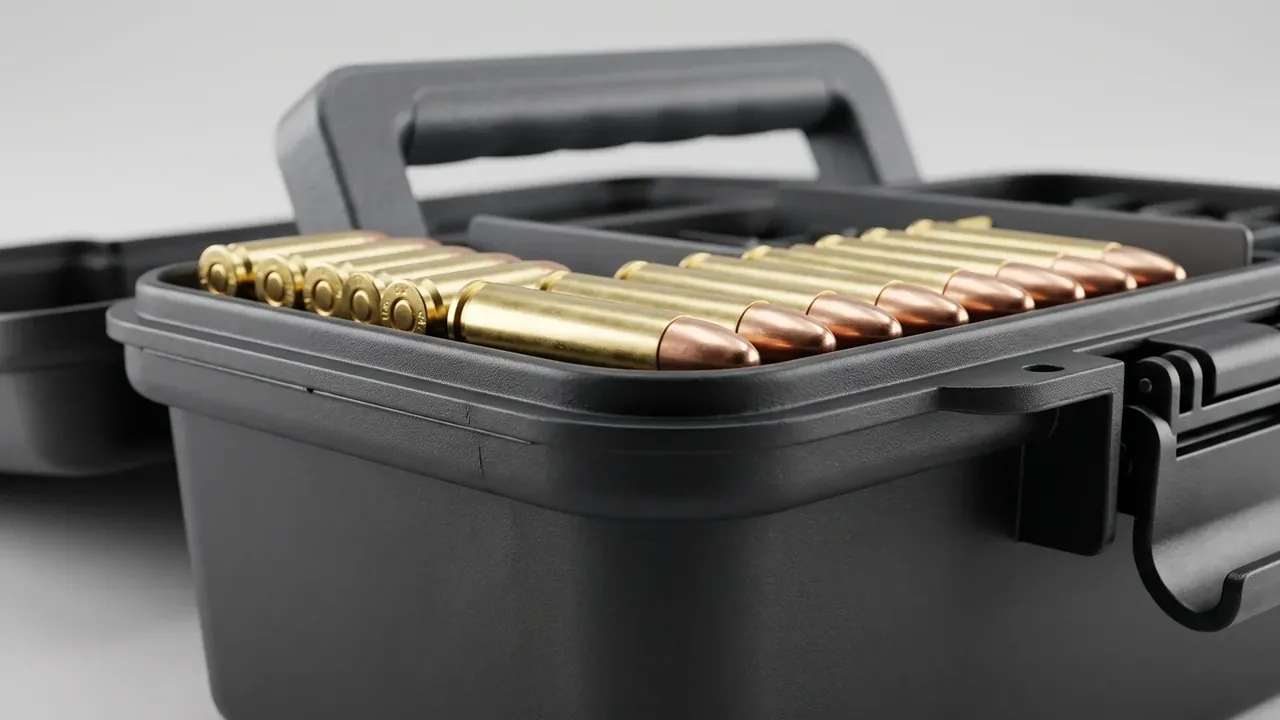
Allow 1.0 to 1.5 mm per side: tighter and the round scuffs the rim, looser and potholes throw it against the channel.
Depth runs at 0.6 times the diameter, so the mass sits in the pocket. Pull force lands at 30 to 50 N, firm in one hand yet back on the floor by its own weight. Edges to 5 mm, draft 1°.
5. Static Dissipation: Three Readings, One Condition
Three readings, one condition: 23 °C, 50 per cent relative humidity, sixty seconds after twenty-five wipes. Otherwise the numbers cannot be compared: one compound spans three orders of magnitude between a dry store and a damp dock.
Surface resistance belongs between 10^6 and 10^9 ohms; below that the discharge concentrates, above it the surface insulates. Terminal to the farthest liner point stays under 2 ohms. Each reading maps to a replaceable part, so a Prop Charge Container is repaired, not scrapped.
6. Sample Arrival: Five Actions, One Page
Five actions on arrival, one number each:
- Weigh the empty case; a 5 per cent deviation asks if the compound changed
- Walk a feeler round the joint, number the points that admit it
- Stack five tiers, measure bulge after 24 hours
- Shake the empty case, load and unload three times
- Read surface resistance at five points, keep the highest
Conclusion
Read the benchmarks in order: cavity, seal and pressure, stack calculation, resistance. Two need a sample, the rest a clause and a meter. One page gives every supplier the same baseline for a Prop Charge Container quotation.
This article discusses only the container (case body) side of specifications and design intent, and does not cover any handling, loading or use of the contents.
Related Reading
- What a prop charge container is
- Material and static choice
- Ammunition case criteria
- Showroom checks
- Gun case sizing
Related Products
- 8 Series — Gun Cases; Military Equipment Cases; Camera Equipment Cases; Drone Cases; Watch Cases; Knife Cases; First Aid Cases; Electronics Equipment Cases
- WL8-2812 PP Gun Case — model WL8-2812
- All protective cases and toolboxes: 7 series, 158 models