

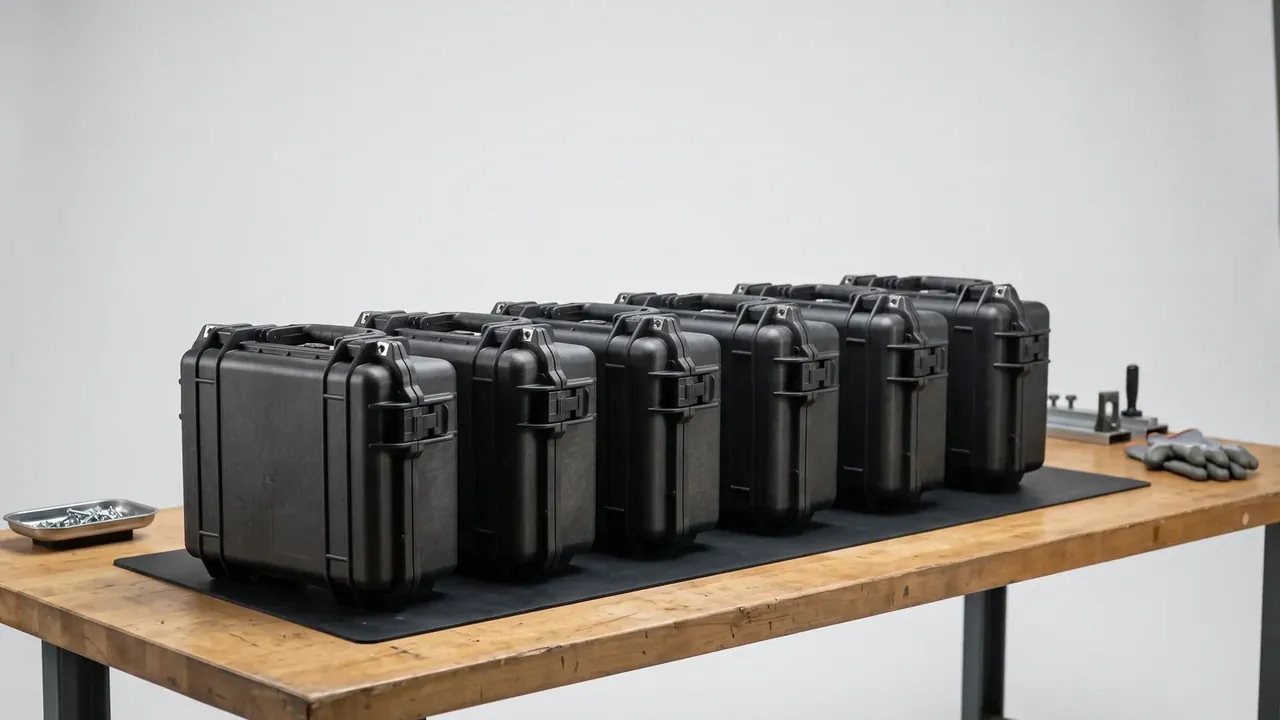
Quick answer: Vetting a Protective Case Manufacturer comes down to three numbers: tonnage and cavity count set the minimum order, mould ownership sets how fast a change runs, and the audit score predicts batch consistency.
Table of contents
- What a Protective Case Manufacturer Quote Contains
- Checking Capacity and Machine Data
- Mould Ownership and Audit Scores
- MOQ Follows Cavity Count
- Lead Time, Batch Consistency and Terms
- FAQ
1. What a Protective Case Manufacturer Quote Contains
A quote is six lines under one total: material, machine time, tooling, hardware, inspection with packing, and overhead. Buyers compare only the total, where the soft lines hide.
Material is net weight times resin price: glass-filled polypropylene at 12.8 a kilo, 5.4 kg a case, gives 69. Machine time is 190 an hour on an 800-tonne press at a 13-minute cycle, or 41.
| Cost line | 1,000 | 5,000 |
|---|---|---|
| Resin and colour | 73 | 70 |
| Machine time | 41 | 35 |
| Tooling | 260 | 52 |
| Hardware | 24 | 22 |
| Inspection and packing | 9 | 7 |
| Overhead and margin | 45 | 20 |
Tooling drives the spread: the same 260,000 mould is 260 a case at 1,000 units and 52 at 5,000, a 208 gap. Inspection on its own line is 0.8 a case; one bundled quality fee adds 6.
2. Checking Capacity and Machine Data
Do not ask how many cases a month a plant makes. Ask for nameplates and cavity counts: output for a Protective Case Manufacturer is daily output per press times running days.
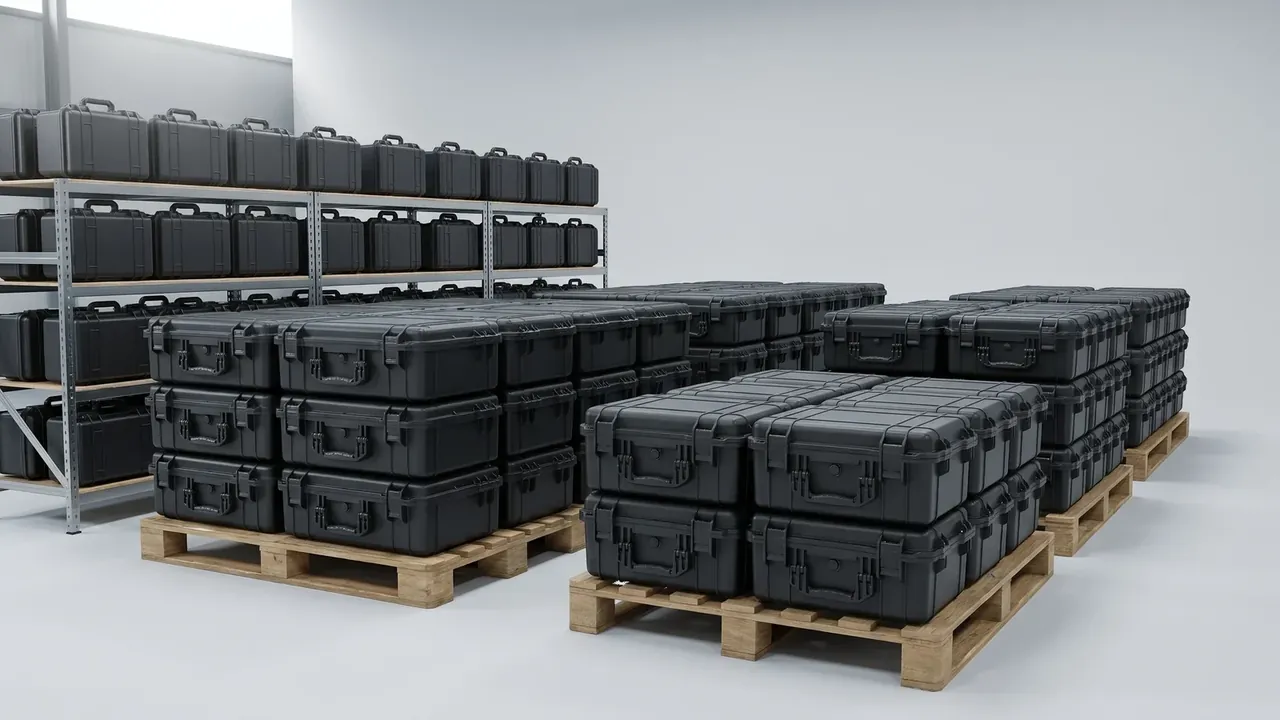
A plant claiming 13,000 a month runs an 800-tonne, a 1,300-tonne and a 2,500-tonne press: 101 cases a day from a single cavity at 13 minutes, 176 from two at 15, 240 from four at 22, or 13,400 across 22-hour days over 26 days. Two presses claiming 20,000 would need a 9-minute cycle or a 30-hour day, and a 2,500-tonne press shared across three case types loses a further four hours per change plus 40 minutes of purging.
3. Mould Ownership and Audit Scores
Mould ownership decides how fast a change moves. Of 54 moulds in use, 38 owned and 16 outsourced is 70 percent; an owned mould turns a revised rib in 1.5 days, an outsourced one in 5 to 7 plus a 3,000 fee.
Ask which mould a case number runs on and when it was last serviced. A supplier without an asset number is borrowing capacity.
An audit scores six blocks out of 100, 82 being the usual pass mark: mould 20, equipment 15, traceability 20, process control 25, inspection 12, despatch 8.
Process control is where questions belong: a CPK under 1.33 will not be recovered by tighter sampling.
4. MOQ Follows Cavity Count
A minimum order is arithmetic: tooling divided by the amortisation ceiling, so 260,000 at 800 a case gives 325 units.
| Cavities | Press | Cycle | MOQ | Daily output |
|---|---|---|---|---|
| 1 | 800 t | 13 min | 300 | 101 |
| 2 | 1,300 t | 15 min | 800 | 176 |
| 4 | 2,500 t | 22 min | 1,600 | 240 |
More cavities means a higher minimum, because four hours of changeover and six reject shots cost 1,900: 1.2 a case across 1,600 units, 6.3 across 300.
Small volume has two routes: a single-cavity tool at 90,000 brings the minimum to 300, or an existing mould re-coloured for 500 at 12 more a case. Three colours of 200 each count as three purges: quote 600.
5. Lead Time, Batch Consistency and Terms
Lead time is credible only in five stages: 3 days sign-off, 25 tooling, 5 first trial, 12 production, 4 inspection and despatch, or 49 in total.
| Stage | Days | Typical slip |
|---|---|---|
| Drawing sign-off | 3 | Two design rounds, plus 4 |
| Tooling | 25 | Slide rework, plus 3 |
| First trial | 5 | Colour rework, plus 2 |
| Production | 12 | Press queue, plus 3 |
| Inspection | 4 | Third-party slot, plus 2 |
A repeat order runs 18 days. Batch consistency rests on a 12-point first-article CMM report, wall spread within 0.25 mm and colour within Grey Card grade 4.
Payment is 30 percent deposit, 40 at trial approval, 25 before despatch, 5 retention for 45 days; monthly terms cost 1.5 percent more, or 18 percent annualised.
Conclusion
Buying from a Protective Case Manufacturer is less about the lowest number than about who opens the six cost lines, reconciles cavities with the minimum order and writes audit scores into the contract. Fix mould ownership, amortisation base, inspection frequency and the cost of credit, and the long-run price has somewhere to fall, which is the real test of a Protective Case Manufacturer.
This article discusses only the container (case body) side of specifications and design intent, and does not cover any handling, loading or use of the contents.
Related Reading
- How a protective case manufacturer builds the shell
- What to ask in a supplier qualification audit
- How to calculate line capacity
- Where the small-batch threshold sits
Related Products
- 8 Series — Gun Cases; Military Equipment Cases; Camera Equipment Cases; Drone Cases; Watch Cases; Knife Cases; First Aid Cases; Electronics Equipment Cases
- WL8-2812 PP Gun Case — model WL8-2812
- All protective cases and toolboxes: 7 series, 158 models