

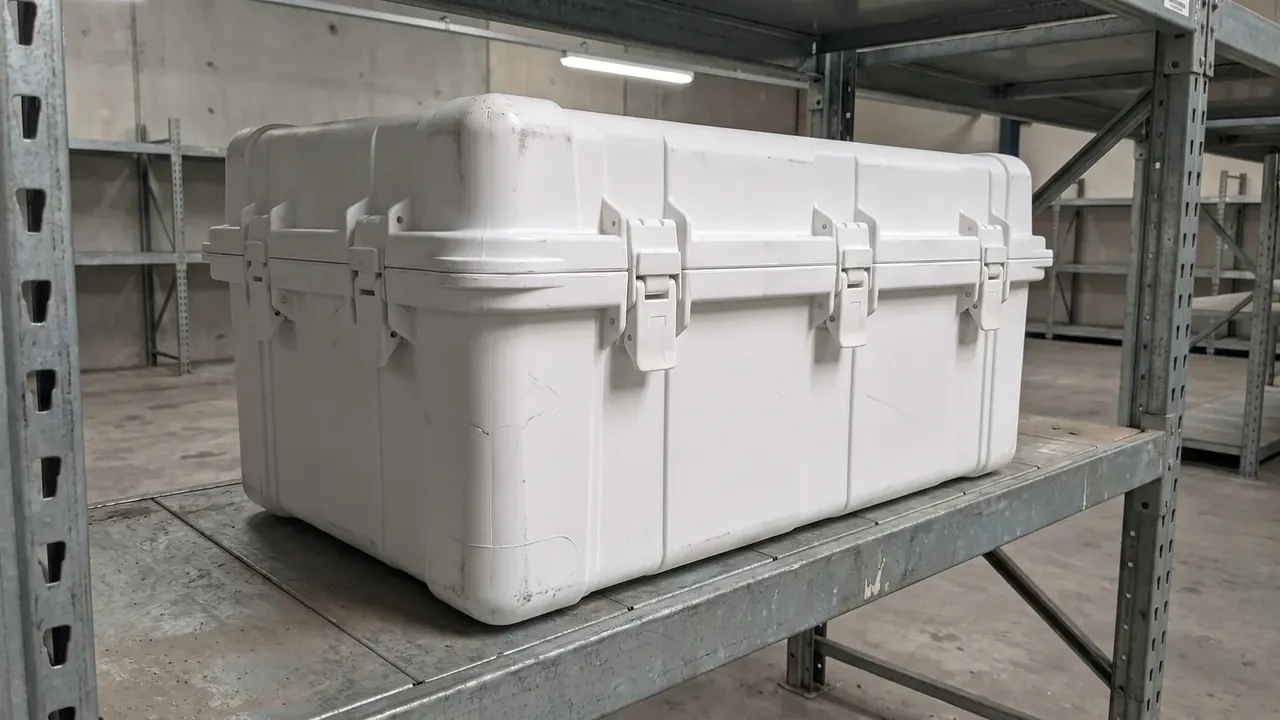
Quick answer: A batch of 120 rotomolded cases taken into service in April 2023 came back nine times by March 2026 — five for a flattened gasket, three for a worn latch tongue. Three inspection tiers, at 7, 90 and 360 days, with one measurable limit each, cut the annual repair rate from 7.5% to 2.4%.
Table of contents
- What the repair tickets showed
- Three tiers at 7, 90 and 360 days
- Washing at 40 °C, three solvents banned
- Three replacement lines
- Stretching 3 years into 6
- Five fields on the sheet
- FAQ
1. What the repair tickets showed
In April 2023 a test-equipment maker took 120 rotomolded cases: 1180 × 590 × 340 mm inside, 46 kg loaded, bound for 17 depots. By March 2026 the batch had come back nine times, each ticket naming one of three parts.
| Failed part | Units | Share | Mean months | First ticket |
|---|---|---|---|---|
| Gasket flattened | 5 | 56% | 27 | Month 25 |
| Latch tongue worn | 3 | 33% | 31 | Month 29 |
| Hinge pin play | 1 | 11% | 34 | Month 33 |
Five of the nine sat in one place, averaging 27 months against 31 or more: a crushed gasket, not a worn one. A lid latched for weeks flattens the rubber and opens a gap along the rim.
The old routine fixed what broke. Tickets said “not sealing”, and the case returned a year later. That is where Protective Case Sales loses the thread: after handover the call belongs to a user with a feeling, not a gauge.
2. Three tiers at 7, 90 and 360 days
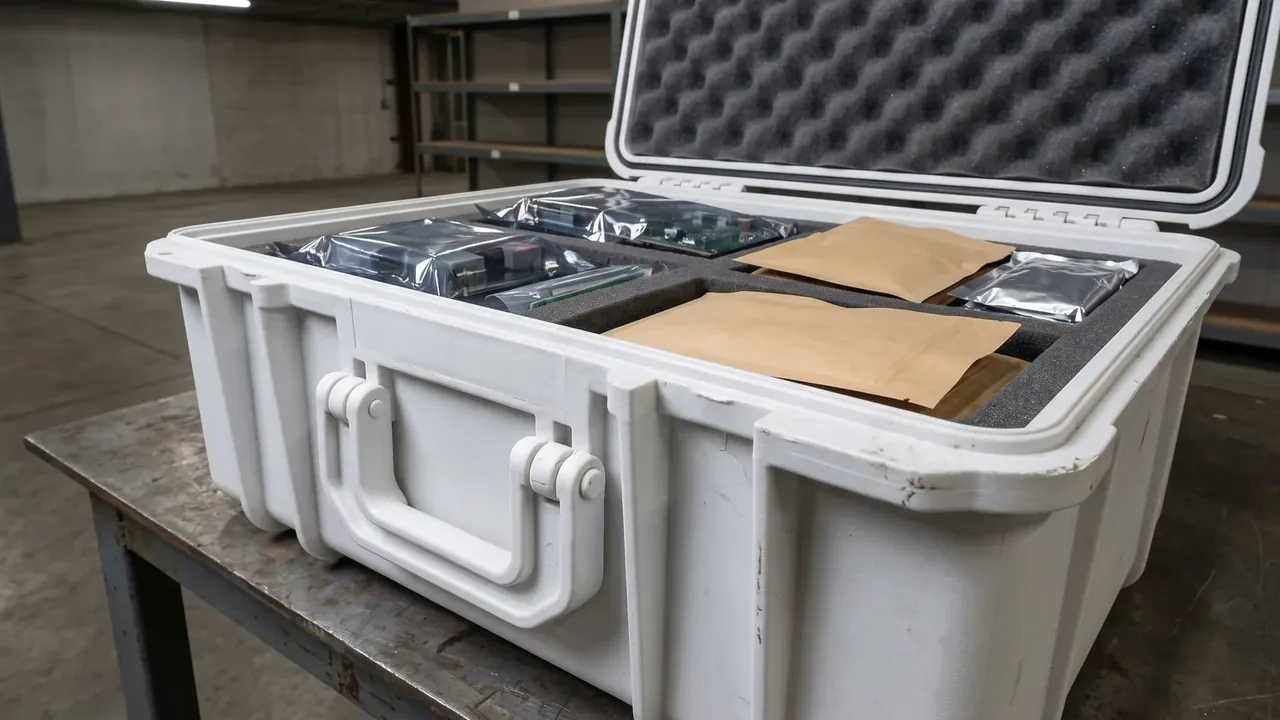
Protective Case Sales tiers split by what each level can detect. Seven days: four checks at the dock, 90 seconds per case. Ninety days: feeler gauge and thickness gauge, 12 minutes. Three hundred sixty days: pressure decay and salt spray on a 10% sample.
| Tier | Interval | Checks | Time | Output |
|---|---|---|---|---|
| One | 7 days | Latch, rim grit, handle cracks, label | 90 s | Exceptions only |
| Two | 90 days | Gasket height, tongue travel, pin play, wall | 12 min | Numbers per case |
| Three | 360 days | Pressure decay, salt spray, drop sampling | Sent out | Report |
Tier three samples 10% — 12 of 120 — covering the batch in 3 years. Protective Case Sales quotations rarely include inspection, so the buyer sets the tiers.
3. Washing at 40 °C, three solvents banned
One rule runs through Protective Case Sales cleaning: if water does the job, no solvent goes near the shell. Neutral detergent at pH 7, water at 40 °C, a soft brush along the ribs, a clean rinse, compressed air in the gasket groove, 30 minutes drying before the lid goes down.
Acetone, thinner and chlorine bleach stay away — the first line of the cleaning note in every Protective Case Sales order.
Acetone blooms ABS white, marking where stress collects; thinner creeps into micro-cracks, and the next drop starts a crack where the cloth passed; bleach left on metal shows rust in 96 hours, and play grows from 0.3 mm. Grease gets 5% neutral soap for 3 minutes instead: a scratch 0.2 mm deep moves the crack origin of a 1.2 m drop from the corner to the scratch.
4. Three replacement lines
Each line has one number; the part comes off when it is reached.
| Part | New | Watch | Replace | Cost |
|---|---|---|---|---|
| Gasket | 12 mm | 9 mm | 35% set | USD 3.00 |
| Latch | 8 mm travel | 6.5 mm | 5.5 mm | USD 2.30 |
| Hinge pin | 0.3 mm play | 0.6 mm | 0.9 mm | USD 1.30 |
Read the gasket at the four side midpoints. Latch the lid 24 hours, open it, wait 30 minutes: 12 mm pressed to 8.6 mm is normal compression at 28%. A gasket that will not return to 9 mm has lost its rebound; replacing it beats waiting for a leak, which costs three desiccant packs at USD 2.00 each.
Judge the latch by tongue travel, not spring feel: from 8 mm down to 5.5 mm the tongue skips open under vibration, which no visual check catches and one 1.2 m drop reproduces. Hinge play is read with a feeler gauge, 0.9 mm being the ceiling. Past it the lid skews, one gasket side is crushed and the other hangs free. The spare kit behind every Protective Case Sales handover should hold all three parts — USD 6.60, less than one service visit.
5. Stretching 3 years into 6
Four moves carry a case from 3 years to 6: out of sunlight, temperature and humidity held, stack capped, stock rotated every half year. Store between -10 °C and 45 °C, humidity under 60%, cases on pallets 100 mm off the floor.
Stack no more than 3 high. The bottom lid then carries the two above it — 46 kg times 2, or 92 kg — on a 4.2 mm skin, and after 12 months it has dipped 1.5 mm, enough to stop the gasket sealing.
Two sums settle it. A new case is USD 66; upkeep at USD 5.50 a year is USD 33 over 6 years, USD 99 all in. Without upkeep a case is scrapped at 3.2 years, so 6 years means two batches, USD 132. Across 120 units the gap is USD 3,960.
6. Five fields on the sheet
Five fields: case number, measuring point, reading, verdict, date. Eight points follow four side midpoints and four corners, matching the gasket readings.
The verdict has three values — pass, watch, replace, the same three used across Protective Case Sales inspection. A watch entry carries the next date, or nobody remembers why it was flagged.
Handover runs on sampling: a supervisor re-measures 10%, 12 cases, and a reading more than 0.2 mm off sends the records back.
A 120-case batch means four tier-two rounds and 52 tier-one rounds a year, under 300 lines. A Protective Case Sales handover with this sheet beats one with a manual.
Conclusion
Inspection, cleaning and replacement come down to three intervals, three limits, five fields. Intervals follow the duty cycle, limits are written in millimetres, and fields tie each reading to one case. Do that and a 3-year shell lasts 6, while Protective Case Sales after-sales work turns from firefighting into a schedule.
This article discusses only the container (case body) side of specifications and design intent, and does not cover any handling, loading or use of the contents.
Related Reading
- Inspecting wheeled cases and swapping wheel sets
- How an enquiry becomes a signed sample
- Sealing and re-checking stored reserve cases
- Load limits on deep-cavity cases
- Adapting a stock design for an OEM order
Related Products
- 8 Series — Gun Cases; Military Equipment Cases; Camera Equipment Cases; Drone Cases; Watch Cases; Knife Cases; First Aid Cases; Electronics Equipment Cases
- WL8-2812 PP Gun Case — model WL8-2812
- All protective cases and toolboxes: 7 series, 158 models