

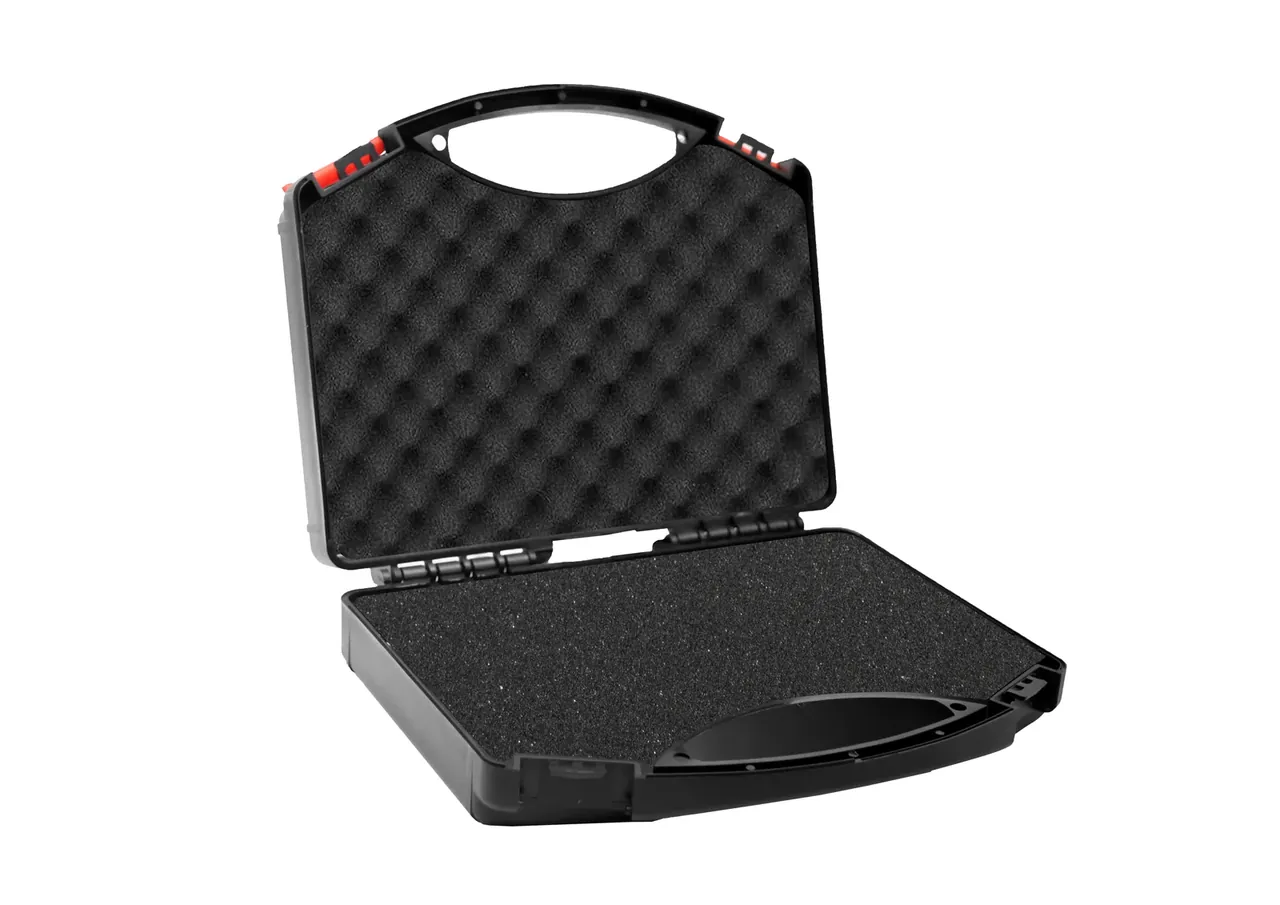
Quick answer: Protective Case Sales is decided in forty minutes at a bench: three samples of one size, eight thickness readings, five latch pulls, one weighing, one 7 kg drop.
Table of contents
- Protective Case Sales in Six On-Site Checks
- Appearance and Marking on the First Look
- Four-Point Thickness Mapping
- Latch and Hinge Feel in Numbers
- Load and Drop to Prove the Fit
- Turning Readings into a Comparison Sheet
- FAQ
1. Protective Case Sales in Six On-Site Checks
A sample meeting in Protective Case Sales is usually a talk about capacity. Give it ten minutes, then run six checks.
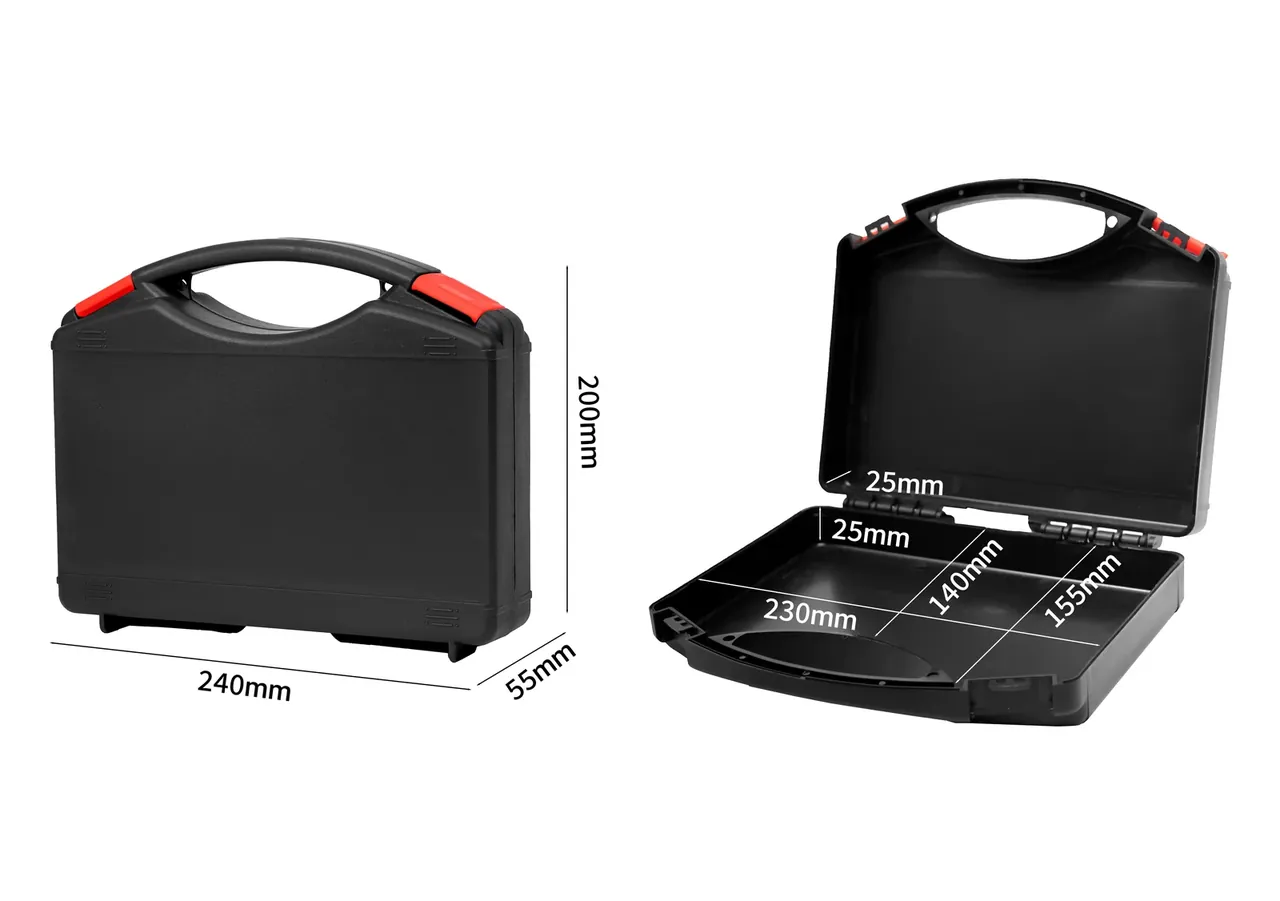
Three samples of one model sat on a bench: 240 by 200 by 55 mm, 0.9 kg empty, marked A, B and C.
| Check | Tool | Record | Fails when |
|---|---|---|---|
| Appearance | feeler gauge | flash, texture | above 0.3 mm |
| Wall | ultrasonic gauge | eight points | below 2.8 mm |
| Latch | force gauge | force, return | under 120 N |
| Hinge | cycle jig | gap after 200 cycles | white pin marks |
| Weight | scale | empty, with foam | 80 g spread |
| Drop | drop rig | six faces from 1.2 m | corner crack |
2. Appearance and Marking on the First Look
The first case lies closed, front out: bridge handle in the lid edge, two red latch tabs, a blank label plate, two feet.
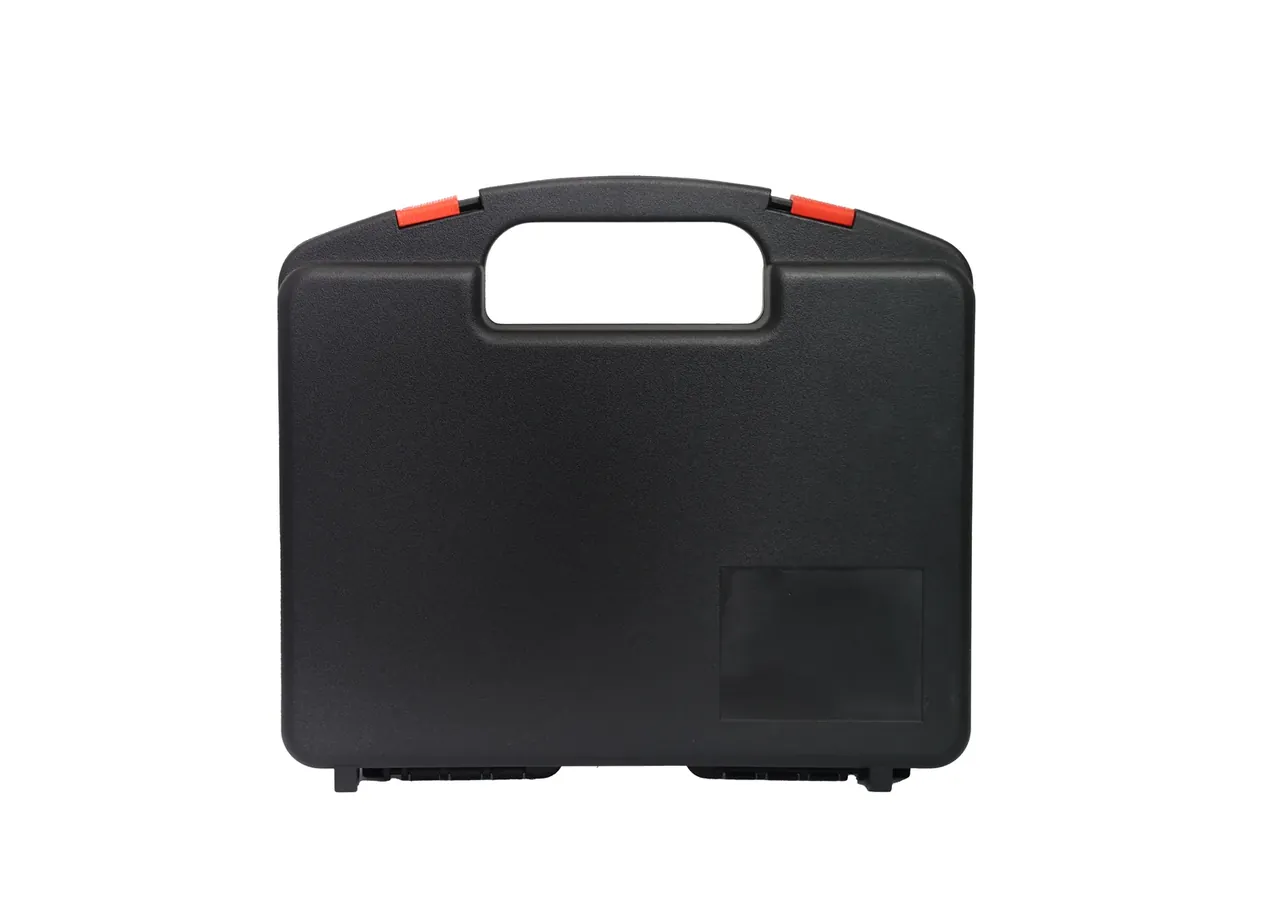
Appearance is not about beauty. It is about consistency.
A parting line should be a thin mark, not a step. A 0.3 mm feeler sliding in means worn tooling, and the seam takes water.
Colour needs an instrument: A against B read 1.8 under D65, C 1.1. Set 1.5 as the limit.
3. Four-Point Thickness Mapping
Wall thickness is the one figure no eye can judge, and the main reason identical cases price apart.
Melt meets at a weld line where strength is lowest, and a cold corner sits 0.2 to 0.4 mm thinner. A read 3.0, 3.4, 2.7 and 3.1 mm; B 2.9 to 3.0; C 3.1 to 3.3. Against a 2.8 mm floor, that 2.7 dropped A.
Outside 240 mm against a 230 mm cavity leaves ten millimetres for walls and ribs; add ribs and 230 mm can fall to 222 mm.
4. Latch and Hinge Feel in Numbers
Latches and hinges get waved through on feel, yet both measure.
- Opening force: median of five pulls. A 168 N, B 132 N, C 181 N; below 120 N a case pops open.
- Closing sound: a thud means the gasket reached compression, a hollow click means it did not.
- Pin gap: 0.2 mm new, growth past 0.3 mm after 200 cycles needs a look.
- Cycles: 8,000 is a fair line for this size.
- Squeeze: a 2.5 mm cord should press to 1.75 mm.
The closing sound is the one to test on the spot.
5. Load and Drop to Prove the Fit
Loading converts dimensions into weight, and it is the step most often skipped. Buyers pick a case from the item outline, measure three sides and order. The first pallet arrives before anyone notices the load exceeds what the handle root carries. The fix is to weigh the item, add foam and accessories, then multiply by 1.3. All three samples weighed 0.9 kg, so with 7 kg of ballast the test began at 7.9 kg. Shift the mass to one side and that corner lands first.
The drop ran at 1.2 m onto concrete, once per face. A cracked 8 mm, B whitened, C took scuffs, and the crack sat near the thinnest reading.
6. Turning Readings into a Comparison Sheet
Readings bind only when written down, so three columns fold into one sheet.
| Item | Reading | Clause for the order |
|---|---|---|
| Wall | A 2.7 to 3.4, B 2.9 to 3.0, C 3.1 to 3.3 mm | eight points at 3.0 mm |
| Latch | A 168 N, B 132 N, C 181 N | 150 to 200 N, median |
| Squeeze | A 24%, B 27%, C 31% | 30% or more |
| Drop | A cracked, B whitened, C scuffed | no crack from 1.2 m |
| Colour | A 1.8, B 1.2, C 1.1 | not above 1.5 |
B is cheap and neat, but every figure sits on the floor, so a worn mould drops it; C reads best at 18% more.
The order needs a point map and a re-test date: 5 pieces per batch, re-measured at batch three.
Conclusion
Forty minutes produced no ranking, only conditions a contract can hold: eight wall points at 3.0 mm, latch force of 150 to 200 N, no crack after six drops from 1.2 m. Turning sturdy into readings is what Protective Case Sales should be judged on.
This article discusses only the container (case body) side of specifications and design intent, and does not cover any handling, loading or use of the contents.
Related Reading
- How Protective Case Sales Runs from Inquiry to Sample
- OEM Protective Case Selection Criteria
- Matching Case Size to the Load Inside
- What to Put in an Inquiry Reply
- Wheeled Case Selection and Load Maths
Related Products
- 8 Series — Gun Cases; Military Equipment Cases; Camera Equipment Cases; Drone Cases; Watch Cases; Knife Cases; First Aid Cases; Electronics Equipment Cases
- WL8-2812 PP Gun Case — model WL8-2812
- All protective cases and toolboxes: 7 series, 158 models