

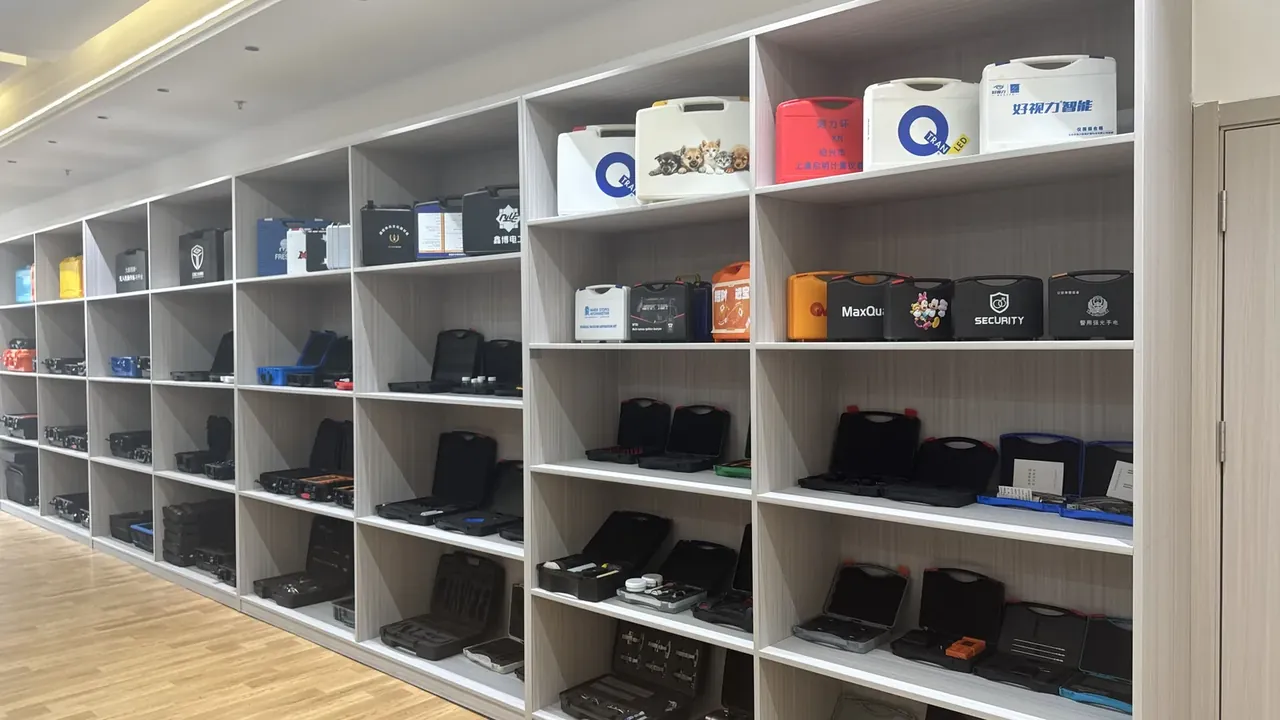
Quick answer: Case sample lead time runs 6 days for a CNC prototype and 27 days for a tooling sample, because the T1 trial takes 22 days and parts need 5 more.
Table of contents
- Two pick-up routes
- Prototype: 48 hours and 6 days
- T1 trial at 22 days
- What 0.3 mm can prove
- Sequencing 33 days
- FAQ
1. Two pick-up routes
Same case: the prototype lands in 6 days, the tooling sample waits 22 days for a trial shot plus 5 days for parts. The delay is not machining. It is the steel: a prototype is cut straight from a plate, while a tooling sample needs a mould that can run.
Both routes start from the same frozen drawing and split on day two. The prototype goes into the CNC queue; the mould goes into cavity and electrode work.
The numbers fold into three entries: 6 days of prototype, 22 days of T1 trial, 5 days of parts, or 33 days from drawing sign-off to a testable sample.
| Item | Prototype | Tooling sample |
|---|---|---|
| Delivery | 6 days | 27 days |
| Cost | CNY 3200 per set of 3 | CNY 850 each |
| Accuracy | ±0.3 mm | ±0.3 mm or better |
| Material | Plate or resin block, not production grade | Same grade as production |
| Good for | Look, assembly, feel | Wall, draft, batch colour |
Per piece the prototype is CNY 1067 against CNY 850, so the tooling sample is CNY 217 cheaper. That gap is not process: it skips programming, fixturing and two days of surface work, and costs the 22 days in front.
Freezing a drawing fixes four items: size, hardware holes, seal groove and parting line. Change any of the first three afterwards and the 22 days restart, pushing 33 to 40.
2. Prototype: 48 hours and 6 days
The 48 hours are fixed: 12 hours roughing, 18 hours finishing, 6 hours drilling and tapping, 12 hours deburring and chamfering. Lid and base run in parallel on one machine, so 48 hours covers both.
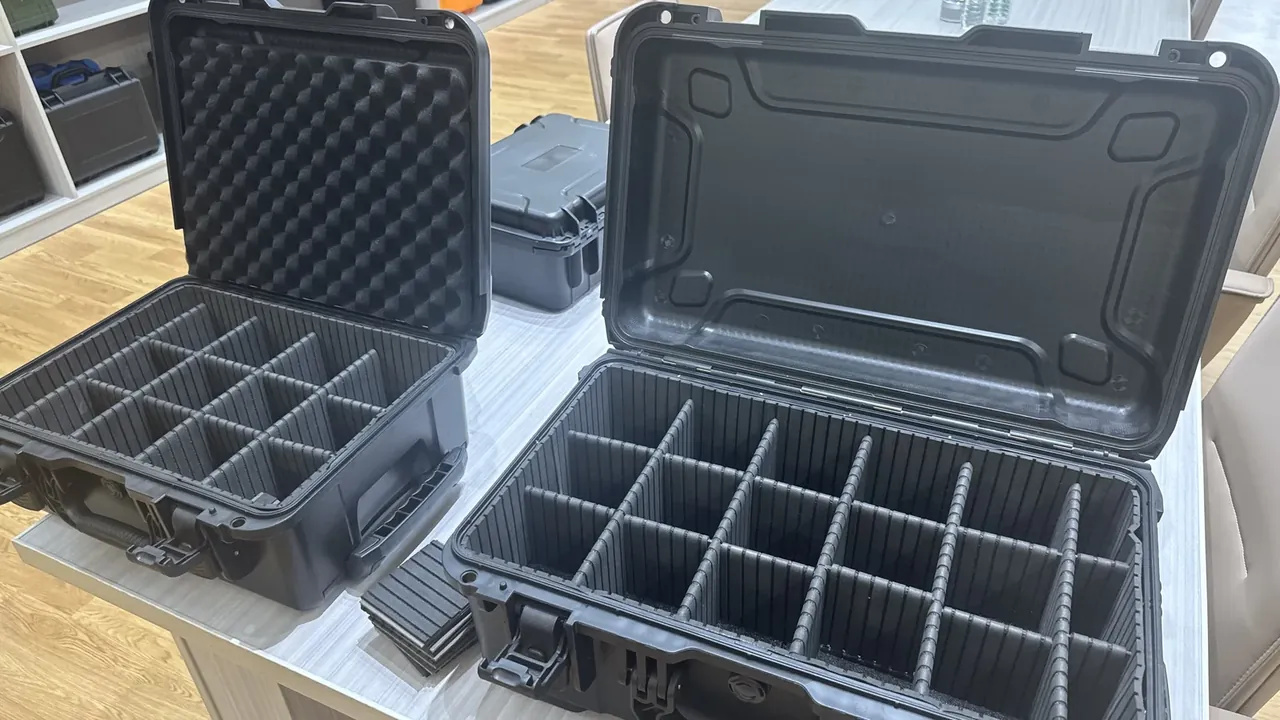
Six days = 48 hours of cutting + 2 days of surface work + 1 day of hardware assembly + 1 day of inspection and packing. Surface work is cut first: an unpainted plate saves a day and kills the appearance check.
The three samples have fixed jobs: one for destructive trials, one for the customer, one as a reference. With fewer than three, every dispute needs a fresh run and the clock resets to day six.
The 0.3 mm figure comes from assembly, not from the machine. Three-axis milling holds 0.05 mm on a single piece, but a prototype is four parts — lid, base, latches, hinges — and the hole stack-up lands near 0.3 mm. That is enough for fit: latches close, hinges turn, handle holes line up. It is not enough for sealing, because a seal groove is held to 0.1 mm and a milled groove shows only shape and depth.
3. T1 trial at 22 days
The 22 days break into five blocks: 3 days of mould design, 12 days of cavity machining, 4 days of fitting and polishing, 1 day of T1 trial, 2 days of rework. They run in series, so any slip adds to the end.
After T1 there are 5 more days: 1 day of appearance check, 1 day of full dimensional inspection, 1 day of assembly trial, 1 day of colour comparison, 1 day of trimming and packing. Quotes that stop at 22 days deliver at 27.
A T1 day runs three shots: fill, dimensions, and one reference. They decide whether the last 5 days stay on plan; with fewer, two of the five go to waiting.
Pricing differs by piece: the tooling sample is CNY 850 each with no tooling charge, so ten pieces cost CNY 8500, against CNY 600 for each extra prototype.
What cannot be compressed is the 19 days before T1. Design and rough machining overlap slightly, since the cavity can be roughed on day one, but electrodes wait for the final 3D model.
4. What 0.3 mm can prove
A prototype proves three things: proportion, assembly and feel. Proportion covers corner radii and where the parting line falls. Assembly covers latch engagement, a hinge opening to 180 degrees, handle holes lining up. Feel covers lid force and handle width.
| Check | Prototype | Tooling sample |
|---|---|---|
| Proportion and radii | Yes | Yes |
| Latch, hinge, handle holes | Yes, ±0.3 mm | Yes |
| Wall uniformity | No, milling sets the wall | Yes |
| Sufficient draft | No, no mould involved | Yes |
| Batch colour | No, plate colour or paint | Yes |
| Seal groove tightness | No, groove is 0.1 mm class | Yes |
Wall uniformity is where people misread a prototype. CNC removes material, so 3.2 mm on the drawing is 3.2 mm everywhere. A rotomoulded wall of the same nominal 3.2 mm measures 2.7 to 3.6 mm, because powder builds up on the mould wall. The more precise the prototype, the more it misleads.
Draft behaves the same way: a milled slope can be one degree, but a real mould usually needs two, so a signed-off shape can still change after the tool is cut.
The parting line cannot be judged either: a prototype is milled in pieces and assembled, while a mould places the seam by cavity structure, often on a side wall.
Batch colour only shows on a tooling sample. A prototype is plate colour or painted, while masterbatch dispersion in moulding surfaces at ΔE level in the second production lot.
5. Sequencing 33 days
Two schedules exist. In series: 6 days of prototype, 22 days of tooling, 5 days of parts. In parallel: the tool starts on the day the drawing freezes, the prototype returns for an appearance review, and changes go into the mould on day 7, pulling the total to 27 days.
Four conditions justify skipping the prototype. The structure carries over with only colour or print changes. Dimensional changes stay under 2 mm and touch no hardware holes. An existing tool is reused with a new insert. Delivery is under 20 days. Meet any one and the 27-day route opens.
Four conditions forbid it: a new tool, a changed seal groove, moved hardware holes, or a customer who wants a physical trial build. Any one of these means 6 days of prototype buys back a 22-day rework.
There is a hidden cost in repeats: a look change after three prototypes means another CNY 3200 and 6 days, while a tooling sample change costs 2 days plus CNY 850 per piece.
Conclusion
The 33 days hold three entries, and the room to shorten case sample lead time sits in the sequence, not the unit price. Nest the prototype inside the tool and the total lands at 27 days; run in series and quote 33.
| Stage | Days | Starts | Can overlap |
|---|---|---|---|
| Prototype build and delivery | 6 | Drawing freeze | Yes, inside the tool window |
| T1 trial | 22 | Drawing freeze or prototype sign-off | Partly |
| Tooling-sample parts | 5 | T1 accepted | No |
| Series total | 33 | Drawing freeze | — |
One decision line remains: does the change touch the cavity? Colour, print and packing changes skip the prototype for a 27-day plan. Any change to wall, seal groove, hardware holes or parting line starts with a 6-day prototype and CNY 3200, which buys back a 22-day rework. The line is drawn on the day the drawing freezes, and each day of delay pushes the 33 days by one.
This article discusses container-side specifications and design implications only, and does not cover any handling, loading or use of the contents.
Related Reading
- Trial moulding runs and their checks
- How trial parts differ from production
- Sample fees and prototype charging
- Custom sample cases and sign-off
Related Products
- 8 Series — Gun Cases; Military Equipment Cases; Camera Equipment Cases; Drone Cases; Watch Cases; Knife Cases; First Aid Cases; Electronics Equipment Cases
- WL8-2812 PP Gun Case — model WL8-2812
- All protective cases and toolboxes: 7 series, 158 models