

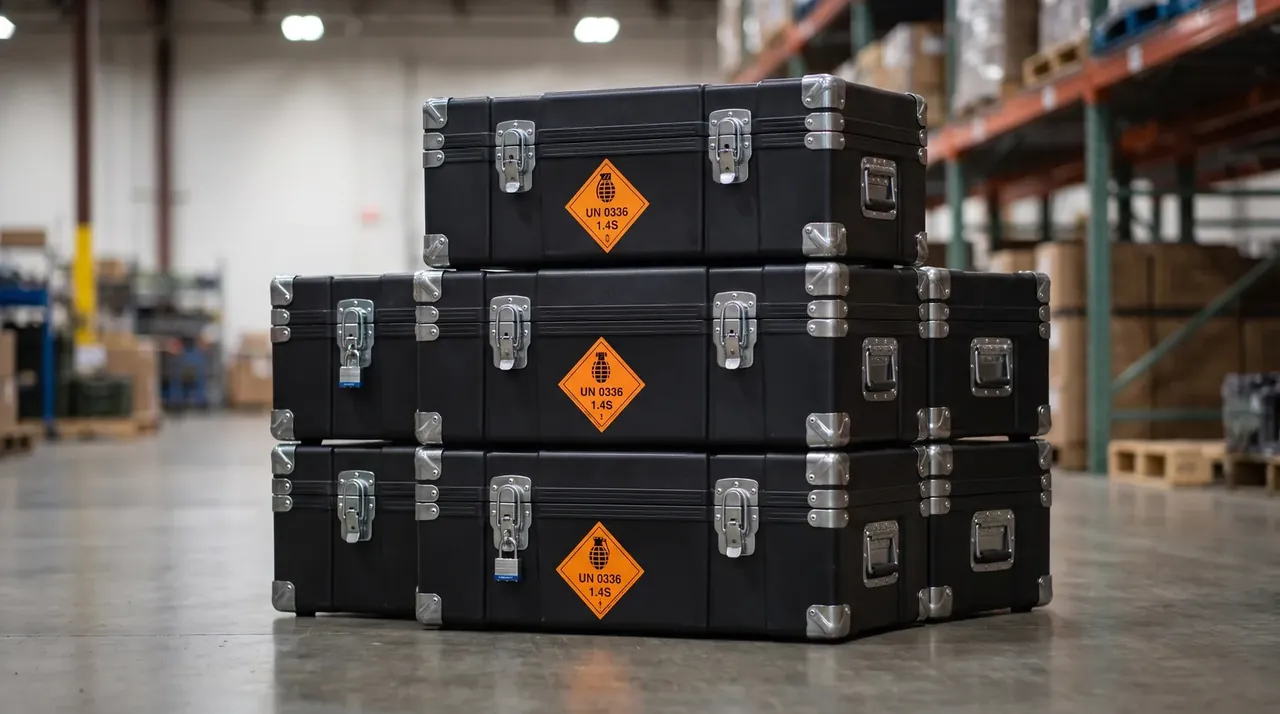
Quick answer: Case asset tagging splits into QR at 3.5 yuan and RFID at 12 yuan, and counting 200 cases takes 40 minutes by hand against 3 minutes through a gate.
Table of contents
- Two routes: 40 minutes and 3 minutes
- Why QR read distance drops to 0.3–0.5 m
- RFID at 6 m and 200 tags at once
- 3.5 yuan and 12 yuan: where 99.2% and 97% come from
- Placement, metal interference and hybrid rollout
- FAQ
1. Two routes: 40 minutes and 3 minutes
Two workers, one handheld scanner, 200 identical cases: 40 minutes. The same aisle with an RFID gate: 3 minutes, all 200 read in one pass. Case asset tagging starts with that 37 minute spread.
The 40 minutes breaks down. Walking to each case and handling it takes 8 minutes, aiming and focusing takes 22, rechecking misses takes 10. Focus eats more than half, because a label on a curved lid loses its three finder patterns as soon as the light comes in at an angle.
| Step | QR, min | RFID, min |
|---|---|---|
| Walk and handle | 8 | 0 |
| Aim and focus | 22 | 0 |
| Recheck misses | 10 | 2 |
| Upload | 0 | 1 |
| Total | 40 | 3 |
Frequency multiplies the spread. Twice a year, 74 minutes saved never pays back the price gap. Twelve times a year, 7.4 hours saved covers the annual rental on two handheld readers.
2. Why QR read distance drops to 0.3–0.5 m
A 25 × 25 mm QR label with 0.5 mm modules reads at 0.8 m on paper and only 0.3–0.5 m on a metal case face. The metal returns the light, flattens the black-and-white contrast in the viewfinder, and the decoder can only compensate by getting closer.
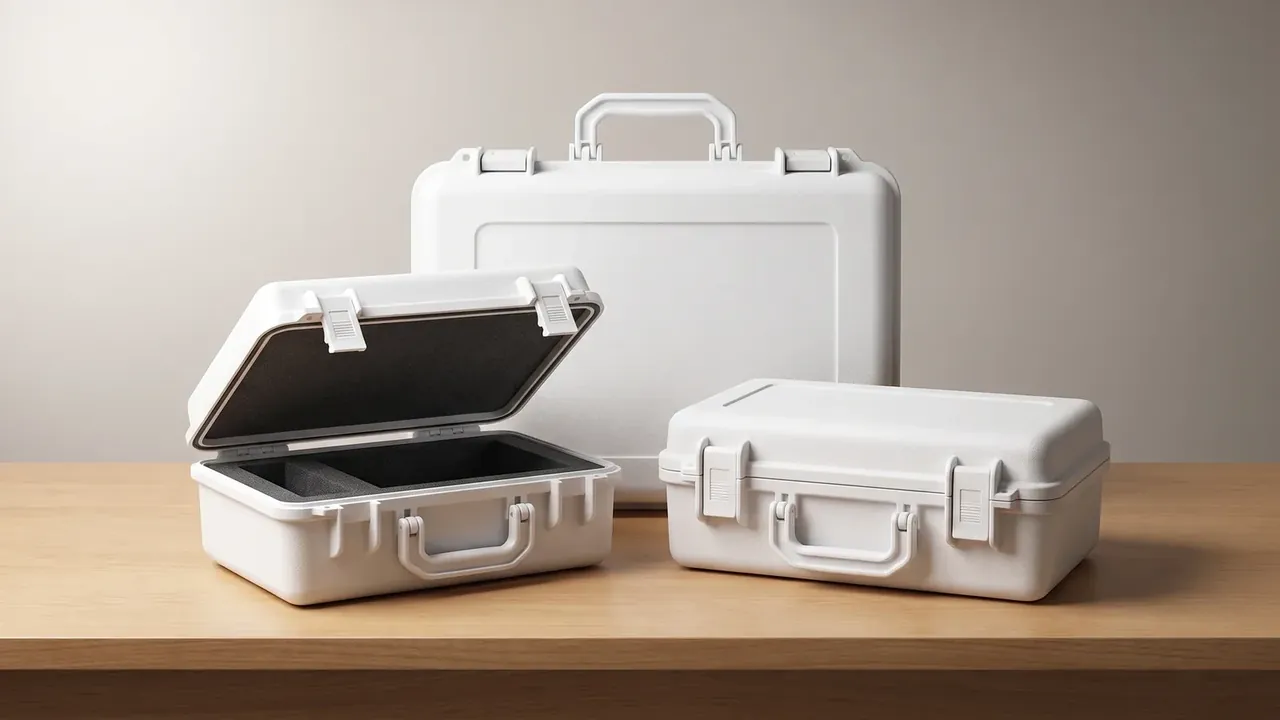
Mounting the label on 0.15 mm polyester with a slight lift off the face recovers 0.6 m, at the cost of thicker edges that peel: corner lifting rises from 3% to 11% within two years.
A curved lid is where labels fail. The lid corners carry an R25 radius, and a 25 × 25 mm label bridging that curve lifts 0.3 mm on both sides, leaving 70% contact and one failure in three scans. Case asset tagging should give up the cosmetic position and sit in the middle of the flat panel.
QR also has to be seen. Stack four high and only the top lid faces outward, so the other three come down first, which is where 8 of the 40 minutes go. Reading angle tightens it further: 0.5 m head on, 0.3 m at 30°, nothing at 45°, so 0.35 m is the honest average on a shop floor.
3. RFID at 6 m and 200 tags at once
Ultra-high frequency at 860–960 MHz gives 6 m of read range and 200 tags per pass, and that is the entire source of its advantage. The field does not need line of sight: stacked, locked or facing away, a tagged case still answers.
Pressed straight onto a metal face, 6 m collapses to 1.2 m. An on-metal label adds a 1.2 mm dielectric layer behind the inlay, restoring 3 m for another 4 yuan and a visibly thicker profile.
The domestic band runs 920–925 MHz with a 2 W ERP power limit and 250 kHz channel width, and those numbers decide whether 200 tags collide: the denser the pile, the further the read rate falls from 99%.
Two hundred per pass is a bench figure. Spread 200 cases over a 3 m × 2.5 m footprint and the gate needs 2 to 3 sweeps before the rate settles at 97%, which is exactly the 2.2 point gap against QR.
Range has a side effect. Any tag within 6 m appears on the list, whether it sits in zone A or zone B, so location needs antennas on both sides of the gate or a second confirmation from a printed code. That is why case asset tagging rarely relies on one technology alone.
4. 3.5 yuan and 12 yuan: where 99.2% and 97% come from
At 3.5 and 12 yuan per label, 200 cases cost 700 and 2400 yuan. The 1700 yuan gap looks trivial until readers, antennas and twelve counts a year land on the same sheet.
| Item | QR | RFID |
|---|---|---|
| Price per label, yuan | 3.5 | 12 |
| 200 labels, yuan | 700 | 2400 |
| Time per count, min | 40 | 3 |
| Labour a year, h | 8 | 0.6 |
| Read rate, % | 99.2 | 97 |
| Cases lifted | Yes | No |
The read-rate gap comes from the reading method, not label quality. QR reads one target at a time and hits 99.2% once aimed; RFID reads a crowd, tags answer over each other and 6 of 200 stay silent.
Those 6 are not random. Labels behind a metal rib, pinched between two cases or cross-polarised to the antenna miss again and again, so the field fix is a QR backup on those 6, which is how most hybrid systems begin.
Labour at 25 yuan an hour makes 40 minutes worth 17 yuan and 3 minutes worth 1.3 yuan. Twelve counts a year put the gap at 188 yuan, roughly the price of 50 RFID labels, which is why pilots start at 50.
Over three years, QR costs 700 yuan plus 24 hours; RFID costs 2400 yuan plus a 6000 yuan reader and 1.2 hours. Below four counts a year, QR still lands 40% cheaper overall.
5. Placement, metal interference and hybrid rollout
Position decides range. On the right of the lid, 15 mm from the edge, 40 mm clear of the latch and 60 mm clear of the handle, the panel is flattest and a 25 mm label sits without bubbles.
RFID wants the opposite: mid-height on the side wall, at least 20 mm from a metal corner and 300 mm above the floor. Mounted low, pallet and slab absorb part of the field and 3 m becomes 1.5 m.
Three field fixes handle metal: switch to an on-metal label, add a 1.2 mm dielectric pad, or move the label to the thickest plastic wall. All three together bring 1.2 m back to 4 m for about 5 yuan per case.
A hybrid rollout suits most sites. Tag 50 cases for 3 months and leave the rest on QR through one full count, then decide. Export lines on RFID and domestic lines on QR is the most common split inside one case asset tagging scheme.
Conclusion
Case asset tagging comes down to three accounts. The first is labels: 700 against 2400 yuan for 200 cases. The second is labour: 7.4 hours a year at twelve counts. The third is misses, where 99.2% and 97% mean 2 against 6 cases out of 200, and six cases missing twice in a row will quietly vanish from the ledger. Only the first account is obvious; the other two need your own count frequency before they mean anything. The practical sequence is to count the cases, count the counts, then read the table below. Land between two rows and tag 50 cases with RFID for 3 months, then decide.
| Situation | Choice | Reason |
|---|---|---|
| Under 200 cases, 2 counts a year | QR | 700 yuan, 40 minutes is tolerable |
| Above 300 cases, 4+ counts a year | RFID | Saves 37 minutes a count |
| Metal face, needs 3 m or more | On-metal RFID | Plain labels fall to 1.2 m |
| Export and domestic lines | Hybrid | RFID outside, QR inside |
This article discusses container-side specifications and design implications only, and does not cover any handling, loading or use of the contents.
Related Reading
- Running QR asset tracking on cases
- Case asset tracking options compared
- Where to put asset labels and what they carry
- Designing the label area and nameplate on a case
Related Products
- 8 Series — Gun Cases; Military Equipment Cases; Camera Equipment Cases; Drone Cases; Watch Cases; Knife Cases; First Aid Cases; Electronics Equipment Cases
- WL8-2812 PP Gun Case — model WL8-2812
- All protective cases and toolboxes: 7 series, 158 models