

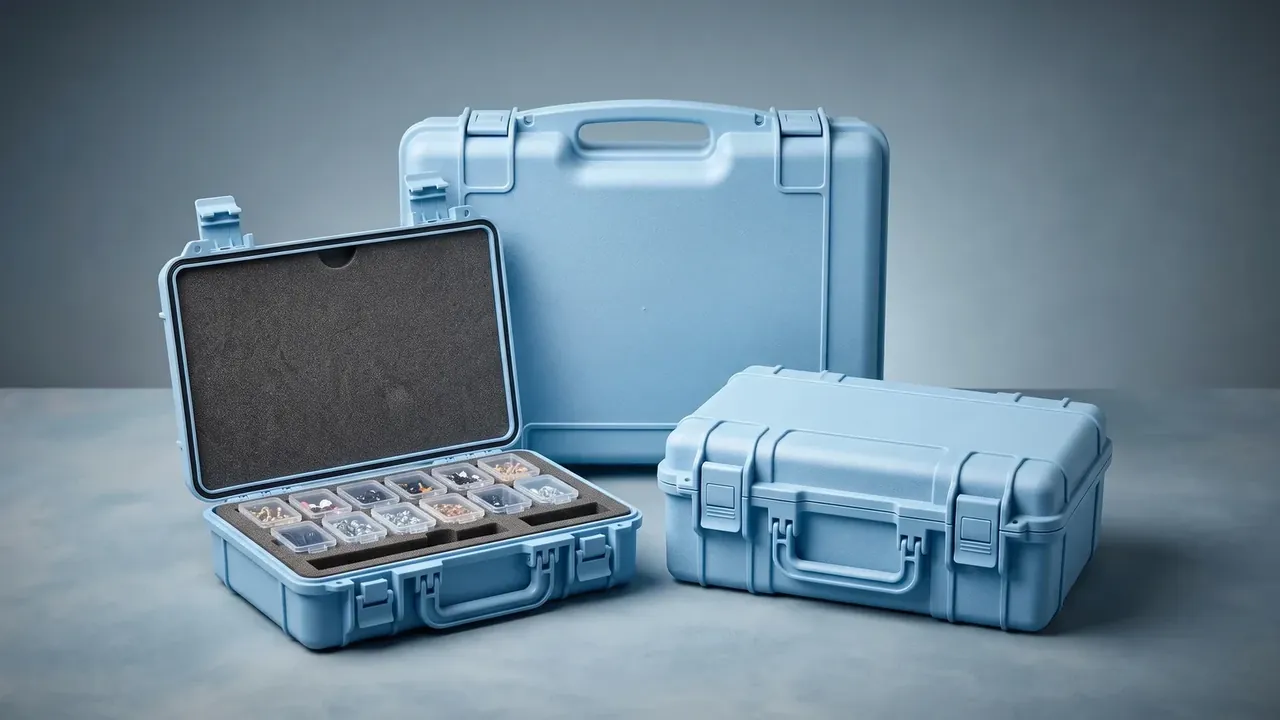
Quick answer: A Rail Transit Testing Equipment Case passes on three checks: the EN 50125 climate class, a three-axis 5 to 150 Hz sweep, and IP67 at 1 m for 30 minutes.
Table of contents
- Reading the Environmental Class
- Three Axes from 5 to 150 Hz
- IP67 and a One-Metre Soak
- 90-Day Service and Two Seal Retests
- Shielding Gaskets and 30 dB
- FAQ
A Rail Transit Testing Equipment Case is accepted on what survives a three-axis 5 to 150 Hz sweep, not on looks: shift a lid half a millimetre and the gasket leaks by the third soak test.
1. Reading the Environmental Class
Read the class of a Rail Transit Testing Equipment Case from where it ends up. EN 50125-3 sorts trackside and platform test gear into T1 from minus 25 to 40 C, T2 from minus 40 to 35 C and TX from minus 55 to 40 C, with cubicle ceilings of 70, 65 and 70 C.
Materials follow that table: a southern platform cabinet is fine on T1, northern gear needs T2, tunnel mouths need TX. Pick too low and the bill arrives two summers later — ABS held at 70 C for 30 days takes a gasket set no latch closes.
| Climate class | Outdoor range | Cubicle ceiling | Typical site |
|---|---|---|---|
| T1 | minus 25 to 40 C | 70 C | southern platform cabinet |
| T2 | minus 40 to 35 C | 65 C | northern trackside gear |
| TX | minus 55 to 40 C | 70 C | tunnel mouth, cold zone |
Humidity travels with temperature: EN 50125-3 points to the climograms of EN 60721-3-3, and 3K2 covers most trackside work. A Rail Transit Testing Equipment Case can only hold the gasket at 25 to 30 percent compression and leave a replaceable desiccant pocket.
2. Three Axes from 5 to 150 Hz
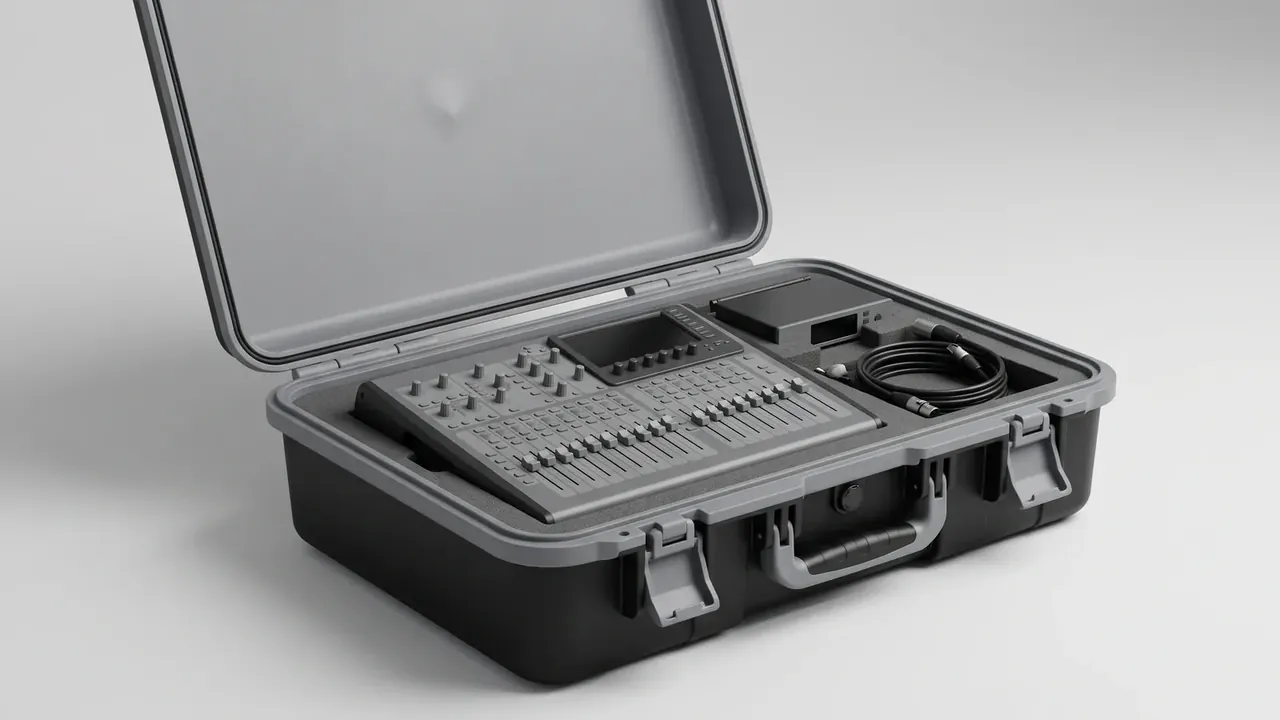
Acceptance cites IEC 61373 for a Rail Transit Testing Equipment Case: body-mounted equipment is Category 1, random vibration runs 5 to 150 Hz for at least 10 minutes per axis, the long-life test runs 5 hours per axis, and shock is a 30 ms half-sine applied 18 times.
Buyers often write 30 minutes per axis: foam needs the full 30 to settle, and a 10-minute sample hides the play that appears later.
| Test | Condition | Duration | Case-side criterion |
|---|---|---|---|
| Random vibration | 5 to 150 Hz, Cat 1 Class B | 30 min per axis | latches shut, seam closed |
| Long life | raised level | 5 h per axis | no hinge walk, no cracks |
| Shock | 30 ms half-sine | 18 shocks | no shell crack, no foam collapse |
The lid seam fails before the wall does. Vibration lets the lid slide 0.2 to 0.4 mm between latches, the gasket stops sealing and IP67 is nominal; four latches or a locating lip holds it vertical-only.
The insert fails second: EVA below 45 kg per cubic metre does not recover after 30 minutes, leaving 1 to 2 mm of play around a lens mount.
3. IP67 and a One-Metre Soak
A Rail Transit Testing Equipment Case proves IP67 in two stages under IEC 60529. Dust first: 2 kg of talc per cubic metre, vacuum under 2 kPa, 8 hours, nothing settling inside.
Water second: the same case takes clean water at ambient, lowest point 1 m under, highest 0.15 m under, 30 minutes, water within 5 K.
Three things go wrong: four latches pulled to eight tenths leave the gasket between two of them under 25 percent compression; a hand-tight gland lets 1 m of head push water along the thread; a valve facing up takes 30 minutes of water column.
IP67 is static immersion only. A depot jet wash beats 1 m of still water and lifts a gasket that passed the soak; anything washed on site needs IPX5 or IPX6 proven separately.
4. 90-Day Service and Two Seal Retests
Service on a Rail Transit Testing Equipment Case runs four rounds a year, two carrying a seal retest. Two is deliberate: each retest removes and refits the gasket, and handling wears it faster than water.
| Service item | Every 90 days | Criterion | Retest rounds |
|---|---|---|---|
| Gasket | inspect imprint, measure set | set under 20 percent | 1 and 3 |
| Latches | check force on each | spread under 15 percent | every round |
| Air pre-check | 1 kPa held 60 s | drop under 0.1 kPa | every round |
Pair one air test with one soak: the air check runs every round, and a drop past 0.1 kPa sends you to latches and glands first, not to the tank.
Ninety days is not arbitrary: trackside slots run quarterly and give about 4 hours, of which 40 minutes belongs to the case.
5. Shielding Gaskets and 30 dB
Rail EMC follows the EN 50121 series, and a Rail Transit Testing Equipment Case is the second shield. A 30 dB margin is the usual floor, because the instrument sits close to the limits from 150 kHz to 1 GHz.
A Rail Transit Testing Equipment Case does not get 30 dB from the wall; it gets it from the seams. Plastic does not conduct, so the inside is coated with a conductive gasket tying lid and base into one cage, at 30 to 40 percent compression: below 30 the contact resistance stays high, above 40 the gasket collapses.
Seam length follows the one-twentieth wavelength rule. At 1 GHz that is 15 mm, which sets latch spacing, screw pitch and the largest cable opening.
| Method | 30 dB reachable | Compression | Upkeep |
|---|---|---|---|
| Coating plus gasket | yes, consistently | 30 to 40 percent | recoat where worn |
| Foil tape across seams | once, not on retest | not applicable | re-taped each opening |
| Beryllium-copper fingers | yes, above 40 dB | 20 to 30 percent | costly, fingers bend |
Write the 30 dB into the acceptance clause, not the datasheet, where the lab measures a bare instrument.
Conclusion
A Rail Transit Testing Equipment Case is fixed by four lines: T1 or T2 for climate, 30 minutes per axis, 1 m for 30 minutes, 30 dB of margin. Put them in the acceptance clause with a 90-day service sheet, and the case is qualified, not merely inspected.
Related Reading
- Tolerance at plus or minus 2 and 0.5 mm
- Plastic cases against wooden crates
- Hinge fatigue life
- Usable cavity and corner loss
JUNZHIJIA
Related Products
- 8 Series — Gun Cases; Military Equipment Cases; Camera Equipment Cases; Drone Cases; Watch Cases; Knife Cases; First Aid Cases; Electronics Equipment Cases
- WL8-2812 PP Gun Case — model WL8-2812
- All protective cases and toolboxes: 7 series, 158 models