

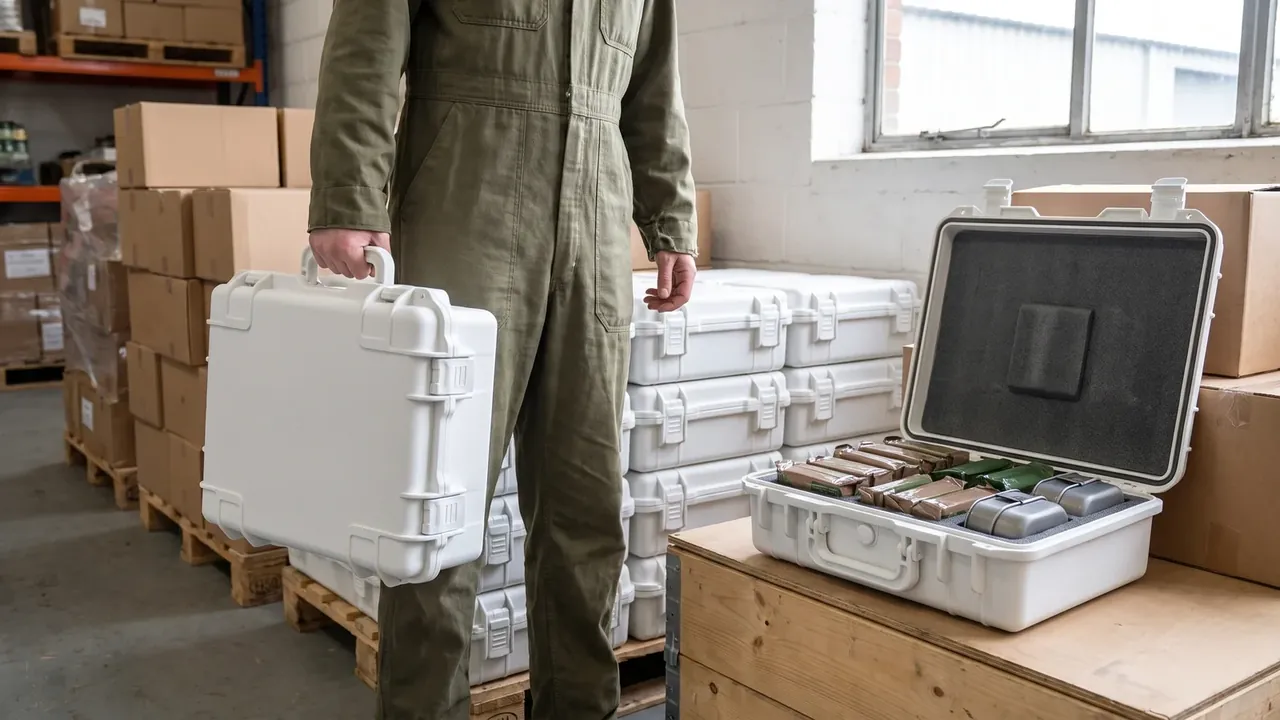
Quick answer: A ration box acceptance standard settles three questions: what to test, how much to sample and how to judge. Six items, sample size from the lot, majors at AQL 2.5, minors at 4.0, critical items at zero defects.
Table of contents
- How a Ration Box Acceptance Standard Is Structured
- Six Incoming Tests in a Fixed Order
- AQL Sampling: Lot Size, Sample Size, Acceptance Numbers
- Verdicts: Zero Defects and Concession
- Records and Traceability
- FAQ
1. How a Ration Box Acceptance Standard Is Structured
A ration box acceptance standard is not a checklist but a grading system: the same defect returns a lot when it is critical and is only logged when it is minor.
Grading follows consequence. Seal, drop and stacking failures damage the food inside and leave no trace, so they are critical. Cavity size, lid gap and latch retention affect assembly, so they are major. Colour, flash and marking affect appearance only, so they are minor.
| Class | Examples | Verdict line |
|---|---|---|
| Critical A | Seal, drop, stacking | Zero defects |
| Major B | Cavity, lid gap, latches | AQL 2.5 |
| Minor C | Colour, flash, marking | AQL 4.0 |
2. Six Incoming Tests in a Fixed Order
The order is fixed: appearance, dimensions, seal, insulation, drop, stacking. The first four leave the sample usable; the last two destroy it and come last on separate boxes.
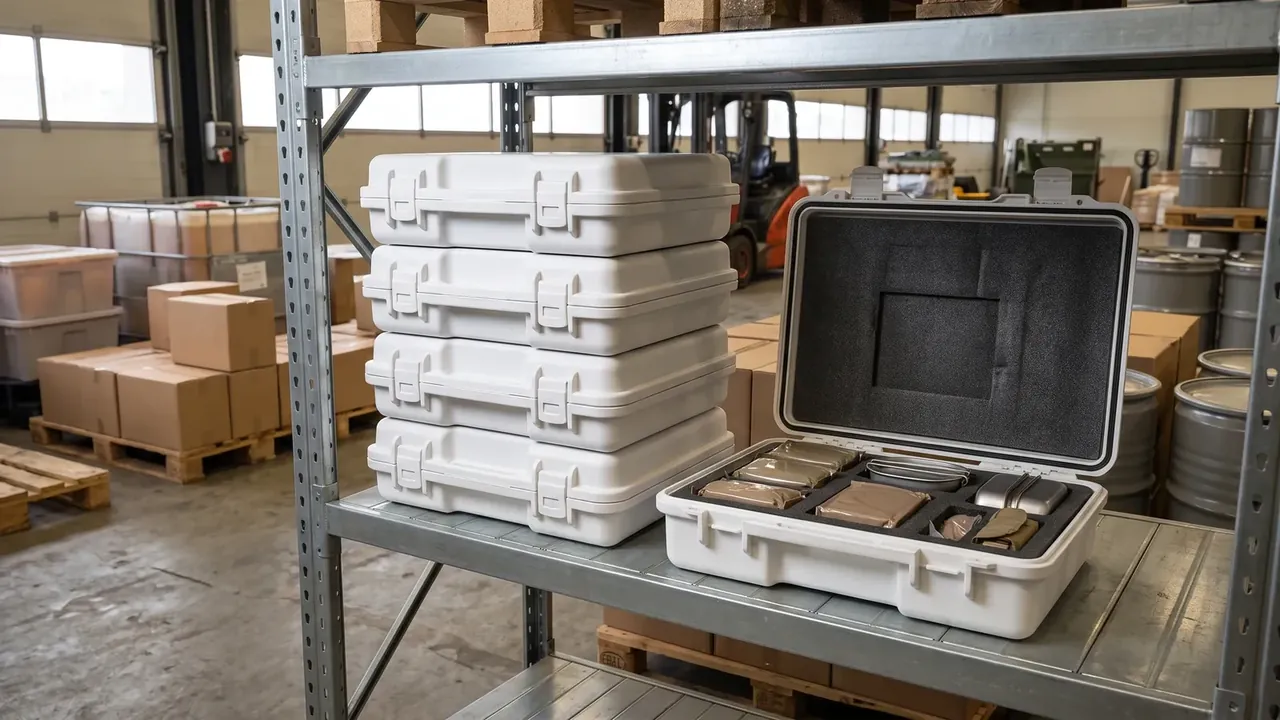
Appearance is checked at 500 lx from 500 mm, and dimensions at three points per axis with callipers and feeler gauges. Seal holds minus 25 kPa for 120 seconds with no more than 1.5 kPa of pressure drop. Insulation starts from 5 degrees Celsius in a 35 degree room and stays below 13 degrees after six hours. Drop is 1.1 m on corner, edge and face; stacking is 450 kg for 72 hours.
| Test | Method | Criterion |
|---|---|---|
| Appearance | 500 lx, 500 mm viewing | Colour 1.5, flash 0.3 mm |
| Dimensions | Callipers, feeler gauges | Cavity 2.0 mm, gap 1.0 mm |
| Seal | Vacuum minus 25 kPa, 120 s | Pressure drop 1.5 max |
| Insulation | 35 degree room, 6 h | 13 degrees max |
| Drop | 1.1 m, corner edge face | No cracks, latches hold |
| Stacking | 450 kg on lid, 72 h | 3 mm, residual 1 mm |
3. AQL Sampling: Lot Size, Sample Size, Acceptance Numbers
Sampling follows an adjusted counting scheme: lot size gives a code letter, the letter a sample size, and the AQL value the acceptance number.
A lot of 501 to 1200 boxes is code J, sample 80: majors at AQL 2.5 accept 5 and reject 6, minors at 4.0 accept 7 and reject 8. A lot of 151 to 280 is code G with 32. Critical items bypass AQL: three samples, zero defects.
| Code | Sample | AQL 2.5 Ac Re | AQL 4.0 Ac Re |
|---|---|---|---|
| G | 32 | 2 / 3 | 3 / 4 |
| H | 50 | 3 / 4 | 5 / 6 |
| J | 80 | 5 / 6 | 7 / 8 |
4. Verdicts: Zero Defects and Concession
Three outcomes exist: accepted, rejected and accepted by concession. Acceptance needs every count within its number and zero critical defects; rejection follows one critical failure or a major count at the rejection number.
| Situation | Verdict |
|---|---|
| One critical defect | Lot rejected |
| Major count within Ac | Lot accepted |
| Count between Ac and Re | Sample again |
| Minor count at Re | Lot rejected |
Concession is minor only, this lot only, with quantity recorded. Letting a major item through turns AQL 2.5 into 100, and reworked lots are resampled from scratch.
5. Records and Traceability
The batch code starts traceability: eight digits for year, month, day, machine and shift, laser-marked on the base outside the load path at 0.2 mm.
The log carries six columns: batch code, sample size, defect counts, verdict, action and inspector. Logs are filed for 36 months, and three retained samples per batch are kept for 12 months. Traceability runs both ways, from code to material lot, and from a failed box back to its batch.
Conclusion
A ration box acceptance standard compresses into three lines: test six items, four non-destructive and two destructive; sample by code with majors at AQL 2.5; judge critical items at zero defects and concede only minor ones. Behind those lines sit grading, sampling and traceability. Written into the contract annex with the record sheets, the ration box acceptance standard holds.
This article discusses only the container (case body) side of specifications and design intent, and does not cover any handling, loading or use of the contents.
Related Reading
- What a ration box is and how its body is built
- How incoming inspection works for supply cases
- Marking rules for pallets and case bodies
- When a returnable container should be retired
Related Products
- 8 Series — Gun Cases; Military Equipment Cases; Camera Equipment Cases; Drone Cases; Watch Cases; Knife Cases; First Aid Cases; Electronics Equipment Cases
- WL8-2812 PP Gun Case — model WL8-2812
- All protective cases and toolboxes: 7 series, 158 models