


Quick answer: A rifle case is not specified by picking a wall thickness and fitting a size around it. Start from the load path and only the loaded areas get material: the chain runs from load to cavity to wall, with a unit cost at each step.
Table of contents
- Rifle Case Specs Start From the Load Path
- Cavity: What Drives Each of the Three Dimensions
- Wall Thickness and Ribs: Which Millimetre Carries Load
- Structural Parts and Rework Cost
- Closing the Cost: Three Build Levels
- FAQ
1. Rifle Case Specs Start From the Load Path
A rifle case loaded to 16.8 kg does not spread that weight evenly. Crossing a speed bump it sees peaks near 3 g, so the load triples in a tenth of a second: it presses the lid, runs through four latches into the side walls and out through the four corners. Latches and corners are two ends of the same force. Spec the case along that path and the money lands where the load is.
| Duty | Peak load | Loaded areas | Spec action |
|---|---|---|---|
| Road transport | 3 g, 500 N | Latches, corners, base | Wider seats, thicker corners |
| Air freight | 1.8 kN side squeeze | Mid side wall, lid | Vertical ribs, cross ribs |
| Warehouse stacking | 320 kg on top | Lid face, four pads | Cross ribs, taller pads |
2. Cavity: What Drives Each of the Three Dimensions
Cavity length follows the longest configuration, commonly 1180 mm with a suppressor or folded stock; width at 330 mm clears side rails; depth at 145 mm covers body plus lid clearance.

Length is the expensive direction: every 10 mm adds about 6 yuan, plus a slider change amortised at 2.5 yuan each across two thousand units.
Width and depth cost far less; neither touches the slider.
Lid clearance is the dimension buyers forget: short of it, they add a foam sheet that eats the allowance.
3. Wall Thickness and Ribs: Which Millimetre Carries Load
Thickness is a set of numbers: 3.0 mm walls, 3.4 mm base, 4.5 mm corners, thickened locally. Running 3.8 mm throughout looks safer and is the worst value on the sheet.
| Area | Usual wall | Reinforcement | Cost per unit |
|---|---|---|---|
| Side wall | 3.0 mm | Vertical ribs, 12 mm high, 95 mm apart | About 4 yuan |
| Base | 3.4 mm | Grid ribs, two longitudinal mains | About 6 yuan |
| Corner | 4.5 mm | Local thickening, radiused | About 3 yuan |
Stiffness goes with the cube of thickness, which is only half useful. Adding 0.1 mm everywhere adds 0.2 kg and 4 yuan; one 12 mm rib adds 0.06 kg and lifts bending stiffness past thirty per cent, turning panel bending into flange tension. Rib spacing has a price: tighten past 95 mm, the part sticks in the tool and cooling grows eight seconds.
Thickening is the most expensive way to strengthen anything.
4. Structural Parts and Rework Cost
Structural parts are the first line buyers cut and the first to come back as rework.
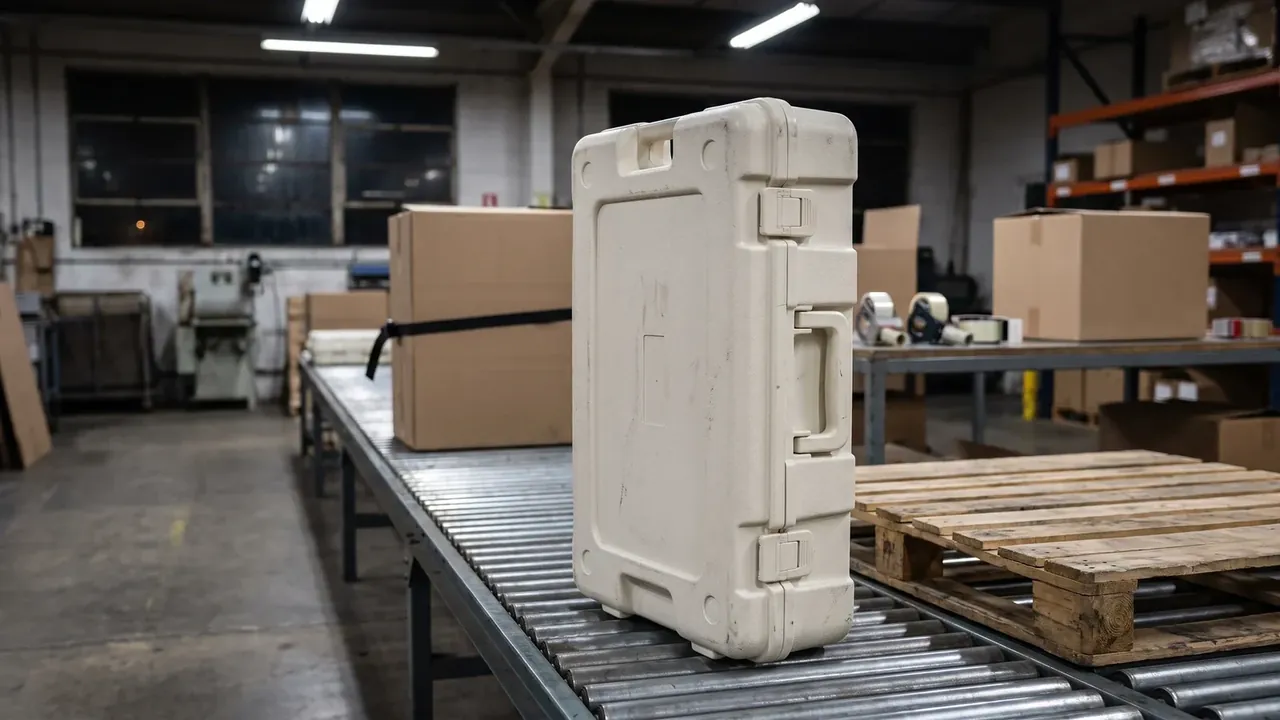
A 5 mm stainless hinge pin costs 1.8 yuan more than a 4 mm one and doubles shear margin. Latch seats are rated 2.6 kN each, so the diagonal pair alone holds ten times the peak; that margin belongs to wear, since latches loosen by year two.
Rework belongs in the spec. A failed seal is forty minutes of strip-down, cleaning, gasket and retest. Widening the groove from 6 mm to 7 mm with an R1 base fillet costs 2 yuan and keeps the gasket seated in cold.
Salt spray hours belong to metal parts, not the shell.
5. Closing the Cost: Three Build Levels
Three levels differ in four places:
- Base: 3.0 mm throughout, four plastic latches, single gasket;
- Reinforced: 3.4 mm base, 4.5 mm corners, metal hinge inserts, plus 22 yuan;
- Expedition: 3.4 mm throughout, double gasket, wider seats, taller pads, plus 58 yuan.
The gap looks small until it meets a rework rate. Reinforced takes rework from 3 per cent to 0.6 per cent; at 1200 yuan per event a two-thousand-unit run saves about 57,000 yuan against 44,000 of extra material.
Compare levels on rework rate, never on unit price.
Conclusion
A rifle case spec collapses into one chain: load path sets loaded areas, loaded areas set cavity and wall, wall and ribs set unit cost, structural parts set rework rate. Walk it once and every premium has a destination, so a quote argument becomes arithmetic about a rifle case.
This article discusses only the container (case body) side of specifications and design intent, and does not cover any handling, loading or use of the contents.
Related Reading
- Sniper rifle case specs: cavity, supports and vibration
- Rifle case selection: length, foam and latches
- Rifle case versus a general long case
- Missile box specs: shell, supports and lifting
Related Products
- 8 Series — Gun Cases; Military Equipment Cases; Camera Equipment Cases; Drone Cases; Watch Cases; Knife Cases; First Aid Cases; Electronics Equipment Cases
- WL8-2812 PP Gun Case — model WL8-2812
- All protective cases and toolboxes: 7 series, 158 models