

Quick answer: Rifle sniper hard plastic safety box hinges on single-end torsion, holding a 1320 mm shell to 2 mm lid shift with three wrap bands and six latches.
Table of contents
- Where Single-End Torsion Comes From in a Rifle sniper hard plastic safety box
- Wall Thickness and Rib Layout in a 1320 mm Injection-Moulded Shell
- How Three Wrap Bands and Six Latches Share Clamping Load
- Measuring Diagonal Deviation After a 1.2 m Angled Drop
- Re-Test Points at -25 °C to 60 °C and 5000 Open-Close Cycles
- FAQ
1. Where Single-End Torsion Comes From in a Rifle sniper hard plastic safety box
Lift a 1320 mm case from one end and the load twists into torque along the long side. The first line a Rifle sniper hard plastic safety box holds is that lid and base do not shift: the limit is ≤2 mm, past which the rim gasket and six latches are pulled out of line.
With both ends supported the floor moment is symmetric; lift one end and the grounded end becomes a pivot, the long side acts like a twisted beam, and lid and base slide. Taking a 4.2 mm wall to 6 mm pushes the 8.8 kg empty mass up while stiffness gains little.
Outer size is 1320 x 380 x 180 mm, cavity 1260 x 320 x 135 mm, wall 4.2 mm, empty 8.8 kg, gross 20.8 kg at 12 kg load. Cavity height is only 135 mm, so energy margin must come from structure and the lid-to-base lip has to stay continuous. Three wrap bands, six latches and floor ribs share one mould. A Rifle sniper hard plastic safety box spends material on the bands, not a thicker ring.
2. Wall Thickness and Rib Layout in a 1320 mm Injection-Moulded Shell
Injection moulding a long shell is most sensitive to uneven shrinkage. A Rifle sniper hard plastic safety box presses continuous ribs along the 1260 mm floor at the 4.2 mm wall, with the gate at midspan so melt fills from the centre to both ends.
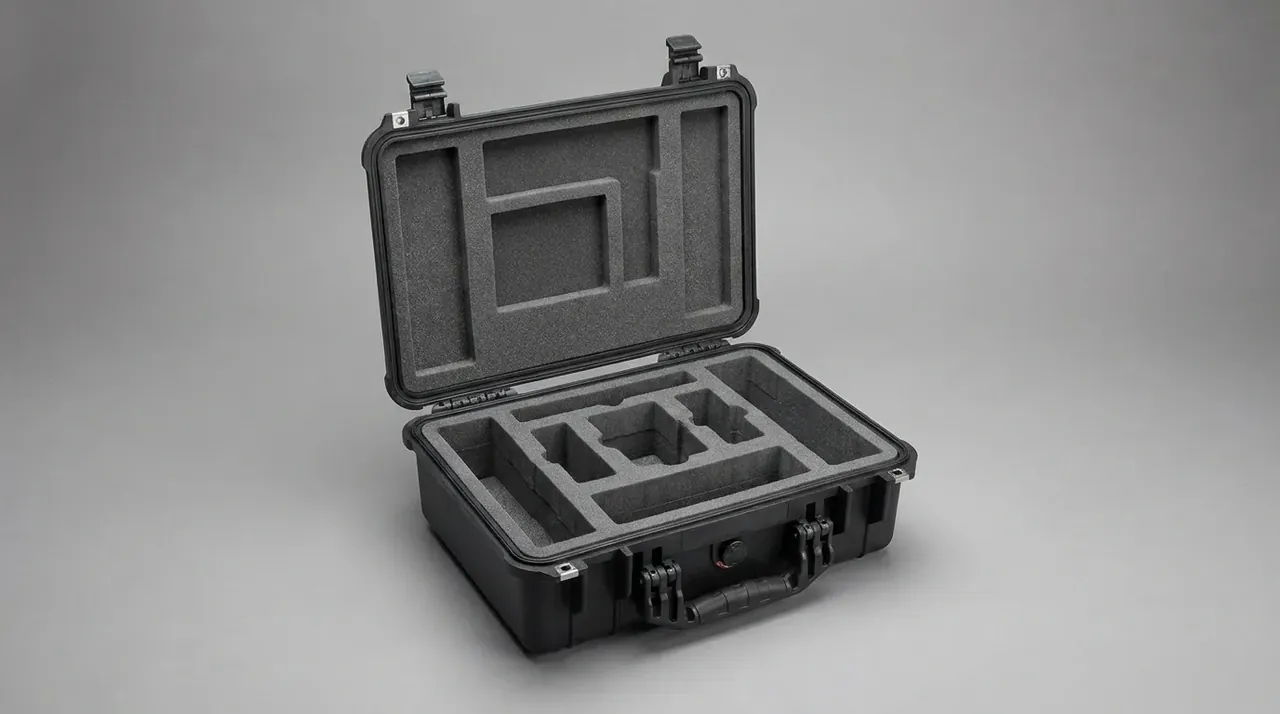
Rib direction matters more than rib count: longitudinal ribs paired with the bands carry torque from handle end to tail. Table 1 lists relative shift by position; the three readings add to ≤2 mm. Band inserts are moulded in one shot since drilling later cuts rib fibres, and a -25 °C to 60 °C range sets the rib allowance.
| Long-edge position | Behaviour under single-end lift | Reading |
|---|---|---|
| Handle end | lid-to-base shift | ≤2 mm |
| Midspan | floor torsion rebound | 1.2 mm |
| Tail pivot | diagonal drift | 1.4 mm |
3. How Three Wrap Bands and Six Latches Share Clamping Load
Three wrap bands divide the 1320 mm long side into thirds, each looping from the floor onto the lid as a closed hoop. Six latches sit evenly along the rim at 420 N each, with clamping load checked assuming the worst latch has released. A Rifle sniper hard plastic safety box does not lean on one oversized latch; six share the torque.
Two handles at 450 N each sit where the end bands cross, so lift force enters the hoop rather than the wall. Table 2 sets out the measures and counts.
| Torsion measure | Position | Count and force |
|---|---|---|
| Wrap band | long edge thirds | 3 bands |
| Latch | even along rim | 6 at 420 N each |
| Handle | end band crossing | 2 at 450 N each |
Even spacing shows its value on an angled drop: with 20.8 kg landing on one corner, two handle-end latches alone would spring the lid, while six spread the torque and hold shift to ≤2 mm. A Rifle sniper hard plastic safety box shares inserts between latch seats and bands, keeping the force path off the thin wall.
4. Measuring Diagonal Deviation After a 1.2 m Angled Drop
A 1.2 m angled drop is the closing case for this Rifle sniper hard plastic safety box, run on a floor corner, one long-edge end and the lid slope. The criterion is diagonal deviation within ≤3 mm afterwards, with six latches closed and the gasket in place.
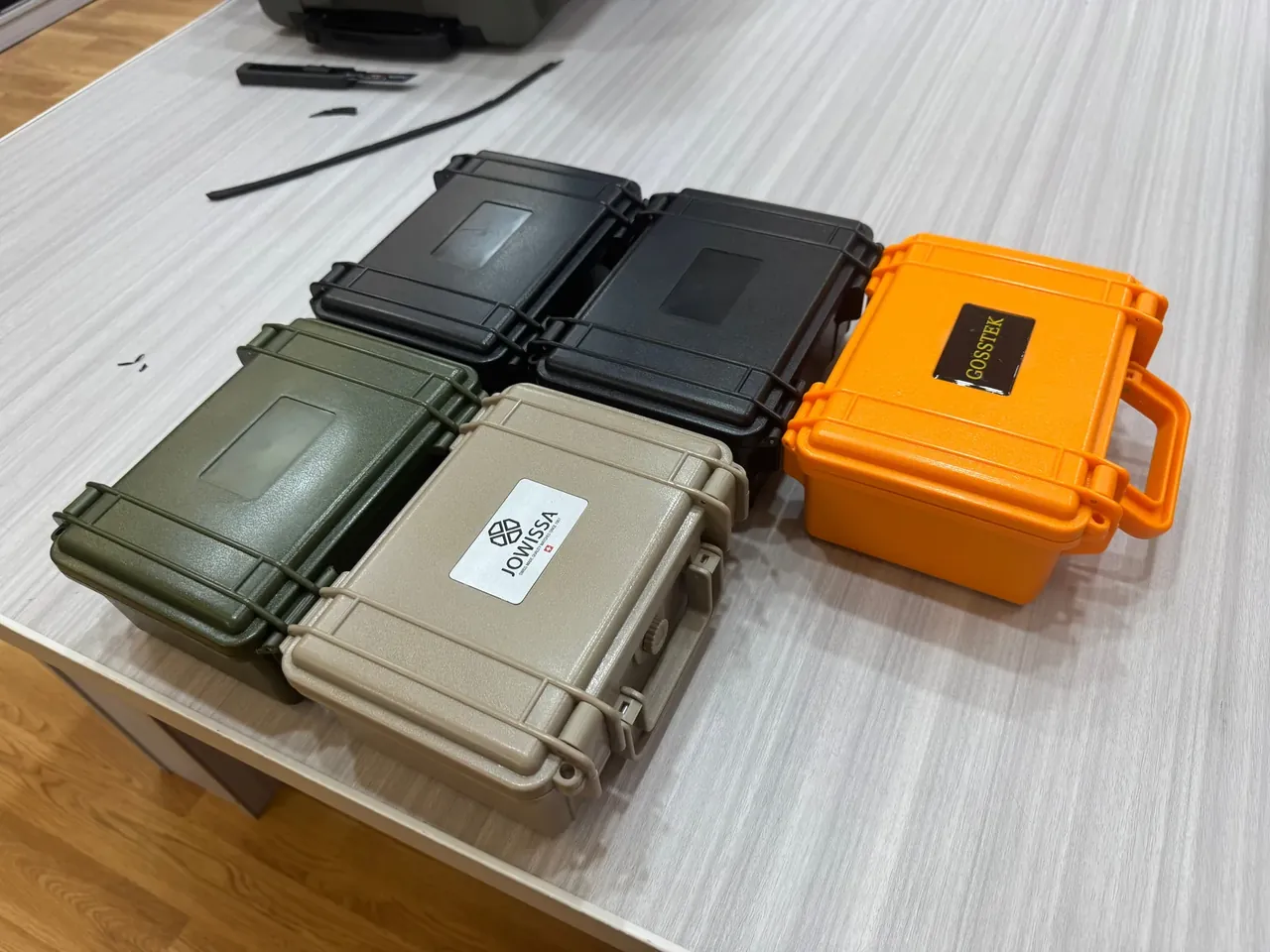
The case rests on a flat table while a height gauge reads all four corners to work out the two diagonals. Testing is benchmarked to an angled-drop method, recording numbers rather than a grade. If deviation grows from ≤3 mm to 4 mm, the band-to-floor bond has microcracked and the case returns for a mould-pressure check; sealing is re-checked to IP67.
5. Re-Test Points at -25 °C to 60 °C and 5000 Open-Close Cycles
Table 3 puts three re-test points on one scale for the 12 kg load, the 1.2 m drop and 5000 open-close cycles.
| Allowed deviation | Re-test point | Verdict |
|---|---|---|
| Lid shift ≤2 mm | single-end lift, 20.8 kg gross | release |
| Diagonal deviation ≤3 mm | after 1.2 m angled drop | release |
| Latch clearance ≤1 mm | after 5000 cycles | release |
After conditioning at both ends of -25 °C to 60 °C, lid shift is re-measured for cold shrinkage and hot creep. The 5000-cycle re-test checks wear on latch seats and the rim lip, passing only if clearance holds within ≤1 mm. A Rifle sniper hard plastic safety box runs temperature cycling first so the material settles.
Passing comes back to lid shift and diagonal deviation.
Conclusion
Handing the 1320 x 380 x 180 mm long side to three wrap bands and six evenly spaced latches holds single-end lid shift inside ≤2 mm, which closes the structure of this Rifle sniper hard plastic safety box. Diagonal deviation of ≤3 mm after a 1.2 m angled drop is its hardest closing line. The -25 °C to 60 °C range, IP67 and 5000 cycles all land on one inspection sheet.
Related Reading
- Long case shipping and packaging structure
- Protective case selection by structure
- Hard safety case specification comparison
- Protective case specifications and inspection
Related Products
- 8 Series — Gun Cases; Military Equipment Cases; Camera Equipment Cases; Drone Cases; Watch Cases; Knife Cases; First Aid Cases; Electronics Equipment Cases
- WL8-2812 PP Gun Case — model WL8-2812
- All protective cases and toolboxes: 7 series, 158 models