

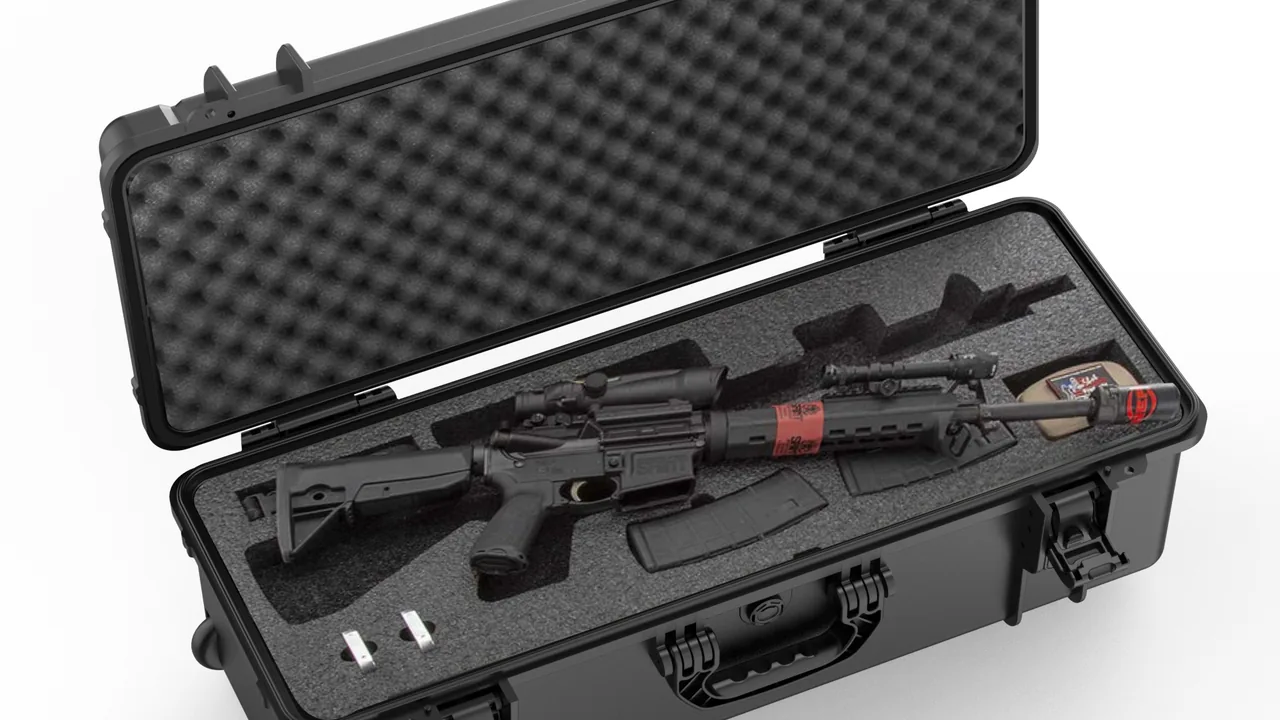
A Rifle Case and a Gun Case are the most underrated links in the chain that connects firearms exporters, cross-border logistics providers and defense trade agents. The same rifle will cross sea, air and road legs safely inside a properly engineered case, and the same rifle will show a shifted optic, a cracked shell or a displaced payload after one port stacking cycle or one rough road segment inside a case that was never designed for the job. JUNZHIJIA builds container engineering solutions for firearms exporters and cross-border logistics operators, and this article discusses the packaging container only: shell reinforcement, insert retention, sealing and pressure equalization, rust prevention, stacking and lifting, locks and traceability, and the packaging certification that travels with an export shipment. For the transport of firearms and ammunition themselves, always follow local regulations and export control requirements; this article addresses packaging containers only.
For a firearms exporter, a cross-border logistics provider or a defense trade agent, the packaging decision is often locked in early. The customer places an order for complete rifles, but what is actually delivered is a deliverable unit made of a case, an insert, a seal, a pallet and a document set. A mismatched case selection, a stacking plan that conflicts with container loading, or an incomplete certification package will all surface at the port inspection or when the customer opens the case. This article follows a practical order: structure and reinforcement, inserts and retention, sealing and pressure, rust prevention and storage, stacking and lifting, locks and traceability, testing and certification, and finally acceptance and delivery. The goal is to treat the packaging container as a verifiable engineering object rather than an accessory bought at the last minute.
Product Forms and Application Targets of Rifle and Gun Cases
A rifle case usually means a long, slim hard case designed for one or two long guns, typically between 1000 mm and 1500 mm in length, with internal cavities cut for the receiver, the optic and magazine positions. A gun case is a broader category: it includes multi-rifle transport cases, wheeled cases with a trolley handle for cross-border movement, and cases built around a complete kit of equipment. In export business the two terms are often merged into a single procurement line, yet their structural priorities differ. A rifle case emphasizes bending stiffness along its length and a tight-fitting insert, while a gun case emphasizes stacking load capacity, lifting interfaces and container load compatibility.
The application targets also differ. A firearms exporter delivers complete rifles, a cross-border logistics provider handles mixed batches in transit, and a defense trade agent often manages a packaged kit with display items and accessories. The common demand across all three can be summarized in three sentences: the payload must hold its position through every transfer leg, water vapor and dust must stay outside the shell, and the case must not fail under stacking and handling. JUNZHIJIA typically confirms the payload list and the transport chain first, then works backwards to shell dimensions, material and insert structure, avoiding the common trap of choosing a case first and forcing the contents into it.
A further distinction is hard case versus soft bag. A hard rifle case relies on shell stiffness and a molded insert to deliver repeatable protection, which suits scenarios that demand zero retention, stackability and lockability. A soft gun bag is lighter and easier to carry, but it cannot provide stable stacking capacity or sealed moisture protection. In export and cross-border transport, most customers still choose a hard shell, and the reason is not appearance but verifiability: the dimensions, weight, protection rating and test results of a hard case can all be written into a procurement document.
Core Packaging Requirements for Firearms Export and Cross-Border Logistics
Breaking the transport chain into stages shows what a container must survive: repeated lifting and forklift handling at ports and freight stations produce drops and impacts; sea freight and long road legs produce continuous vibration; movement across climate zones produces temperature cycling and condensation; humid and salt-laden environments produce corrosion risk; pressure changes in an air cargo hold produce a pressure differential; and warehousing and load planning apply long-term static stacking load. The optic, receiver and barrel of a firearm are all sensitive to deformation, so any impact not absorbed by the insert can turn into a shifted zero or secondary surface damage.
Beyond mechanical and climatic loads, firearms export adds compliance and security requirements. The shell needs a controllable locking and seal interface so that every handover leaves a verifiable seal record. It needs support for numbered labels or electronic tags so batches can be traced. It needs material declarations and test records that satisfy the importer or the carrier. JUNZHIJIA groups these under the term container-side compliance interface, and reserves locking points, seal holes and label areas during the design stage so that the packaging can accept the sealing and traceability process on delivery rather than being drilled and modified on site.
Packaging requirements also shift with the transport mode. Air freight cares more about weight, volume and sealing stability under pressure differential. Sea freight cares more about long-term humidity, salt spray and stacking. Road and rail intermodal transport cares more about cumulative vibration and repeated handling. If a single gun case is to serve all three modes, it must envelope all of these dimensions rather than satisfy only one. This is why JUNZHIJIA asks for the complete transport chain during the evaluation stage: it fixes the envelope conditions in one pass instead of discovering them after delivery.
Shell Material and Reinforcement Rib Design
Shell material sets the upper limit of protection. Modified PP offers good toughness, chemical resistance and moderate cost, which suits longer, heavier firearm cases. ABS offers higher surface hardness and a flatter appearance, which suits scenarios where delivery image and precision payloads matter. PC and PC alloys offer outstanding impact resistance, which suits transport environments with wide temperature swings. The key point is that an engineering plastic protective case differs from an ordinary injection-molded tote not in the material name but in wall thickness distribution, rib orientation and the assembly strength of hinges and latches, a subject covered in more detail in reinforcement rib design for protective cases.
For a long, slim rifle case, the central structural conflict is the balance between bending stiffness and weight. The longer the shell, the more likely the middle will deflect under stacking and handling, so the primary load direction usually needs ribs running along the length, plus a transverse support ridge at the center of the lid. Corners and floor contact zones need local thickening to form load-bearing columns, so that stacking load travels through the corners instead of pressing on the center of the lid. Combined with a thickened base and a wrap-around hinge, the shell can hold its geometry through repeated opening and stacking cycles.
Seal channel design also belongs to the structural domain. The mating surface between lid and base needs a continuous seal channel whose depth and width match the cross-section of the chosen gasket, so the gasket does not lose its resilience after long compression. The inside of the lid is usually double-walled or ribbed to reduce lid deflection under pressure differential or stacking load. In long-gun case projects, JUNZHIJIA brings the seal channel, reinforcement ribs and latch seats into the same tooling design, reducing the risk of later local reinforcement breaking seal continuity. For heavy transport cases that are lifted frequently, the shell also needs molded lifting holes or lugs, positioned so the lifting points align with the projected center of gravity of the payload, preventing the case from tilting and the contents from shifting during a lift. These details are set at the drawing stage, which is far more reliable than fitting lifting eyes onto a finished case.
Inserts and Retention: Achieving Zero Freedom Inside the Case
The insert is what creates zero freedom inside the case. If a firearm has even a few millimeters of travel, repeated vibration and hard braking will make the payload strike the cavity wall again and again, and the impact energy travels through the wall back into the receiver and optic, accumulating over time into a shifted zero or surface abrasion. Zero freedom means a CNC-molded insert fits the contact surfaces of the stock, receiver and barrel, while a lid cushion applies moderate preload so that the payload has no free play inside the case.
Insert material must match the payload. EVA and XPE are closed-cell foams with a balanced relationship between cushioning and rebound, suitable for most long-gun cavities. PU foam is softer and suits precision parts that demand surface finish, but it loses resilience after prolonged compression. PE board is stiff and is often used for layered base plates and support structures. Softer is not better: a foam that rebounds too quickly can make the payload bounce and amplify the impact, and a detailed comparison is available in design points for custom foam inserts.
For cavity layout, JUNZHIJIA usually adopts a two-layer base-and-lid structure. The base insert is cut to the outline of the stock and receiver to limit fore-aft and lateral movement. The lid insert provides relief above the optic and receiver, applying light pressure only to non-critical areas so the scope tube never takes direct load from the lid. For magazine wells, cleaning tools and spares carried in the same case, separate small compartments with removable dividers prevent small items from colliding with the main payload and simplify inventory checks.
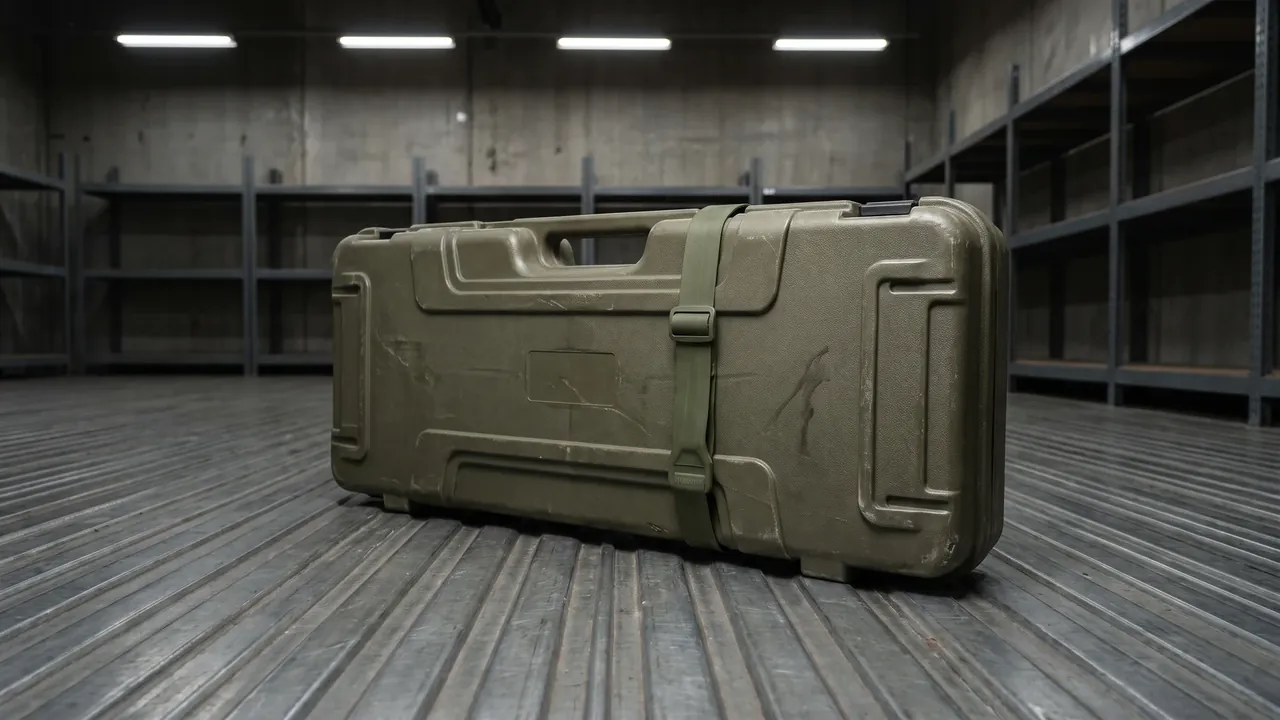
In a multi-rifle gun case, the walls between cavities must be thick enough to prevent adjacent payloads from pressing on each other under impact. If a removable divider system is used, the dividers must not dislodge under vibration. Cavity cutting tolerances are typically held around plus or minus 1 mm: too tight makes loading difficult, too loose removes any retention value.
Sealing, IP Protection and the Pressure Equalization Valve
Sealing performance determines whether the case can resist rain, spray and dust. In engineering practice, IP ratings are usually assigned according to IEC 60529 or the corresponding GB/T 4208 standard, and IP67 is common for firearm transport cases: no ingress during short immersion under specified conditions, plus complete dust protection. Achieving this rating depends not on a single gasket but on the combination of shell stiffness, seal channel dimensions and latch clamping force. Lid deflection causes uneven gasket compression, and latches spaced too far apart allow the mating surface to open locally.
Gasket material must be selected for the service environment. Silicone has a wide temperature range and good resilience, suitable for transport across climate zones. EPDM offers good weather and water resistance at moderate cost, suitable for routine sea and road freight. Neoprene has better oil resistance, suitable for scenarios where oil contact is possible. Gasket hardness and cross-section compression must match the seal channel depth: insufficient compression causes leakage, while excessive compression accelerates aging and increases opening effort. On long-gun cases, JUNZHIJIA evaluates latch count in segments according to shell dimensions to keep gasket load uniform along the full perimeter.
For cases that travel by air or across high plateaus, a pressure equalization valve is almost mandatory. In an air cargo hold, pressure is far lower than at ground level, and if internal air cannot escape, a pressure differential forms. That differential can push the gasket to one side and destabilize the seal, or create negative pressure after landing that makes the case hard to open. Sea freight across climate zones produces a similar breathing effect through day-night temperature swings. The valve allows slow gas exchange while maintaining waterproof and dustproof performance, so internal pressure follows ambient changes gently, as explained in how a pressure equalization valve works. One reminder: the valve itself must stay clean. If it becomes blocked by dust or salt crystals, it stops working, so inspect valve flow during every maintenance cycle. Gaskets are wear parts; over the long term a replacement interval should be established so that aging seals do not quietly degrade the protection of the whole case.
VCI Rust Prevention and Long-Cycle Sea Freight and Storage
The main risk to machined metal surfaces such as barrels and receivers during long sea freight and humid storage is corrosion. Corrosion on metal usually starts at small scratches and fingerprints, and once it spreads it affects both appearance and fit. VCI vapor-phase corrosion inhibitor materials release molecules that form a protective film on metal surfaces, extending protection during storage even if the case is briefly opened or the seal is challenged, which is particularly valuable for export batches that spend months at sea.
In practice, VCI is combined with desiccants and humidity indicator cards. The desiccant lowers initial internal humidity and absorbs moisture that enters during transport, the indicator card lets an operator judge quickly whether action is needed at opening, and the VCI provides continuous surface protection. The precondition is that metal surfaces must be clean and dry before packing; residual cutting fluid, fingerprints or old rust prevent the protective film from adhering evenly. For surfaces that are already corroded, VCI can only slow progress, not reverse it, so treat the surface before packing.
For high-salt-spray routes or humid warehouse storage, JUNZHIJIA recommends strengthening the corrosion package, for example by increasing VCI quantity, adding desiccant or wrapping the contents in a VCI bag. The higher the seal rating of the case, the more stable the internal environment, and the longer the corrosion measures remain effective. Conversely, if the case seals poorly, even a large amount of desiccant will be consumed by moisture that keeps entering, a logic consistent with managing protective cases in humid warehouse environments.
Storage practice matters too. Cases stored long term should be kept off the floor so the base does not touch damp concrete. They should not share a warehouse with acids, bases or salt-bearing materials, and stacking should never exceed the design layer count, otherwise the bottom case will creep under long-term static load. For batches that require periodic inventory, reseal promptly after inspection and top up desiccant, keeping the internal environment from fluctuating repeatedly.
Stacking Strength and Palletized Load Planning
Stacking strength must be calculated as the static load from upper layers plus the dynamic load of transport, not simply as single-case compression. In practice, first determine the pallet layer count and the usable container stack height, calculate the maximum static load on the bottom case, then add a dynamic factor for transport vibration and braking and check lid and wall stiffness against it. A lid with reinforcement ribs and a double-wall structure resists collapse far better, and a case with locally thickened floor contact zones creeps less under long static load. Related calculation methods are described more systematically in stacking and pallet planning for protective cases.
Pallet loading must match the case feet to the pallet dimensions, avoiding any case that bridges a gap between pallet boards and is left unsupported. If case dimensions do not match a standard pallet, it is better to build a custom pallet than to force an oversized case onto an undersized one. Where necessary, add a full-sheet separator or honeycomb board between layers to spread the concentrated load from upper cases. For a long, slim rifle case, avoid leaving the middle of the case cantilevered beyond the pallet edge; a long overhang flexes repeatedly in transit and accelerates shell fatigue.
Layer arrangement also affects stability. Cases of similar volume and height should share a layer to avoid eccentric loading, heavy cases should go at the bottom, and edges of each layer should be aligned as closely as possible. Wrap the stack with stretch film or strapping to prevent displacement in transit. For high-value batches, corner protectors and a top board on the pallet reduce scuffing from forklift handling.
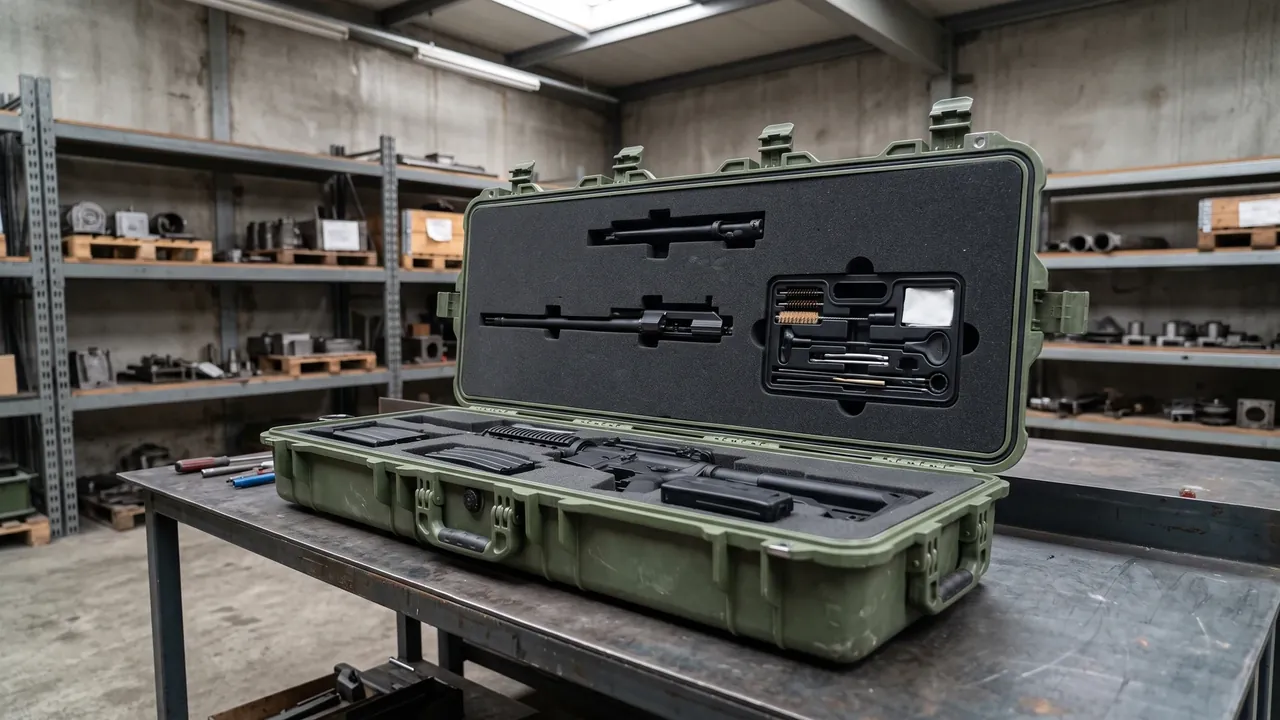
If the customer requires a full-container delivery, the stacking plan must also interact with container internal dimensions: determine the number of rows and layers from container width and height, then check that total weight is within the container limit, avoiding both the situation where the load fits but exceeds the weight limit and the situation where an overweight load over-compresses the bottom cases. For heavy projects, JUNZHIJIA usually provides a recommended stack height and a pallet layout drawing so the customer can rehearse the load plan.
Lifting, Forklift Handling and Container Load Planning
Heavy gun transport cases are mainly moved at ports and freight stations by forklift and lifting gear, which makes the lifting interface a weak point. The case should have forklift pockets or lifting lugs aligned with the projected center of gravity, so the case stays level during a lift and the payload does not shift. Lifting straps should not cut directly across case corners; use corner pads to spread the pressure where needed. On wheeled cases with a trolley handle, the wheels are load-bearing parts: use ramps for steps and loading slopes rather than dragging the case by the handle over a curb, a point covered in loading and transport precautions for protective cases.
Container load planning involves three concerns: weight distribution, securement and loading sequence. Weight should be spread fore and aft as evenly as possible, avoiding concentration at one end that exceeds axle load limits. Gaps between cases should be filled with dunnage or air bags to prevent lateral sliding at sea. High-value batches can be strapped to container floor rings. For a full container of gun cases, place the heaviest cases at the bottom and near the primary load-bearing area, with lighter cases and accessory cases on top.
The loading sequence must follow the load plan. Cases loaded first usually sit at the far end of the container, so a disrupted sequence can make later securement impossible and force a re-stuff. Port and freight station environments are busy, so stencil handling marks such as center of gravity, this way up and keep dry on the outside of the case to help operators judge orientation quickly. Handling marks should be in a separate zone from traceability labels and in a different color so they do not interfere.
For batches with multiple transfers, inspect and record the case exterior at every handover, focusing on corners, latches and seal surfaces for impact deformation. Finding and fixing an issue early is far more economical than opening an entire batch at the destination.
Locks, Seals and RFID Asset Traceability
Locking and sealing a firearm transport case is both a security requirement and the carrier of handover responsibility. Common locking methods include latch points for padlocks, built-in combination locks and reinforced hasps with locking holes. Selection must balance tamper resistance against ease of operation, and the lock point should be tied to the structural load path so the hasp does not become a stress concentration. For batches subject to customs or third-party inspection, a one-time seal position should be reserved in addition to the lock, with the seal number recorded on the handover sheet.
The value of a seal is that it creates a verifiable handover chain. From factory release, customs declaration and vessel loading to collection at the destination port, every transfer of responsibility corresponds to a seal check. If a seal number does not match or a seal is broken, the responsible stage can be identified immediately. For high-value batches, add a case serial number and batch label alongside the seal for double verification. In delivery documents, JUNZHIJIA usually recommends that customers maintain a seal ledger mapping number, date of use and the person handling the handover.
At the asset management level, QR codes or RFID tags can be introduced. QR codes are low cost and easy to scan manually, while RFID suits fast batch inventory and automatic warehouse check-in and check-out. The tag location should avoid locks and sealing surfaces, usually placed on a flat side area with scratch protection. For gun cases that circulate for years, binding the case serial number to the packed contents list allows quick verification during repair, parts replacement or re-delivery, reducing repeated counting.
Traceability data only matters if someone maintains it. Archive the case serial number, material batch, test records and service history together to form a complete chain from manufacturing to use. For a defense trade agent delivering documents to multiple parties, this archive is especially valuable during audits and customer inquiries. Keep the data fields lean: number, batch, status and location are enough to make the system work.
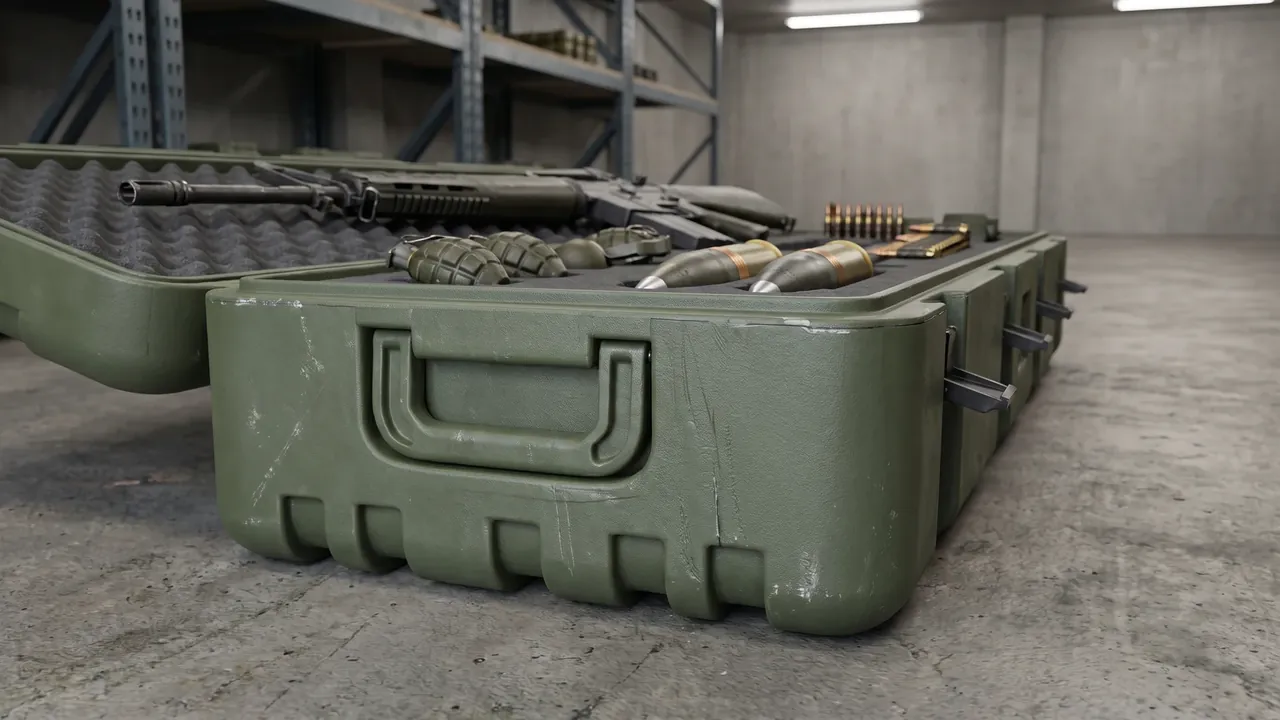
Transport and Environmental Reliability Testing: MIL-STD-810H and GJB References
Whether a packaging solution is accepted by an importer or a carrier ultimately depends on test data. Common verification items include vibration, drop, stacking, immersion, rain and temperature cycling. Vibration testing exposes loose inserts, loosened fasteners and payload displacement. Drop testing verifies the integrity of corners, latches and hinges under impact. Stack testing verifies lid creep resistance under long static load. Immersion and rain testing correspond to the IP rating, and temperature cycling examines gasket and engineering plastic stability under alternating hot and cold.
On standards, references include the GB/T 4857 series of basic transport package tests, the ISTA series of transit test procedures, and the MIL-STD-810H and GJB requirements for military environmental adaptability. MIL-STD-810H provides a methodology framework that emphasizes tailoring test conditions to the actual environment rather than copying a fixed profile, which matters greatly for firearm transport cases because the real logistics chain varies widely between customers. For batches that must meet military procurement requirements, see the key points in MIL-STD-810H compliance for protective cases and GJB military standard protective case requirements.
Test design must match the weight and center of gravity of the actual packed contents. The same case body has different resonant frequencies and impact responses when loaded with different weights, so drop height and vibration profile should be determined against the heaviest loading condition rather than letting a light-load result represent a heavy load. Before testing, JUNZHIJIA usually asks the customer to confirm the standard loading configuration and writes that configuration into the test report so the conclusion can be reproduced.
Passing a test does not mean permanent reliability. Gaskets age, engineering plastics creep and latches wear, so periodic sampling is recommended after batch delivery, with focus on gasket compression, latch strength and insert fit. For cases that have been repaired or had parts replaced, run a fresh seal and impact verification so that a local change does not undermine whole-case performance.
Export Packaging Certification, UN Marking and ATA 300 Air Compliance
On the export side, the packaging container usually faces several kinds of requirements. First, wood pallets or wood crates fall under plant quarantine rules and generally need heat treatment or fumigation with marking under ISPM 15 before export, to avoid detention or return in the destination country. Second, if the packaging carries regulated goods, it must meet the carrier's and the destination's packaging certification requirements, with supporting documents retained; such requirements are often related to the UN packaging certification framework, and the exact applicability depends on carrier and destination rules. Third, reusable air cases can be adapted to the structural logic of ATA 300 so the carrier can handle them as a known category, as outlined in the ATA 300 airline case standard explained.
For batches destined for specific markets such as the United States, the importer's requirements on packaging marking, material declarations and test documents also apply, and details are available in import certification requirements for protective cases. A common thread runs through all of these requirements: documents and physical goods must agree. If the marking states a material, the case must be that material; if an IP rating is claimed, the corresponding test record must exist. A verbal promise is worth less than a traceable document.
The compliance boundary must be emphasized again. Whether firearms and ammunition themselves may be exported, and under what procedures and qualifications, falls under export control and local law and must be handled by a qualified entity in accordance with official rules. JUNZHIJIA designs and manufactures packaging containers and can supply material declarations, test records and drawing documentation, but it does not and cannot replace the customer's compliance responsibility. This article deals with packaging container engineering only and does not address the physical or chemical properties or handling of any contents.
For a defense trade agent delivering documents to multiple parties, it helps to lock the certification list at the start of the project and write down who issues each document, when it is issued and which shipment it travels with. Certification paperwork often delays shipment more than the cases themselves, so early scheduling significantly reduces the risk of a last-minute hold.
Acceptance, Batch Records and the Delivery Checklist for Gun Transport Cases
Acceptance after the cases arrive should separate can it be loaded from is it loaded well. Can it be loaded means dimensions match the contents and latches close properly. Is it loaded well means insert fit, gasket compression, stacking capacity and complete marking. In practice, an AQL sampling plan is often used for appearance and assembly inspection, with priority on cavity dimensions, gasket integrity and latch assembly strength, because these are the most variable points in batch consistency. Related methods are described in acceptance and AQL sampling for protective cases.
Batch records matter just as much. Archive each batch's case serial numbers, material batch, insert drawing revision, test parameters and measured weight, so any field issue can be traced. In the delivery documentation it provides to firearms exporters and logistics providers, JUNZHIJIA usually includes these records so that packaging quality can be traced rather than judged by impression. The fields do not need to be complex: number, revision, test, weight and date are enough.
A delivery checklist typically includes the case body, molded insert, removable dividers, desiccant or humidity indicator card, VCI components if required, seals and locks if required, traceability labels, stacking and lifting marks, and use and maintenance instructions. Marking should state the payload name, model compatibility, gross weight and center of gravity cues so that handlers can judge orientation. For a gun case that circulates repeatedly, attach a simple maintenance schedule showing gasket replacement and latch inspection intervals.
Turning these practices into a checklist significantly reduces execution variance. In gun transport case projects, JUNZHIJIA typically proceeds in the order of confirming the chain, defining the insert, defining the shell, defining sealing and rust prevention, defining stacking and marking, and defining testing and documents. Each step has a clear input, avoiding the common mistake of fixing shell dimensions first and forcing the contents in afterwards. This way every step from manufacturing to delivery can be verified against a reference, and the packaging container turns from a passive accessory into a controllable link in the supply chain.
Conclusion
Treating a gun transport case as a verifiable engineering object is the shared starting point for firearms exporters, cross-border logistics providers and defense trade agents who want to reduce delivery risk. Shell material and reinforcement ribs set the structural foundation; inserts and retention determine whether the payload has zero freedom; sealing and pressure equalization determine reliability across climates and in the air; VCI and desiccant determine corrosion risk over long storage; stacking and lifting determine whether a whole consignment passes safely through ports and freight stations; locks, seals and traceability determine whether handovers form a closed loop; and testing and certification determine whether the solution is accepted by importers and carriers. Handling these seven items one by one is far more economical than dealing with a single case-opening incident after the fact.
JUNZHIJIA, manufactured by Kexin New Materials (Guangdong) Co., Ltd., has long provided container engineering solutions for Rifle Case and Gun Case applications in firearms export and cross-border logistics, covering shell structural design, custom inserts, sealing and rust prevention configuration, stacking and lifting adaptation, and testing and documentation support. Whether for complete-rifle export packaging or reusable cases for logistics circulation, JUNZHIJIA can provide a custom solution based on the payload list and the transport chain. For the transport of firearms and ammunition themselves, always follow local regulations and export control requirements.
Frequently Asked Questions About Rifle and Gun Cases
Q: What is the difference between a rifle case and a gun case, and how should a buyer decide? A: A rifle case usually means a long, slim hard case for one or two long guns, typically 1000 mm to 1500 mm long, with the structural emphasis on bending stiffness along the length and a tight-fitting insert. A gun case is a broader category that also includes multi-rifle transport cases, wheeled cases with a trolley handle and cases built around complete equipment kits, where the emphasis is on stacking capacity, lifting interfaces and container load compatibility. Start selection from the payload rather than the product name: for a single long gun, prioritize an insert cut to the outline of the firearm and confirm the lid relief above the optic; for multiple guns or a full kit, evaluate total weight, center of gravity and stack layer count, then decide wall thickness, rib density and whether wheels are needed. Transport mode also matters, because air freight penalizes weight while sea freight rewards stackability, so a case that is ideal for one mode may be mediocre for another. JUNZHIJIA works backwards from the payload list and the complete transport chain rather than applying a fixed case pattern.
Q: Why is zero freedom inside the case so important for a long gun in transit? A: If a firearm has even a few millimeters of travel inside the case, repeated vibration and hard braking will make the payload strike the cavity wall again and again, and that impact energy travels through the wall back into the receiver and optic. Over time this accumulates into a shifted zero or secondary surface damage, and the damage is usually invisible until the weapon is used. Zero freedom means a CNC-molded insert fits the contact surfaces of the stock, receiver and barrel, while a lid cushion applies moderate preload so the payload has no free play. For a rifle with an optic, the insert needs a dedicated relief pocket above the scope so the tube never takes direct load from the lid, since scope tubes are far more fragile than the receiver they sit on. Softer foam is not automatically better: a fast-rebounding foam can make the payload bounce and amplify the impact, while a closed-cell foam balances cushioning and rebound more predictably over many trips. JUNZHIJIA cuts tooling from actual three-dimensional data and confirms fit with a dummy load before delivery.
Q: Why do firearm transport cases for export need a pressure equalization valve? A: In an air cargo hold, pressure is far lower than at ground level, and if internal air cannot escape, a pressure differential forms. That differential can push the gasket to one side and destabilize the seal, or create negative pressure after landing that makes the case hard to open. Sea freight across climate zones produces a similar breathing effect through day-night temperature swings, and the effect repeats for weeks on a long route. A pressure equalization valve allows slow gas exchange while maintaining waterproof and dustproof performance, so internal pressure follows ambient changes gently and the gasket never faces a sustained one-way differential. For cases that fly frequently or move between high and low altitude, the valve is close to standard equipment; for pure road use or short trips, weigh the cost and maintenance burden against the benefit. Note that the valve itself must stay clean, because dust or salt crystals can block the membrane and silently disable it, so check valve flow during every maintenance cycle and treat it as a wear part like the gasket.
Q: Are VCI rust-prevention inserts suitable for firearm transport cases? A: Yes, but they must be used correctly to work. VCI materials release corrosion inhibitor molecules that form a protective film on metal surfaces, which is particularly valuable for machined surfaces such as barrels and receivers during long sea freight and humid storage. JUNZHIJIA typically places a VCI insert or a VCI bag inside the case and combines it with desiccant and a humidity indicator card to form a complete corrosion package: the desiccant lowers initial humidity and absorbs moisture that enters, the indicator card helps an operator judge whether replacement is needed at opening, and the VCI provides continuous surface protection between inspections. The precondition is that metal surfaces must be clean and dry before packing, because residual cutting fluid, fingerprints or old rust prevent the film from adhering evenly. For surfaces already corroded, VCI can only slow progress, not reverse it, so treat them first. The better the case seals, the longer the VCI remains effective, because a poorly sealed case keeps consuming desiccant and diluting the protective atmosphere.
Q: How should stacking strength and pallet layout be determined for gun transport cases? A: Stacking strength must be calculated as the static load from upper layers plus the dynamic load of transport, not simply as single-case compression. First determine the pallet layer count and the usable container stack height, calculate the maximum static load on the bottom case, then add a dynamic factor for vibration and braking and check lid and wall stiffness against the total. A lid with reinforcement ribs and a double-wall structure resists collapse far better than a flat lid of the same thickness, and locally thickened floor contact zones reduce creep under long static load. Pallet layout must match case feet to pallet dimensions, avoiding any case that bridges a pallet gap and is left unsupported, and a full-sheet separator between layers spreads concentrated load from the cases above. Long, slim rifle cases need special attention because their middle can overhang the pallet edge and flex repeatedly in transit. JUNZHIJIA recommends stack testing for heavy configurations, verified under the GB/T 4857 series or a relevant ISTA procedure, with measured height and layer count written into the delivery documentation.
Q: Why do air-shipped gun cases often reference the ATA 300 standard? A: ATA 300 is an industry specification for reusable air transport cases, and its core idea is to manage the case as an air cargo unit that circulates many times, setting requirements for structural strength, closure method, marking and maintenance. Referencing ATA 300 for air-shipped gun cases helps the case withstand repeated handling and cargo hold stacking while letting the carrier treat it as a known category, which reduces friction at check-in. It is important to note that ATA 300 governs the suitability of the case as an air case; it does not replace the carrier's acceptance conditions or the declaration requirements for the specific goods inside, which remain the shipper's responsibility under applicable rules. In air case projects, JUNZHIJIA checks latch points, hinges and marking against the ATA 300 category logic and reserves space for carrier labels in line with IATA-related requirements, so the case can be identified smoothly at check-in and security screening. Buyers should confirm the exact category with the carrier before tooling, because changing the closure or hinge design later is expensive and slow.
Q: What reliability tests should a gun transport case undergo? A: Common verifications include vibration, drop, stacking, immersion and temperature cycling. Vibration testing exposes loose inserts and loosened fasteners, drop testing verifies corner and latch integrity under impact, stack testing verifies lid creep resistance under long static load, immersion and rain testing correspond to the IP rating, and temperature cycling examines gasket and engineering plastic stability under alternating hot and cold. References include the methodology of MIL-STD-810H, the GB/T 4857 series, relevant ISTA procedures, and the GJB test requirements for military packaging. JUNZHIJIA sets test parameters against the weight and center of gravity of the actual packed contents, and because the same case behaves differently under different loads, it tests the heaviest configuration and records that configuration in the report for reproducibility. Passing a test does not mean permanent reliability, so gaskets and latches should still be rechecked periodically against the real service environment, and any repaired or modified case should be re-verified before it returns to service.
Q: What certification and compliance items matter for packaging containers at export? A: On the container side there are usually three items to watch. First, wood pallets and wood crates fall under plant quarantine rules and generally need ISPM 15 heat treatment or fumigation with marking before export, otherwise the shipment may be detained or returned. Second, if the packaging carries regulated goods, it must meet the carrier's and the destination's packaging certification requirements, with supporting documents retained; such requirements are often related to the UN packaging certification framework, and exact applicability depends on carrier and destination rules. Third, reusable air cases can be structurally adapted to the ATA 300 logic so the carrier can identify them easily. Whether firearms and ammunition themselves may be exported, and under what procedures, falls under export control and local law and must be handled by a qualified entity in accordance with official rules. JUNZHIJIA designs and manufactures packaging containers and can supply material declarations, test records and drawings, but it does not and cannot replace the customer's compliance responsibility.
Related Reading