

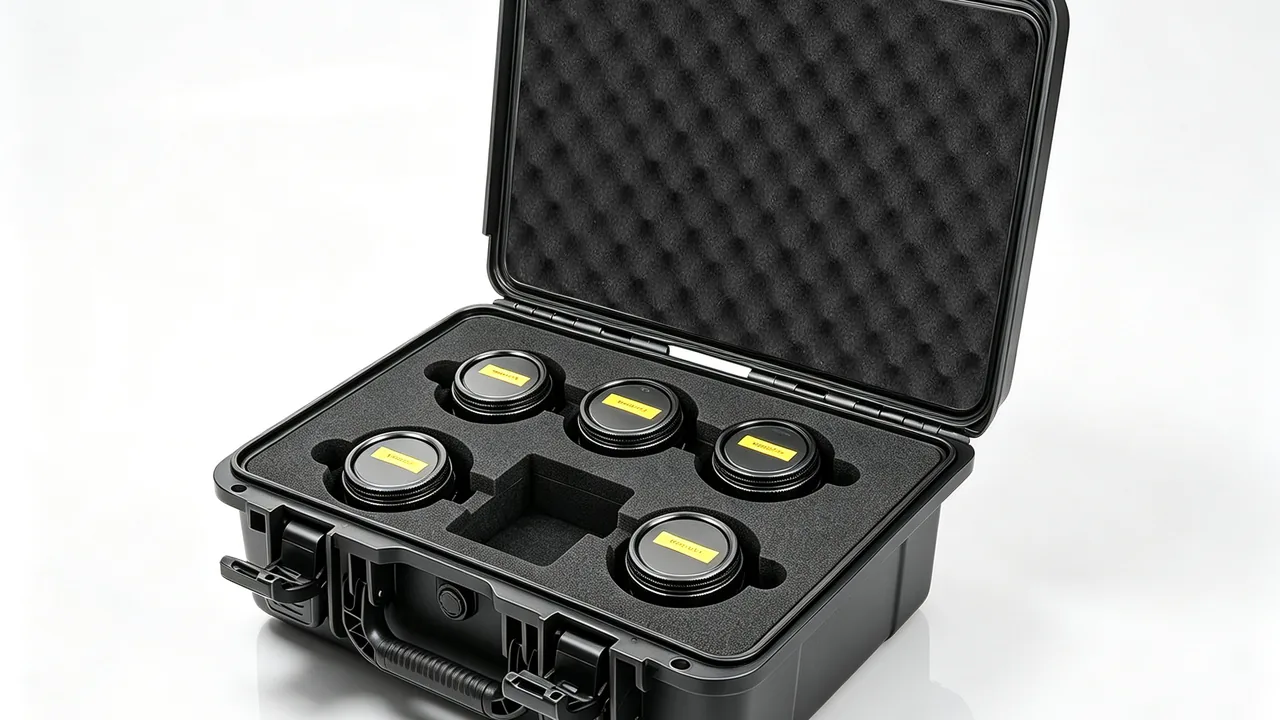
A rifle is the kind of equipment that most tests a case's geometry: it is long, its centre of gravity is offset, and it carries many bolt-on parts. There are the wood or polymer stock areas that fear knock and compression, the optical sight that fears shock and contact, and the barrel, rail and bipod that fear both bending and scratches. A sound rifle case must hold on four lines at once: lengthwise dimension, liner shaping, lock compliance and sealed moisture resistance. A flat foam sheet plus a few sponge blocks will not do. JUNZHIJIA's protection principle for rifle cases is organised along four lines: lengthwise rigidity, profile restraint, compartment isolation, and compliant locking. Use a reinforced shell to resist lengthwise bending, shaped pockets to restrain the rifle in six directions, separate compartments to isolate the optic and accessories, and an inspection-ready lock to meet transport compliance, instead of shoving a long gun into an ordinary toolbox.
Many rifles are damaged in transport and storage because of one word: long. If the rifle rests at both ends with the middle suspended inside the case, transport vibration puts an alternating bending moment on the barrel-to-receiver and stock-to-receiver joints. A wood stock cracks, a polymer stock shows stress whitening, and a fibreglass or carbon barrel bends micro-plastically in extreme cases. If the optical sight presses directly on the lid, drop impact travels through the mount, at best losing zero and at worst damaging the scope body. Metal parts condense moisture in the cargo-hold temperature and humidity cycle, and the rail and bolt show rust. These injuries share one trait: invisible at delivery, exposed only in use, with almost no reliable on-site remedy. This article addresses licensed case holders, hunting and shooting-sport practitioners, firearm dealers, and the case manufacturers and export packaging engineers serving them. It works through shell structure, liner shaping, compartment layout, sealing, compliant locking and acceptance criteria, with a configuration table and FAQ.
Table of Contents
- Failure Modes and Protection Logic in Long-Gun Transport
- Shell Structure: Rigid Design Against Lengthwise Bending
- Liner Shaping: Profile Restraint and Six-Direction Fixing
- Compartment Isolation: Separate Space for Optic, Magazines and Accessories
- Sealing and Moisture Control: The Key to Long-Term Rifle Storage
- Locking and Compliance: The Hard Constraint in Transport
- Handles, Casters and Heavy Handling Design
- Transport Test Basis: ISTA, GB/T 4857 and ASTM D4169
- Packing Marks, Traceability and Receiving Inspection
- Configuration Checklist and Selection Table
- Turnaround Maintenance and Long-Term Storage Management
- OEM/ODM Customisation and Branded Delivery
- Frequently Asked Questions FAQ
- Conclusion and Related Reading
Failure Modes and Protection Logic in Long-Gun Transport
A rifle's failure modes differ fundamentally from a handgun's. A handgun is small with concentrated mass, so protection focuses on not losing or knocking it; a rifle is large and slender, so protection focuses on not bending, vibrating or dampening it. Understanding this difference is the premise of rifle case design. A rifle decomposes into stock, receiver, barrel, forend and rail, optical sight, bipod and magazine interface, each with different vulnerabilities: the stock fears knock and pressure, the receiver fears poor fixation and dirt, the barrel fears bending, the optic fears shock and zero drift, and the rail and interfaces fear scratches.
From damage statistics, rifle transport and storage injuries concentrate in four classes. The first is lengthwise bending and joint cracking. When a rifle is supported at both ends with a suspended middle, vibration concentrates an alternating bending moment at the barrel-to-receiver and stock-to-receiver joints; a wood stock cracks along the grain and a composite stock shows stress cracks. The second is optic shock and zero drift. The optical sight is the highest point on the rifle; if the case interior is too low or the liner does not relieve the optic separately, the lid presses on the optic first in a drop, and the impact travels through the mount, shifting the internal prism and adjustment mechanism as a systematic point-of-impact drift. The third is surface corrosion. With poor humidity control, cargo-hold temperature and humidity cycling condenses moisture on metal parts, and the barrel exterior, rail and bolt show rust that spreads faster once the coating is damaged. The fourth is accessory mixing damage. Magazines, cleaning tools, spare optics and bipods in the same cavity as the rifle strike one another, damaging both the accessories and the rifle coating.
The table below maps failure paths to measures by part, as a pre-packing checklist.
| Part | Typical Material | Transport Failure | Protection Measure |
|---|---|---|---|
| --- | --- | --- | --- |
| Stock | Wood, polymer, composite | Knock, cracking, whitening | Profile pocket support, soft edge lining, no suspension |
| Receiver | Steel, aluminium alloy | Surface scratch, moisture rust | Compartment fixing, desiccant, no hard contact |
| Barrel | Carbon steel, stainless, carbon fibre | Lengthwise bend, coating scratch | Full-length or two-point support, never a rest point |
| Optical sight | Aluminium body, glass lens | Shock, zero drift, lens breakage | Separate relief, foam wrap, no top compression |
| Rail and forend | Aluminium alloy, polymer | Edge chipping, coating wear | Soft lining, no direct metal contact |
| Magazines and parts | Steel, polymer | Mutual impact, loss | Separate compartments, matching the list |
Once this table is understood, the design logic is clear: the shell needs enough lengthwise rigidity to resist bending, the liner must be shaped to the rifle profile to restrain six-direction movement, the optic needs its own relief to avoid top compression, the accessories need separate compartments to avoid mixing impact, and the sealing and lock must stand on both compliance and moisture protection at once. None of the five can be omitted; any missing one shows up in transport or long-term storage.
Shell Structure: Rigid Design Against Lengthwise Bending
The primary structural conflict of a rifle case is length. A standard rifle is often around a metre, and with a suppressor or long barrel it can exceed 1.3 metres, so the case is a classic long-beam structure in the length direction. If the wall is thin and the reinforcement is insufficient, the case visibly deflects when supported at both ends under a middle load or when stacked, the liner deforms with it, and the rifle takes an added bending load. Rifle case structural design must therefore put lengthwise rigidity first.
There are three ways to raise lengthwise rigidity. The first is material upgrade, from ordinary injection PP to glass-fibre reinforced PP or PC alloy, or directly to rotomoulded LLDPE for greater wall thickness and bending section. The second is structural reinforcement, with longitudinal ribs along the length inside or outside, or transverse hoop ribs at the middle and ends, splitting the long beam into several shorter spans and greatly reducing mid-span deflection. The third is composite load sharing between liner and shell, letting a rigid liner layer share the bending load rather than leaving the wall to carry it alone.
The mating face between lid and base is also a lengthwise structural key. A long lid tends to warp along its length; if the latch count is insufficient, a gap appears at the middle after closure, harming sealing and reducing rigidity. The sound approach is to arrange three or more latches evenly along the long edge so the lid is loaded uniformly over its full length. For extra-long rifle cases, an additional latch or compression point can be added at the middle. Latch pockets should have metal reinforcement so the plastic hook does not become brittle in cold.
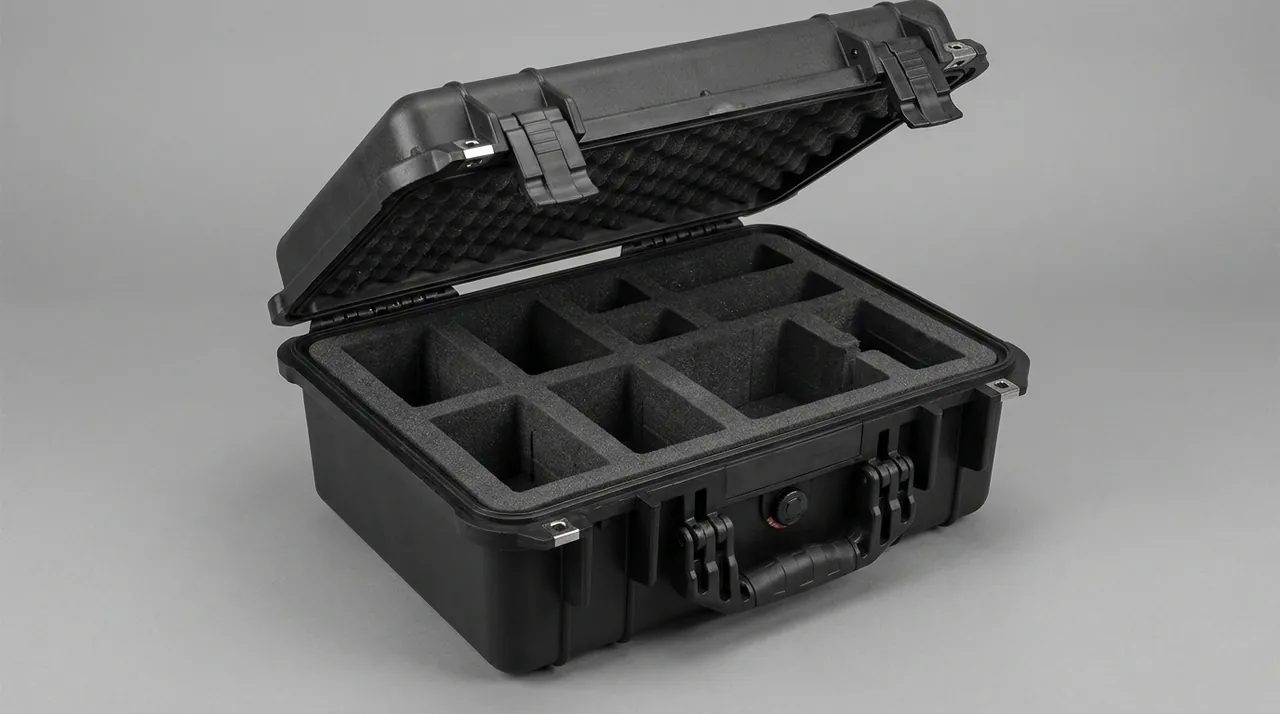
The cross-section shape also affects bending capacity. For the same material, a case with edge beams or a box section has far higher bending stiffness than a flat-plate section. A rifle case should therefore use a box structure with internal longitudinal edge beams and external hoop ribs, not a simple thin-walled box. Handle and caster mounting points should land on these reinforcements, transferring handling loads into the main structure rather than concentrating on a single wall thickness. The figure below shows the vertical fixing and shaped liner pockets inside a long gun case.
Liner Shaping: Profile Restraint and Six-Direction Fixing
The liner is the core of a rifle case's protection. Unlike an ordinary bag that "puts a layer of foam in", a rifle case liner must achieve profile restraint, that is, cutting shaped pockets to the firearm outline so the firearm cannot move freely up, down, left, right, forward or back once seated. A flat foam sheet can only support weight, not limit movement, so the firearm still slides and strikes the wall in drop and vibration.
Shaped pocket design has several rules of thumb. The first is depth, usually half to two thirds of the firearm section so the firearm cannot jump out as a whole while there is still room to lift it out. The second is the pocket form, which should match the real outline including the stock curve, receiver contour, and forend and rail shape, rather than a simple rectangular channel. The third is relief, with separate relief pockets for the optic, charging handle, magazine release, sling loops and other protrusions so they do not press on the lid or hang unsupported.
Cushion material selection is equally critical. Rifle case liners commonly use closed-cell foam with low compression set, such as EVA, PE, IXPE or their composites. The closed-cell structure resists water absorption, holds up to compression set and rebounds stably, which suits long-term storage and repeated turnaround. Where higher vibration absorption is needed, a layered structure can be used: softer foam near the firearm to fit the profile, firmer foam near the wall to spread the load. A layered design forms a soft-then-firm energy-absorption gradient in a drop, balancing fit and impact resistance.
Cushion thickness should be set from the permitted acceleration and allowable foam compression, not simply thicker. Overly thick soft foam rebounds strongly in a drop, loading the firearm a second time; too thin cannot absorb impact energy, and the load goes straight into the structure. The reasonable method is to estimate the required thickness from the possible drop height and the allowable acceleration of the contents, then verify by test. In its whole-case fixation of long guns and accessories, JUNZHIJIA uses compartment and shaped-pocket methods consistent with the modular idea of the removable divider system, configuring shaped liner sets by model and accessory list.
Compartment Isolation: Separate Space for Optic, Magazines and Accessories
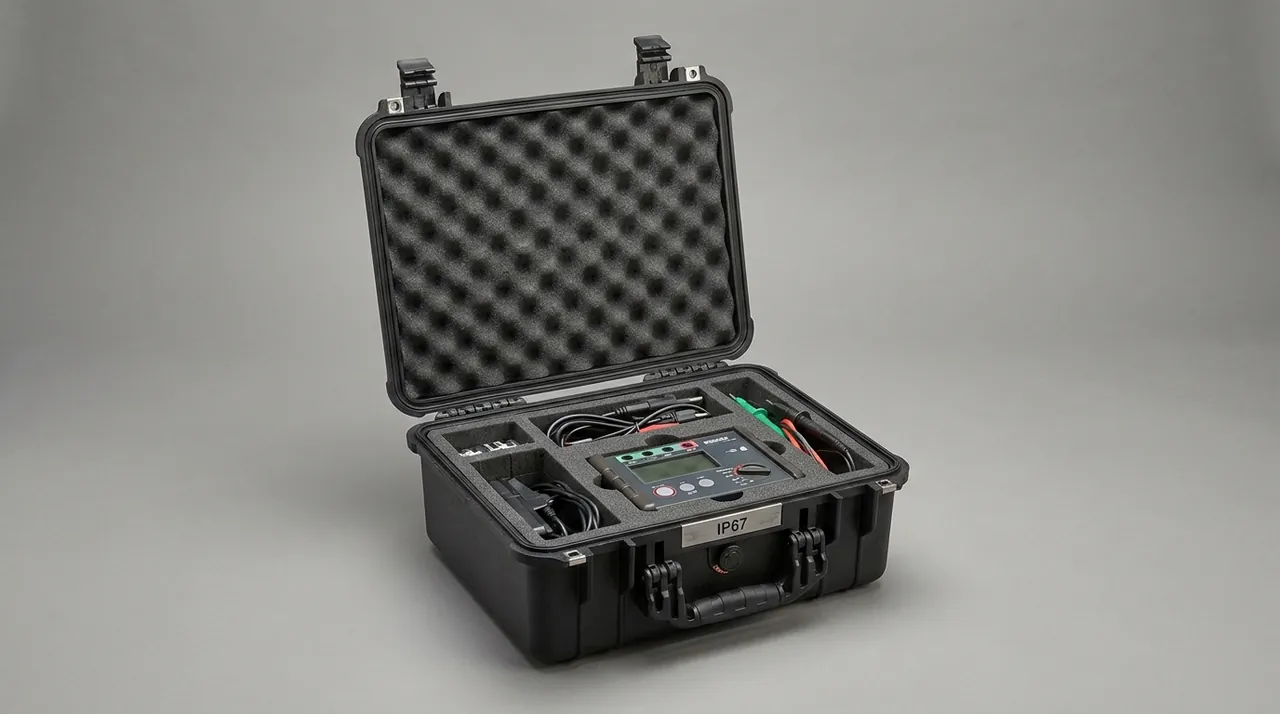
Compartments are what distinguishes a rifle case from an ordinary long box. A rifle in transport is often accompanied by magazines, cleaning tools, spare optics, a sling, a bipod and spare batteries; if these share a cavity with the rifle, they strike one another in transport, damaging both the accessories and the rifle. The sound approach gives the accessories separate cavities separated by solid material, not pushing them all into one common void.
The optical sight needs the most independent treatment. It is not only the highest point on the rifle but also the most precise component, whose internal prism, adjustment mechanism and sealing all fear shock and vibration. The optic should have its own shaped pocket wrapped in foam, and the top must have clear relief space so the lid does not press on the optic when closed and loaded. For larger high-power optics, the pocket should be made to the tube diameter and objective size to avoid local loading from a generic pocket.
Magazines and ammunition should be stored and fixed in separate compartments. A magazine that can move freely inside strikes other items during handling and hits the rifle; ammunition should be unloaded and separated, meeting transport compliance. Cleaning tools and rods, as long items, should have their own slots along or across the case so they do not lie flat against the barrel and scratch it. Every accessory compartment should correspond to the shipping list, so opening, counting and packing records match one to one. The figure below shows a rifle body, optical sight and magazines fixed in separate liner compartments.
Sealing and Moisture Control: The Key to Long-Term Rifle Storage
A rifle combines metal with wood and composites, and is especially sensitive to humidity. A steel receiver and barrel rust in a humid environment, a wood stock absorbs moisture and deforms, and composite interfaces can delaminate under repeated moisture cycling. Rifle case sealing and moisture design therefore serve both transport and long-term storage.
The sealing rating decides how well the case resists dust and water penetration, described by the IP code of IEC 60529 and GB/T 4208. IP65 means dust-tight and protected against water jets, suited to rain, splash and dust; IP67 means dust-tight and protected against short immersion, suited to possible immersion or long-term high humidity. Because rifle cases are often used outdoors, for hunting and for field storage, IP67 is generally recommended, with a pressure-equalisation valve for air travel low pressure and temperature swings.
The first element of sealing design is matching groove and gasket. The gasket needs stable compression and rebound, and the ratio of groove depth to gasket diameter must ensure reliable contact after closure without over-compression into permanent set. Over long use the gasket ages and loses rebound, the most common cause of seal failure, so it should be a periodic check item. The second element is the pressure-equalisation valve, using a waterproof breathable membrane to equalise pressure slowly while blocking liquid water and dust. The third is the coordination of sealing and locking, since only sufficient and even latch clamping compresses the gasket to its working set.
Internal humidity control uses desiccant, humidity indication and structural ventilation together. At packing, add enough desiccant for the cavity volume and expected storage period, and place a humidity indicator card so the holder can judge internal humidity without opening. Structurally, avoid closed dead corners so moisture is adsorbed by the desiccant rather than lingering. JUNZHIJIA's pressure-equalisation approach in long-gun and accessory cases matches the sealing structure paired with the removable divider system; see the selection points for the case pressure-equalisation valve.
Locking and Compliance: The Hard Constraint in Transport
Rifle transport and storage are strictly regulated, and the case lock must satisfy both safety and compliance. The compliance core is three points: the container must be hard and lockable by design, it cannot be opened without authorisation once locked, and only the holder holds the means to unlock. Against these three points, lock design balances anti-pry strength, closure reliability and the uniqueness of key or code.
A single latch point is the most common problem in long gun cases. With one latch securing the lid, the lid opens a gap on the far side under lengthwise torsional load, harming sealing and reducing rigidity. The sound approach is to arrange three or more latches evenly along the long edge so the lid is loaded uniformly after closure. Latch areas should have metal reinforcement plates so the plastic hook does not become brittle in cold or after long use. For extra-long rifle cases, add a latch or compression point at the middle.
It must be specially stressed that the transport and possession of rifle-type equipment must strictly comply with the laws and regulations of each jurisdiction. The case product design serves only safety, compliance and protection, and does not involve the use or performance of firearms. For cross-border transport, confirm the destination's rules on lock type, unlocking authority and transport container, so the case is not blocked at check-in by a non-compliant lock. During selection, keep the lock specification and test records so they can be provided to the carrier at check-in or customs.
Handles, Casters and Heavy Handling Design
A rifle case is often heavy, especially a full case with optic, bipod and accessories, whose mass can exceed twenty kilograms. Handle and caster design therefore directly affects handling safety and user experience. The handle should sit near the centre of gravity along the length so a single-hand pull keeps the case level; for extra-long cases, two handles or a detachable shoulder strap balance the load better. The handle base should join through integral moulding or metal inserts, not just plastic threads.
Wheeled cases need casters rated for the load with suitable diameter and locking. Small casters have high rolling resistance and wear fast on uneven ground; a heavy rifle case should use larger, bearing-fitted casters. Casters should lock to prevent self-rolling on a vehicle or conveyor. The caster base joint is the most likely to crack; it should transfer load into the case inner wall through a reinforcement plate or through-bolt. Where frequent loading is expected, forklift pockets can be added for mechanical handling.
Handle and caster reliability must be checked over long use. After repeated turnaround, check the handle base bolts, caster base joints and whether the wall plate at these positions has cracked. Tighten looseness promptly and stop using a case with cracks, assessing whether it can be repaired. A faulty case entering transport carries far more risk than its residual value. For rifle cases to be air-checked, the outline should be as regular as possible so protruding parts are not caught by conveyor equipment.
Transport Test Basis: ISTA, GB/T 4857 and ASTM D4169
A rifle case's protection capability should ultimately be verified by transport testing rather than claimed by parameters. By test object and purpose, the basis falls into three groups. The first is whole-case performance testing, represented by the ISTA series, evaluating a packaged case in real logistics through combined vibration, impact, drop and stacking. The second is domestic transport package test methods, represented by the GB/T 4857 series, covering vibration, impact, stacking and drop. The third is distribution cycle testing, represented by ASTM D4169, combining multi-stage sequences per the expected transport cycle.
For a long gun case, three load classes matter most. The first is drop, simulating slips and throws in manual handling, the most direct way to check the combined cushioning of shell, latch and liner. The second is vibration, simulating continuous vehicle and cargo-hold vibration, checking liner shift, optic loading and structural fatigue. The third is stacking, checking the case's compression resistance under upper loads in storage and transport. Air transport also needs attention to low pressure on the sealed cavity, so the pressure-equalisation valve should work normally under pressure change.
When setting a test plan, first define the case's actual transport route and expected loads, then choose the corresponding sequence rather than applying a uniform template. Test conditions should be written into the purchase technical agreement, defining items, severity levels and criteria. The criteria are not only "the case does not break" but also "contents have no displacement, the optic has no displacement, locking functions normally, no seal leakage". Sample cases should be documented as part of the product consistency proof. It should be stated honestly that transport testing verifies the packaged case under given conditions and cannot be converted directly into an absolute guarantee for any real logistics.
Packing Marks, Traceability and Receiving Inspection
The marking and traceability design of a rifle case directly relates to traceability in the event of misrouting, delay or dispute. The exterior should carry clear, durable markings that are hard to change without damaging the case, usually including the case number, the owning unit or holder information, a content list note and necessary handling marks. Handling marks can follow convention with "this way up", "keep dry" and "do not roll" symbols, combined with the case number to form a unique identity.
The internal list is an important feature of a rifle case. The list should correspond to the internal compartment layout, itemising firearm model, optic model, accessory category and quantity so that opening, counting and packing records can be cross-checked one to one. For whole-kit transport by hunting and shooting-sport groups, the list should also connect with stock-in and stock-out records to form a complete chain from packing through transport to arrival and warehousing.
Receiving inspection should follow a fixed sequence: first check the case exterior and lock state, then check the gasket and pressure-equalisation valve, then open and check the list against the physical contents. The opening sequence matters, because a wrong order can load or lose the firearm during removal. Problems found at acceptance should be recorded on the spot and photographed, compared with the packing record, to judge whether damage occurred in transport or at packing. Any nonconformance should be recorded and notified to the sender rather than absorbed on site. For rifle cases that turn around many times, acceptance is not only arrival inspection but also return inspection.
Configuration Checklist and Selection Table
Selection should proceed through three layers of "use — environment — load". The first layer defines use: single rifle for short carry, multiple rifles for dealer transport, or batch turnaund of group equipment. The second defines environment: air travel, outdoor storage, or long-term warehousing. The third defines load: frequent handling and stacking needs. Once the three layers are set, case size, lock count, sealing rating, liner type and caster configuration converge accordingly.
The table below gives configuration suggestions for three typical scenarios as a starting point to be fine-tuned to actual needs.
| Item | Personal single-rifle carry | Dealer multi-rifle transport | Group equipment turnaround |
|---|---|---|---|
| --- | --- | --- | --- |
| Shell material | Injection glass-fibre PP | Injection PP or rotomoulded LLDPE | Rotomoulded LLDPE |
| Lengthwise rigidity | Longitudinal ribs | Hoop ribs + longitudinal edge beams | Hoop ribs + edge beams + forklift pockets |
| Lock | Three-point integral lock | Three-point anti-pry lock | Three-point anti-pry lock + lock records |
| Sealing | IP67 | IP67 | IP67 + pressure-equalisation valve |
| Liner | Single-rifle profile pocket + optic relief | Multi-slot + accessory compartments | Modular compartments + list correspondence |
| Handling | Load-bearing handle + sling | Load-bearing handle + casters | Casters + forklift pockets |
A common misconception in selection is "compare only length and price". The value of a rifle case lies mainly in lengthwise rigidity, liner matching, lock compliance and sealing reliability, none of which is easy to judge from appearance. At the procurement stage, ask for the liner configuration plan, lock specification and sealing rating statement, and verify them against the actual transport route, rather than ordering on nominal length alone.
Turnaround Maintenance and Long-Term Storage Management
In long-term use, wear concentrates on the latch, gasket, hinge, handle and caster. Latch springs under long compression lose elasticity, showing as loose closure or hard opening; aging gaskets lose rebound, showing as reduced protection rating; worn hinge pins loosen the lid and affect seal compression; handle and caster joints under repeated load may loosen or crack. Maintenance should build a periodic inspection system around these five, with intervals based on use frequency.
Long-term storage management is a step many holders overlook. The humidity, temperature and ventilation of the storage environment directly affect the internal state. Place the rifle case in a dry, ventilated and sun-protected environment, check the humidity card periodically and replace desiccant as needed. For rifles with wood stocks, avoid sharp temperature swings in long storage to prevent repeated moisture expansion of the wood. Metal rust prevention can combine internal desiccant with surface anti-rust treatment; deal with any rust promptly and find the humidity source.
Another meaning of turnaround maintenance is the retirement decision. When the shell cracks, the latch pocket breaks, the seal groove deforms, or the handle or caster base tears, the case cannot return to its original protection level even with part replacement, so it should be retired rather than patched. The maintenance system should define retirement criteria so that "use it while it works" does not cause rifle damage or compliance risk.
OEM/ODM Customisation and Branded Delivery
For firearm dealers and hunting and shooting-sport brand owners, rifle cases often need customisation for their own product line and brand image. Common dimensions include: tooling the case size and internal layout for specific firearm models and accessory lists; choosing the lock type for the target market's compliance requirements; making colour, silk-screen and packaging marks to the brand standard; shaping the liner to the customer's markings and product profile; and compiling the documents to the customer's template.
The customisation process should proceed as "requirement confirmation — structural design — sample verification — volume delivery". Requirement confirmation should define the target market's transport compliance; structural design sets case size, lengthwise reinforcement and liner layout; sample verification confirms the design boundary through drop, vibration and sealing tests; volume delivery ensures batch consistency and complete documents. JUNZHIJIA provides firearm dealers and brand owners with an integrated plan from structural tooling to liner moulding, lock selection and branded delivery, bringing compliance and protection requirements forward into design rather than patching them at check-in. KeXin New Materials (Guangdong) Co., Ltd. acts as the manufacturer providing production and quality assurance for that customisation. For export projects, packing marks and traceability numbers should also be unified so the customer can count and warehouse by one numbering logic at destination. It must again be stressed that the application and transport of rifle-type equipment must comply strictly with the laws of each jurisdiction, and the content above concerns the structure, protection and transport management of case products, not the use or performance of firearms.
Frequently Asked Questions FAQ
Q: Why must a rifle not be "supported at both ends with a suspended middle" inside the case?
A: A rifle is a classic slender long-beam structure; if it rests only at both ends with the middle suspended, transport vibration creates an alternating bending moment along the case length, concentrated at the barrel-to-receiver and stock-to-receiver joints. A wood stock cracks along the grain, a composite stock shows stress whitening or cracks, and a long barrel bends micro-plastically in extreme cases. The correct approach is to support the firearm full-length or at two or more points on the shaped liner pockets, so self-weight and inertial load transfer evenly along the pocket rather than through two suspended points. For an extra-long barrel or a suppressor configuration, add a support point at the middle or muzzle end and use soft padding to spread the contact stress, avoiding local compression that bends the barrel. A practical way to confirm full-length support is to slide a thin feeler between the barrel and the liner along its length; any gap that lets the feeler pass without contact marks a suspended span that will take bending load in vibration and should be filled or re-supported.
Q: What special requirements apply to placing the optical sight inside the case?
A: The optic is the highest point on the rifle and the most precise component, whose internal prism and adjustment mechanism fear shock and vibration, so it must be handled separately. First, the optic should have its own shaped pocket wrapped in foam, avoiding hard contact with the rifle; second, the top must have clear relief space so the lid does not press on the optic when closed and loaded; third, for high-power or large-objective optics, the pocket should be made to the tube diameter and objective size to avoid local loading from a generic pocket. A sound approach is to make the liner thickness cover the optic's highest point with margin, and set a soft pad on the lid at the corresponding position, so a drop impact is absorbed by the liner rather than transferred through the mount to the internal mechanism. The optic pocket should also stay clear of the charging handle and rail edges, because a pocket that pinches these features can hold the rifle slightly off its seat and transfer load into the mount during a drop rather than into the foam.
Q: What does IP67 mean for a rifle case, and why also fit a pressure-equalisation valve?
A: IP67 means the case is dust-tight and protected against short immersion, exactly the rating needed for outdoor, hunting and field storage. But in a well-sealed case, a cargo-hold low pressure or transport temperature swing creates a pressure difference that acts on the gasket and walls, either forcing the seal open into a leak or making the lid hard to open. A pressure-equalisation valve uses a waterproof breathable membrane to equalise the pressure slowly while blocking liquid water and dust. It works together with the gasket: the gasket handles static sealing and the valve handles dynamic pressure relief. For rifle cases that routinely travel by air or across climate zones, the valve is nearly essential and should be confirmed at selection. For a case that is opened and closed often, the valve should sit where it cannot be covered by the liner or a folded sling, since a covered valve defeats the pressure relief and can leave the lid stuck after a cold flight.
Q: How is internal humidity controlled, and how much desiccant is needed?
A: Control uses desiccant, humidity indication and structural ventilation together. The desiccant amount depends on the cavity volume, the air humidity at packing, the moisture adsorbed by the liner material and the expected storage period, typically a set number of grams per litre of cavity volume, with a humidity indicator card so the holder can judge internal humidity without opening. For sea freight or long-term tropical storage, use a desiccant with greater capacity and shorten the replacement interval, and check metal parts for rust periodically, tracing the humidity source before treating any rust found. The desiccant should be placed so air can circulate around it rather than being buried under the liner, and the indicator card should be readable on opening without disturbing the packed rifle, so a damp reading is noticed before the case is left closed again. For coastal or monsoon routes the desiccant should be sized for the worst season rather than the average, and the indicator should be read before the case is closed again. Q: Why should a rifle case have three or more latches along the long edge?
A: A long lid tends to warp, and if the latch count is insufficient a gap appears at the middle after closure, harming sealing and reducing lengthwise rigidity. With a single latch securing the lid, the lid opens a gap on the far side under lengthwise torsional load, and the inspector cannot confirm reliable closure. The sound approach is to arrange three or more latches evenly along the long edge so the lid is loaded uniformly over its full length; for extra-long cases, add a latch or compression point at the middle. Latch areas should have metal reinforcement plates so the plastic hook does not become brittle in cold or after long use, which benefits both compliance and rigidity. Three or more latches also spread the sealing load over the full gasket length, so a single worn or stiff latch does not leave a long unsupported section of seal that can lift in a drop or under internal pressure.
Q: What transport tests should a rifle case pass, and what are the criteria?
A: Three groups of basis can be used: whole-case performance testing such as the ISTA series, evaluating a packaged case in real logistics through combined vibration, impact, drop and stacking; domestic transport package test methods such as GB/T 4857 covering vibration, impact, stacking and drop; and distribution cycle testing such as ASTM D4169, combining multi-stage sequences per the expected transport cycle. A rifle case mainly verifies drop, vibration and stacking, and air transport also needs attention to low pressure on the sealed cavity. Test conditions should be written into the purchase agreement, with the report honestly stating its laboratory nature and boundary. It also helps to agree which laboratory performs the test and how the sample is prepared, because a case tested empty behaves differently from one tested with a representative rifle and optic, and the result is only useful if it reflects the real load. Recording the drop orientation also matters, since a long case tends to land on a corner rather than flat, and a corner impact loads the latch and the hinge bosses hardest. Q: Which parts should be checked after a rifle case has turned around many times?
A: Wear concentrates on the latch, gasket, hinge, handle and caster. Latch springs under long compression lose elasticity, so check whether closure is firm and opening smooth; aging gaskets lose rebound, so check whether rebound is still stable and the surface cracked or hardened; worn hinge pins loosen the lid and affect seal compression; handle and caster joints under repeated load should be checked for loose bolts or cracked wall plate. Intervals should follow use frequency and environment, shorter for frequent turnaround or humid and salt-spray use. Replace an aging gasket or treat rusted hardware promptly rather than letting a faulty case enter the next transport round. The hinge is often overlooked but carries the lid weight every time the case is opened, so checking for play and for cracked hinge bosses alongside the latch and gasket gives a fuller picture of whether the case is still fit for transport. A short written log of these checks turns servicing into a planned task rather than a repair carried out after a failure in transit. Q: Under what conditions should a rifle case be retired?
A: When the shell cracks, the latch pocket breaks, the seal groove deforms, or the handle or caster base tears, the case cannot return to its original protection level even with part replacement, so it should be retired rather than patched. The judgement is whether the damage affects the case's overall rigidity, sealing continuity and locking reliability. A shell crack expands in a drop, a broken latch pocket removes closure rigidity, a deformed seal groove lowers the protection rating, and a torn handle or caster base prevents reliable transfer of handling load. A faulty case entering transport poses far higher risk to the internal rifle and optic than its residual value, so the maintenance system should define retirement criteria to avoid larger losses from "use it while it works".
Conclusion and Related Reading
The protection logic of a rifle case is essentially using structure to answer the three problems that length brings: lengthwise bending is.
Related Reading