

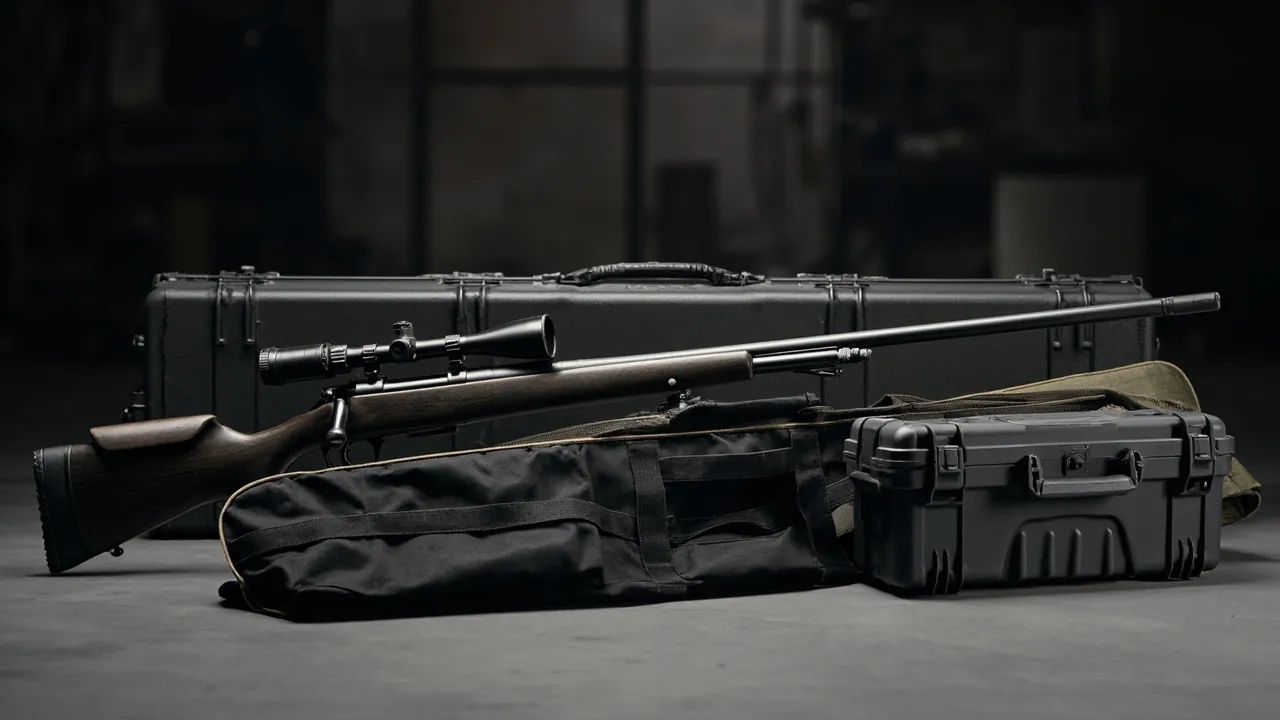
Short answer: the fundamental difference between a gun case and an ammo box is not shape or material but design intent. A gun case is a protective container designed for a single long, impact-sensitive item that must stay located, so its core purpose is shape matching and retention. An ammo box is a load-bearing container designed for many small, regular items packed densely, so its core purpose is volume efficiency and stacking. That difference ripples through dimensional proportions, lining type, latch layout, sealing level, handling method and stackability. The most visible result is that a gun case is usually thin and long, giving space to a fitted lining and single-item location, while an ammo box is usually thick and square, giving space to bulk packing and layer stacking. Mixing the two therefore tends to be poor on both sides: using a gun case for loose components wastes volume badly, and using an ammo box for precision long items gives too little retention and cushioning. This article compares six design dimensions, provides a lookup table and a selection decision path, and sets out the practical boundaries of a multi-purpose case.
In procurement and warehousing these two case types are often quoted together, because they look similar, use similar materials and both stress water resistance and drop protection. But if their design intents are conflated, the result is a case that will not fit, or fits but will not retain, or will not stack. Understanding the two design logics not only helps choose the right case but also lets a buyer describe requirements precisely enough for custom work. Every case product discussed here refers to the container itself, used for storage and transport, and nothing beyond that.
Table of Contents
- Short Answer: One Designed for Shape, One for Volume
- Setting the Scope: Both Are Storage and Transport Containers
- Design Intent: Protecting One Item versus Carrying Bulk
- Dimensional Logic: Thin and Long versus Thick and Square
- Lining Systems: Fitted versus Generic Compartments
- Latches and Opening Structures
- Sealing and Protection Ratings
- Handling and Transport Design
- Stacking and Warehousing
- Design Dimension Lookup Table
- Selection Decisions: Which Type for Which Application
- Common Misconceptions and Corrections
- Customisation and OEM: The Boundaries of a Multi-Purpose Case
- FAQ
- Conclusion and Related Reading
Short Answer: One Designed for Shape, One for Volume
One sentence captures it: a gun case solves how to hold one thing steady, an ammo box solves how to hold many things efficiently. The first is a shape problem, the second a volume problem. Every other difference follows from this.
The gun case's design axis is shape matching. The protected object is usually long, has protrusions, is easily scratched and is high value. A gun case therefore needs a long internal cavity, a lining that matches the outline, reliable location and cushioning, and structure that prevents shifting in transit. Its goal is not to hold much but to hold firmly, retrieve quickly and protect well.
The ammo box's design axis is volume efficiency. The stored objects are usually many, regular in shape and able to pack tightly. An ammo box therefore needs a nearly cubic cavity, higher volume utilisation, compartments that ease counting and retrieval, and a stackable body. Its goal is not single-item location but overall efficiency and stacking stability.
The overlap is the common ground of a storage and transport container: water resistance, dust protection, impact resistance, weathering and lockability. That is why they are often grouped in one product family. But beneath the common ground the design orientations are completely different, and mixing them forces a compromise in one dimension.
A quick test: ask first whether the contents are a single item or a batch, then whether shape or volume takes priority. Once both questions are answered, the case direction is largely settled.
Setting the Scope: Both Are Storage and Transport Containers
To avoid confusion, the scope must be stated. The gun case and the ammo box discussed here are both industrial packaging and storage and transport containers, used to hold, protect and move goods. The discussion focuses on the case body itself, its structure, material, sealing, latches and lining, and nothing beyond.
Gun case, in industrial and logistics language, usually means a long-item transport case: a fitted protective container for slender, fragile items that need location, typically with a long, flat internal cavity and a pre-cut or moulded lining. In civil applications it is also widely used for instruments, optical equipment and measuring tools that are long and precision-made.
Ammo box, in industrial and logistics language, usually means a bulk storage case: a large-capacity container for regular, densely packable small items or unit packages, typically with a square or near-cubic cavity and dividers or general-purpose foam.
Outside the scope. No operation, procedure or performance metric is discussed. Everything concerns how the container is designed, selected and accepted. For a systematic comparison of material and sealing between such cases and ordinary storage boxes, see military ammo box versus ordinary storage box and military storage case versus general storage case.
Why the scope matters. Many selection disputes come from comparing two products with different design intents on the same price and specification table, then concluding that one type is not worthwhile. The correct approach is to classify by content form first, then compare within a class.
Design Intent: Protecting One Item versus Carrying Bulk
Design intent determines everything. Once the two intents are compared, all later structural differences follow naturally.
Protecting one item (gun case): the goal is to keep a single high-value, impact-sensitive, fixed-shape object in place through transport and storage, avoiding collision and easing quick retrieval. The key metrics are location accuracy, cushioning margin and retrieval speed.
Carrying bulk (ammo box): the goal is to store a large quantity of regular small items or unit packages densely in a limited volume, with support for stacking and counting. The key metrics are volume utilisation, packing stability and stacking capacity.
The trade-offs:
- To locate a single item, space must be reserved for a fitted lining, and volume utilisation falls. This is the necessary cost of a gun case.
- To gain bulk efficiency, a large regular cavity must be used, and single-item location is weak. This is the necessary compromise of an ammo box.
That trade-off explains why "hold much and locate every piece" is usually unachievable: the two space-allocation logics conflict by nature. For the logic of linings versus dividers, see how to choose dividers versus foam in a case.
Another difference is weight distribution. Gun case contents are usually one to a few items, concentrated and possibly offset to one end or one side, so the case must handle local load and centre of gravity. Ammo box contents are usually evenly distributed, so the concern is overall load and stacking. Weight distribution directly affects wall-thickness distribution and base structure; see balancing case wall thickness and strength.
Dimensional Logic: Thin and Long versus Thick and Square
Shape is the most direct expression of design intent. Placed side by side, the two are almost instantly distinguishable.
Gun case: thin and long. The cavity length is usually much greater than the width, while depth is comparatively small, forming a flat, elongated cavity. The reason is that the protected object is slender and needs to be enveloped with minimum volume. Length-to-width ratios of 3:1 to 8:1 and higher are common. Structurally, to keep stiffness, a long case usually needs denser transverse ribs or greater wall height to resist bending.
Ammo box: thick and square. The cavity approaches a cube or square column, with a length-to-width ratio of about 1:1 to 2:1 and a relatively large depth. The reason is that many small items need three-dimensional dense packing, and a near-cubic shape gives the highest volume utilisation. Structurally, to keep stacking stable, the rim and base often have interlocking steps and the walls have longitudinal ribs.
How aspect ratio affects handling and stacking. A long case has a centred but wide-reaching centre of gravity and needs good grip design for one-person handling; a square case has a low centre of gravity and a short span, and stacks more easily. In stacking, a square case's height-to-width ratio is easy to keep in a stable band, while a long case can bend under stack load because of insufficient stiffness along the long axis, so its stacking capacity is usually weaker and must be assessed separately; see stacking structure design points.
The reverse-engineering logic also differs. A gun case's cavity is usually derived from the length, width and height of the protected item, plus lining thickness. An ammo box's cavity is usually derived from the packing pattern of the unit package, how many per layer and how many layers, then checked for volume utilisation. The two logics require different enquiry information, and an accurate description lets the supplier give a precise solution.
Lining Systems: Fitted versus Generic Compartments
The lining is where the two types differ most, and where selection is most often underestimated.
Gun case lining: fitted, single-item location. The common approach uses pre-cut or CNC-cut foam to excavate a recess matching the protected item, so that once seated the item has no room to move. The foam is usually layered: a base layer for support, a middle layer fitted to the outline, and a top layer for clamping. EVA, PE and polyurethane foams are common, with density and hardness chosen by item weight. The goal is fit so close that the item hardly moves even without straps.
Ammo box lining: generic compartments, bulk capacity. The common approach uses removable dividers, grids or thin foam to divide a large space into regular cells, each holding a unit package or several small items. The division is flexible and adjustable to contents; the foam is usually thin, mainly for anti-chafing and light cushioning rather than precision location.
Why they cannot be swapped. Using a gun case's fitted lining for bulk small items gives cells that do not match and wasted space; using an ammo box's generic compartments for precision long items gives insufficient retention and shifting in transit. Shifting produces dynamic shock whose peaks can far exceed the static load, a common cause of damage to precision items.
Factors in custom foam. Whatever the case type, a custom lining must consider content weight, fragility, retrieval frequency, cleaning requirements and any anti-static need. Factors and pitfalls are covered in factors in custom case foam and how to choose pre-cut foam linings. For a full classification of lining forms, see types of case internal foam.
Latches and Opening Structures
Latches and opening structures reflect differences in use frequency and protection level, and the two types diverge clearly.
Gun case: reliable closure with easy opening. A long case usually uses two or more latches distributed at both ends and the middle, so that the long edges are compressed evenly. With only a central latch, the ends of a long case lift because of insufficient stiffness, harming sealing and retention. The latches are usually quick-clamping types, balancing seal compression and opening speed.
Ammo box: durability under frequent opening and stacking stability. A square case's latches are usually on two adjacent sides or at the four corners, working with interlocking steps to improve stacking stability. Because bulk storage needs frequent counting and retrieval, latch durability and repeatability are the focus.
Latch count and even compression. In either type, too few latches cause uneven seal compression and local leaks. The clamping sequence also matters: multi-point latches should be closed alternately so the seal is compressed evenly. For latch form, material and layout, see how to choose case latches.
Hinges and lid structure. A long case's hinges carry a larger bending moment and need a longer hinge axis or more hinge points; a square case's lid is closer to square and loads more evenly, so hinge design is simpler. Hinges are the basis of opening reliability and wear under long, frequent use, so service life should be assessed at selection.
Lockability and security design. Both types may need padlock or lock-hole provisions. Lock-hole position, shackle diameter and anti-pry structure affect the overall security level. Where theft or accidental opening is a concern, state the locking requirement in the enquiry rather than adding it later.
Sealing and Protection Ratings
Both types stress water and dust protection, but the rating orientation and failure risks differ.
Rating orientation. A gun case, whose contents are usually high value and sensitive to moisture and dust, tends toward a higher sealing level, such as an IP67-class rating, and attention to long-term seal reliability. An ammo box, whose contents are often bulk and may have their own packaging, can accept a slightly lower rating, but still needs reliable protection for outdoor or transport use.
Failure risk distribution differs. A long case has a longer sealing perimeter and more seams, so it has theoretically more leak paths; a square case has a nearly square sealing face, where the four corners are the difficulty. The weak points differ: the long case is about even compression along the long edges, the square case about seal fit at the corners.
Design factors in the sealing system. Seal material, groove dimensions, compression ratio and lid stiffness together set the rating. A long case needs higher lid bending stiffness, otherwise the middle bulges and the seal becomes discontinuous; a square case needs higher precision in corner sealing. For structure and material logic, see outdoor case seal ring design and how to choose case seal materials.
Water performance and contents. Where contents are extremely moisture-sensitive, both types should be assessed for seal degradation in long-term storage, with a pressure equalisation valve and desiccant considered. For long-term sealing behaviour, see are waterproof ammo boxes really waterproof.
Handling and Transport Design
Handling method determines handles, castors, stacking and transport adaptation, and the two types again differ.
Gun case: one-person carry, grip balance. A long case usually has a handle near the centre of gravity, and some products add a shoulder strap or carry harness for long one-person trips. In transport, a long case slides easily in a vehicle and needs restraint or lashing.
Ammo box: two-person or palletised handling, bulk efficiency. A square case suits two-person lifting or whole-pallet movement, and often has base features for pallet adaptation. In transport, square cases stack stably and use space well, making them the preferred form for full-vehicle loads.
Adaptation to transport standards. Where either type is used in transport, vibration, shock, drop and stacking should be assessed. Military and transport packaging validation methods, such as MIL-STD-810H, ASTM D4169, ISTA and the GB/T 4857 series, apply by the same logic, but the test setup and judgement vary by case type, for example the drop attitude differs between a long case and a square case. For the full certification set, see what certifications an ammunition transport box needs.
The trade-off on handles and castors. Adding castors to a long case lengthens it further and increases the turning radius; a square case is more manoeuvrable with castors. Whether castors are needed should follow transport distance, floor conditions and total weight, not be fitted uniformly.
Stacking and Warehousing
Stacking capacity is the most easily overlooked difference, and where problems concentrate when the two are mixed.
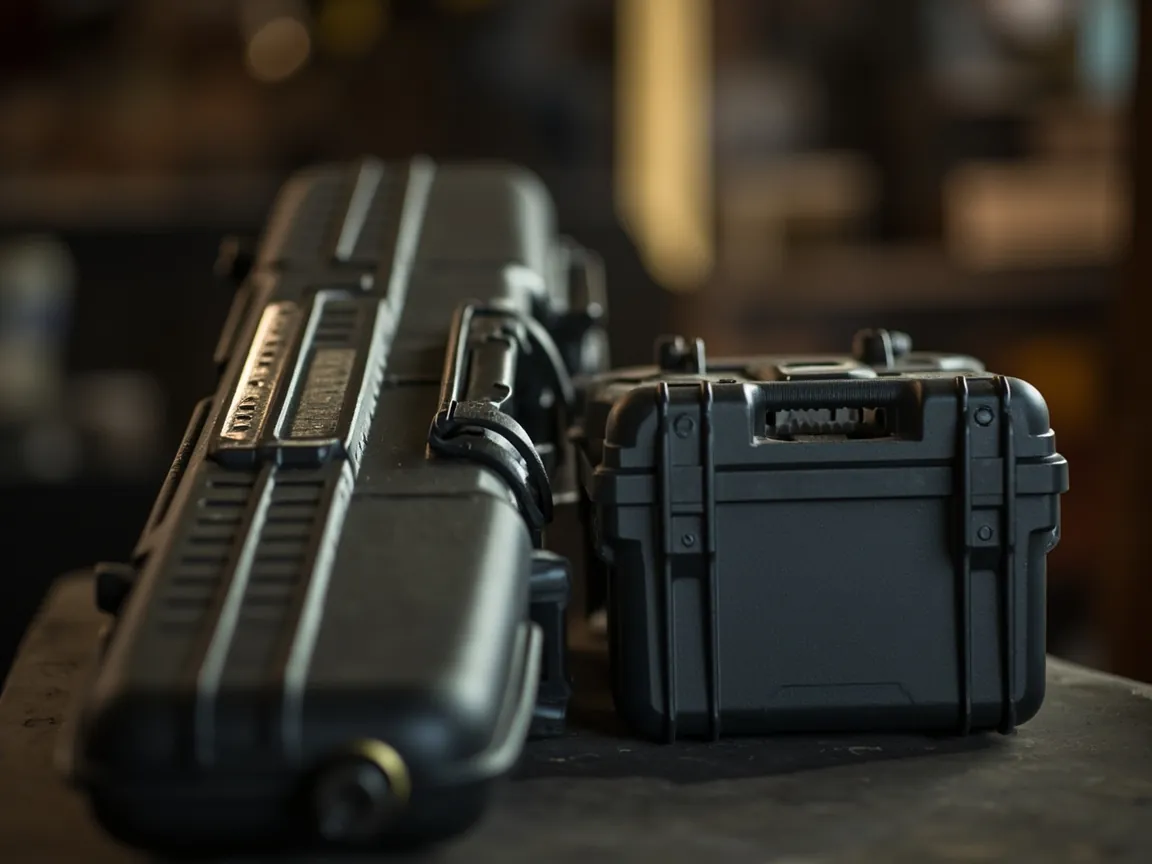
A square case (ammo box) is naturally better for stacking. A near-square height-to-width ratio, interlocking rim and base, and even weight distribution make stable stacking easier. The layer count depends on long-term compressive strength, gross weight per box, storage duration and temperature.
A long case (gun case) has limited stacking. Insufficient stiffness along the long axis causes the middle to bend under stack load, so the layer count is usually lower than a square case of the same material. Where stacking is necessary, control the height-to-width ratio, add support points, and prefer racking over direct stacking.
Warehousing layout differences. Square cases suit dense stacking and palletisation with high space efficiency; long cases suit vertical storage or dedicated racks and use more aisle space. In warehouse planning the two types should be zoned to avoid uneven loading and toppling from mixed storage.
The link between contents and stacking. Gun case contents are concentrated, giving a large local load in stacking; ammo box contents are evenly distributed, giving a smooth overall load. So even at similar external dimensions, a gun case's permitted layer count should be more conservative.
Design Dimension Lookup Table
The table below summarises the differences across six dimensions for quick comparison and enquiry. The descriptions are typical orientations; actual products may differ through design choices.
| Design dimension | Gun case (long-item transport case) | Ammo box (bulk storage case) |
|---|---|---|
| --- | --- | --- |
| Design intent | Single-item location and protection | Bulk capacity and efficiency |
| Shape ratio | Thin and long, aspect ratio above 3:1 | Thick and square, aspect ratio 1:1 to 2:1 |
| Cavity form | Flat, elongated cavity | Near-cubic cavity |
| Lining system | Fitted, layered foam | Generic compartments, dividers or thin foam |
| Latch layout | Multi-point at both ends and middle | Two adjacent sides or four corners with interlock |
| Sealing focus | Even compression along long edges | Fit precision at corners |
| Handling | One-person carry, balance-focused | Two-person or palletised, efficiency-focused |
| Stacking capacity | Limited, needs racking or height limit | Strong, suits dense stacking |
| Typical contents | Slender precision items, instruments, optical parts | Regular small items, unit packages, accessories |
| Custom derivation | Cavity derived from protected item | Cavity derived from packing pattern |
Two selection rules can be drawn. First, classify by content form: slender items lean toward a gun case, bulk small items toward an ammo box. Second, adjust by use: where frequent handling or stacking is needed, a square case fits better; where single-item high protection is needed, a long case fits better.
Selection Decisions: Which Type for Which Application
Turning the table into an executable decision path, judge in this order.
- Step one: content form. Single slender item, choose a long case; many regular small items, choose a square case; both, consider separate cases or a custom mixed lining.
- Step two: protection requirement. High value, impact-sensitive, shift-sensitive, choose a long case with fitted lining; impact-tolerant with unit packaging, choose a square case with generic compartments.
- Step three: handling method. Long one-person carry, a long case with handle or harness; two-person lifting or palletisation, a square case.
- Step four: warehousing method. High-density stacking, a square case; vertical or racked storage, a long case.
- Step five: sealing and documentation. State the protection rating, whether a pressure valve is needed, and whether transport and environmental validation reports are required.
Handling mixed applications. Where a batch contains both slender and bulk small items, the common approach is to configure separate cases, each playing to its strength; a mixed lining with a fitted side and a compartmented side is also possible, but it makes the two sides load unevenly, so centre of gravity and stacking must be reassessed. The feasibility of a mixed solution depends on the weight ratio and retrieval frequency of the two item types.
Validating the decision. After selection, run a trial load with real or equal-weight substitutes to verify centre of gravity, retrieval speed and retention before bulk purchase. For the specific requirements of long-item transport cases, see structural requirements for firearm transport cases.
Common Misconceptions and Corrections
The misconceptions below appear most often in selection, with corrections listed.
| Common misconception | Symptom | Correction |
|---|---|---|
| --- | --- | --- |
| Interchangeable just because shapes look similar | Fits but will not retain, or wastes space | Classify by content form first |
| Using a long case for bulk small items | Low volume utilisation, hard to count | Switch to a square case with compartments |
| Using a square case for precision long items | Shifting shock, insufficient location | Switch to a long case with fitted lining |
| Too few latches | Long case ends lift, uneven seal | Add multi-point latches at ends and middle |
| Ignoring stacking differences | Long case bends under stack load | Control aspect ratio, prefer racking |
| Lining chosen only to "make it fit" | No cushioning, no location | Choose foam by weight and fragility |
| One sealing level for all duties | Insufficient protection in demanding use | Set the rating by application and validate |
| Ignoring transport stress | Loosening or damage after transit | Validate to transport standards |
Most misconceptions reduce to one: using external dimensions instead of design logic for selection. Similar shape does not mean equivalent function; the starting point should be content form and use.
Customisation and OEM: The Boundaries of a Multi-Purpose Case
"One case for many uses" is a common request, but it has clear boundaries, and understanding them avoids a design dilemma.
Feasible multi-purpose approaches:
- Same body, different linings. Use one case platform and switch between a fitted and a compartmented lining for different contents. This is the most economical approach, provided the case dimensions cover the size range of both content types.
- Modular lining. Use removable dividers and replaceable foam modules to switch between compartments and fitted configurations within one case, suited to varied contents in modest quantities.
- Layered design. Put small items on top and long items below, coexisting through structural layering. Centre of gravity and retrieval order must be checked.
Infeasible or costly approaches:
- One cavity for both single-item high protection and high volume ratio. The space-allocation logics conflict, and forcing both usually fails both.
- One shape for both high stacking and long-item carry. The long shape conflicts with stacking stability, and forcing both sacrifices one.
A suggested customisation flow. List contents and forms, decide the primary-purpose case type, assess the boundaries of multi-purpose needs, design the lining, validate by trial loading, then finalise. Provide content dimensions, weight, retrieval frequency, protection rating, and transport and storage requirements so the supplier can propose an accurate platform and lining combination.
JUNZHJIA, manufactured by KeXin New Materials (Guangdong) Co., Ltd., produces protective cases, tool boxes, military-specification storage cases and waterproof junction boxes. It can derive case dimensions and lining solutions from content form and application, support multiple lining configurations on one case platform, and supply custom foam, seals and test documentation, serving wholesale, distribution, OEM/ODM and global supply.
FAQ
Q: What is the core difference between a gun case and an ammo box in one sentence? A: In one sentence: a gun case is designed for shape, an ammo box for volume. A gun case serves a single, slender, impact-sensitive item that must stay located, so it gives space to a fitted lining and retention and is thin and long. An ammo box serves many regular, densely packable items, so it gives space to volume utilisation and stacking and is thick and square. That core difference carries through to dimensional ratio, lining type, latch layout, sealing focus, handling method and stacking capacity. It also explains why two types of similar shape cannot be used interchangeably: the wrong choice either will not fit or will not retain. Selection should first decide whether the contents are a single item or a batch, then whether shape or volume takes priority.
Q: Can an ammo box be used as a gun case, or a gun case as an ammo box? A: For a short-term emergency, yes; for long-term use, it is not advised, because the design intents differ and mixing forces a compromise. Using an ammo box for a slender precision item gives insufficient retention and cushioning: generic compartments cannot match a long outline, and the item shifts in transit, where dynamic shock peaks far exceed the static load and can damage precision parts. Using a gun case for bulk small items gives low volume utilisation: the space reserved by the fitted lining for a large item is wasted, and counting and retrieval are awkward. Where mixed use is genuinely needed, use one case platform with different linings, or a modular lining, rather than forcing one type to hold the other's contents. Always trial-load before committing.
Q: Why is a long gun case unsuitable for high-density stacking? A: The main reason is stiffness along the long axis. In stacking the load passes vertically, and a long case spans widely, so under sustained load it bends and the middle sags, giving uneven contact and local overload between layers; the long case's height-to-width ratio is usually larger, so stability is also weaker than a square case. A long case's permitted layer count is therefore generally lower than a square case of the same material. Where stacking is unavoidable, control the aspect ratio, add mid-span support, reduce gross weight per box, or use racking instead of stacking. A square case, being near-square, evenly loaded and often interlocked, is better for dense stacking. Plan the case type and racking together rather than considering the case alone.
Q: How does the sealing design focus differ between the two types? A: The focus differs because of geometry. A long case has a longer sealing perimeter and more seams, and its main risk is the middle of the long edges: if lid bending stiffness is insufficient, the middle bulges, seal compression is insufficient and the contact band becomes discontinuous, so a long case needs higher lid stiffness and more even multi-point clamping. A square case has a near-square sealing face, and its main risk is the four corners, where the seal bend radius, fit precision and compression uniformity are the difficulty, so a square case focus on corner sealing precision. Both share the need for matched seal material, sensible groove dimensions and compression ratio. Either way, set the protection rating from the application and validate with standard testing rather than by experience.
Q: Should the lining be fitted foam or generic compartments? A: Decide by content form and protection requirement. For a single, high-value, shift-sensitive item, choose fitted foam, excavating a recess that matches the outline with pre-cut or CNC-cut foam so the item has no room to move, usually in layers: base support, middle fit and top clamping. For regular, densely packable bulk items, choose generic compartments, using removable dividers or grids to divide a large space into regular cells, with thin foam mainly for anti-chafing and light cushioning. Where both long and small items occur, consider a modular lining or separate cases. Also consider retrieval frequency, cleaning requirements and any anti-static need. For the trade-off between dividers and foam, and the factors in custom linings, see the related articles on this site.
Q: What information should I give a supplier to choose the right case type? A: Six items are recommended. First, the content list and form: single item or batch, dimensions, weight per item, whether slender, whether there are protrusions. Second, protection requirements: sensitivity to impact, shifting and moisture, and the fragility or sensitivity level. Third, retrieval method: frequency, whether quick retrieval is needed, whether counting is needed. Fourth, handling method: one-person carry, two-person lifting or palletisation, and any total weight limit. Fifth, warehousing method: whether dense stacking is needed, the layer count, and whether racking is used. Sixth, compliance requirements: protection rating, whether transport and environmental validation reports are needed, and whether locking is required. The more complete the information, the more accurately a supplier can judge between a long-item transport case and a bulk storage case and propose the right lining and structure.
Q: Does a multi-purpose case create a design dilemma? A: Yes, and the boundaries are clear. The feasible approach is one case platform with different linings: where the case dimensions cover the size range of both content types, switching between a fitted and a compartmented lining changes the use at the lowest cost. A modular lining or layered design can also achieve coexistence. What is infeasible or costly is one cavity serving both single-item high protection and high volume ratio, because the space-allocation logics conflict, and one shape serving both high stacking and long-item carry, because the long shape conflicts with stacking stability. The right approach is to define the primary use first, then assess the boundaries of secondary use, rather than pursuing universal application. Any multi-purpose solution should be validated by trial loading for centre of gravity, retention and retrieval.
Q: How does transport validation differ between the two types? A: The applicable standard systems are the same, but the test setup and judgement vary by case type. Transport packaging and environmental validation usually cite MIL-STD-810H, ASTM D4169, the ISTA series and the GB/T 4857 series, covering vibration, shock, drop, stacking and temperature-humidity. The differences are that a long case's drop attitude, support points and centre-of-gravity distribution differ from a square case, so tests should be designed for the actual attitude; a long case is more about bending and local impact along the long axis, a square case more about stacking and corner impact. So even under the same standard, the test plan should be tailored to the case type. In the report, confirm the sample model, attitude, loading method and pass criteria so that they match the delivered product and actual use.
Q: How can I tell whether a case is designed more as a gun case or an ammo box? A: Four features give a quick answer. First, aspect ratio: above 3:1 with a flat cavity leans long-item; about 1:1 to 2:1 with greater depth leans bulk-item. Second, lining: fitted recesses and layered foam lean single-item location; dividers, grids and thin foam lean bulk compartments. Third, latch layout: multi-point at both ends and the middle usually serves even sealing on a long case; two adjacent sides or four corners with interlocking steps usually serves stacking stability. Fourth, stacking design: interlocking rim and base with emphasis on layer count leans bulk storage; emphasis on carry balance and single-item retrieval leans long-item. Combining the four reveals the design orientation, which can then be compared with the content requirement.
Conclusion and Related Reading
Returning to the title question: the difference between a gun case and an ammo box is essentially two routes, design for shape and design for volume. A gun case centres on single-item location and protection, is thin and long, uses a fitted lining and focuses on carry balance and long-edge sealing. An ammo box centres on bulk capacity and efficiency, is thick and square, uses generic compartments and focuses on volume utilisation and stacking stability. The two share the common ground of a storage and transport container, water resistance, dust protection, impact resistance, weathering and lockability, but differ in dimensional logic, lining system, latch layout, sealing focus, handling method and stacking capacity, so mixing them forces a compromise in one dimension.
Three practical recommendations: first, classify by content form, with slender single items leaning long-item cases and regular bulk items leaning square cases. Second, adjust by use, choosing a square case for frequent handling or dense stacking and a long case for single-item high protection. Third, validate the selection by trial loading, confirming centre of gravity, retention and retrieval before bulk purchase.
JUNZHJIA, manufactured by KeXin New Materials (Guangdong) Co., Ltd., produces protective cases, tool boxes, military-specification storage cases and waterproof junction boxes, serving wholesale, distribution, OEM/ODM and global supply, and can derive case and lining solutions from content form with supporting test documentation.
Related Reading